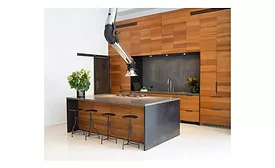
For the renovation of a loft in a landmarked building in the Union Square neighborhood of Manhattan, the New York City design/build firm Studiodb devised a series of bookshelves and sliding doors that allowed for an expansive layout, with the flexibility to create private spaces when needed.
Based in northern Italy, Bisazza is a leading producer of high-end glass mosaic tile with showrooms in cities around the world, including New York City, Los Angeles, and Chicago.
The latest materials and processes, from carbon-negative window film to water-free textile dyeing, that help save resources, reduce emissions, and recycle waste.
The Blackstone pendant, Broadleaf ceiling fixture, and Wildwood wall sconce are three new Arts & Crafts—inspired light fixtures from Portland, Oregon-based Rejuvenation.
After years of collaboration on custom steel architectural elements and furnishings with Seattle-based metal shop 12th Avenue Iron, Olson Kundig Architects has now designed the firm’s first line of commercially available products to be fabricated by the shop.
For its line of House Number tiles launched last year in collaboration with House Industries, Sausalito, California-based Heath Ceramics applies the same spinning mold technique used to craft their ceramic bowls.
Inspired by Hearst Castle, the "little something" William Randolph Hearst asked architect Julia Morgan (1872-1957) to build in San Simeon, California, in 1919 (scroll down to watch video), Tilevera’s Hearst Castle Collection of stone, glass, and wood tile interprets the castle’s spirit in material, color, and design.