Prototypes
2006 Product Reports Prototypes
Prototypes 2006
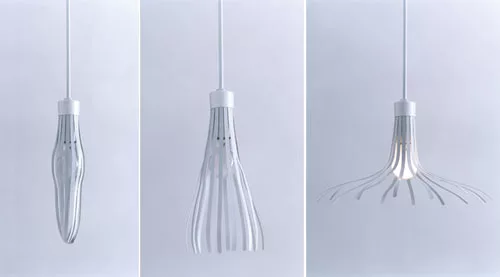
Animated lamp Designed by the Tokyo-based design firm Nendo, the Hanabi lamp was on display at this year’s Milan Furniture Fair along with other designs that “resemble natural phenomena”. Hanabi is a shape-memory alloy lamp whose thin ribs “bloom” in response to the heat of the incandescent bulb. When the light is turned off, they slowly “wither” and return to a closed position. Nendo is currently negotiating with an Italian manufacturer for production. Nendo, Tokyo. www.nendo.jp

Prototypes 2006
Illuminating rooftops These LED roof tiles developed by Dutch designer Lambert Kamps have been produced for some small custom projects. The translucent polyester roof tiles have built-in LEDs that work like pixels to create text, logos, and graphics on rooftops. Kamps is currently researching a method to make the tiles run on solar energy. Lambert Kamps, Groningen, The Netherlands. www.lambertkamps.com

Prototypes 2006
Poetry in concrete Inspired by how the weather transforms landscapes, designer Susanne Happle’s Solid Poetry concrete reveals a hidden pattern on contact with water. Possible applications include residential bathroom tiles, outdoor garden pavers, or public sidewalks. The patterns will be permanently visible after a period of time. Terratorium, a Dutch-based materials company, hopes to have the patent-pending technology in production by mid-2007. Terratorium, Eindhoven, The Netherlands. www.terratorium.nl

Prototypes 2006
Gecko-inspired adhesive Synthetic Gecko is an artificial surface that grips incredibly tightly without glue or pressure: A sheet of the material just over 3.3 feet (1 meter) could be used to suspend the weight of an average family car. The surface replicates the hairs on a gecko’s feet that ensure the toes are always in close contact with the surface beneath. A number of potential business applications includes new building products. BAE Systems, Farnborough, U.K. www.baesystems.com

Prototypes 2006
The power of the sun Power Plastic is inexpensive (five times less than traditional PV), lightweight (1 to 2 ounces per square foot), and versatile (can be colored, patterned, and cut to fit). The light-activated polymer PV material can be integrated into architectural products such as rooftops, siding, and blinds, although there are no current partnerships in the A&D market. Konarka, Lowell, Mass. www.konarka.com

Prototypes 2006
Can take a punch The Dow Corning Active Protection System consists of a 3D spacer textile treated with a special coating that remains soft and flexible under normal conditions, but hardens instantly upon impact. When the impact force is removed, the material immediately returns to a flexible state. Dow Corning will initially market the technology to manufacturers of protective motorcycle apparel, but anticipates expansion into other industries, including construction. Dow Corning, Midland, Mich. www.activeprotectionsystem.com

Prototypes 2006
Origami light filter Conceived as a hybrid drape/Venetian blind, the In-Out Curtain is an operable screen that combines origami and digital production. Each module of the curtain is designed with internal tensions so it holds both a closed/concave and an open/convex shape, transforming the quality of light. IwamotoScott Architecture, San Francisco. www.iwamotoscott.com
Prototypes 2006
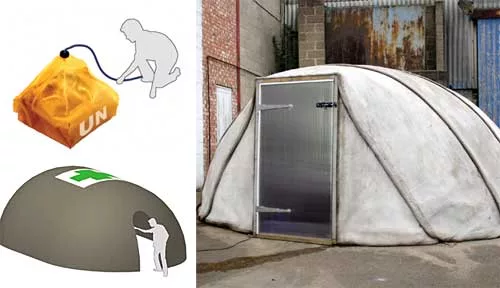
Building in a bag Designed by Peter Brewin and William Crawford, Concrete Canvas is a rapidly deployable hardened shelter for disaster victims. The system is delivered folded and sealed in a sack which is then filled with water. After the cement inside is hydrated, the sack is unfolded to form the shelter’s footprint. A plastic inner tube is then inflated by activating a small chemical pack. The cement impregnated cloth cures into a dome shape, and is ready to use in 12 hours. Seven trial shelters are planned to be field tested by April 2007 and production should start in April 2008. Crawford Brewin Ltd., Northhampton, U.K. www.concretecanvas.org.uk