Newsmaker: Brad Cloepfil
|

When Brad Cloepfil, AIA, founder and principal at Allied Works Architecture, unveiled his design for the Museum of Art and Design in New York, he added fuel to a heated and unusual preservation debate. His plan to alter a 158-foot marble edifice on the south side of Columbus Circle prompted some preservationists to rally behind an exemplary, but widely disliked work of late Modernism.
Two Columbus Circle was built in 1964 and designed by Edward Durrell Stone for the short-lived Huntington Hartford Museum. Critics tore into the monolith when it was completed, one of them dismissively referring to it as the “lollipop" building for its geometric colonnade.
The nickname survived longer than the museum. After it closed in 1969, the building went through a string of uses, housing the city’s department of cultural affairs for nearly 18 years. The Museum of Arts and Design purchased the building in 2002 and secured Allied Works for the design shortly after.
When the museum’s renovation plan—with windows cut into formerly blank stretches of façade—was announced, some high-profile figures, including Barry Bergdoll, Frank Stella, Robert A. M. Stern, and Tom Wolfe, spoke out against the intervention. Many preservationists argued that the building, as a prominent work of 1960s Modernism and part of the site’s fabric, should be landmarked. Against their protests, however, the New York City Landmarks Commission allowed the renovation to go forward.
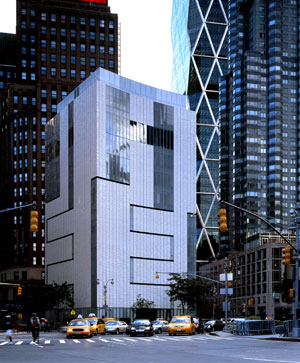
This weekend, Cloepfil’s $90 million, 54,000-square-foot rework of the building opens to the public. According to the architect, the new design not only retains the shape and massing of the original structure, it also acknowledges and builds on its place in the history of Columbus Circle.
The architect has kept some of the original building’s signature details. The façade is still grayish white, though the marble has been replaced with 22,000 light-catching terra-cotta tiles, and the lollipop columns have been encased with translucent glass.
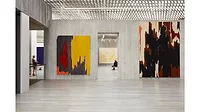
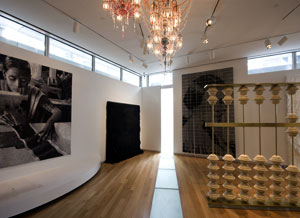
Cloepfil’s most notable addition is a two-foot-wide ribbon of insulated glass that zips across the façade, framing the galleries where wall and ceiling meet and cutting lines through the floors. Not only does this band of windows create a recognizable public face for the museum, but it also allows natural light to penetrate the galleries from multiple angles.
Founded as the Museum of Contemporary Crafts in the 1950s, the Museum of Arts and Design is dedicated to contemporary art and design created from hand-manipulated media. Its collection of some 2,000 objects ranges from jewelry to contemporary craft-based work and has grown rapidly along with plans to move to the Columbus Circle site.
Since founding Portland-based Allied Works in 1994, Cloepfil and his firm have designed projects for the Contemporary Art Museum St. Louis, the University of Michigan Museum of Art, and the Seattle Art Museum, among other art spaces.
I caught up with him on a preview tour of the new museum. We discussed how the institution’s exhibition needs influenced his design and his relationship with the museum’s curators during the design process.
William Hanley: How does this project respond to the original structure and its place in the composition of Columbus Circle?
Brad Cloepfil: We’re just adding another voice to a series of voices that have been here. I just think it’s exciting. In the United States, when do you see this kind of transformation of an existing building as an idea of history and as an idea of both preserving—to a certain extent—and proposing something new? How do you propose something new on an existing body? There is a dialogue and tension between those two things.
WH: Another force at work is the programming needs of the institution and how it wants to present itself. How did you approach its ambitions with the design?
BC: It’s funny, in almost all the museum work I’ve done, it’s never that specific. It’s just an understanding of the general collection of objects. I’ve yet to do a museum where the exhibits or the curation was decided until about four months before it opened.
You create a context. It’s almost like you’re creating a site for the art. For this building we scaled it with the cuts to start to imply volume, and then that’s where they located the [interior] walls. You kind of imply a scale of space and they respond to it.
It’s an instrument that the curators play.
WH: But you couldn’t show photographs or works on paper in here. The amount of natural light seems to respond to the collection.
BC: The amount of natural light is about the objects. This material can take this much light—I mean, this is a lot of light.
What was also so fun is that we knew that, making these cuts, the rooms are so small that you get light all the way in. You don’t need the Renzo Piano luminous ceiling, which you do if you have deep galleries because you’ll never get the light in. But here to get exterior side lights to fill a volume like this is pretty amazing. I can’t think of other museums that have this kind of light without it coming from the top.
WH: Did you have a steady back and forth with the curators during the design process?
BC: There was a lot, but it was mostly technical. How much wall space? What is the nature of the light? How much light? How do we control the light?
Curators are historian and critics and theorists, and they are focused on the objects. They really have to see the building built before they start to understand how to put the work into the space.
Looking for a reprint of this article?
From high-res PDFs to custom plaques, order your copy today!