Architectural Record
search
cart
facebook twitter linkedin youtube
  • Sign In
  • Subscribe
  • Sign Out
  • My Account
Architectural Record
  • NEWS
    • Latest News
    • Awards
    • Interviews
    • Obituaries
    • Podcasts
      • Design:Ed Podcast
      • Sponsored Podcasts
  • OPINION
    • Book Reviews / Excerpts
    • Exhibition Reviews
    • Forum
  • EXCLUSIVES
    • Videos
    • Design Vanguard
    • Top 300 Firms
    • Sponsored Content
    • Sponsored eBooks
    • From the Archives
  • CONTINUING ED
    • Editorial Continuing Ed
    • CE Center
    • CE Academies
  • PROJECTS
    • Buildings By Type
    • Reuse & Renovation
    • Museums & Arts Centers
    • Colleges & Universities
    • Multifamily Housing
    • Interiors
    • Lighting
    • Kitchen & Bath
  • HOUSES
    • Record Houses
    • House of the Month
    • Featured Houses
  • PRODUCTS
    • Products by Category
    • Record Products of the Year
    • Latest Products
  • EVENTS
    • Dates & Events
    • Record on the Road
    • Innovation Conference
    • Sustainability in Practice
    • Women In Architecture
    • Webinars
    • Ad Excellence Awards
    • Submit an Event
  • CONNECT
    • Ask RECORD AI
    • Newsletters
    • Contact
    • Advertise
    • Editorial Calendar
    • Store
    • Customer Service
  • SUBMIT
    • Submission Guidelines
    • RECORD Competitions
  • MAGAZINE
    • Subscribe
    • My Account
    • Digital Edition
    • Current Issue
    • Firm Pass
    • Historic Archive
Projects

National Swimming Center

PTW, Arup, and CSCEC wrap a set of pools with high-tech bubbles.

By Clifford A. Pearson
July 19, 2008

Beijing, China

PTW Architects, CSCEC+Design, and Arup

They started with the idea of a box made of bubbles enveloping a set of swimming pools. The concept came quickly and earned everyone’s support. Figuring out how to make it work turned out to be more difficult. For three months in the spring of 2003, a team from the Australian architecture firm PTW, Arup, and China State Construction and Engineering (CSCEC) explored evolutionary biology, arcane 19th-century geometry, and the latest computer-modeling technology, racing against a competition deadline for the design of the National Swimming Center, the main venue for swimming events at the 2008 Olympics.
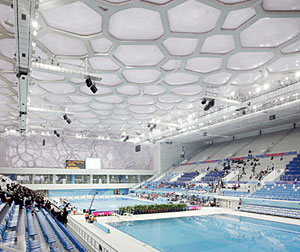
National Swimming Center
Photo 'Tim Griffith

The team had already learned that Herzog & de Meuron’s bird’s-nest scheme was selected for the National Stadium next door. “We wanted to do something different from Herzog & de Meuron’s design,” recalls Tristram Carfrae, the leader of the Arup delegation. “Their’s was red and round, so our’s would be blue and boxy.” Since swimming pools need to be heated most of the year, the team figured that a greenhouse—a building that captures and holds solar energy—would be the most efficient structure for the job. That led to the notion of a continuous skin for the roof and walls, one that would be transparent or translucent. Glass wouldn’t be right, because its acoustics would create a din inside the building. So the team selected ethylene tetrafluoroethylene (ETFE), a transparent form of the plastic Teflon. In addition to being acoustically transparent, the material is lightweight and remarkably sturdy even at thicknesses as little as 0.008 inches (0.2 millimeters).

Looking at forms and patterns found in nature, the group started designing the skin. They quickly focused on soap bubbles and what happens to their geometry when they congregate. At first, the designers tried clustering cylinders to create a flat roof and walls, but weren’t happy with the gaps between the cylinders and the awkward shift from vertical cylinders (to support the roof) to horizontal ones (to support the walls). In their search for the most efficient way to divide space into cells of equal size with the least surface area between them, the designers explored solutions proposed in the 19th century by Belgian physicist Joseph Plateau and British mathematician William Thomson Kelvin, and by the Irish physicist Denis Weaire and his assistant Robert Phelan in the late 20th century. Eventually, the team adapted Weaire and Phelan’s ideas, developing a building skin made of cells with either 14 or 12 sides. “We wanted the bubble pattern to seem random, not repetitious,” explains Chris Bosse, who was one of the project architects for PTW and now runs his own firm in Sydney called the Laboratory for Visionary Architecture (LAVA). Using the Weaire-Phelan geometry, the group created a skin made of 4,000 ETFE bubbles, some as large as 30 feet across, with seven different sizes for the roof and 15 for the walls.

A space frame assembled on-site from 22,000 steel tubes welded to 12,000 nodes holds the cells in place and provides a column-free structure with spans of 396 feet in either direction. The three-dimensional frame is nondirectional—meaning it has no up or down, left or right—making it perfect for a high-seismic zone such as Beijing. The chemically treated water in the pools and the air pollution outside the building, though, are both corrosive. So the design team placed the steel frame inside a cavity made of two layers of ETFE pillows. For the roof, the cavity is 25 feet deep, and for the walls it is 12 feet.

Called the Water Cube (even though it’s a box 584 feet square and 102 feet high, not a cube), the rectangular design won over the competition jury. Completed early this year, the building seems to float on water, thanks to a reflecting pool surrounding it and a gentle cascade of water washing down its base and into the pool. Inside, the bubble theme continues with circles incised on the floor of the main lobby and a Bubble Lounge on the second floor where—you guessed it—champagne is served at bars made of smooth Corian dotted with circles.

KEYWORDS: Beijing

Share This Story

Looking for a reprint of this article?
From high-res PDFs to custom plaques, order your copy today!


Cliff portrait 2 0t5a1761 0031

Contributing editor Clifford Pearson is the co-author, with A. Eugene Kohn, of The World By Design, and writes about architecture and urbanism.

Post a comment to this article

Report Abusive Comment

Subscription Center
  • Create an Account
  • Start a Subscription
  • Manage My Account
  • Sign Up for Newsletters
  • Visit Customer Service
  • Update Preferences

More Videos

Sponsored Content

Sponsored Content is a special paid section where industry companies provide high quality, objective, non-commercial content around topics of interest to the Architectural Record audience. All Sponsored Content is supplied by the advertising company and any opinions expressed in this article are those of the author and not necessarily reflect the views of Architectural Record or its parent company, BNP Media. Interested in participating in our Sponsored Content section? Contact your local rep!

close
  • TAMLYN XtremeTrim Exterior Trim
    Sponsored byTamlyn

    Designing Cleaner Panel Facades: Why Exterior Trim Details Matter

  • Building with Vapor Barriers
    Sponsored byReef Industries, Inc.

    Vapor Barriers Help Control Moisture in Tighter Building Designs

  • Duct Interior with Prodeq System
    Sponsored byHenry, a Carlisle Company

    Designing Resilient Water Containment Systems

DESIGN:ED Podcast
Listen to Architectural Record’s DESIGN:ED Podcast

Events

June 10, 2026

Rethinking Stormwater – The Power of Porous Paving

Credits: 1 AIA LU/HSW; 1 AIBD P-CE; 0.1 ICC CEU

Learn how porous paving systems support stormwater management, reduce heat island effects, and enhance sustainable site design performance.

June 11, 2026

Very Early Warning Fire Detection for Mission-Critical Facilities

Credits: 1 AIA LU/HSW; 1 AIBD P-CE; 0.1 ICC CEU

Examine advanced fire detection strategies that support uptime and enhance safety in data centers and other mission-critical facilities.

View All Submit An Event

Products

2026 Architect's Square Foot Costbook

2026 Architect's Square Foot Costbook

See More Products

Popular Stories

Practice Matters illustration

What’s in a (Firm’s) Name? Thinking About Succession and Legacy

Practice Matters illustration

By the Numbers: Counting America's Architects

Riverdale House by Studio Lau

Riverdale House by Studio Lau

House on a Hill

Design Vanguard 2026: Forma

Crane Cove, ONO

Design Vanguard 2026 Winners

Broader Sustainability of CMU - Free Webinar - May 21, 2026

Related Articles

  • National Swimming Center Project Portfolio

    See More
  • Digital Beijing

    See More

Related Products

See More Products
  • manual

    2026 National Building Cost Manual

  • const estimator

    2026 National Construction Estimator

  • Architectural Record - August 2025

    Architectural Record August 2025 Issue

See More Products
×

The latest news and information

#1 Source for Architectural Design, News and Products

SUBSCRIBE
  • RESOURCES
    • Advertise
    • Contact Us
    • Submit
    • Store
  • ACCOUNT CENTER
    • Create an Account
    • Start a Subscription
    • Manage My Account
    • Sign Up for Newsletters
    • Visit Customer Service
    • Update Preferences
  • PRIVACY
    • PRIVACY POLICY
    • TERMS & CONDITIONS
    • DO NOT SELL MY PERSONAL INFORMATION
    • PRIVACY REQUEST
    • ACCESSIBILITY
  • SERVICES
    • Marketing Services
    • Reprints
    • Market Research
    • List Rental
    • Survey/Respondent Access
  • STAY CONNECTED
    • Linkedin
    • Facebook
    • Instagram
    • YouTube
    • X (Twitter)

Copyright ©2026. All Rights Reserved BNP Media, Inc. and BNP Media II, LLC.

Design, CMS, Hosting & Web Development :: ePublishing