Ewha Womans University Campus Center
Dominique Perrault blends built and natural environments in a new campus center for the growing student body of Seoul's Ewha Womans University.
Architects & Firms
Seoul, South Korea
Blurring the line between construction and topography, French architect Dominique Perrault’s campus center for Ewha Womans University in Seoul, South Korea’s trendy Sinchon district is seamlessly integrated into the sloping hillside it intersects. At the crux of the prestigious campus, this multitiered, multifunctional hive of activity anchors the site and creates a landscape of its own.

The unique site is particularly fitting for the school, which was founded by American Methodist missionary Mary F. Scranton in 1886 and named Ewha (pear blossom in Sino-Korean) by the emperor in 1887 for the abundance of delicate flora at its original location in the city’s central Chong-dong area. Beyond poetic metaphor, however, necessity was the mother of this striking structural invention.
Primarily, the existing gated campus of traditional Collegiate Gothic structures, designed in the 1930s by W.M. Vories, the eponymous, Japan-based architectural design firm of Kansas-born William Merrell Vories, was becoming increasingly inadequate. Ewha had risen in prominence and size to more than 20,000 students—reputedly the world’s largest private women’s university. Yet, while its international student body continued to grow, most domestic students were living at home, many with 2-hour commutes, and the campus lacked sufficient study space or places to gather for long days at school. For those who did remain on campus, weekends proved disconcertingly lonely and detached. Moreover, the addition of a notable building would communicate the university’s growing global connection.
Working with a task force, former university president Shin In-ryung established structural and logistical guidelines for the proposed facility. It would be embedded into the landscape, include bi-level parking and a commercial area on lower levels, and redefine access to the campus. It was also determined that the project would require a design by an established international architect. So in February 2004, invitations to compete for the project were sent to a select group of firms from which three finalists were chosen: Zaha Hadid, Foreign Office Architects (FOA), and Perrault.
Ultimately, the commission was awarded to Perrault for his scheme’s sensitivity to landscape. According to the architect, his brief was “to expand urban activities into the campus.” His solution was to rebuild the site’s original topography, a hill with a slope; introduce the new building into the “constructed” hillside; then cover the building with a park. The result is both heroic and naturalistic, depending on the viewer’s perspective.
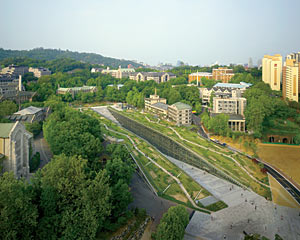
Remarkably, little changed from Perrault’s original program. Crucial to his realization was the decision to bifurcate the concrete-framed structure, dividing it into seemingly cloned halves by an immense rift, or “valley”—a strong assertion of contemporary intervention into the landscape. Ramped from its intersection with the street, this passage, lined with granite pavers, descends into the sliced reconstructed hillside, allowing access to the buildings along its route. It then terminates at a grand stairway that not only climbs up into the campus at the opposite end but serves as an informal seating area or, as Perrault envisioned, an open-air amphitheater. Intended to be a link to the community and social space for students and visitors, this walkway maintains a controlled progression of height to width that points downward to the interior activities, and upward to the older buildings on the hills above.
Insulated glazed walls, supported by a polished, stainless-steel-clad aluminum framing system notable for its perpendicular vertical fins, provide light to the lowest interior levels and animate both indoor and oudoor spaces with human activity. Intermittent doorways, signified by bold graphic numerals, provide the simplest of alterations to the otherwise continuous curtain wall.
Surmounting the binary structure, a green roof partially conceals the large building footprints. At the outset, Perrault intended to plant trees in this overhead park, but the shallow depth of the soil would only permit grass and shrubs. Nonetheless, the constructed roofscape produces a natural effect with a stone path that meanders among plantings, artfully introduced mechanical elements (read chimneys), and stairs. It is difficult to understand if the park existed on the hillside, or if the hillside is entirely new. Indeed, the passageway can disappear from view, depending on where one stands on either side of the building, leaving only greenery merged with the campus landscape.
Perrault, a proponent of below-grade structures—with built projects like the French National Library in Paris and Velodrome and Olympic swimming pool in Berlin under his belt—feels there should be more research on the use of the earth, or landscape, as a viable building material like concrete or steel. “Usually nature is around the architecture,” he says, adding that he and fellow architects should be “thinking about another kind of relationship with nature and soil.”
Within this trompe l’oeil–like setting, one will find a battery of much-needed spaces—enough to constitute “a small city,” notes Yoonhie Lee, associate professor of the university’s department of architecture, and a member of the original competition committee instrumental in the center’s interior programming. No single programmatic element dominates, though the building tends to aggregate the noisier, more social activities on the lowest level, four levels beneath the roof. Like a commercial district, this level, B-4, contains a twinned-screen art cinema, coffee houses, a gymnasium, restaurant, theater, art exhibition space, commercial banks, and retail outlets.
The higher you ascend, the quieter it gets, because, explains Lee, while classes are held here, one of the center’s most important functions is to provide places for study. Formal, monitored librarylike spaces, with reserved carrels and desks, alternate with informal couches interspersed throughout, where students talk in small groups, review lessons, or simply socialize. A large, open staircase links upper and lower levels adjacent to the glazed curtain wall and seems to attract more student traffic on inclement days than the “valley” outside, which can seem daunting. While gravity-based drainage removes heavy monsoon rain, snowfall on the outer passage must be cleared by hand.
Of course, one benefit of building into a hillside is energy conservation. According to university sources, the thermal mass of the green roof and side walls sheltered by existing topography has resulted in a passive protection system that saves up to 25 percent of total energy costs as compared to conventional construction. Perrault also used a concrete core activation system, (aka in-floor HVAC made of piped heating and cooling under floor slabs) along with a “thermal labyrinth” system that optimizes air flow in the interstices between retaining walls and other structural elements to cool ambient air. And while the building’s interior could have been dark and dingy, Perrault and his collaborators inserted light wells down through to the lowest inhabited levels, a strategy augmented by the glazing.
In terms of budget, the simple system and material choices, such as exposed-concrete columns, helped to deliver the building on time and within the financial strictures of the university. Even fireproofing, often prohibitive in such large open spaces, doubled as decorative elements in the otherwise muted interiors.
Clearly, Ewha Womans University took a bold step specifying a scheme that goes not up, but down. No less dramatic or memorable than the towers dotting the Asian landscape, the campus center makes a strong statement of the institution’s commitment to the future, to its heritage, to its place in the environment, and to its students.
Looking for a reprint of this article?
From high-res PDFs to custom plaques, order your copy today!