Museum of Arts and Design (Jerome and Simona Chazen Building) by Allied Works
New York City
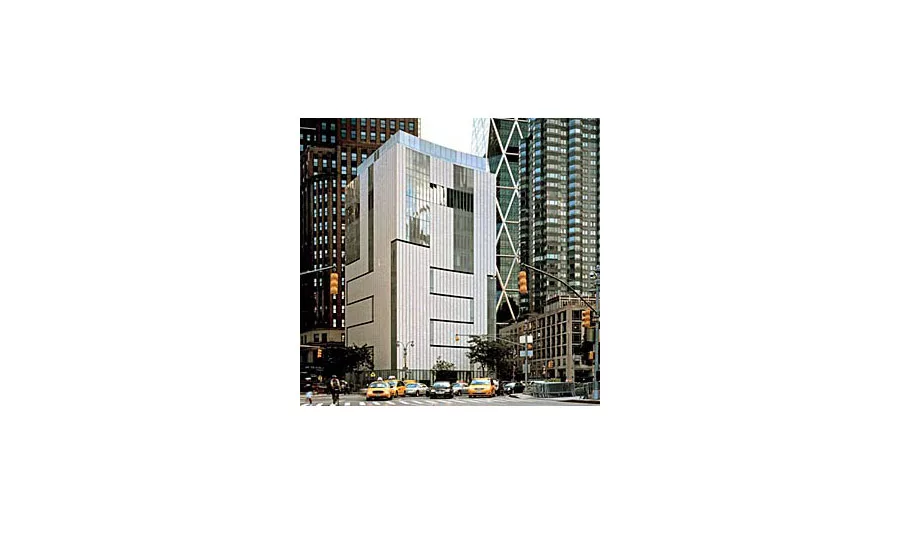
Photo © Helene Binet
Architects & Firms
Lighten up. That’s my advice to the critics of New York City’s Museum of Arts and Design (MAD). The renovation by Allied Works Architecture turned what had been a dreary, haunted house (Edward Durell Stone’s 1964 Gallery of Modern Art) into a lively amenity for the city. And—at risk of damning with faint praise—the best of the buildings fronting Columbus Circle.
Additional Content:
Jump to credits & specifications
On one of my visits, I was accompanied by my sons, who were delighted to see that the museum’s entrance facade seems to spell “HI.” I explained to them that the oversize letters were accidental—the principal of Allied Works, Brad Cloepfil, AIA, had called for three vertical bands of glass on the north and west facades. But after construction had begun, the museum insisted on the addition of a horizontal band on the north (entrance) facade, to improve the views from the planned ninth-floor restaurant. That addition turned two of the verticals into an “H,” leaving the third an “I,” and angered Cloepfil, who took the unusual step of telling journalists of his complaint about the client’s intervention.
But my sons didn’t understand why Cloepfil was upset. “Every building should say ‘HI,’ ” they announced, as if proferring a manifesto. Metaphorically speaking, they’re right: Every building, unless it’s a bioweapons laboratory or a prison, ought to be inviting. Stone’s original building for Huntington Hartford was about as welcoming as a mausoleum.
By contrast, Cloepfil’s scheme—which required removing one of the building’s famous lollipop columns—features an inviting entrance facing Columbus Circle. Inside, a handsome stairway draws visitors up to the second floor. From there, it is possible to continue on narrower, but still pleasant, flights, to each of the gallery levels. In creating such an effective circulation system in a confined space (the footprint, a tetragon with a gently concave front, measures 4,770 square feet), Cloepfil scored a major success. And the galleries those stairways lead to are surprisingly bright and open. Who knew that the building, which was scaleless behind Stone’s fussy faux-Venetian facade, contained some 54,000 square feet over 12 levels? It seemed, at most, half that big.
For Cloepfil, previously known for Weiden + Kennedy’s ad agency headquarters in Portland, Oregon (where he is based), and the Contemporary Art Museum (2003) in St. Louis, MAD was a chance at the big time. Cloepfil was chosen in 2002 over Toshiko Mori, FAIA, Zaha Hadid, and Smith-Miller Hawkinson. But preservationists were outraged by plans to alter Stone’s exterior, and the project was delayed by lawsuits (including one in 2005 against MAD and its director, Holly Hotchner, for “conspiracy to obstruct and subvert the lawful functioning of the New York City Landmarks Preservation Commission”). Cloepfil says he knew there would be controversy, but, “I didn’t think it would be as vicious as it was.”
Still, he never considered keeping the Stone facade. Cloepfil had found the building “frightening” since his days at Pratt in the 1970s and later at Columbia’s GSAPP. And it was an urbanistic wasteland—“a block that had been taken away from the city for so long,” he says. Then, too, the cladding, according to engineers retained by MAD, was beyond repair. Cloepfil replaced Stone’s white Vermont marble with glazed terra-cotta tile. “Its iridescence brings the body of the building alive,” he says, though some observers see a strong resemblance to a 1960s white brick apartment building.
But recladding is one thing; the architect faced a bigger challenge working with the building’s structure, consisting of concrete core and perimeter bearing walls (raised on those “lollipop” columns), and concrete slabs. Cloepfil decided to create a 2-foot-wide cut through the north facade facing Columbus Circle to bring light into the galleries. But that simple gesture devolved into a series of deep, dark horizontal gashes and shallow, glass-fritted vertical stripes that seem to draw on different architectural vocabularies. Cloepfil describes the cut as “a relatively minor intervention,” yet it reads as a complex, and confusing, set of moves.
During construction, Cloepfil had said the cut through the facade would turn the bearing wall structure into a series of cantilevers. In reality, metal pins are needed to reduce deflection and they quite noticeably traverse the horizontal gaps; Cloepfil concedes the pins are bigger than he had expected. Inside, the clumsy way the glazed vertical slits meet their horizontal extensions near the gallery ceilings (which Cloepfil says is explained by the need to hide blackout shades in overhead soffits) has come in for heavy criticism. But Cloepfil is undeterred. “I have to say, it’s an exquisitely detailed building,” he says. “If there’s one thing I know how to do, it’s detail.”
He was less gallant when it came to the new horizontal window, which he blamed on a museum donor who “suddenly became a designer.” Cloepfil called the result “disconcerting and disruptive.”
Cloepfil will have other chances to show what he can do as a museum designer: at the University of Michigan, where his 100,000-square-foot art museum will open this spring, and in Denver, where his Clyfford Still Museum is expected to break ground this summer. In those projects, where he is not treading on hallowed ground, his architecture will get a chance to succeed or fail on its own merits. As for the new MAD: Perhaps it’s not a great building—but it is a building to be grateful for.
PeopleArchitect: Allied Works Architecture Brad Cloepfil (Principal)
Engineer(s): Structural: MEP: Consultant(s): Acoustical: Other: Signage & Media:
General contractor: F.J. Sciame Construction Co., Inc.
Photographer(s): Richard Barnes Hélène Binet
CAD system, project management, or other software used: VectorWorks
|
ProductsExterior cladding Masonry: Terracotta tiles glazed by Royal Tichelaar Makkum Metal/glass curtainwall:
Roofing Built-up roofing:
Windows Aluminum:
Glazing Glass:
Doors Entrances: Metal doors: Wood doors: Special doors (sound control, X-ray, etc.):
Hardware Locksets: Hinges: Closers: Exit devices: Pulls: Cabinetry:
Interior finishes Cabinetwork and custom woodwork: Paints and stains: Wallcoverings:
Other Lobby Feature Stair: Treads: Special surfacing: Floor at base of Feature Stair: Stone floor in Lobby: Resilient flooring: Auditorium: Furnishings Reception furniture: Fixed seating: Upholstery:
Lighting Interior ambient lighting: Downlights: Task lighting: Gallery Lighting: Controls:
Conveyance Elevators/Escalators:
Plumbing Kohler Lavatories, Water Closets, Urinals, and service sinks Water Cooler: |
Looking for a reprint of this article?
From high-res PDFs to custom plaques, order your copy today!