Architectural Record
search
cart
facebook twitter linkedin youtube
  • Sign In
  • Subscribe
  • Sign Out
  • My Account
Architectural Record
  • NEWS
    • Latest News
    • Awards
    • Interviews
    • Obituaries
    • Podcasts
      • Design:Ed Podcast
      • Sponsored Podcasts
  • OPINION
    • Book Reviews / Excerpts
    • Exhibition Reviews
    • Forum
  • EXCLUSIVES
    • Videos
    • Design Vanguard
    • Top 300 Firms
    • Sponsored Content
    • Sponsored eBooks
    • From the Archives
  • CONTINUING ED
    • Editorial Continuing Ed
    • CE Center
    • CE Academies
  • PROJECTS
    • Buildings By Type
    • Reuse & Renovation
    • Museums & Arts Centers
    • Colleges & Universities
    • Multifamily Housing
    • Interiors
    • Lighting
    • Kitchen & Bath
  • HOUSES
    • Record Houses
    • House of the Month
    • Featured Houses
  • PRODUCTS
    • Products by Category
    • Record Products of the Year
    • Latest Products
  • EVENTS
    • Dates & Events
    • Record on the Road
    • Innovation Conference
    • Sustainability in Practice
    • Women In Architecture
    • Webinars
    • Ad Excellence Awards
    • Submit an Event
  • CONNECT
    • Ask RECORD AI
    • Newsletters
    • Contact
    • Advertise
    • Editorial Calendar
    • Store
    • Customer Service
  • SUBMIT
    • Submission Guidelines
    • RECORD Competitions
  • MAGAZINE
    • Subscribe
    • My Account
    • Digital Edition
    • Current Issue
    • Firm Pass
    • Historic Archive
Architectural Technology

Fashioning an aural architecture
By Joann Gonchar, FAIA
Fashioning an Aural Architecture

Fashioning an Aural Architecture

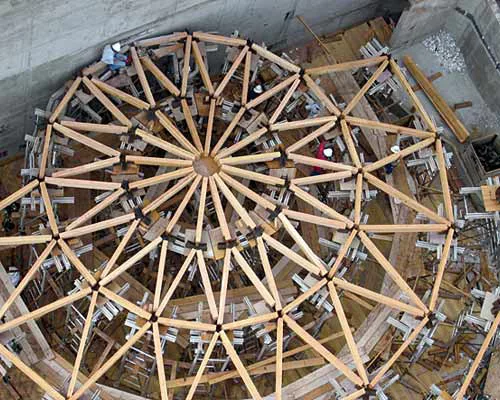
To build the 76-foot-diameter dome over the main theater at the Tempe Center for the Arts, construction workers installed a structure of glue-laminated beams connected by steel saddles and supported with shoring.

Photo © Bernon Monger
Fashioning an Aural Architecture

Fashioning an Aural Architecture

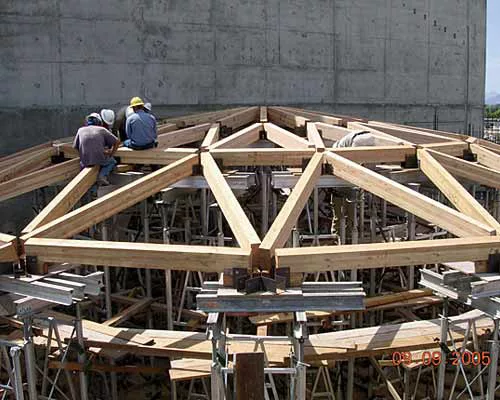
To build the 76-foot-diameter dome over the main theater at the Tempe Center for the Arts, construction workers installed a structure of glue-laminated beams connected by steel saddles and supported with shoring.

Photo © Peter Rutti
Fashioning an Aural Architecture

Fashioning an Aural Architecture

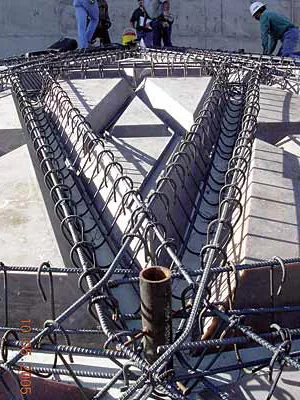
Though the configuration of the wood members resembles a lamella pattern in the finished ceiling, their purpose was to provide temporary support for the fiberglass formwork.

Photo © Peter Rutti
Fashioning an Aural Architecture

Fashioning an Aural Architecture

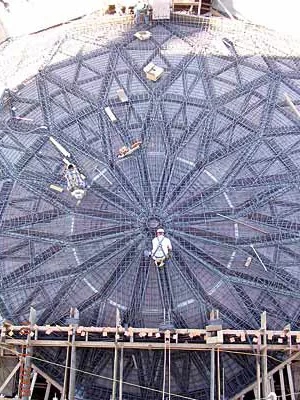
To ensure that the concrete flowed evenly around the dome’s dense network of steel reinforcement, contractors used a self-consolidating mix.

Photo © Peter Rutti

Fashioning an Aural Architecture

Fashioning an Aural Architecture

Crews formed the shell and ribs with 125 cubic yards of concrete in a single 8-hour pour.

Photo © Thomas Brown

Fashioning an Aural Architecture
January 16, 2008
Crimped and folded like the tectonic plates of the nearby Papago and Camelback Mountains, the roof that tops the Tempe Center for the Arts provides the facility with its signature element. Made of concrete over metal deck and supported by exposed tubular trusses, the iconic roof shelters the collection of programmatic elements that compose the $67.6 million center, including a 600-seat proscenium theater, a 200-seat studio theater, and a 3,500-square-foot gallery. The architects, Barton Myers Associates of Los Angeles, and local firm Architekton, conceived these as discrete volumes, each with its own roof below the enveloping structure.
 
This “box within a box” system serves an acoustical function, with the outer roof providing the first line of defense against the noise of jets on their way to and from Phoenix’s Sky Harbor Airport, only 2 miles away from the building’s site at the edge of Tempe’s Town Lake, says Peter Rutti, Barton Myers senior associate. The outer roof’s peak, about 100 feet above grade, is supported by a series of steel columns that sits on the concrete perimeter walls of the main theater fly tower. At the base of the columns are laminated rubber-and-steel-plate bearing pads. These isolators allow transfer of gravity loads but mitigate transfer of lateral loads induced by airborne vibration into the performance spaces, explains structural engineer Bruce Danziger, associate principal in the Los Angeles office of Arup.
 
Of the many volumes sheltered under the great roof, the main theater, with its poured-in-place ribbed dome spanning 76 feet, is the most complex. And much of its complexity is for acoustical reasons. According to Kurt Graffy, principal consultant with Arup Acoustics, in San Francisco, the lamella pattern of radiating beams aids the distribution of sound that would otherwise unevenly collect within the dome’s curved surface. The room’s size and physical characteristics provide “dry” conditions, or short reverberation times, best suited for dramatic presentations. However, an electro-acoustic enhancement system simulates the room volume and finishes that provide the longer reverberation times necessary for classical music, says Graffy.
 
Paradoxically, in order to ensure that the intricate dome was built correctly, the structural drawings called out the radii and elevations, but did not specify the dimensions of all of the components. “It is important to give only the necessary geometric information that can be used to establish the dimensions of each element,” says Danziger. The practice “forces the contractor to really understand the geometry and helps limit the possibility of errors in the drawings due to changes,” he adds.
 
So, before beginning construction, the contractor’s project manager built several scale models. And the fabricator of the fiberglass formwork worked in 3D CAD to generate shop drawings. “If we were to build the dome today, we would use BIM (building information modeling),” says Bill Okland, president of Tempe-based Okland Construction.
 
To build the actual dome, the contractor first installed a temporary “dance floor” at the theater’s eventual catwalk level to protect crews working on the room’s interior while roof construction moved forward. They then erected a skeletal dome-shaped structure of glue-laminated beams to support the formwork.
 
Within the forms, workers installed a dense network of rebar before placing the dome’s self-consolidating concrete in a single 8-hour pour to create the 6-inch-thick shell, and the 6-inch-deep and 10-inch-deep ribs. Then they waited a nerve-racking seven days before stripping the forms and removing the wood beams. Though the work went smoothly, Okland says the dome “was the most technically challenging concrete we’ve ever poured.”


Share This Story

Looking for a reprint of this article?
From high-res PDFs to custom plaques, order your copy today!


Joann gonchar

Joann Gonchar, FAIA, LEED AP, is deputy editor at Architectural Record. She joined RECORD in 2006, after working for eight years at its sister publication, Engineering News-Record. Before starting her career as a journalist, Joann worked for several architecture firms and spent three years in Kobe, Japan, with the firm Team Zoo, Atelier Iruka. She earned a Master of Architecture degree from the University of Pennsylvania and a Bachelor of Arts from Brown University. She is licensed to practice architecture in New York State.

Post a comment to this article

Report Abusive Comment

Subscription Center
  • Create an Account
  • Start a Subscription
  • Manage My Account
  • Sign Up for Newsletters
  • Visit Customer Service
  • Update Preferences

More Videos

Sponsored Content

Sponsored Content is a special paid section where industry companies provide high quality, objective, non-commercial content around topics of interest to the Architectural Record audience. All Sponsored Content is supplied by the advertising company and any opinions expressed in this article are those of the author and not necessarily reflect the views of Architectural Record or its parent company, BNP Media. Interested in participating in our Sponsored Content section? Contact your local rep!

close
  • TAMLYN XtremeTrim Exterior Trim
    Sponsored byTamlyn

    Designing Cleaner Panel Facades: Why Exterior Trim Details Matter

  • Building with Vapor Barriers
    Sponsored byReef Industries, Inc.

    Vapor Barriers Help Control Moisture in Tighter Building Designs

  • Duct Interior with Prodeq System
    Sponsored byHenry, a Carlisle Company

    Designing Resilient Water Containment Systems

DESIGN:ED Podcast
Listen to Architectural Record’s DESIGN:ED Podcast

Events

June 10, 2026

Rethinking Stormwater – The Power of Porous Paving

Credits: 1 AIA LU/HSW; 1 AIBD P-CE; 0.1 ICC CEU

Learn how porous paving systems support stormwater management, reduce heat island effects, and enhance sustainable site design performance.

June 11, 2026

Very Early Warning Fire Detection for Mission-Critical Facilities

Credits: 1 AIA LU/HSW; 1 AIBD P-CE; 0.1 ICC CEU

Examine advanced fire detection strategies that support uptime and enhance safety in data centers and other mission-critical facilities.

View All Submit An Event

Products

2026 Architect's Square Foot Costbook

2026 Architect's Square Foot Costbook

See More Products

Popular Stories

Practice Matters illustration

What’s in a (Firm’s) Name? Thinking About Succession and Legacy

Coronado Bridge

The Architect’s Guide to San Diego

Practice Matters illustration

By the Numbers: Counting America's Architects

Riverdale House by Studio Lau

Riverdale House by Studio Lau

House on a Hill

Design Vanguard 2026: Forma

Broader Sustainability of CMU - Free Webinar - May 21, 2026

Related Articles

  • On the Boards: Orlando Performing Arts Center by Barton Myers

    See More
  • Quay Quarter Tower

    3XN’s Quay Quarter Tower in Sydney Transforms and Expands an Outmoded 1970s Skyscraper

    See More
  • SoMA

    In Manhattan, CetraRuddy Transforms an Aging Office Building into Much-Needed Housing

    See More

Related Products

See More Products
  • american arch.jpg

    American Architecture: An Illustrated Encyclopedia

See More Products
×

The latest news and information

#1 Source for Architectural Design, News and Products

SUBSCRIBE
  • RESOURCES
    • Advertise
    • Contact Us
    • Submit
    • Store
  • ACCOUNT CENTER
    • Create an Account
    • Start a Subscription
    • Manage My Account
    • Sign Up for Newsletters
    • Visit Customer Service
    • Update Preferences
  • PRIVACY
    • PRIVACY POLICY
    • TERMS & CONDITIONS
    • DO NOT SELL MY PERSONAL INFORMATION
    • PRIVACY REQUEST
    • ACCESSIBILITY
  • SERVICES
    • Marketing Services
    • Reprints
    • Market Research
    • List Rental
    • Survey/Respondent Access
  • STAY CONNECTED
    • Linkedin
    • Facebook
    • Instagram
    • YouTube
    • X (Twitter)

Copyright ©2026. All Rights Reserved BNP Media, Inc. and BNP Media II, LLC.

Design, CMS, Hosting & Web Development :: ePublishing