Guggenheim Face-Lift Retains Original Wrinkles
Restoration team tackles thorny preservation issues while preparing a 50-year-old architectural icon for its next half-century.
Guggenheim Face-Lift Retain Original Wrinkles
Photo © Solomon R. Guggenheim Foundation/David Heald
Guggenheim Face-Lift Retain Original Wrinkles
Photo © Solomon R. Guggenheim Foundation
Guggenheim Face-Lift Retain Original Wrinkles
Image courtesy Angel Ayon, Wasa/Studio A
Guggenheim Face-Lift Retain Original Wrinkles
Photo courtesy Mapei
Guggenheim Face-Lift Retain Original Wrinkles
Photo © Angel Ayon, Wasa/Studio A
Guggenheim Face-Lift Retain Original Wrinkles
Photo courtesy Mapei
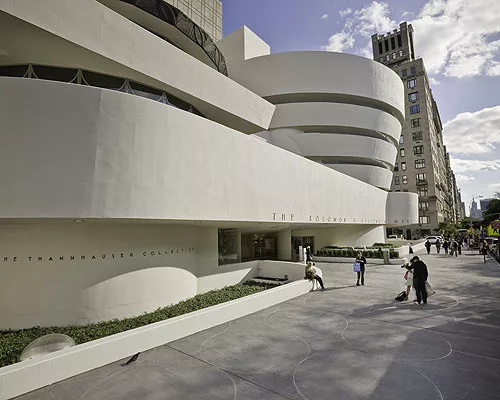
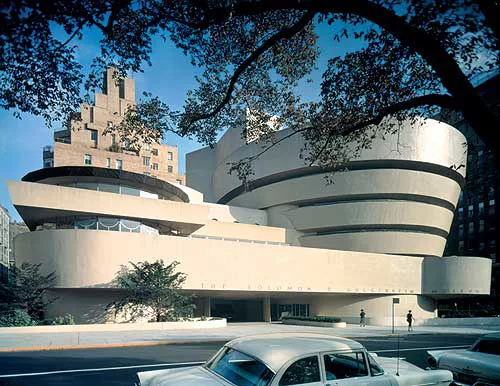
The ink spilled in the media about the color of the Solomon R. Guggenheim Museum’s recently restored facade would probably cover its entire surface. The controversy has raged since the exterior restoration of the building, on New York City’s Fifth Avenue, began in 2005. Purists argued that the exterior of Frank Lloyd Wright’s final masterpiece should be returned to its original Powell Buff color, which had a decidedly yellow cast. Archival records confirm that even though Wright approved the color, the facade remained Powell Buff for only a few years after the museum’s completion in 1956. Since the early 1960s, succeeding paint jobs were some variation of the hue everyone now associates with the building, described as a light gray, off-white, or London fog.
The opposing camp, which included the client and the restoration team, argued in favor of staying with the light gray. To return the exterior to buff would, first of all, create a jarring juxtaposition next to a now 16-year-old addition by Gwathmey Siegel & Associates.
And secondly, the yellow hue is no longer a defining, aesthetic characteristic of Wright’s building. After viewing two large gray and buff painted panels against the addition’s limestone cladding, the city’s Landmarks Preservation Commission agreed and approved the light gray by a 7 to 2 vote.
Pamela Jerome, AIA, principal at New York City–based WASA/Studio A, the preservation architect of record for the $29 million project, sees the facade color debate from the preservationist’s perspective. “With [completion of] the 1992 addition, the museum became a hybrid complex,” she explains. “The preservationist then must address the question in terms of what we call ‘progressive authenticity’ and ask what the building’s function is today,” she says, adding that the museum has been defined by changes that have been made over the past 50 years.
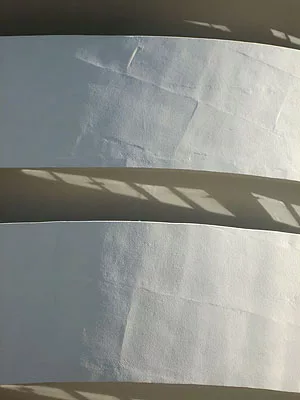
The facade restoration is a different story. “Here, we were charged with interpreting the principle of ‘authenticity of craftsmanship,’ ” Jerome continues. Although Wright had envisioned the spiral as smooth and monolithic, the actual facade “is incredibly hand-made,” she says. “When sunlight rakes across the surface, you can see vertical lines and wood-grain impressions left by the formwork.” Even the 11 coats of paint applied over the gunite walls in the half-century since the building’s completion did not conceal these markings.
The project’s structural engineer, Robert Silman Associates, advocated wrapping the spiral in carbon fiber. Use of the material would have achieved the pristine finish that Wright had imagined and would also have prevented cracking. However, the architects ultimately opted for another approach. “We determined that [making] the surface smooth would erase the craftsmanship,” says Jerome.
Much about the original construction was unconventional and, in some ways, counterintuitive. For example, the spiral was built without expansion joints. Also, the formwork was erected on the exterior and the gunite was sprayed on from the inside, the opposite of conventional practice.
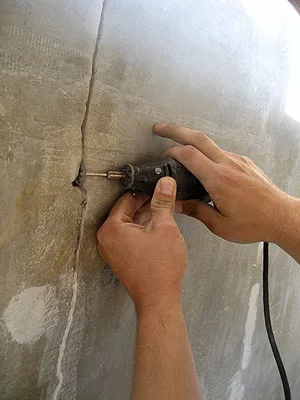
To determine the scope of work and devise a plan for repairs and upgrades, Silman and consultant Integrated Conservation Resources (ICS) spent 17 months conducting noninvasive testing and monitoring cracks in several locations to measure the structure’s movement. The firms found two types of cracks: those that had developed over embedded steel, and shrinkage cracks, some as wide as 1¼ inch. According to Glenn Boornazian, ICS president, the nonshrinkage cracks are due to thermal expansion and contraction and to the unusual geometry of the walls.
After completing testing and analysis, the team began a search for appropriate patching material, crack filler, and coatings. Six companies presented their products for laboratory testing, which ICS conducted using the original gunite formula. The field narrowed, and three manufacturers provided mock-ups, and eventually the international construction materials company MAPEI was selected as the single source for the materials.
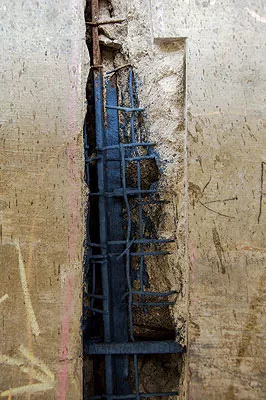
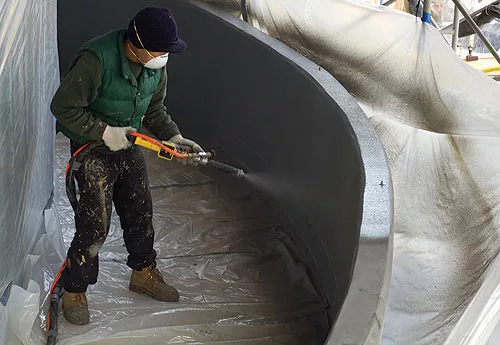
Repair and restoration involved four steps. First, workers removed rust from the steel reinforcing, and applied corrosion inhibitor. The second step involved patching damaged or spalling concrete in sections as small as 1 square inch to as large as 900 square feet. The patch offered installers the ability to replicate the original contours without erasing existing imperfections, as required by the architect’s specifications. The third step waterproofed the exterior with a sprayed-on cementitious membrane. Finally, the exterior was finished with a light-gray, fiber-reinforced elastomeric coating.
Jerome is confident that the restoration, unveiled in late September, will take the Guggenheim to its 100th anniversary, providing that the building is vigilantly maintained. Problems that don’t exist now can develop over time. “Damage, such as cracks or corrosion, accelerates exponentially,” she warns. In anticipation of when restoration is again necessary, the project team has made sure its interventions are reversible, says Jerome. “The aspiration of a preservationist is to ensure that the ability of future generations to re-treat the building are not compromised.”
Looking for a reprint of this article?
From high-res PDFs to custom plaques, order your copy today!