Competition for Ideas
St. Louis holds a design competition that points the way for well-run ideas competitions.
American architects frequently complain that we lack effective design competitions in this country. We frequently point to Europe, where the widespread use of competitions by public and private clients apparently yields positive results, encouraging creative ideas and leveling the playing field for younger practitioners. Although these events are sometimes fraught with their own issues, such as fairness or adequate compensation or politicizing, we are constantly seeking new ways to open up the process.

A competition recently took place in St. Louis that, while small, might serve as a model for other cities: It worked like a textbook case, with annotated lessons along the path, so take note. The primary player was the Washington University School of Medicine, which partnered with AIA St. Louis. Here’s what happened.
Paul Duell, an architect and a client of other architects at the university, served as the organizer. The senior project manager for design and construction for the medical school, he had a lingering, unsolved problem. The city’s Central West End Metrolink station, its most active metro stop, lay at his footstep — an ugly site in need of improvement. Although the St. Louis light-rail system has been highly successful, this active stop, which serves both the medical school and the Barnes-Jewish Hospital to form one of the largest nonprofit health-care complexes in the country, greets its approximately 5,000 riders with a daily dose of the medical school’s power plant. Imagine leaving work from patient care, exhausted, and looking up at a slew of pipes carrying steam or waste. Duell called in a crash team. Lesson number one: Architects make great clients.
At his instigation, Washington University School of Medicine partnered with AIA St. Louis to instigate an ideas competition. Entries were open to teams with an unusual blend of skills and experience. Here’s what the AIA’s Web site said: “Entry must be made by a team comprising at least one architect with at least 20 years of experience and one architectural intern or architect with less than twenty years experience.” (Read wilder, creative ideas would be tempered with experience.) Lesson number two: Give younger architects a shot.
The jury consisted of a diverse gathering. Pay attention. Yes, design professionals took part. Louis Saur, FAIA, a respected local architect, joined Laura Solano, from Michael Van Valkenburgh’s office in Boston (who had overseen the realization of a poetic plaza just above the Metrolink stop, incorporating a lotus-filled pool by Maya Lin). And (full disclosure), this editor joined. But consider the client involvement that follows.
Rather than limit the jury to an in-crowd of designers, which always seems more comfortable, Duell went for power at the power plant. He cajoled the executive vice chancellor for administration at the medical school into joining, generating moxie on campus. Ditto the group president from BJC HealthCare responsible for its capital programs. A key representative from St. Louis’s Metrolink capped it off. Lesson number three: Incorporate the critical decision makers in the decision.
The jury deliberated, as juries do, with projected images behind closed doors, but had the advantage of being adjacent to the site, which allowed them literally to walk outdoors, despite the summer doldrums, and stand on the Metro platform. Lesson number four: Nothing compensates for familiarity with and access to the actual site.
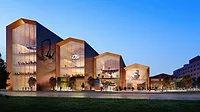
Overall, the teams described artful, sustainable methods of screening a power plant. Some showed how to engage a multilevel site with structures that bridged levels and functions, including housing, retail, and public space. Having made their decision on a first project that would receive a cash award, a richly imaginative kinetic screening device by Trivers Associates, the university offered a second, equal sum, to be offered at the jury’s discretion. The jury issued a second award for an alternative vision to HKW Architects. Lesson number five: When ideas are involved, why should they be limited to a single winner?
On day two, the St. Louis chapter of the AIA hosted a luncheon meeting to discuss the competition and present the winners to a filled room. Representative jury members had the luxury of presenting each of the thirteen entrants in some detail, describing their critiques of the ideas, the presentation quality, whether verbal or graphic, and overall impressions. While the discussions exceeded the intended time frame, the luxury of giving adequate time to each entry warranted it. Lesson number six: If time or space allows, give adequate attention to all entrants, not just the winners.
After two days, the jury emerged from air-conditioning and blinked in the full sun, having done their homework. The university/medical center complex had clever, creative notions for enriching its critical transit hub. But most important, the powers-that-be had been presented with alternative visions on future expansion at that location — loosely formed, broadly suggested, but real ideas. One of them may well come to pass. Lesson number seven: The results of an ideas competition may extend beyond the expected consequences.
Had the jurors not been in the same room, so much would have been lost. Not only body language (an obvious fatality of the current swing toward virtual juries), but the context of the site, the willingness to stay and talk about potential uses of plans, and, uniquely in this case, the full presentation of results. In the name of economy and trying to be hip, we are cutting out travel and settling on virtual juries. Ugh. They feel like homework. They lack joy. They don’t allow for chance. Comparisons of projects are virtually impossible. And no client will ever join in for the full proceedings. Lesson number eight: Conduct juries in person.
The St. Louis power-plant competition might be smaller than many, but its excellent structure demonstrates that juries can still be an effective way of sharing ideas.
If you wish to write to our editor-in-chief you can email him rivy@mcgraw-hill.com.
Looking for a reprint of this article?
From high-res PDFs to custom plaques, order your copy today!