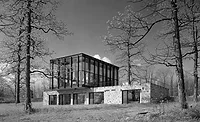
Genesis of Genius
Case Study: Richard Neutra
In this excerpt from The Creative Architect, Serraino’s description of Neutra points to an imposing but insecure figure.
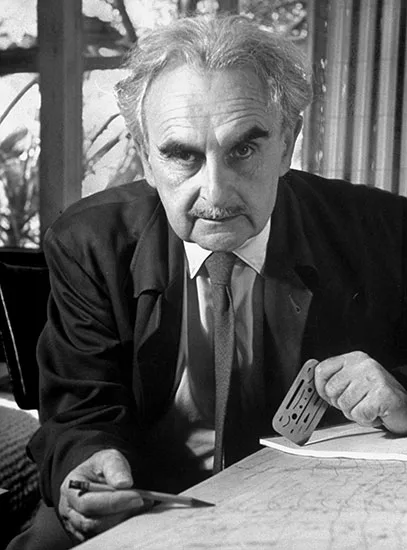
Richard Neutra
After arriving in Los Angeles in 1925, the Viennese-born Richard Neutra quickly became known for his elegantly Modernist design.
Photo © Ed Clar / Getty Images
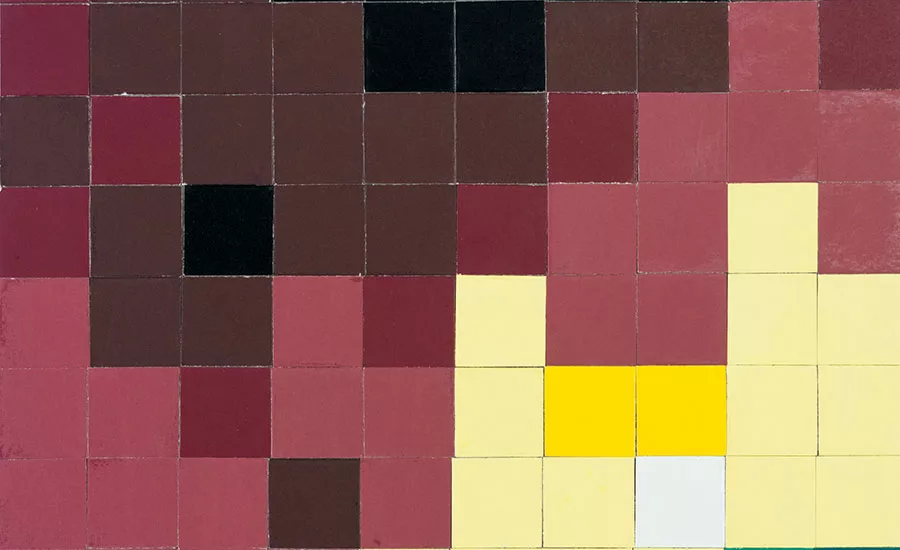
Richard Neutra
In his mosaic for the creativity test, Neutra shows a willingness to deal with color.
Photo © IPAR
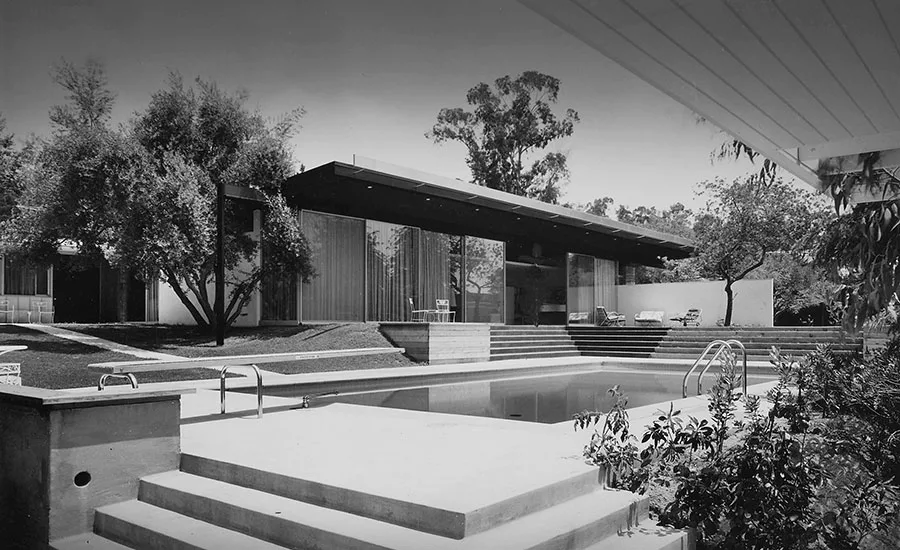
Richard Neutra
Neutra’s 1955 Kronish House exemplifies the continual refining of his vocabulary.
Photo © J. Paul Getty Trust
Editor’s Note: In June, The Creative Architect: Inside the Great Midcentury Personality Study, by Pierluigi Serraino, will be published by Monacelli Press. The book is based on psychological tests conducted by the University of California, Berkeley, in 1958–59 to try to determine what promotes creativity in architects. RECORD presents excerpts of three case studies of the leading architects of the day—Eero Saarinen, Philip Johnson, and Richard Neutra—along with the author’s summary of the goals, methodology, and findings of this unusual, almost-forgotten investigation. Go back to the main article.
That Richard Neutra was exceptionally driven to self-affirmation is part and parcel of the mythology he created around himself. The interview and creativity measurements provide an insight into that drive. Neutra’s interviewer, Sarnoff Mednick, wrote “One can understand a significantly large portion of Neutra’s behavior and attitudes by knowing two things: he must have people love him and be thoroughly devoted to him. Anything less than this is extremely disquieting. Second, to simply say that he has a high need for achievement would tend to be misleading. That statement is too mild. There is no room for question regarding his ability to solve any problem that might interest him. Not only must he be able to solve them all, but he must solve them better than anyone else. He almost literally thinks of himself as a superman.”
Neutra received very high scores— the highest of the 40 architects—for the 10 personality traits. Mednick awarded him a 9—the top score—for Inquiringness, Esthetic Sensitivity, Sense of Destiny, and Maturity and Responsibility. He also fared well in Personal Stability and Adjustment (8) and Ability to Evaluate Ideas (8). Strangely, his lowest score was a 6 in Originality.
In terms of work and sleeping habits, Neutra was unusual by American standards— bedtime at 11 p.m., up at 4 a.m., and a nap in the afternoon from 2 to 4. Shortly after waking, he would be able to start his day. He considered that since high school he was at his most creative early in the morning, although he could work late into the night, but with less confidence.
While in Vienna, Neutra did meet Freud, probably due to his friendship with the psychoanalyst’s son, Ernst. When asked if he had ever had an intense experience of mystical communion with the universe, life, God, etc., Neutra answered,“I think so, quite often.” The same reply was given when he was asked whether he experienced desolation, emptiness, or loneliness. His fear of abandonment was palpable throughout the interview and his dominance appeared as a coping mechanism to circumvent a paralyzing fear of rejection. In his youth, whenever he was left alone, he feared that his parents would not come back, although there was no rational basis for this anxiety.
The architect described his family background in the most harmonious terms. He was raised in an apartment in Vienna—the same throughout his entire youth—by loving parents, and with older siblings who disciplined him more than his father and mother did. Free from financial worries, the household valued cultural pursuits; religion had no place whatsoever in his upbringing, despite his Jewish heritage. His father often reminded the young Richard to be a star student, yet both parents gave him a significant amount of autonomy, and the atmosphere at home was laissez-faire. There were neither punishments nor strict rules, but certainly the importance of education and knowledge was stressed. When Neutra spoke of his brothers, he mentioned they were well educated: one was a neurologist, the other a mechanical engineer. He also had a sister, but being the youngest of them was lonely while growing up. Neutra did not identify with either parent.
An excellent student in high school, Neutra stated that his professors were a great influence on him. His reading preferences anticipated his theoretical leanings in his architectural career— cosmic physics, chemistry, and poetry—Baudelaire in particular. His penchant for debating, sharing ideas, and discussing was the glue between him and his peers. During this period he hesitated over a career in mechanical engineering, but eventually chose architecture during military service. This idyllic balance between living and learning changed in architecture school at the Technical University of Vienna. He found his professors there most ineffective, “the curriculum was stupid,” and he engaged himself wholly in philosophy courses at the university. Vienna was at the peak of its cultural and artistic power when Neutra was maturing, and the young student immersed himself in theater, opera, concerts, and readings. When asked about his heroes, he listed Victor Adler, a psychiatrist who was the leader of the socialist party of Austria, Nietzsche, Hugo von Hofmannsthal, and Hamlet-type actors.
Looking for quick answers on architecture and design topics?
Try Ask RECORD, our new smart AI search tool.
Ask RECORD →
Neutra declared the work of Otto Wagner to be the trigger for his interest in architecture. He saw his buildings while in elementary school, and Wagner remained his hero ever after. Additionally he internalized Wagner’s fighting for modern architecture in Vienna: “He had a great battle with the city to put in modern stations on the railroad. He won.” He stated that he was the favorite pupil of Adolf Loos and added, “I am now the architectural hero of Vienna. I have taken Otto Wagner’s place as a hero. They awarded me the prize.” Early in his career Neutra was an associate of Erich Mendelsohn in Berlin, which made his emigration to America in October 1923 very rough. As he recalled: “I didn’t see how I would make a living. I started in Brooklyn as the lowest paid draftsman. Quite a change from [being an] associate of Mendelsohn.”
When Neutra went to Los Angeles in 1925 and began designing the Lovell Health House, he felt that he had found his voice and a chance to demonstrate his own architectural principles. He gave 1927 as the house’s completion date, although it was actually finished in 1929 and showcased in an article written by the client, Dr. Lovell, for the Los Angeles Times, published toward the end of 1929.
Architecture was the fusion of Neutra’s interest in art and science, although he expressed frustration over his inability to “get a team together that functions.” His heroic stance became once again evident when he was asked about the value he placed on creativity in architecture: “Not being exotic about forms, but taking a battle memorial and making it into a shrine of the free world.”
When pressed to pick his best work, he chose the Kaufmann House in Palm Springs (1947): “It is a building outside of cultural precedence. No one has built on a desert. Only nomads live in the desert.” But his immediate outlook was “desperate.” His then partner, Robert Alexander, was leaving him, and he feared the impact this would have on clients. More likely this anxiety over impending change was a result of the tension that affected his entire emotional life: an overwhelming intellectual energy fueled by an anxiety over being abandoned, whose origins might never be known.
Looking for a reprint of this article?
From high-res PDFs to custom plaques, order your copy today!