Why the Field of Architecture Needs a New Business Model
Photo © Madmaxer / Getty Images
A recent headline in Britain’s tabloid Express read, “Construction jobs BOOM: Bricklayers and plasterers earn MORE than architects.” It seems that skilled construction workers in the UK are at the front of the pay line, with architects bringing up the rear. Ouch. But architects reading this headline on either side of the Atlantic are hardly surprised.
There’s an oft-repeated trope in our profession that we’re underappreciated, losing ground to specialists, and under the thumb of contractors. Most architects have their own version of these complaints, but, unfortunately, they reflect the reality of the essential value proposition of architecture as a profession. Despite the relative strength of the current economy, architects are still paid far less than comparable professionals of equal education and import, and we create value through outmoded delivery systems where the client’s first—and often most important—priority is getting the lowest fee from the architect. When your price is driving selection, you’re a commodity.
Let’s examine the economic dynamics of this syndrome, and then I would like to challenge the current methods of value creation and propose a new business model for architects.
Why the Value of Architectural Services Is Depressed
First, some economic basics: according to AIA statistics, American architects are responsible for designing about $600 billion worth of buildings each year, for which they are paid approximately $29 billion in fees, or about 4.8 percent of construction value. Those fees are largely paid as a commodity, mostly as lump sums or versions of a fixed fee (like percentage of construction). But real value is rarely reflected when compensation is a commodity, and that is hurting the overall economics of the profession.
Other professions have much better value propositions, and that shows up in their paychecks. There are about 110,000 licensed architects in the U.S. and about 106,000 billable positions in U.S. firms. Compared to the 950,000 practicing physicians and 1.33 million lawyers, we’re a pretty rare resource. Nonetheless, the salaries of architects—as a proxy for how well we convert our value in the marketplace of building—are depressed, and that’s depressing.
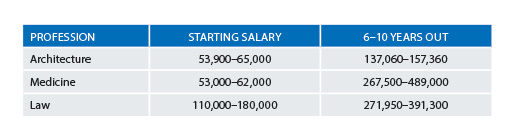
At Yale, where I teach, three of the professional schools accredited for licensure (Law, Architecture, and Medicine) make for an interesting comparison of starting and early-career salaries for graduates, who presumably are in high demand and able to command paychecks at the high end of the spectrum:
The architecture profession today is far leaner and meaner than its pre-crisis state in 2009, likely due to new technology. Net revenues of American firms have largely recovered from the dip, having returned to their 2008 peak by 2015. But firm staffing has decreased by 17 percent, from 128,000 billable positions in 2008 to just 106,000 in late 2016, meaning 22,000 fewer in staff are doing roughly the same amount of work. Salaries are showing modest rises but fee percentages probably lag pre-crisis levels, and since employees haven’t seen 17 percent increases in their paychecks, the productivity gain may be even higher. And while there are no well-understood measures of architectural productivity, there is a strong correlation between this productivity jump and adoption of advanced technologies like BIM in our discipline. But efficiency merely drives prices down further in a market where time spent isn’t related to value delivered.
Are Architects Selling Time or Results?
Commoditized fee structures, salary pressure, and low profit margins are all symptoms of a larger disease: the actual value that architects create is not realized for them financially. Buildings are central to civilization itself, and absolutely necessary not just for survival but progress. As insurance companies remind us relentlessly, designing things is risky business, but the business risk of practice (running out of money) is not correlated to liability risk (getting sued), unlike the way it is in almost every other market where assuming higher risk means a higher reward. The economic models for designing and building—how architects and builders are selected and contracted—are almost exclusively driven by getting the lowest price, irrespective of the desired result. Enormous waste (as much as 35 percent of construction costs), ineffectiveness (where around 30 percent of all projects miss budgets and schedules), and environmentally irresponsible building (resulting in 40 to 50 percent of the carbon contributing to climate change) are the outcomes. Clearly, there is lots of room for improvement. Designing and building remain risky, questionably profitable, unpredictable, and often just not very much fun.
Looking for quick answers on architecture and design topics?
Try Ask RECORD, our new smart AI search tool.
Ask RECORD →
Once upon a time, contracts in our business were gentlemen’s agreements (and they were, unfortunately, all gentlemen). But, since then, various experiments in project-delivery models—construction management, design-build, “early contractor involvement,” design assist—have each attempted to make the industry more effective. Whether “bring the contractor on early!” (construction management), or “create one line of responsibility” (design-build), or “let the builders do the working drawings” (design assist), each of these attempted to improve the ends without a careful reexamination of the means. None of these techniques, despite episodic success, has improved the productivity, profit margins, results, or even the pleasure of working in the building industry itself.
But focusing exclusively on productivity and cost/schedule conformance is to miss the real opportunity for change, like measuring the success of surgery not by whether the patient is cured but by how fast the procedure was completed. There is another way: shifting the value propositions of practice from selling time to creating results for clients. Compensation models could be based on delivering outcomes of the building process itself, including the performance of the finished building. This isn’t just magical thinking—rapidly evolving technologies that combine the computational power of the cloud, the representational potency of digital models, and the analytic capabilities of simulation software are already allowing designers to predict aspects of building more accurately—cost estimating with more quantitative precision, energy consumption based on use, even embodied energy and carbon. It is just a matter of time before these technologies expand the predictive reach of the architect into occupant behavior, building life cycle performance, even usage outcomes like employee satisfaction or staffing efficiencies.
Using Digital Tools to Drive Results and Innovate Practice
The implications of this strategy are far more profound than just new contracts and fee formulas or fancy digital simulation tools. The predictive power of new digital tools can amplify our abilities as designers to solve complex “wicked problems,” as theorist Horst Rittel puts it, and create new, important, and valuable solutions for clients willing to pay for them. But practice models, design methods, and our willingness to take responsibility for the results of our work, will need radical reform.
We could start with the immediate challenges of cost and schedule conformity, working in concert with our builder collaborators to assure clients that these basic objectives of design and construction can be accomplished—and we should be rewarded when they are (and punished when they are not). Establishing credibility from there, we could move on to building-performance objectives like energy usage, carbon emissions, even maintenance-cost optimization. Ultimately, an outcome-based delivery system could connect the purpose of a building—offices to boost the effectiveness of workers, schools to teach better, hospitals that promote faster healing—with the architect’s ability to realize those goals. These changes in the business model can’t be implemented by architects unilaterally, but clients would certainly welcome any strategy where the architect, with skin in the game, is truly invested in project-based outcomes that are both in the client’s and the architect’s interest.
Examples of result-based fees have been gaining momentum in construction: architects paid to provide subcontractors with digital data under design-bid-build; shared conditions based on selected outcomes in CM at Risk contracts; integrated teams under design-build; outcome-based profit objective paid under Integrated Project Delivery (IPD). Architects empowered by predictive and simulative tools (and, soon enough, bolstered by machine learning and big data) can operate with more powerful agency to create greater value for clients.
And here’s where today’s innovation culture can meet the challenges of outcome-based practice; technology might be necessary, but it’s not sufficient to create ideas of new value, and technology’s potential will go unrealized without equal inventiveness in new business models, practice approaches, and willingness to experiment with definitions of architectural services. In the past several years, I have observed a dramatic shift in the interests of my architecture students, who are increasingly dissatisfied with the standard platforms, obligations, and rewards of traditional practice; they have lost their enthusiasm for establishment firms. They’re taking courses outside the architecture school at the business school, some even earning MBAs to go with their M. Arch.’s. They are studying and generating innovative business models, creating start-ups, joining hackathons, and seeking jobs with firms led by architects who are also entrepreneurs, researchers, builders, and developers. This is good news for the profession: a generation of fresh talent demanding new ways of practice, moving ahead with both youthful enthusiasm and a blissful ignorance of our inglorious past.
The architect and mathematician Christopher Alexander once suggested that architectural design was the obligation to create “an intangible form in an indeterminate context.” This can certainly be true of the serious, ineffable qualities of good design. But in our modern age, the practical context is increasingly determinate, and outcome-based design practice—enabled by new attitudes, business models, and technology—will empower us to deliver the real value of both.
Looking for a reprint of this article?
From high-res PDFs to custom plaques, order your copy today!