Architectural Record
search
cart
facebook twitter linkedin youtube
  • Sign In
  • Subscribe
  • Sign Out
  • My Account
Architectural Record
  • NEWS
    • Latest News
    • Awards
    • Interviews
    • Obituaries
    • Podcasts
      • Design:Ed Podcast
      • Sponsored Podcasts
  • OPINION
    • Book Reviews / Excerpts
    • Exhibition Reviews
    • Forum
  • EXCLUSIVES
    • Videos
    • Design Vanguard
    • Top 300 Firms
    • Sponsored Content
    • Sponsored eBooks
    • From the Archives
  • CONTINUING ED
    • Editorial Continuing Ed
    • CE Center
    • CE Academies
  • PROJECTS
    • Buildings By Type
    • Reuse & Renovation
    • Museums & Arts Centers
    • Colleges & Universities
    • Multifamily Housing
    • Interiors
    • Lighting
    • Kitchen & Bath
  • HOUSES
    • Record Houses
    • House of the Month
    • Featured Houses
  • PRODUCTS
    • Products by Category
    • Record Products of the Year
    • Latest Products
  • EVENTS
    • Dates & Events
    • Record on the Road
    • Innovation Conference
    • Sustainability in Practice
    • Women In Architecture
    • Webinars
    • Ad Excellence Awards
    • Submit an Event
  • CONNECT
    • Ask RECORD AI
    • Newsletters
    • Contact
    • Advertise
    • Editorial Calendar
    • Store
    • Customer Service
  • SUBMIT
    • Submission Guidelines
    • RECORD Competitions
  • MAGAZINE
    • Subscribe
    • My Account
    • Digital Edition
    • Current Issue
    • Firm Pass
    • Historic Archive
Climate Change & SustainabilityArchitect Continuing Education

Think Global, Act Local: San Francisco's Carbon Policy

By Joann Gonchar, FAIA
San Francisco

Photo © Marcelo Vinante/Alamy Stock Photo

May 1, 2020

Architects & Firms

David Baker Architects
Mithun

Over the past 30 years, San Francisco has made impressive progress cleaning up its built environment. Since 1990, carbon emissions from the operation of buildings have dropped 51 percent. And between 2013 and 2018—despite tremendous economic growth—energy use in commercial structures was reduced 11 percent. But with buildings still responsible for 2.2 million tons of greenhouse-gas emissions annually (about 44 percent of the citywide total), there is more work to do. To completely decarbonize buildings in San Francisco by midcentury, “we need to redouble our efforts,” says Barry Hooper, senior green-building coordinator with the city’s Department of the Environment. “The next 10 years will be critical.”

A primary focus for San Francisco has been on greening the electrical grid while advancing all-electric buildings and moving away from the use of natural gas. Last September, the Board of Supervisors approved legislation requiring that buildings larger than 50,000 square feet depend only on renewable energy by 2030. Then, in January of this year, they adopted two ordinances. One bans gas con­nections in new or significantly renovated municipal facilities. A second sets a higher performance bar—above the already stringent energy code—for all buildings that opt to include gas infrastructure.

READ MORE ABOUT

• Climate Change

• Sustainable Architecture

• Green Building

Such all-electric measures have been sweeping California. Berkeley was first, with its city council voting last July to prohibit gas hookups in new small and midsize residential buildings. Since then, 29 other jurisdictions throughout the state have adopted regulations that discourage gas or outright ban it. These policies will have a significant impact, since much of California’s grid is already carbon-free. In San Francisco, almost 70 percent of its electricity comes from renewable sources, while an astounding 81 percent of building-related emissions are attributed to natural gas.

All-electric advocates tout a number of benefits beyond reductions in climate-warming emissions: better indoor air quality as a result of eliminating combustion and avoiding the risks associated with flammable gas in a seismic region. In addition, repairing natural gas infrastructure damaged during a major quake could take many months, compared with a week for restoring electrical service.

For multifamily buildings in particular, electrification makes good sense, says Katie Ackerly, sustainability lead at David Baker Architects. Among its all-electric projects are two buildings in Hunters View, with 120 ­affordable units, slated to break ground in January 2021. Ackerly explains that domestic hot water is the largest single energy consumer in housing, and heat pump technology for this use is not only well established, but often works at a higher efficiency.
David Baker Architects' affordable housing project.
1
Balboa Park Upper Yard.
2

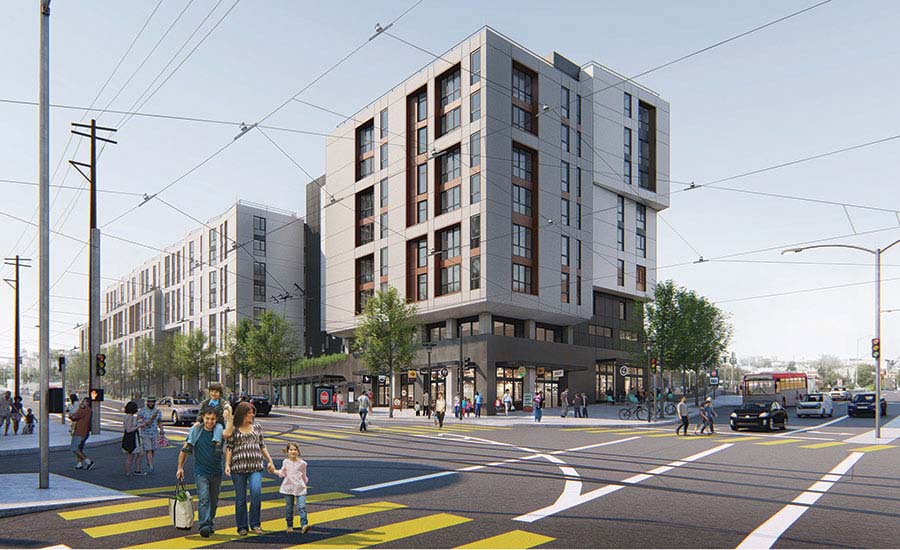
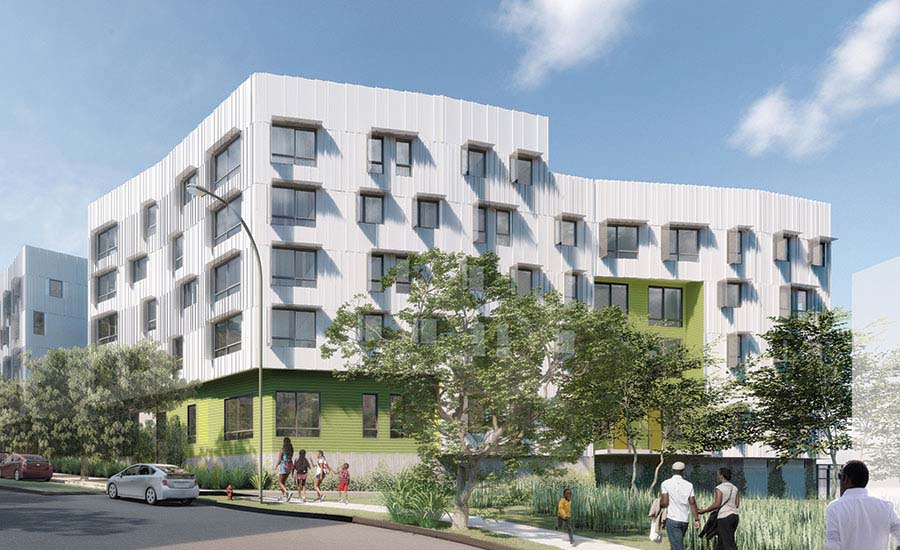
One market where the all-electric typology is taking hold in San Francisco (top) is in affordable housing. Two such projects slated to break ground early next year are a pair of buildings, with a total of 120 apartments, in Hunters View, designed by David Baker Architects (1) and the 131-unit Balboa Park Upper Yard, designed by Mithun (2). Images courtesy David Baker Architects (1) ; Mithun (2), click to enlarge.

Anne Torney, a partner at Mithun, says a sticking point for the all-electric concept is in market-rate housing, where developers consider high-end gas ranges a selling point. “Affordable-housing nonprofits think about community benefits and public policy goals more broadly, and they don’t need to worry about marketability,” she says. Her firm has several affordable all-electric multifamily projects under way, including the 131-unit Balboa Park Upper Yard, expected to break ground early next year.

Moving all-electric new construction forward is the easy part, says Hooper. “The tougher question is, ‘What do we do with our existing buildings?’ ” How best to wean all of the city’s building stock off gas will be addressed in a zero emissions “road map” to be released in November. It has been informed by a task force that includes design professionals, developers, utilities, and community members. Hooper acknowledges that implementing these policy recommendations will require time and investment from both the public and private sectors. But, he warns, “the cost of inaction will be greater.”

Back to Continuing Education: Cities' Carbon Policy

Looking for quick answers on architecture and design topics?
Try Ask RECORD, our new smart AI search tool.
Ask RECORD →

KEYWORDS: embodied energy San Francisco

Share This Story

Looking for a reprint of this article?
From high-res PDFs to custom plaques, order your copy today!

Joann gonchar

Joann Gonchar, FAIA, LEED AP, is deputy editor at Architectural Record. She joined RECORD in 2006, after working for eight years at its sister publication, Engineering News-Record. Before starting her career as a journalist, Joann worked for several architecture firms and spent three years in Kobe, Japan, with the firm Team Zoo, Atelier Iruka. She earned a Master of Architecture degree from the University of Pennsylvania and a Bachelor of Arts from Brown University. She is licensed to practice architecture in New York State.

Post a comment to this article

Report Abusive Comment

Subscription Center
  • Create an Account
  • Start a Subscription
  • Manage My Account
  • Sign Up for Newsletters
  • Visit Customer Service
  • Update Preferences

More Videos

Sponsored Content

Sponsored Content is a special paid section where industry companies provide high quality, objective, non-commercial content around topics of interest to the Architectural Record audience. All Sponsored Content is supplied by the advertising company and any opinions expressed in this article are those of the author and not necessarily reflect the views of Architectural Record or its parent company, BNP Media. Interested in participating in our Sponsored Content section? Contact your local rep!

close
  • TAMLYN XtremeTrim Exterior Trim
    Sponsored byTamlyn

    Designing Cleaner Panel Facades: Why Exterior Trim Details Matter

  • Building with Vapor Barriers
    Sponsored byReef Industries, Inc.

    Vapor Barriers Help Control Moisture in Tighter Building Designs

  • Duct Interior with Prodeq System
    Sponsored byHenry, a Carlisle Company

    Designing Resilient Water Containment Systems

DESIGN:ED Podcast
Listen to Architectural Record’s DESIGN:ED Podcast

Events

June 16, 2026

Focus on the Façade: Exploring Steel, Timber & Fire-Rated Curtain Walls and Channel Glass Systems

Credits: 1 AIA LU/HSW; 1 AIBD P-CE; 0.1 ICC CEU

Explore modern façade and glazing systems that enhance daylighting, fire safety, and thermal performance while expanding architectural design possibilities.

June 18, 2026

Rebooting the Aging Office Building

Credits: 1 AIA LU/HSW; 1 AIBD P-CE; 0.1 ICC CEU; 1 PDH

Explore façade retrofit strategies and award-winning design concepts that can transform aging office buildings into healthier, higher-performing workplaces for today’s hybrid workforce.

View All Submit An Event

Products

2026 Architect's Square Foot Costbook

2026 Architect's Square Foot Costbook

See More Products

Popular Stories

Coronado Bridge

The Architect’s Guide to San Diego

SanDiegoAirport

Top 300 Architecture Firms of 2026

Crane Cove, ONO

Design Vanguard 2026 Winners

House on a Hill

Design Vanguard 2026: Forma

House A on a Hill

Design Vanguard 2026: Santiago Valdivieso

Focus on the Facade - Free Webinar - June 16, 2026

Related Articles

  • Canada’s Earth Tower

    Think Global, Act Local: Vancouver's Carbon Policy

    See More
  • A five-story condo building in Brooklyn by ZH Architects.

    Think Global, Act Local: New York's Carbon Policy

    See More
  • Mori Buildings’ Toranomon Hills.

    Think Global, Act Local: Tokyo's Carbon Policy

    See More

Related Products

See More Products
  • AR June 2026 Issue

    Architectural Record June 2026 Issue

See More Products
×

The latest news and information

#1 Source for Architectural Design, News and Products

SUBSCRIBE
  • RESOURCES
    • Advertise
    • Contact Us
    • Submit
    • Store
  • ACCOUNT CENTER
    • Create an Account
    • Start a Subscription
    • Manage My Account
    • Sign Up for Newsletters
    • Visit Customer Service
    • Update Preferences
  • PRIVACY
    • PRIVACY POLICY
    • TERMS & CONDITIONS
    • DO NOT SELL MY PERSONAL INFORMATION
    • PRIVACY REQUEST
    • ACCESSIBILITY
  • SERVICES
    • Marketing Services
    • Reprints
    • Market Research
    • List Rental
    • Survey/Respondent Access
  • STAY CONNECTED
    • Linkedin
    • Facebook
    • Instagram
    • YouTube
    • X (Twitter)

Copyright ©2026. All Rights Reserved BNP Media, Inc. and BNP Media II, LLC.

Design, CMS, Hosting & Web Development :: ePublishing