Architectural Record
search
cart
facebook twitter linkedin youtube
  • Sign In
  • Subscribe
  • Sign Out
  • My Account
Architectural Record
  • NEWS
    • Latest News
    • Awards
    • Interviews
    • Obituaries
    • Podcasts
      • Design:Ed Podcast
      • Sponsored Podcasts
  • OPINION
    • Book Reviews / Excerpts
    • Exhibition Reviews
    • Forum
  • EXCLUSIVES
    • Videos
    • Design Vanguard
    • Top 300 Firms
    • Sponsored Content
    • Sponsored eBooks
    • From the Archives
  • CONTINUING ED
    • Editorial Continuing Ed
    • CE Center
    • CE Academies
  • PROJECTS
    • Buildings By Type
    • Reuse & Renovation
    • Museums & Arts Centers
    • Colleges & Universities
    • Multifamily Housing
    • Interiors
    • Lighting
    • Kitchen & Bath
  • HOUSES
    • Record Houses
    • House of the Month
    • Featured Houses
  • PRODUCTS
    • Products by Category
    • Record Products of the Year
    • Latest Products
  • EVENTS
    • Dates & Events
    • Record on the Road
    • Innovation Conference
    • Sustainability in Practice
    • Women In Architecture
    • Webinars
    • Ad Excellence Awards
    • Submit an Event
  • CONNECT
    • Ask RECORD AI
    • Newsletters
    • Contact
    • Advertise
    • Editorial Calendar
    • Store
    • Customer Service
  • SUBMIT
    • Submission Guidelines
    • RECORD Competitions
  • MAGAZINE
    • Subscribe
    • My Account
    • Digital Edition
    • Current Issue
    • Firm Pass
    • Historic Archive
Climate Change & SustainabilityArchitect Continuing Education

Think Global, Act Local: Tokyo's Carbon Policy
By Mira Locher , FAIA
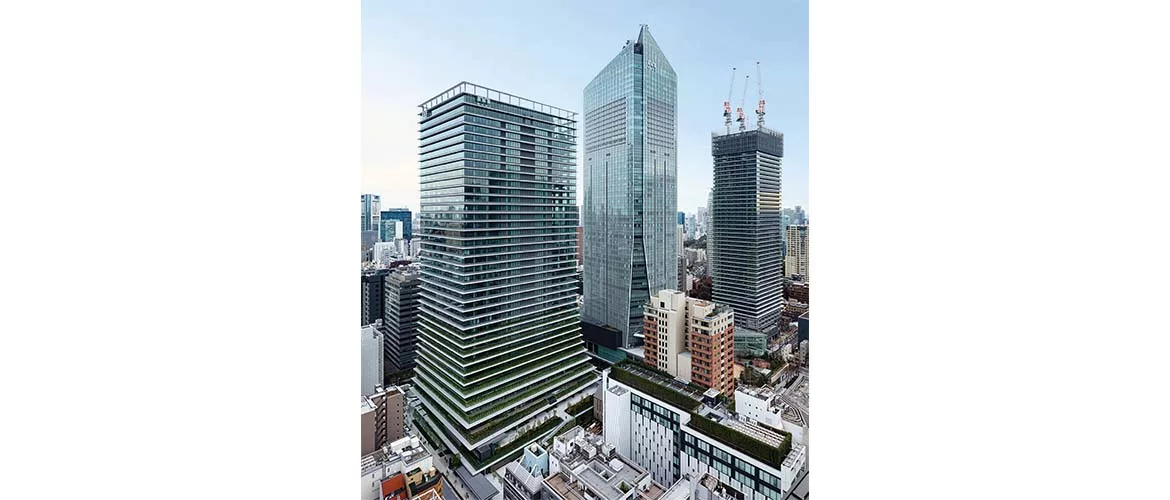
Mori Buildings’ Toranomon Hills.
Mori Buildings’ Toranomon Hills mixed-use complex, with towers by Ingenhoven Architects (at left and at right in photo), Nihon Sekkei (at center), and eventually OMA, depends on high-performance design and 100 percent renewable energy. Photo courtesy of SS Inc.
May 1, 2020

A decade ago, recognizing that commercial and industrial buildings—including its iconic high-rise towers—produced almost half of the city’s total carbon emissions, Tokyo started the world’s first urban carbon cap-and-trade initiative. The mandatory program aims to reduce CO2 emissions by 30 percent and energy consumption by 38 percent, compared to 2000 levels, in 1,400 of the city’s largest carbon emitters. Although the facilities covered by the program represent just 2 percent of the total number of Tokyo’s commercial buildings, they account for nearly 19 percent of emissions, making the policy “effective and powerful,” says Satoshi Chida, Tokyo Cap-and-Trade Program (TCaTP) director, and a critical element in the city’s plan for achieving zero emissions by 2050.

Implemented in five-year phases, the TCaTP places increasingly stringent limits on emissions, while also creating a framework for trading carbon credits. Facilities with reductions in excess of the required caps receive credits, which can be banked for future use or sold to facilities with deficient reductions. To further incentivize high-performance building design, Tokyo annually recognizes “top level” and “near top level” facilities and awards them, in recognition of their early actions, a relaxation of the caps in future phases.

READ MORE ABOUT

• Climate Change

• Sustainable Architecture

• Green Building

Tokyo clients and architects are responding to the city’s increased emphasis on energy efficiency through state-of-the-art facilities and innovative building-management schemes. Mori Buildings, one of Japan’s largest developers, is promoting high-performance design and the use of 100 percent renewable energy throughout Toranomon Hills, a mixed-use complex rising in central Tokyo. The first building, the 2014 Toranomon Hills Mori Tower, designed by Nihon Sekkei, was certified as a top-level facility in 2018. Two subsequent structures, by Düsseldorf-based Ingenhoven Architects, are a just-finished office tower and a residential high-rise slated for completion early next year. Both are expected to achieve top-level status. With features such as planted outdoor ledges, high-performance glazing, photovoltaics, and advanced lighting and mechanical systems, firm founder Christoph Ingehoven hopes his designs “will influence the way Tokyo develops over the next 20 years, with more planted facades, more public green space, and high levels of sustainable-building certifications.” The complex’s final building, the Toranomon Station Tower, OMA’s first high-rise in Tokyo, recently broke ground and also is targeting significant reductions in energy consumption and CO2 emissions.

The program has been achieving better than expected reductions. The goal for the TCaTP’s initial phase (2010–14) was a 6–8 percent reduction from base year CO2 emissions, followed by a second phase (2015–19) goal of 15–17 percent. But the results showed a 25 percent decrease by 2014 and a 27 percent reduction by 2018.

Initial reductions were achieved in part due to stringent energy-use restrictions in the aftermath of the 2011 Fukushima nuclear power plant accident, but also through improved operations, changes to building systems and equipment, and modified tenant behavior. Chida notes that the program has made the city’s buildings more resilient. Since owners and tenants already had begun to take action to reduce energy use to comply with TCaTP, they were better prepared for the restrictions that followed the nuclear plant’s shutdown, he says. Once restrictions were lifted, reductions were still achieved, even though Japan became more reliant on carbon-intensive electricity sources, depending on imported oil, natural gas, and coal.

So far, the cuts have been brought about mainly through decreased consumption, or meeting the “caps.” Chida predicts that the “trade” part of the program will see more use in phases three and four, which each mandate an additional 10 percent reduction, as it will be increasingly difficult for existing facilities to meet these progressively stringent targets.

The trading of credits will also come into play for the 2020 Tokyo Olympic/Paralympic Games, now postponed until summer 2021. The Tokyo Metropolitan Government developed a separate Sustainability Plan for the renovated and newly constructed sports venues and is working to secure donations of credits from TCaTP to offset the Games’ emissions. After the Games, large-scale Olympic/Paralympic facilities will come under the cap-and-trade program.

Back to Continuing Education: Cities' Carbon Policy

Looking for quick answers on architecture and design topics?
Try Ask RECORD, our new smart AI search tool.
Ask RECORD →

KEYWORDS: embodied energy Tokyo

Share This Story

Looking for a reprint of this article?
From high-res PDFs to custom plaques, order your copy today!


An educator, author, and architect working in the U.S. and Japan, Mira Locher, FAIA, teaches at the University of Utah and is a partner in Kajika Architecture.

Post a comment to this article

Report Abusive Comment

Subscription Center
  • Create an Account
  • Start a Subscription
  • Manage My Account
  • Sign Up for Newsletters
  • Visit Customer Service
  • Update Preferences

More Videos

Sponsored Content

Sponsored Content is a special paid section where industry companies provide high quality, objective, non-commercial content around topics of interest to the Architectural Record audience. All Sponsored Content is supplied by the advertising company and any opinions expressed in this article are those of the author and not necessarily reflect the views of Architectural Record or its parent company, BNP Media. Interested in participating in our Sponsored Content section? Contact your local rep!

close
  • TAMLYN XtremeTrim Exterior Trim
    Sponsored byTamlyn

    Designing Cleaner Panel Facades: Why Exterior Trim Details Matter

  • Building with Vapor Barriers
    Sponsored byReef Industries, Inc.

    Vapor Barriers Help Control Moisture in Tighter Building Designs

  • Duct Interior with Prodeq System
    Sponsored byHenry, a Carlisle Company

    Designing Resilient Water Containment Systems

DESIGN:ED Podcast
Listen to Architectural Record’s DESIGN:ED Podcast

Events

June 10, 2026

Rethinking Stormwater – The Power of Porous Paving

Credits: 1 AIA LU/HSW; 1 AIBD P-CE; 0.1 ICC CEU

Learn how porous paving systems support stormwater management, reduce heat island effects, and enhance sustainable site design performance.

June 11, 2026

Very Early Warning Fire Detection for Mission-Critical Facilities

Credits: 1 AIA LU/HSW; 1 AIBD P-CE; 0.1 ICC CEU

Examine advanced fire detection strategies that support uptime and enhance safety in data centers and other mission-critical facilities.

View All Submit An Event

Products

2026 Architect's Square Foot Costbook

2026 Architect's Square Foot Costbook

See More Products

Popular Stories

Coronado Bridge

The Architect’s Guide to San Diego

Practice Matters illustration

What’s in a (Firm’s) Name? Thinking About Succession and Legacy

Practice Matters illustration

By the Numbers: Counting America's Architects

Inward House

Inward House by VeeV Design Studio

Riverdale House by Studio Lau

Riverdale House by Studio Lau

Broader Sustainability of CMU - Free Webinar - May 21, 2026

Related Articles

  • A five-story condo building in Brooklyn by ZH Architects.

    Think Global, Act Local: New York's Carbon Policy

    See More
  • Canada’s Earth Tower

    Think Global, Act Local: Vancouver's Carbon Policy

    See More
  • Stockholm.

    Think Global, Act Local: Stockholm's Carbon Policy

    See More

Events

View AllSubmit An Event
  • April 22, 2026

    One Foot In, One Foot Out—The Balancing Act of Teaching and Practicing Architecture

    NOW ON DEMANDCredits: 1 AIA LU/Elective; 1 AIBD P-CE;  0.1 ICC CEU; 0.1 IACET CEUJoin Architectural Record for a discussion with three leading firms on the future of the academic–practice hybrid model and its impact on the next generation of architects.
View AllSubmit An Event
×

The latest news and information

#1 Source for Architectural Design, News and Products

SUBSCRIBE
  • RESOURCES
    • Advertise
    • Contact Us
    • Submit
    • Store
  • ACCOUNT CENTER
    • Create an Account
    • Start a Subscription
    • Manage My Account
    • Sign Up for Newsletters
    • Visit Customer Service
    • Update Preferences
  • PRIVACY
    • PRIVACY POLICY
    • TERMS & CONDITIONS
    • DO NOT SELL MY PERSONAL INFORMATION
    • PRIVACY REQUEST
    • ACCESSIBILITY
  • SERVICES
    • Marketing Services
    • Reprints
    • Market Research
    • List Rental
    • Survey/Respondent Access
  • STAY CONNECTED
    • Linkedin
    • Facebook
    • Instagram
    • YouTube
    • X (Twitter)

Copyright ©2026. All Rights Reserved BNP Media, Inc. and BNP Media II, LLC.

Design, CMS, Hosting & Web Development :: ePublishing