Architectural Record
search
cart
facebook twitter linkedin youtube
  • Sign In
  • Subscribe
  • Sign Out
  • My Account
Architectural Record
  • NEWS
    • Latest News
    • Awards
    • Interviews
    • Obituaries
    • Podcasts
      • Design:Ed Podcast
      • Sponsored Podcasts
  • OPINION
    • Book Reviews / Excerpts
    • Exhibition Reviews
    • Forum
  • EXCLUSIVES
    • Videos
    • Design Vanguard
    • Top 300 Firms
    • Sponsored Content
    • Sponsored eBooks
    • From the Archives
  • CONTINUING ED
    • Editorial Continuing Ed
    • CE Center
    • CE Academies
  • PROJECTS
    • Buildings By Type
    • Reuse & Renovation
    • Museums & Arts Centers
    • Colleges & Universities
    • Multifamily Housing
    • Interiors
    • Lighting
    • Kitchen & Bath
  • HOUSES
    • Record Houses
    • House of the Month
    • Featured Houses
  • PRODUCTS
    • Products by Category
    • Record Products of the Year
    • Latest Products
  • EVENTS
    • Dates & Events
    • Record on the Road
    • Innovation Conference
    • Sustainability in Practice
    • Women In Architecture
    • Webinars
    • Ad Excellence Awards
    • Submit an Event
  • CONNECT
    • Ask RECORD AI
    • Newsletters
    • Contact
    • Advertise
    • Editorial Calendar
    • Store
    • Customer Service
  • SUBMIT
    • Submission Guidelines
    • RECORD Competitions
  • MAGAZINE
    • Subscribe
    • My Account
    • Digital Edition
    • Current Issue
    • Firm Pass
    • Historic Archive
Climate Change & SustainabilityArchitect Continuing Education

Think Global, Act Local: Vancouver's Carbon Policy
By Katharine Logan
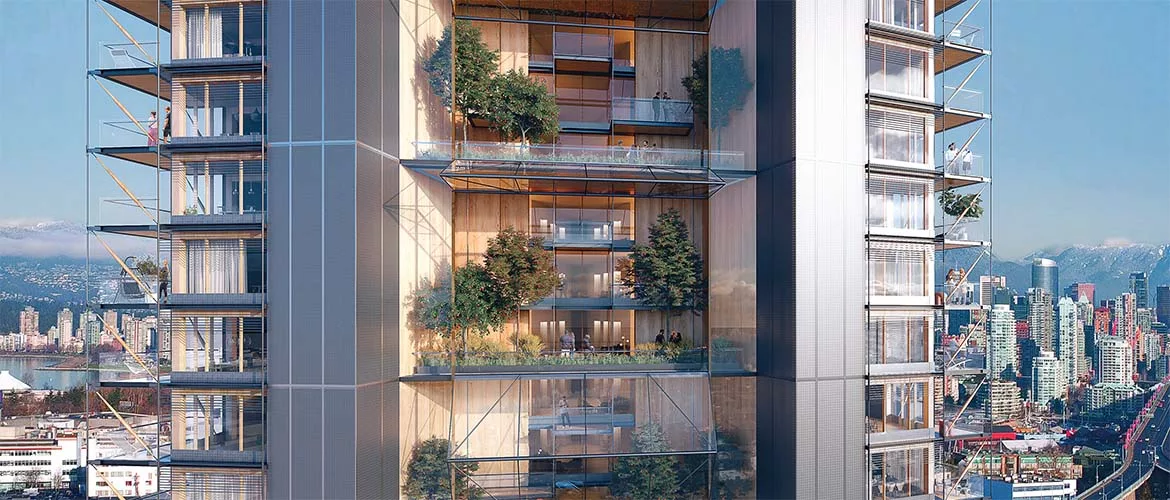
Canada’s Earth Tower

Canada’s Earth Tower, currently in design by the Vancouver office of Perkins and Will, aims to be, at 40 stories, the world’s tallest hybrid mass timber structure. Images Courtesy of Perkins and Will

May 1, 2020

Like other cities with strong commitments to combating climate change, Vancouver, Canada, is targeting citywide carbon neutrality by 2050. Because half of the metropolis’s existing building stock is expected to have been replaced by then, emissions limits apply to new construction first. “Everything that’s not a solution today becomes a problem later,” says Doug Smith, sustainability director at the City of Vancouver.

Within the overall 2050 limit, the municipality’s Zero Emissions Buildings Plan (2016)  establishes a finely sliced series of deadlines reflecting the degree of challenge faced by various building types. Commercial and residential projects have the lowest hurdle in reducing emissions, with plenty of successful precedents. As of 2025, zero emissions buildings—those that are highly efficient and meet their energy needs from renewable sources—will be the only new construction permitted in these two categories. More specialized buildings, such as schools, hospitals, and industrial facilities, will have a little longer to achieve the target—until 2030. “It’s important to set those limits far in advance so that industry understands what they are and when they’re coming,” says Smith, “so there are no surprises.” To date, emissions from new buildings in the city have dropped by 43 percent compared to a 2007 benchmark.

READ MORE ABOUT

• Climate Change

• Sustainable Architecture

• Green Building

In addition to regulating, the municipal government is also leading by example. As Vancouver’s single biggest landlord, with a portfolio of over 600 buildings, the city began imposing a zero-emissions requirement on its own new construction—including libraries, fire stations, community centers, and police stations—two years ago, and is now working to bring its existing buildings to zero emissions before 2040.

For all other existing buildings, the city is developing a plan in consultation with residents and industry for a target deadline of zero emissions by 2045. Achieving zero emissions presents a bigger challenge for older buildings—and a more delicate one, says Smith. “You don’t want to create an equity issue where wealthier homeowners can afford to meet the new standards, and people just getting by can’t.”  The initial approach will focus on raising awareness of emissions levels through reporting on energy consumption and encouraging the integration of reduction measures into scheduled maintenance and replacements. “Our strategy for the next three or four years is to start educating existing building owners,” says Smith. The plan is expected to go before council in October this year.

As well as setting limits, providing leadership, and catalyzing change (with available tools such as regulations, funding, and density incentives), Vancouver sees education as critical. “Everything we’re doing now, we’ve never done before,” says Smith, “so we need to work with industry, to help them reduce their learning curve.” The municipality subsidizes training for trades in the techniques of zero-emissions construction, such as tight building envelopes and blower door testing. It has also instituted a Zero Emissions Building Exchange (ZEBx), which pays the developers of cutting-edge projects to hire technical and engineering students to document the process, including notes, photography, videos, and site tours, all concluding with a published report of successes and lessons learned. “The role of ZEBx is to bring together members of what’s otherwise a very competitive industry,” says Smith, “and have them learn from each other.”

As of this past February, zero-emissions projects in the city’s pipeline included 344,000 square feet approved for building permits, 909,000 square feet approved for rezoning or development, and 3.91 million square feet in inquiries and applications. Most of these projects are designed to the Passive House standard, with the remainder designed to the net zero criteria of such programs as the Living Building Challenge and Natural Resources Canada’s R-2000.
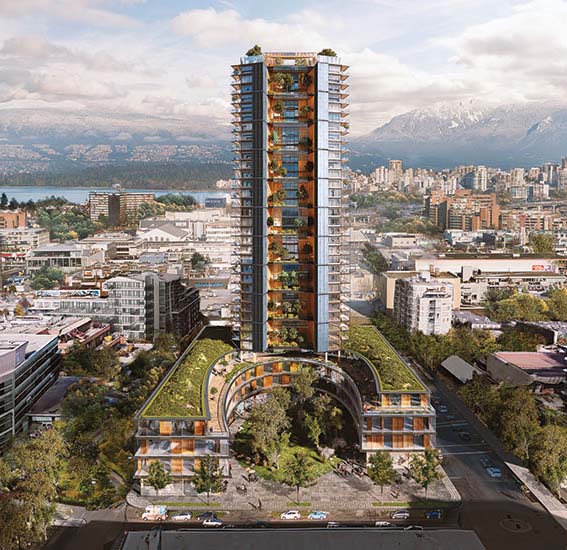
Canada's Earth Tower's podium.
1
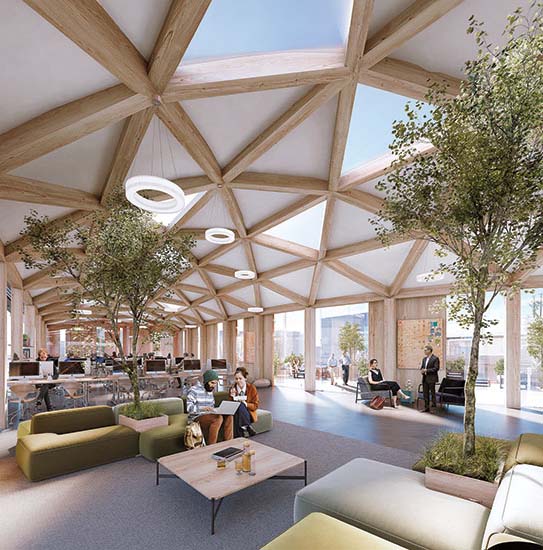
Canada's Earth Tower's coworking space.
2

Canada’s Earth Tower, which rises from a U-shaped podium (1) and includes coworking space (2) and 200 apartments, has such features as multistory winter gardens (top). The project is targeting Passive House certification and is helping inform the development of the Canada Green Building Council’s forthcoming Zero Carbon Building Standard. Images Courtesy of Perkins and Will, click to enlarge.

As an example of the type of project waiting in the wings, a 40-story hybrid mass-timber tower now in design at the local office of Perkins and Will is helping to inform the development of the Canada Green Building Council’s forthcoming Zero Carbon Building Standard. In addition to its zero-emissions operation, Canada’s Earth Tower, as the planned mixed-use building is called, will sequester carbon in its wood structure. “Timber buildings built to the Passive House standard are absolutely what we all should be doing to address climate change,” says Derek Newby, a Perkins and Will associate principal. With a growing number of built examples in Vancouver and worldwide, he says, “both strategies are well understood and achievable now.”

Back to Continuing Education: Cities' Carbon Policy

Looking for quick answers on architecture and design topics?
Try Ask RECORD, our new smart AI search tool.
Ask RECORD →

KEYWORDS: embodied energy Vancouver

Share This Story

Looking for a reprint of this article?
From high-res PDFs to custom plaques, order your copy today!

Katharine Logan is an architectural designer and a writer focusing on design, sustainability, and well-being.

Post a comment to this article

Report Abusive Comment

Subscription Center
  • Create an Account
  • Start a Subscription
  • Manage My Account
  • Sign Up for Newsletters
  • Visit Customer Service
  • Update Preferences

More Videos

Sponsored Content

Sponsored Content is a special paid section where industry companies provide high quality, objective, non-commercial content around topics of interest to the Architectural Record audience. All Sponsored Content is supplied by the advertising company and any opinions expressed in this article are those of the author and not necessarily reflect the views of Architectural Record or its parent company, BNP Media. Interested in participating in our Sponsored Content section? Contact your local rep!

close
  • TAMLYN XtremeTrim Exterior Trim
    Sponsored byTamlyn

    Designing Cleaner Panel Facades: Why Exterior Trim Details Matter

  • Building with Vapor Barriers
    Sponsored byReef Industries, Inc.

    Vapor Barriers Help Control Moisture in Tighter Building Designs

  • Duct Interior with Prodeq System
    Sponsored byHenry, a Carlisle Company

    Designing Resilient Water Containment Systems

DESIGN:ED Podcast
Listen to Architectural Record’s DESIGN:ED Podcast

Events

June 10, 2026

Rethinking Stormwater – The Power of Porous Paving

Credits: 1 AIA LU/HSW; 1 AIBD P-CE; 0.1 ICC CEU

Learn how porous paving systems support stormwater management, reduce heat island effects, and enhance sustainable site design performance.

June 11, 2026

Very Early Warning Fire Detection for Mission-Critical Facilities

Credits: 1 AIA LU/HSW; 1 AIBD P-CE; 0.1 ICC CEU

Examine advanced fire detection strategies that support uptime and enhance safety in data centers and other mission-critical facilities.

View All Submit An Event

Products

2026 Architect's Square Foot Costbook

2026 Architect's Square Foot Costbook

See More Products

Popular Stories

Coronado Bridge

The Architect’s Guide to San Diego

Practice Matters illustration

What’s in a (Firm’s) Name? Thinking About Succession and Legacy

Practice Matters illustration

By the Numbers: Counting America's Architects

Inward House

Inward House by VeeV Design Studio

Riverdale House by Studio Lau

Riverdale House by Studio Lau

Broader Sustainability of CMU - Free Webinar - May 21, 2026

Related Articles

  • Stockholm.

    Think Global, Act Local: Stockholm's Carbon Policy

    See More
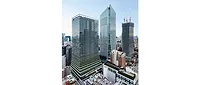
  • Mori Buildings’ Toranomon Hills.

    Think Global, Act Local: Tokyo's Carbon Policy

    See More
  • A five-story condo building in Brooklyn by ZH Architects.

    Think Global, Act Local: New York's Carbon Policy

    See More

Related Products

See More Products
  • Architectural Record - September 2025

    Architectural Record September 2025 Issue

See More Products

Events

View AllSubmit An Event
  • April 22, 2026

    One Foot In, One Foot Out—The Balancing Act of Teaching and Practicing Architecture

    NOW ON DEMANDCredits: 1 AIA LU/Elective; 1 AIBD P-CE;  0.1 ICC CEU; 0.1 IACET CEUJoin Architectural Record for a discussion with three leading firms on the future of the academic–practice hybrid model and its impact on the next generation of architects.
View AllSubmit An Event
×

The latest news and information

#1 Source for Architectural Design, News and Products

SUBSCRIBE
  • RESOURCES
    • Advertise
    • Contact Us
    • Submit
    • Store
  • ACCOUNT CENTER
    • Create an Account
    • Start a Subscription
    • Manage My Account
    • Sign Up for Newsletters
    • Visit Customer Service
    • Update Preferences
  • PRIVACY
    • PRIVACY POLICY
    • TERMS & CONDITIONS
    • DO NOT SELL MY PERSONAL INFORMATION
    • PRIVACY REQUEST
    • ACCESSIBILITY
  • SERVICES
    • Marketing Services
    • Reprints
    • Market Research
    • List Rental
    • Survey/Respondent Access
  • STAY CONNECTED
    • Linkedin
    • Facebook
    • Instagram
    • YouTube
    • X (Twitter)

Copyright ©2026. All Rights Reserved BNP Media, Inc. and BNP Media II, LLC.

Design, CMS, Hosting & Web Development :: ePublishing