Bay Window Tower House by Takaaki Fuji + Yuko Fuji Architecture
Tokyo

Adjacent to the glazed front door of the Bay Window Tower House is a very small parking spot, which helps to open the public pathway. Photo © Masao Nishikawa
Architects & Firms
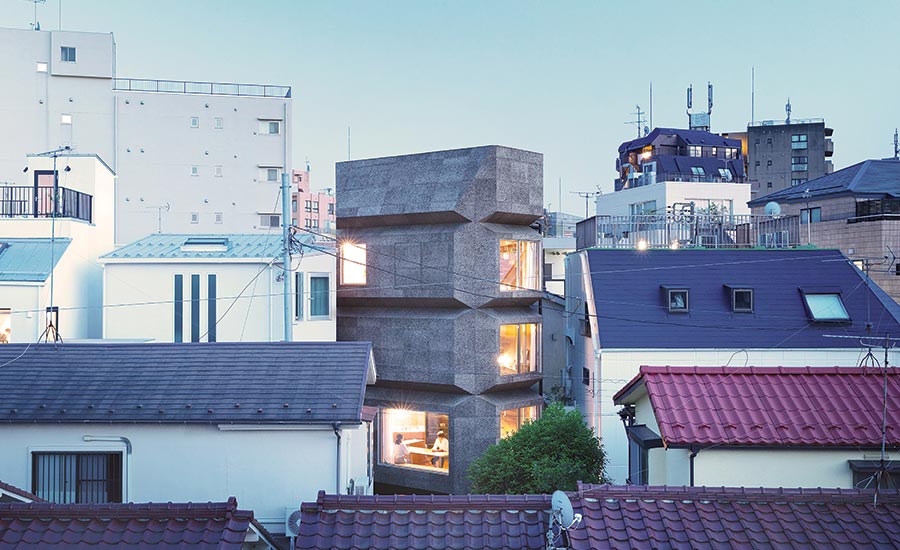
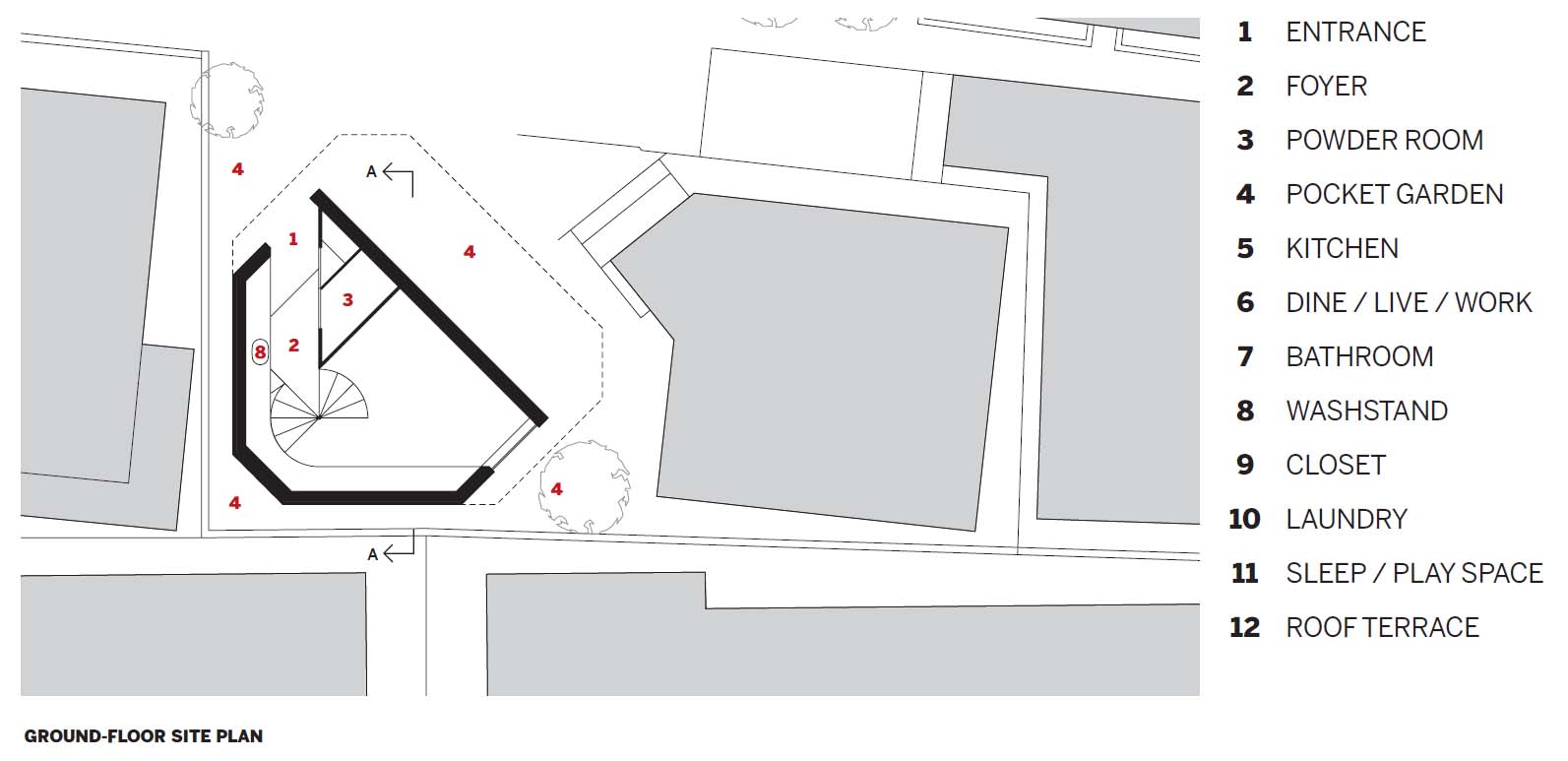
Historically, solid walls that simply shut out the surroundings were a common coping mechanism for building on tight and unpredictable sites in Japan. But, nowadays, a number of designers are much more willing to connect their works to proximate buildings and urban-planning quirks. Breaking rank with the boxy dwellings dotting their central-Tokyo neighborhood, architects Takaaki and Yuko Fuji created a cork-clad octagonal house with triangular pocket gardens that insert much needed breathing room into the congested urban fabric. By prioritizing the siting of their building as well as its volume, the architects realized their dream home and became good neighbors too.
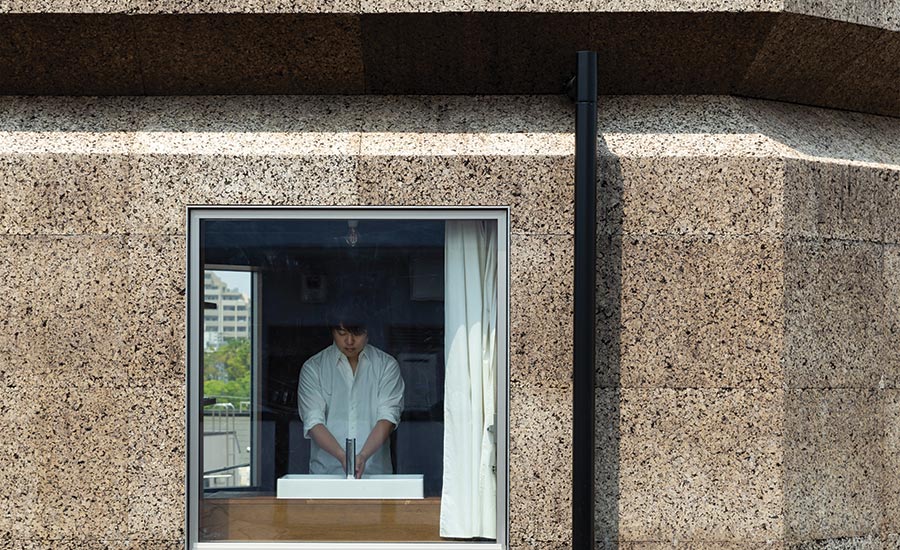
On the fourth floor, a picture window frames a wash basin. Photo © Masao Nishikawa, click to enlarge.
The house’s unusual massing results from an off-the-rack digital-simulation program that enabled the architects to explore possible building shapes and site orientations as well as microclimate conditions. Unsurprisingly, their 474-square-foot parcel, a subdivision of a larger plot that previously held a two-story apartment building, came saddled with challenging size restrictions and setback requirements. In addition to maximizing their space, the designers wanted to reduce their dependence on mechanical climate control and minimize the impact on the houses surrounding the site on three sides. Since lots in Tokyo can be very small, the views, ventilation, and privacy of existing homes are frequent casualties of new construction next door. Positioned at a 45-degree angle in relation to the 7½-foot-wide public pedestrian walkway—the site’s only access—their atypical, eight-sided volume handily achieved these goals.
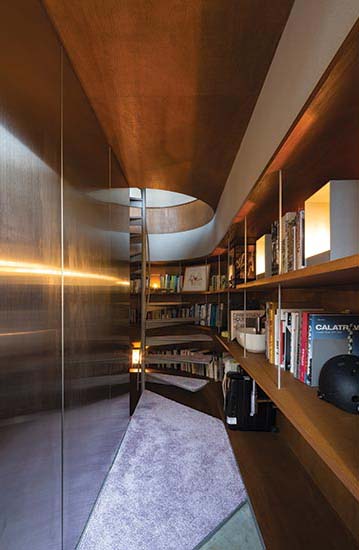
A wall of custom shelving at the entrance is illuminated by portable steel-encased lamps designed by the architects. Stainless steel walls enclose a powder room opposite. Photo © Masao Nishikawa
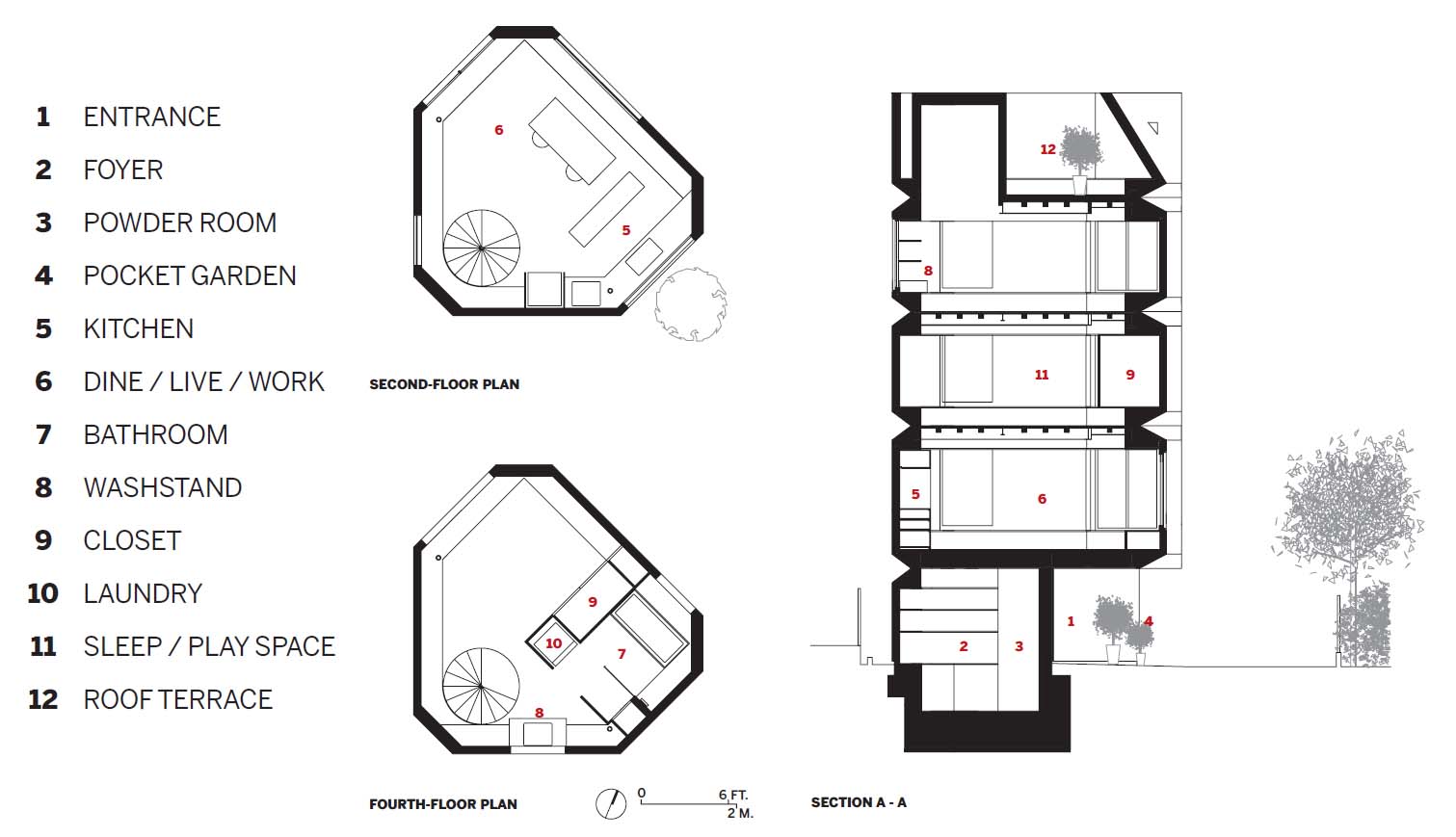
While the architects could have gone with a conventional rectangular footprint, slicing the corners off their allowable building mass also enabled them to swap floor area for additional height. Connected by a spiral stair, the four-stories of the house (plus roof terrace) mainly contain multipurpose spaces—a traditional Japanese planning strategy born anew. The only fixed programmatic areas are a powder room on the ground floor, combined kitchen, dining, and living area on the second floor, and a bathroom on the fourth. Even function-specific furniture is limited. Instead, futons convert the fourth floor into the family’s sleeping area, and a host of built-in elements—such as bookshelves, storage bins, and seating—can accommodate activities as various as writing, eating, playing, and designing buildings for their joint practice. (In addition, Yuko and Takaaki have day jobs as architects at Taisei Corporation and at Mitsubishi Jisho Sekkei, respectively.) By championing flexibility, the architects aim to avoid the common pitfall of purpose-built rooms falling into eventual obsolescence, while making highly efficient use of every inch in the here and now.
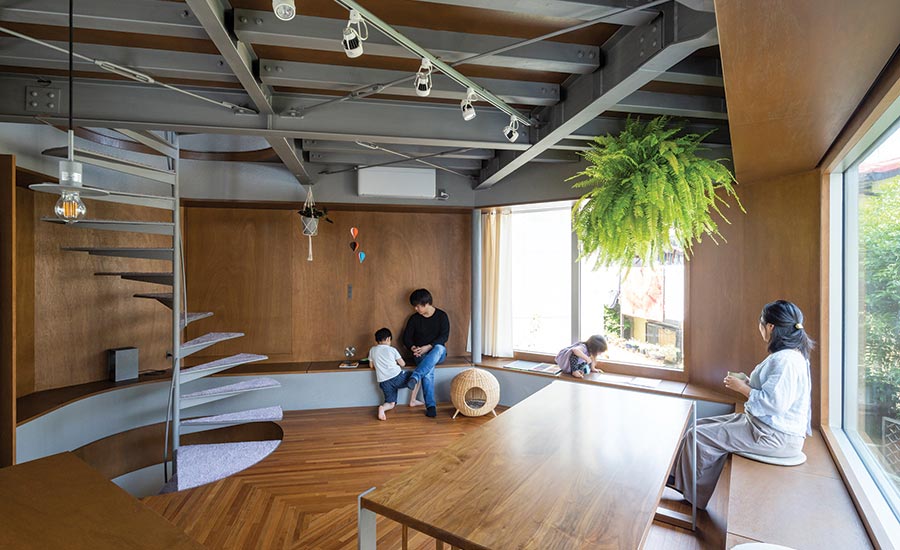
Built-in seating and cabinets minimize furniture needs in the live/work/dine space. Photo © Masao Nishikawa
Another way that the architects enlarged their living area was by treating all eight sides of the building as “bay windows,” which are exempt from floor-area-ratio calculations in Japan. Jutting out 16 inches from the building’s permissible footprint and articulated with angled exterior cuts, the massive, cork-covered planes incorporate both solid and transparent sections to modulate the interior climate and protect privacy. While traditional operable windows admit daylight and air, triple-layered operable panels integrated into the cladding enhance natural ventilation. Made of the same cork, backed by wood and heat-resistant glass (to block unwanted heat), they can be opened to let in fresh air without solar gain. The carefully positioned glazing also “edits” the surroundings while framing a variety of outside scenes, from intimate glimpses of the walkway at grade to sweeping panoramas of the Tokyo cityscape from the fourth floor. “The view outside gives each floor a distinct character,” comments Takaaki Fuji.
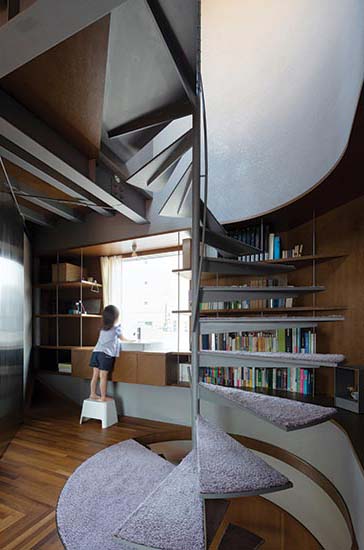
The fourth-floor basin sits outside the bathroom for quick washups. Photo © Masao Nishikawa
According to the architect, the “bay windows” are also key elements of the structural system. Due to the narrow accessway, large machinery, including pile drivers, could not be brought on-site. Instead, construction materials had to be hand carried, and a lightweight steel frame, supported by concrete-mat foundations, was erected. Encased with steel, the bay windows counter horizontal and seismic forces. This reduced the size of loadbearing vertical members, both a weight and space-saving measure. Coated with silver paint dusted with a shimmery powdered mica, the exposed metal frame is a defining feature of the interior, complementing the oil-finished teak flooring and lauan-plywood walls and ceilings.
A roof terrace is concealed by 7-foot-high walls. Photo © Masao Nishikawa
Outside, it is the 2-inch-thick carbonized-cork cladding that accounts for the house’s distinct appearance. A material that first caught Takaaki Fuji’s eye while visiting an Álvaro Siza building, the treated cork is not only sustainable, rot-proof, and lightweight, it is also a good insulator because of its porosity. Though Japan produced the material in the 1950s as refrigerator insulation, before foamboard was invented, cork is no longer domestically available, requiring the architects to import the material from Portugal. Over time, Fuji anticipates that the chocolate brown covering will gracefully go gray. “A house ought to age well,” Fuji explains.
Named for its unique form, the Fujis’ residence seems on a trajectory to do just that. In Japan, few homes last more than 30 years. Due to the architects’ choice of timeless, durable materials, their creation of flexible space, and the building’s thoughtful siting within its context, the Bay Window Tower House ought to well exceed that norm.
Watch the video
Click plan to enlarge
Click plans to enlarge
Credits
Architect:
Takaaki Fuji + Yuko Fuji Architecture
Engineer:
Tomonori Kawata (structural)
Consultants:
Atsushi Mitsui (lighting design); Kensuke Hotta, Akito Hotta, Xiao Yahan (environmental)
Client:
Takaaki and Yuko Fuji
Size:
908 square feet
Completion Date:
February 2020
Sources
Cladding:
carbonized cork
Wood:
teak (flooring); lauan plywood (walls and ceiling)
Looking for quick answers on architecture and design topics?
Try Ask RECORD, our new smart AI search tool.
Ask RECORD →
Looking for a reprint of this article?
From high-res PDFs to custom plaques, order your copy today!