House in Colima by Di Frenna Arquitectos
Mexico
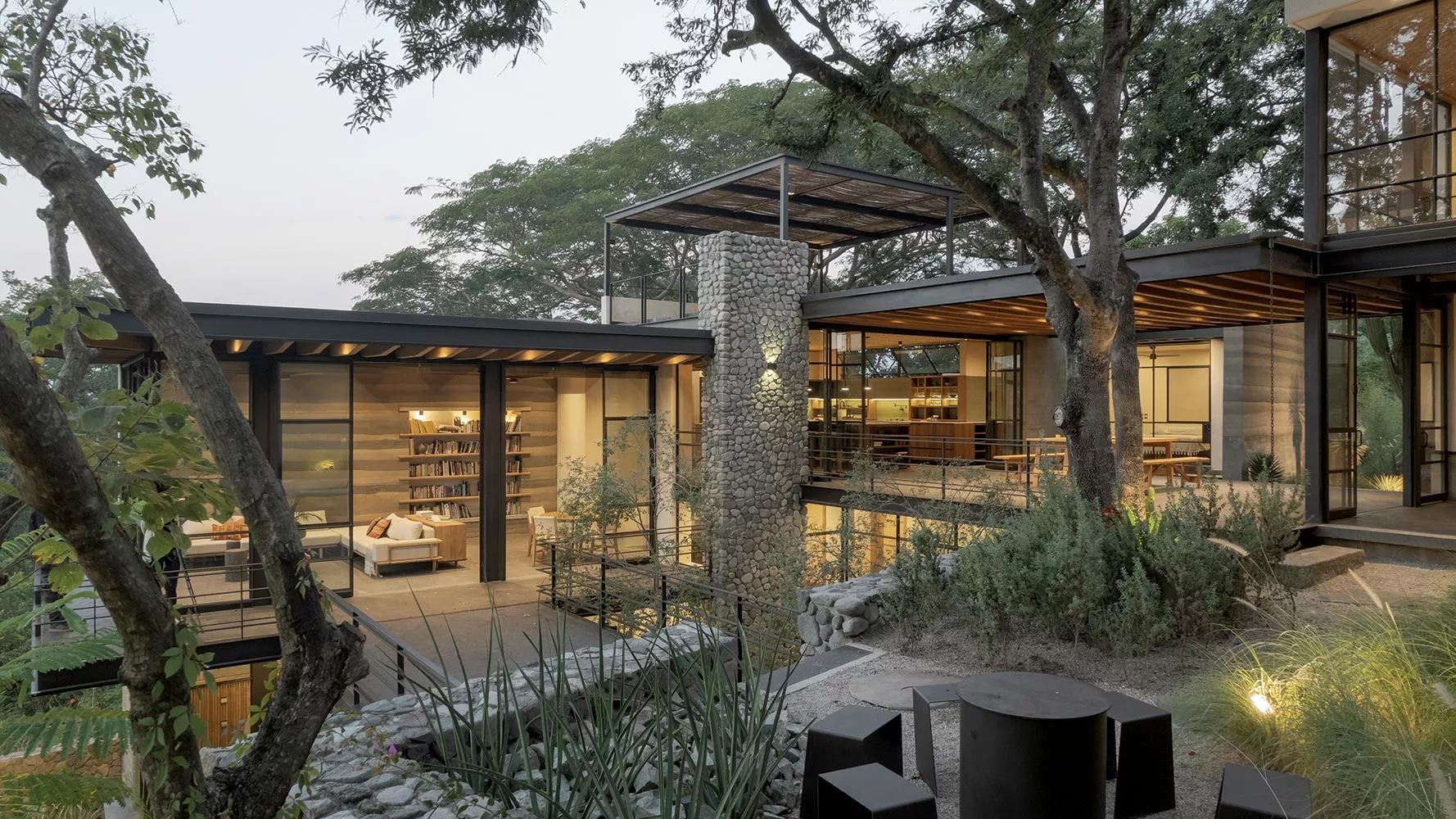
House in Colima. Photo © Lorena Darquea
Architects & Firms
What might a 19th-century German architect teach us about a 21st-century Mexican house? Plenty. Gottfried Semper published The Four Elements of Architecture in 1851, arguing that the first buildings consisted of roofs, which involved carpentry; walls, involving weaving; mounds, involving terracing and masonry; and hearths, involving ceramics. While Semper’s interest in architectural anthropology may seem far removed from contemporary architecture, his ideas help explain what makes this house in Comala, in west-central Mexico, such a compelling residential complex.
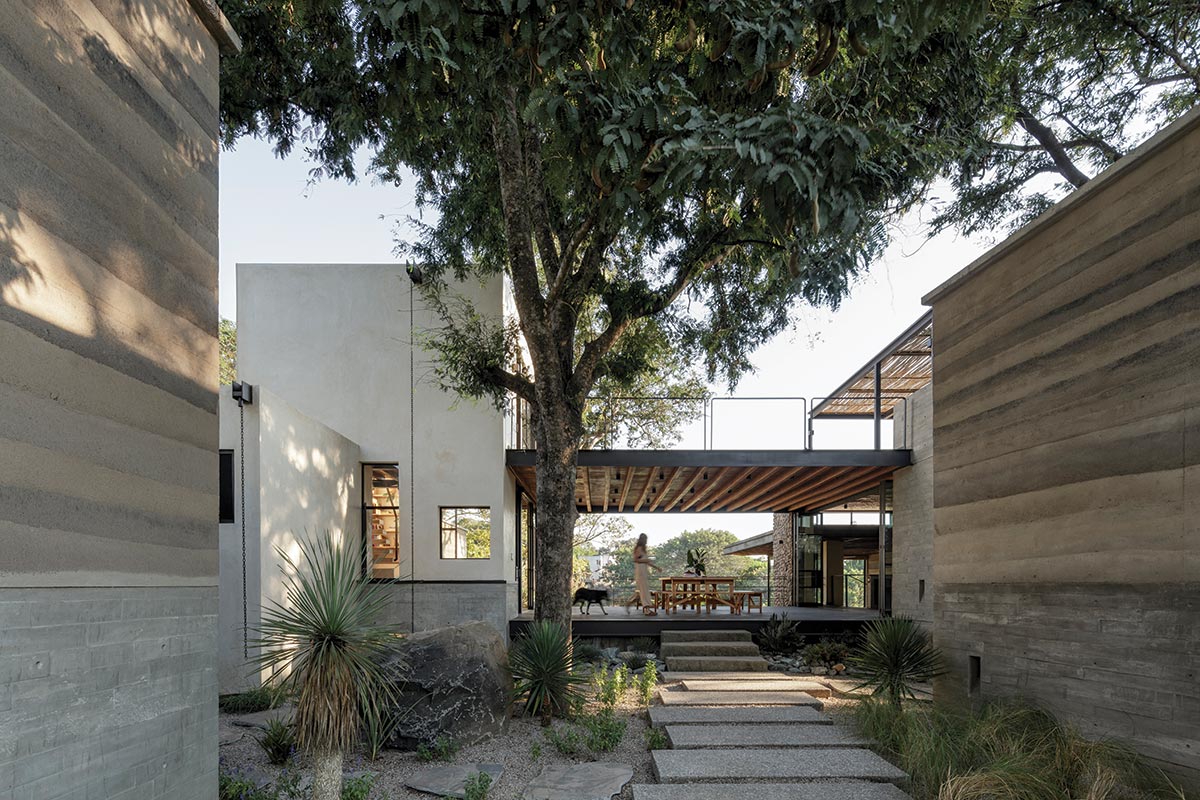
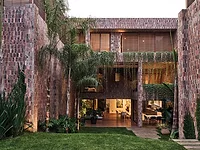
The entry walkway passes beneath tamarind trees and leads to a breezeway (above). A natural material palette evokes the property’s former hacienda (top). Photo © Lorena Darquea, click to enlarge.
Designed by the Mexican architect Matia Di Frenna Müller, the house occupies part of the former hacienda of the late artist and designer Alejandro Rangel Hidalgo, whose nearby home now serves as a museum of pre-Hispanic ceramics. Di Frenna wanted his design to be “in dialogue with the hacienda...as a poetic gesture to honor its location...including the use of rescued techniques and materials that were originally used in the hacienda complex.” Semper would have approved.
Consider Di Frenna’s treatment of the house’s site. The complex stands on a slight rise—a mound, as Semper would say—with a broad stair leading up from two carports to a terrace and small pool, on one side, and a meandering walk, on the other, that winds past a tall organ cactus and mature tamarind trees to the main house. Semper saw elevated mounds as a protective measure for buildings but also a way to delineate our place in the landscape and to create a sense of arrival. These clearly happen here.
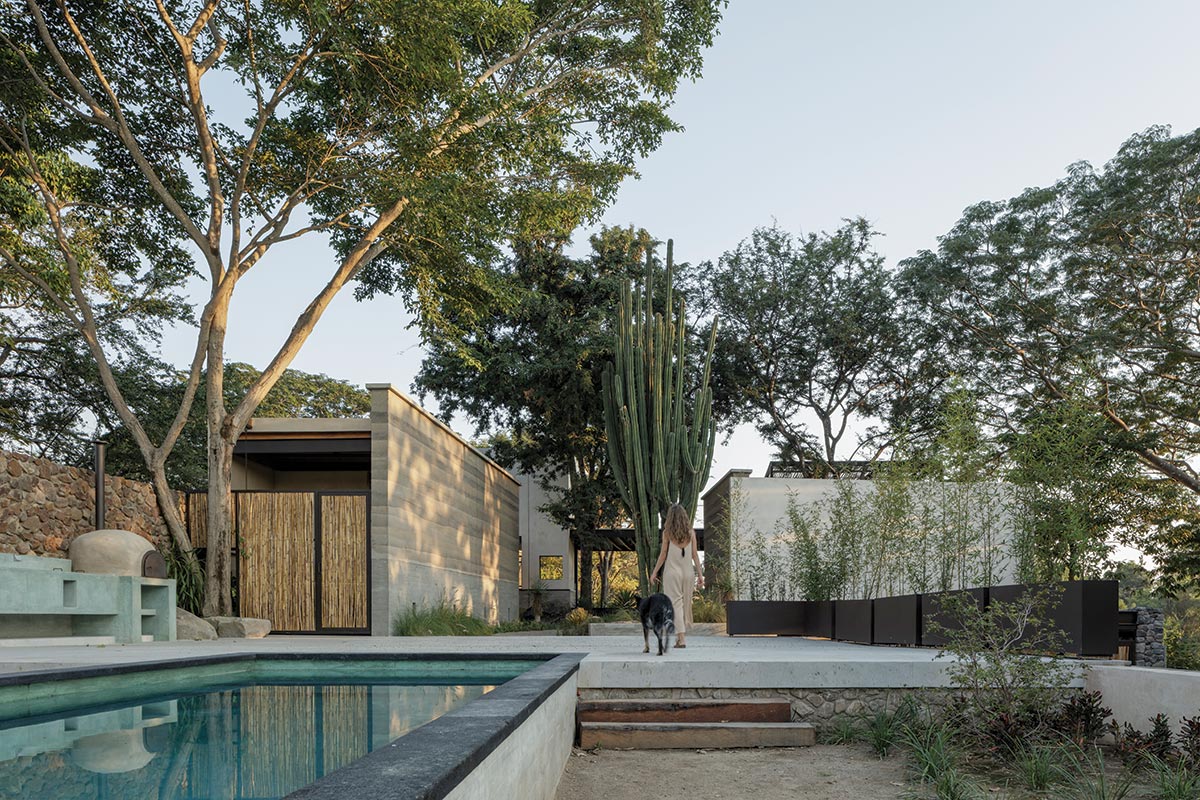
A swimming pool and two guest bungalows flank the arrival terrace. Photo © Lorena Darquea
The owners, one of whom hails from California and the other native to Mexico, moved from an apartment to this house, planning to start a family and “take full advantage of the location of the land and its topography to achieve interesting views and environments that blend with nature,” says Di Frenna. And he achieved that, with the house overlooking a canyon and with traditional rammed-earth walls, “chukum” stucco cladding, and retaining walls and piers clad in rounded stonework, evoking the rocks from the river below.
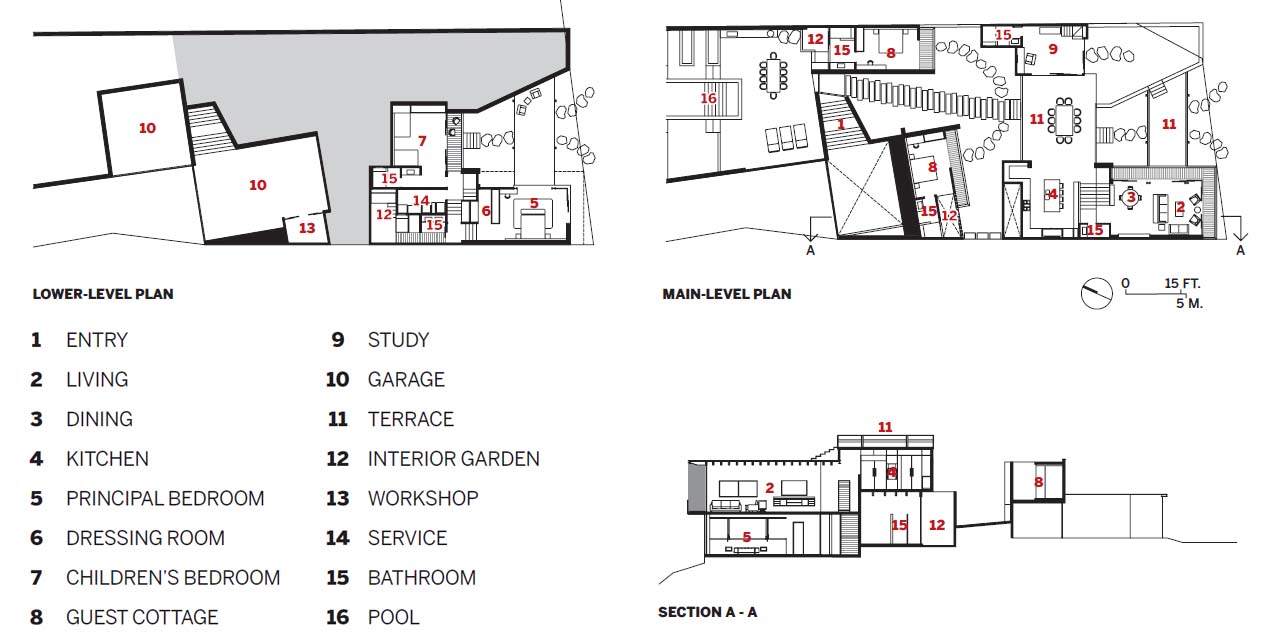
To preserve the site’s tree canopy, Di Frenna “exploded” the plan. Two guest cottages, for visiting family or bed-and-breakfast rentals, stand on either side of the entry walk. You enter the house through a breezeway that has a study on one side and a kitchen on the other, overlooking the living and dining area, half a flight down. “The clients wanted space for different events,” says Di Frenna, “but they did not require the house to have one continuous level.”
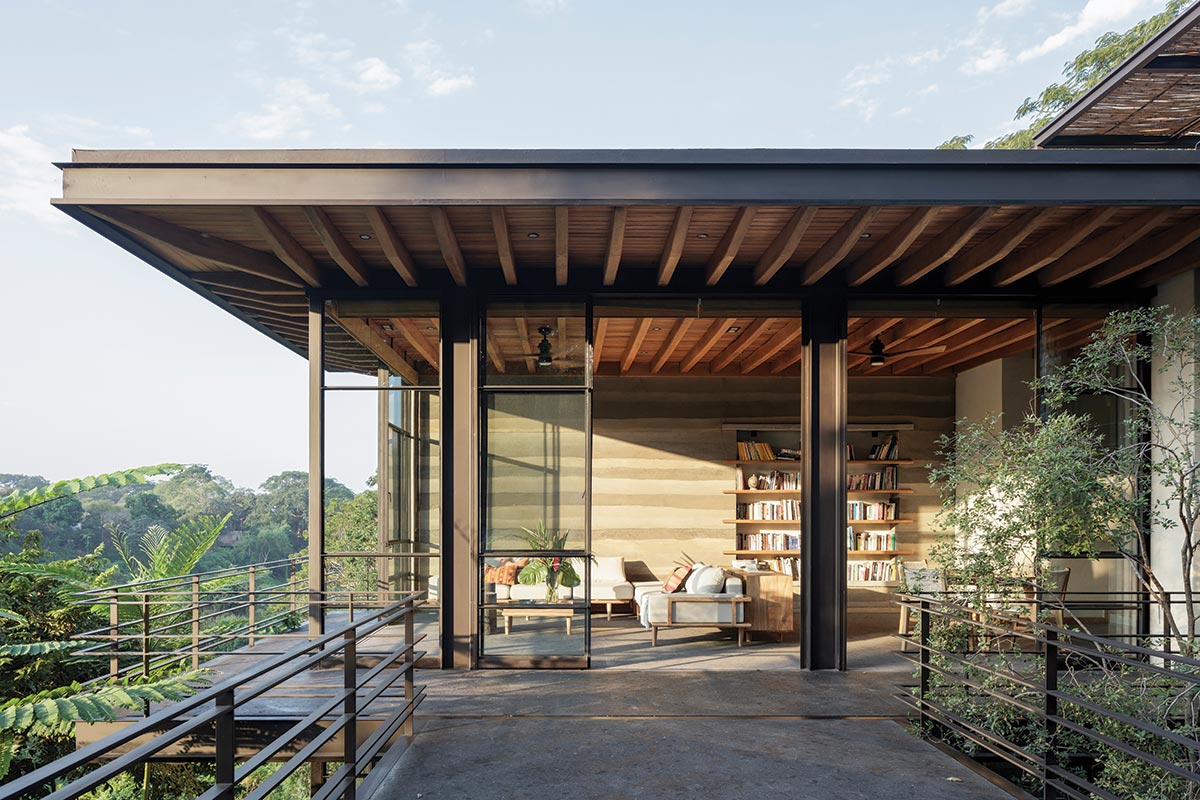
The living room looks out to the canyon. Photo © Lorena Darquea
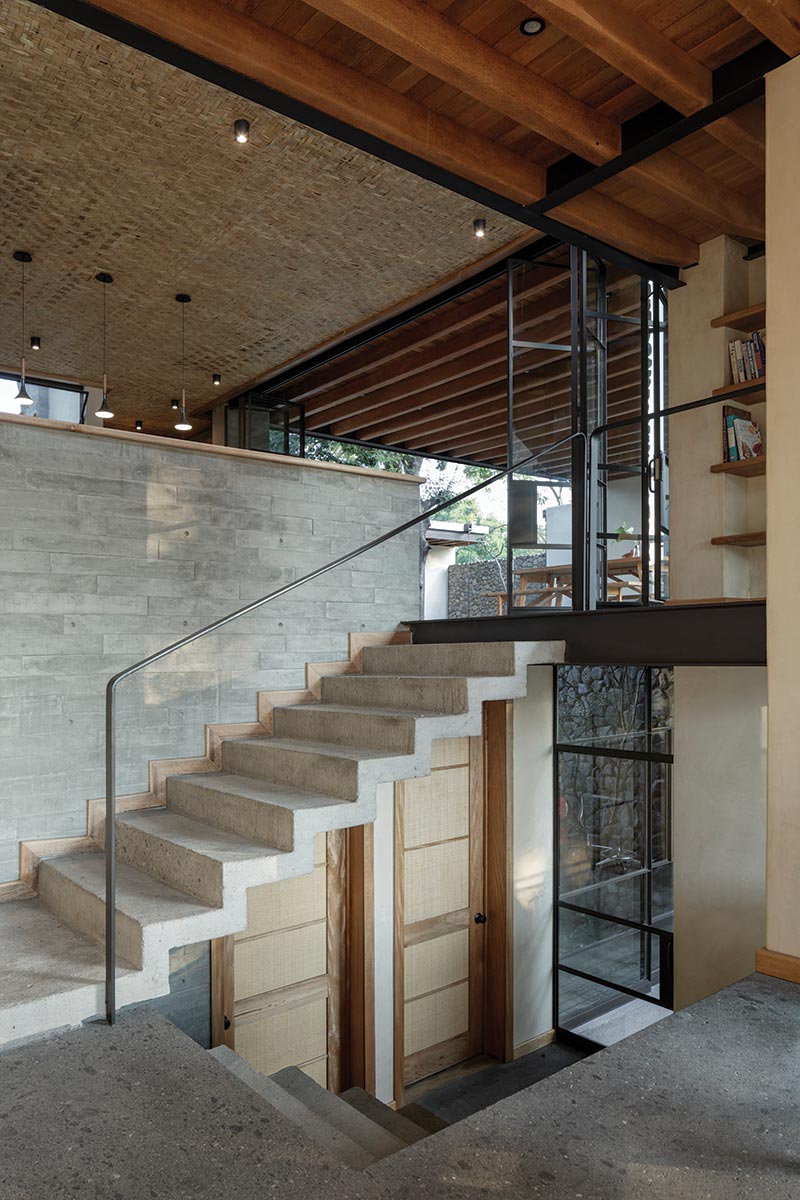
A stair from the kitchen leads down to the dining area and a bedroom below that. Photo © Lorena Darquea
That allowed the architect to step the house down the hill toward the river, with a bedroom and bath a half-flight down from the living area and a principal bedroom another half-flight down, opening onto a lower terrace. The house also steps up, with an interior stair along the side of the two-story study that leads to a yoga studio, which opens out to rooftop terraces and a steel-framed shade structure. Meanwhile, the roof over the principal-bedroom patio serves as a bridge that connects the living room to a hillside terrace. Semper saw roofs as the defining feature of the first buildings, and Di Frenna has used every inch of the ones here.
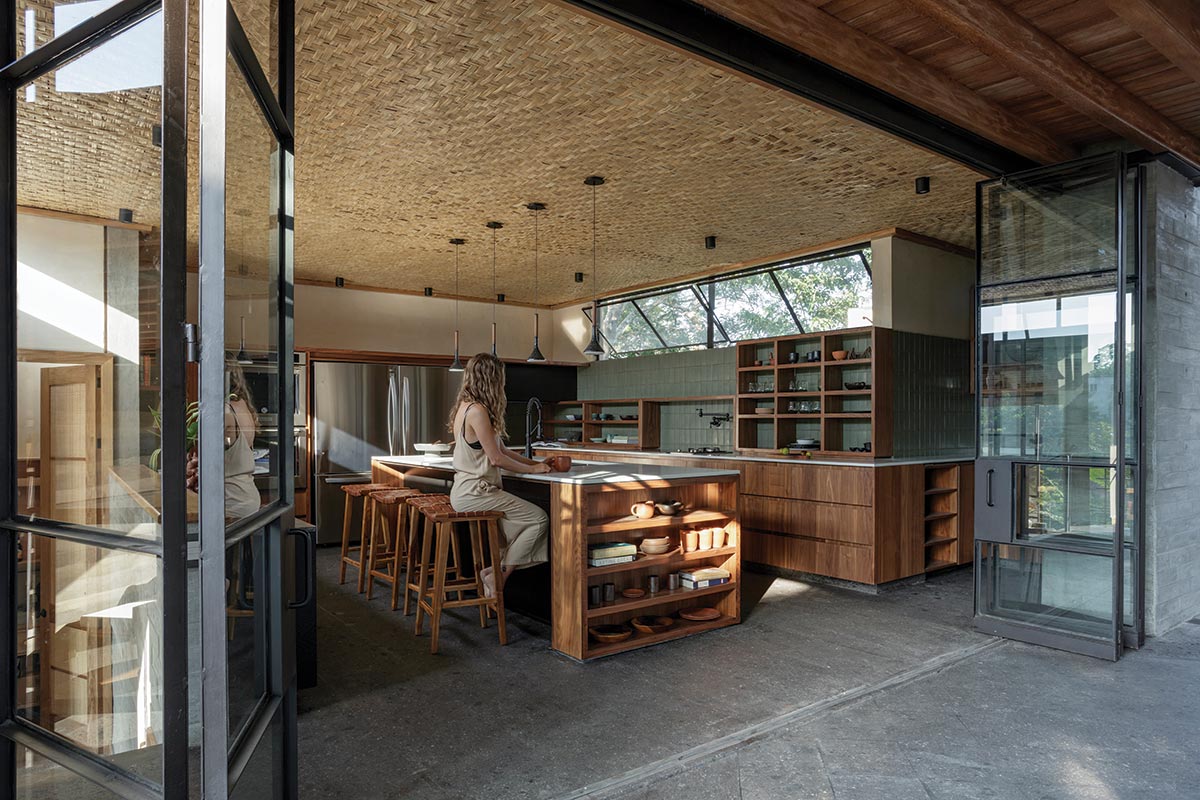
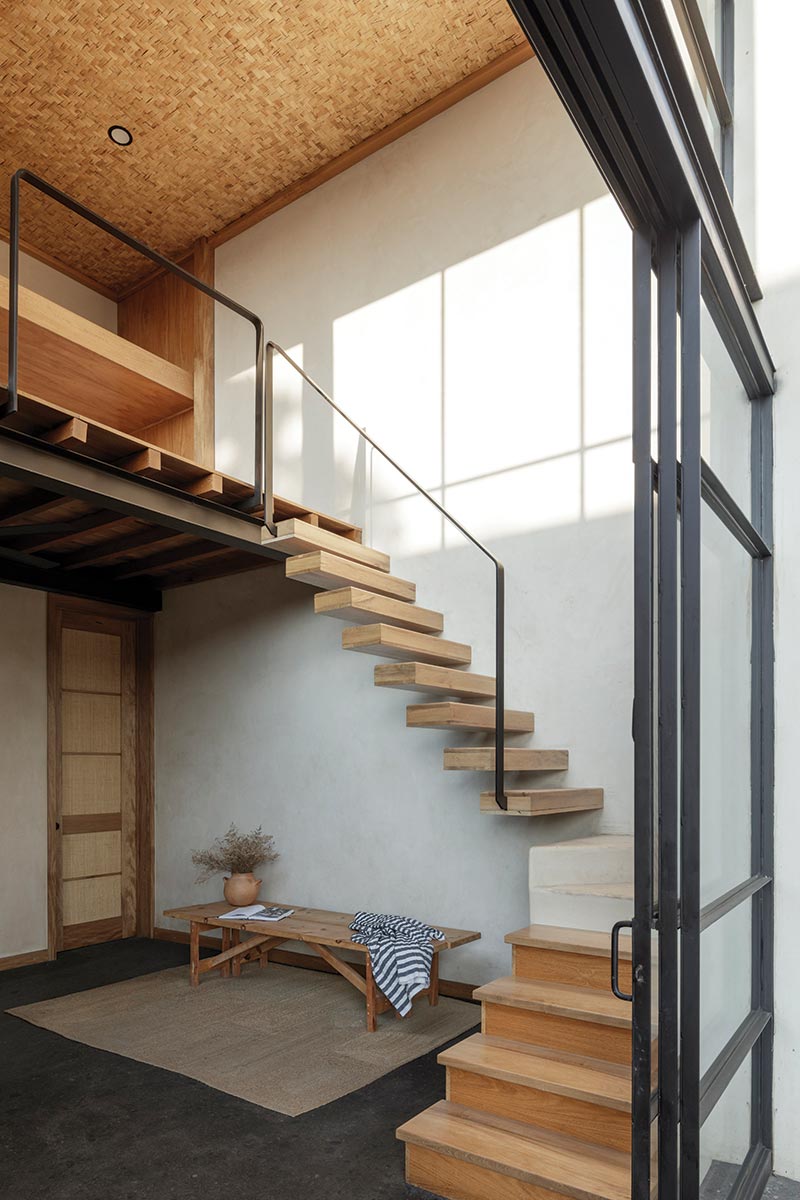
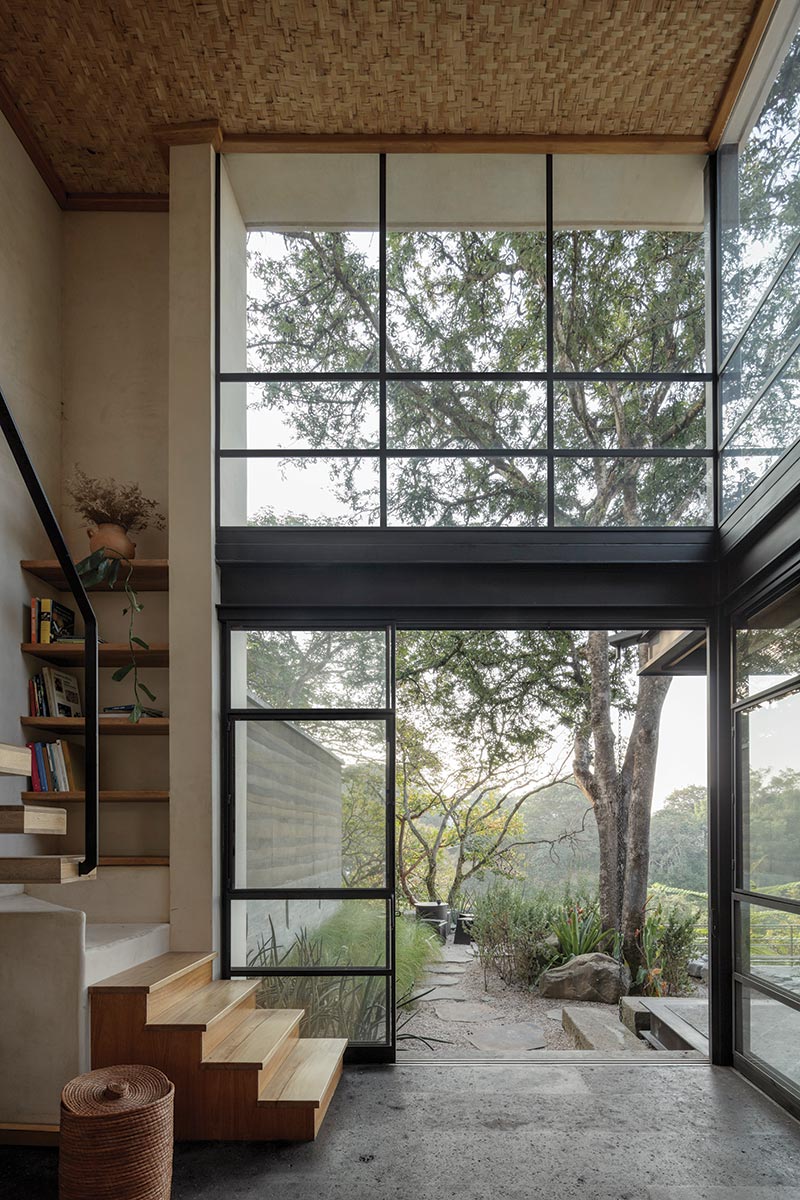
Semper’s argument that the earliest walls were “woven” is an idea reflected in the woven reedlike material, called “carrizo,” that Di Frenna deploys throughout the house. The use of carrizo also recalls the hacienda’s former artist owner, who sought to revive traditional crafts through his work. Di Frenna wanted to “highlight the connection to the land and to the craftsmanship promoted by Rangel.”
Looking for quick answers on architecture and design topics?
Try Ask RECORD, our new smart AI search tool.
Ask RECORD →
1
Reedlike “carrizo” ceilings are employed in the kitchen (1) as well as in the two-level study (2), which looks out to the canyon below (3). Photos © Lorena Darquea
2
3
As a German, Semper saw the hearth as a source of heat as well as a place to cook and to gather. But in a warm climate, like Mexico’s, where cooling matters more, the hearth becomes a kind of a metaphor for moving air rather than heating it. Di Frenna has cooled the house with tall ceilings, large openings, and a location high above a canyon in order to capture air currents and promote cross ventilation. Cave-like spaces, such as the bedrooms partly buried in the slope, have concrete floors that stay cool. There is even an outdoor bathtub and an alfresco shower in a secluded sunken garden: architecture open to the elements, as Semper might say.
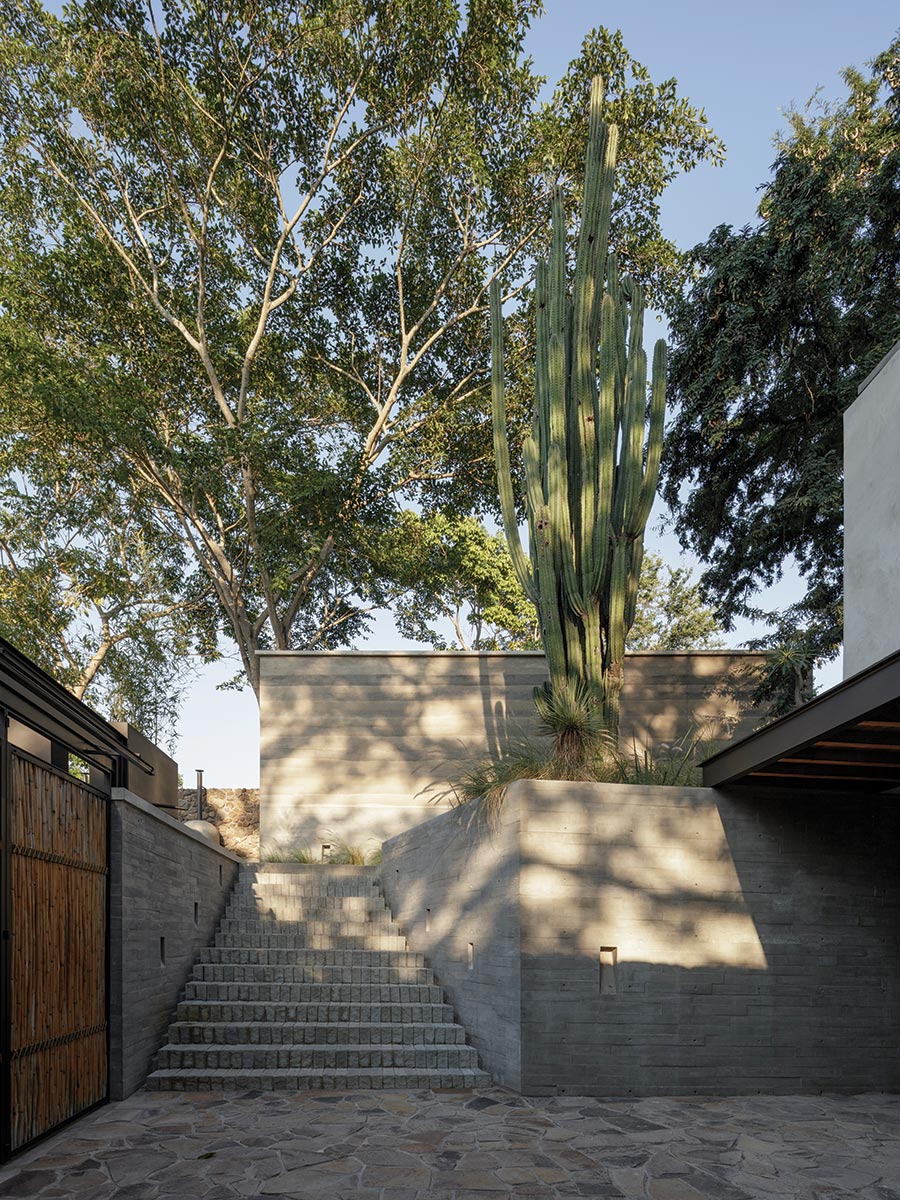
Photo © Lorena Darquea
The central role of the hearth, with its ceramics (in Semper’s theory), transmutes into a set of symbolic forms in this house. While an earlier phase of the design had an outdoor firepit, the realized project has no fireplace, but it does have plenty of fired materials, such as ceramic-tile walls in the kitchen and the black-steel frames of the windows and glass doors throughout the house. And at night, the exterior lighting creates the impression of multiple points aflame, Di Frenna says, encouraging guests to wander through the complex before gathering together.
This combination of traditional elements and local resources with contemporary conceptions of light and space help make this house a captivating work of architecture. Gottfried Semper has been interpreted as a conservative, as someone who wanted to return to a version of the primitive hut, but Di Frenna shows here how wrong that reading of the architect has been. By “marrying traditional crafts and materials to new techniques and innovative structural solutions,” says Di Frenna, his work reveals Semper’s renewed relevance. It might even start a new movement, the Semper faithful: Semper Fi.
Click drawing to enlarge
Credits
Architect:
Di Frenna Arquitectos — Matia Di Frenna Müller, founder and CEO; Mariana de la Mora Padilla, design lead architect; Juan Gerardo Guardado Ávila, construction manager, civil engineer
Engineer:
Hugo Saucedo Acosta (structural, civil)
General Contractor:
Di Frenna Arquitectos
Consultants:
Aurelio Alcaraz Rodriguez, Los Olivos Garden Center, Di Frenna Arquitectos (landscape); Bruno Taller (kitchen)
Client:
Sasha Rosse and Francisco Franco
Size:
4,300 square feet
Construction Cost:
$477,000
Completion Date:
December 2021
Sources
Steel Structure:
Transformaciones Metálicas Virgen
Wood Structure:
El Roblito
Roofing:
Pasa Tecnología Impermeable
Glazing:
ALCON
Hardware:
Kwikset
Lighting:
Tecnolite, Bticino, Estevez
Looking for a reprint of this article?
From high-res PDFs to custom plaques, order your copy today!