The Renewables Gambit: Putin Loses, the West Unites, and the Gambit Pays Off
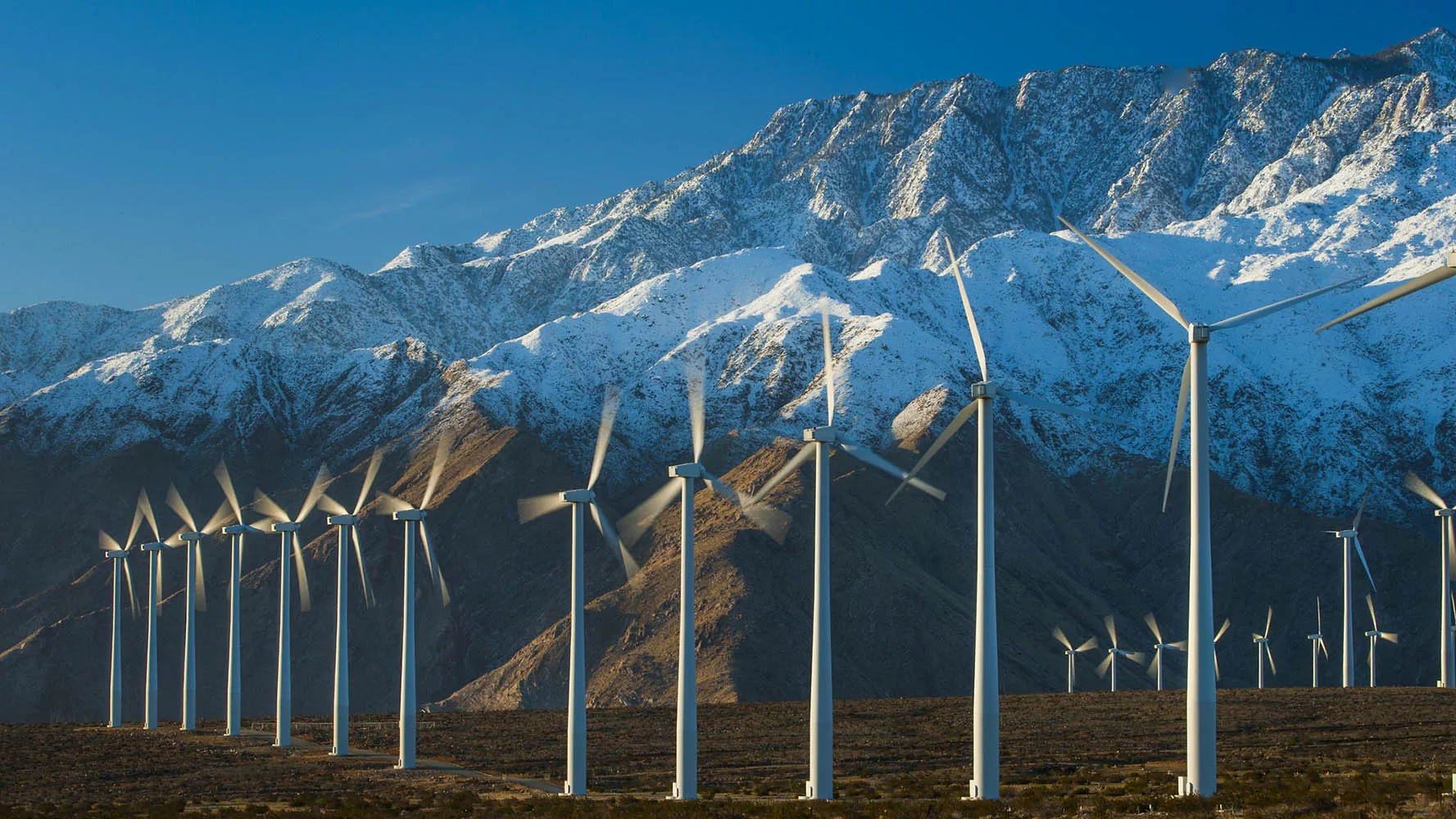
Renewable energy development in the California desert. Photo by Tom Brewster Photography
The Russian invasion of Ukraine has generated the headlines of the fossil fuel industry’s dreams, with articles claiming that the transition to green energy will be more difficult, or that the 1.5-degree goal is all but dead—or even calling for more drilling and fossil fuel development. But these assessments are clouding the extraordinary progress currently taking place worldwide: the development of sustainable, resilient, and zero-carbon built environments; and the unprecedented and explosive growth of renewable energy generation, a promising solution for both ecological and political stability in the 21st century.
Nowhere are these achievements more evident than in the statistics coming from the solar and wind industries. Solar electricity generation is now growing exponentially worldwide, doubling between 2016 and 2019, and doubling again by 2021. Wind electricity generation is following a similar trajectory, doubling between 2016 and 2021.
In the U.S., solar and wind electricity generation is growing at an impressive rate as well. Solar electricity generation doubled between 2015 and 2017, and again by 2021. Wind generation doubled between 2010 and 2015, and again by 2021. So why do we think it’s so difficult to accelerate this growth and address both climate change and energy security?
We are accustomed to thinking of growth and change in linear terms because that’s what we’re most familiar with: a child growing about 2.5 inches a year, for example, or a car rental billed at a fixed daily rate or per mile traveled. We’re not used to exponential growth—very gradual growth followed by an explosive increase over a very short period—and as a result, we tend to underestimate it. Consider the lesson of the following legend:
A clever courtier presented a beautiful chessboard to his king and requested in return one grain of rice for the first square of the chessboard, two grains for the second square, four for the third, eight for the fourth, and so on, with each square having double the number of grains as the square before.
The king agreed to what he thought was a modest request, only to discover that he had promised to deliver more rice than he had in his storerooms. The fifth square required 16 grains, the 15th 16,348, the 40th a million million, and so on—so his entire supply would be exhausted long before he reached the 64th square.
Wind and solar energy are now the cheapest source of electricity generation for much of the world, and they continue to become cheaper each year—between 2010 and 2019, the unit cost of solar energy decreased 85 percent, and that of wind energy decreased 55 percent. The cost of lithium-ion batteries, essential for storing renewable energy that is generated at variable rates, also fell by 85 percent. With such quick progress, the remarkable solar and wind growth numbers are not unfathomable. And with market forces, increasing pressure for energy security, and the implementation of emissions reduction plans by governments and institutions, including incentives for sustainable development and electrification policies, explosive growth will continue to be the norm.
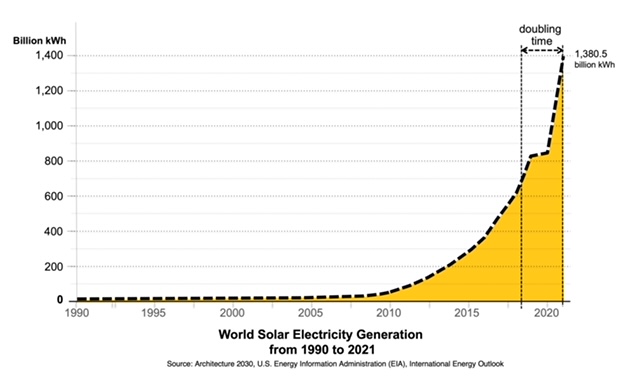
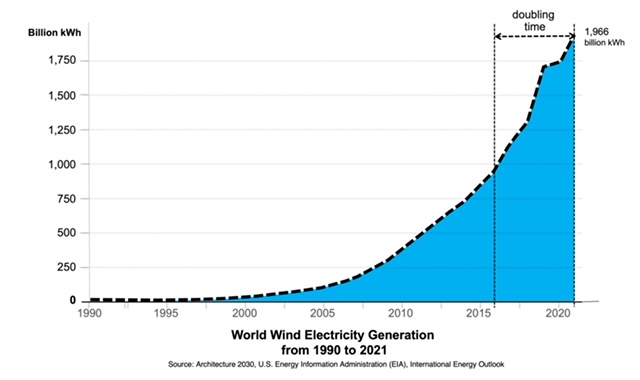
Solar and wind generation have been increasing globally over the past two decades. Images © Architecture 2030
The price of fossil fuel-generated power depends on the cost of plant construction and operations, geopolitics, and the respective prices of fuel, storage, and transportation. Solar- and wind-generated power, on the other hand, are very different: their fuel sources (sunlight and wind) are delivered free worldwide; they are not encumbered by fuel supply chain issues; their installation and operating costs are comparatively low; and they require minimal rare earths or other difficult-to-obtain materials.
Looking for quick answers on architecture and design topics?
Try Ask RECORD, our new smart AI search tool.
Ask RECORD →
Today, 40.2 percent of the global power sector is supplied by zero-carbon-generated energy, with renewables—wind, solar, geothermal, and hydropower—making up three-quarters of the supply. If solar and wind sustain their present course of exponential growth, 60 to 75 percent of global power will be generated by renewables in 2030, and we will be able to phase out carbon dioxide emissions and transition to a zero-carbon power sector by 2040.
The war in Ukraine has reminded us once again of the catastrophic security and humanitarian costs of fossil fuel dependency. With Vladimir Putin using fossil fuels as a geopolitical weapon, the struggle in Ukraine, coupled with the climate crisis, has united the West around a struggle to rapidly wean ourselves off fossil fuels. A global transition to renewable energy generation will dramatically reduce the power wielded by autocratic petrostates like Russia, whose economies are heavily dependent on the extraction and export of oil and natural gas.
In short, the renewables gambit is paying off. With an impressive foundation in place, now is the time to accelerate the transition to a zero-carbon built environment by implementing the following actions:
New Buildings and Developments
- Adopt current zero-carbon building codes, standards, and policies. This ensures that all new buildings are highly efficient, use no on-site fossil fuels, and generate or procure enough renewable energy to meet building demand.
Existing Buildings and Developments
- Enact policies that leverage building intervention points—or moments during a building’s life cycle where construction is likely to occur—in order to accelerate energy efficiency upgrades, shift to electric or district heating systems powered by carbon-free renewable energy sources, and generate or procure carbon-free renewable energy. Aligning work with these intervention points can help mitigate the cost barriers and disruption associated with renovations.
Embodied Carbon
- Enact policies and incentives that accelerate existing building reuse and renovation, use recycled and low-carbon or carbon-sequestering materials, design for deconstruction, and reduce emissions by designing carbon-sequestering sites and landscapes.
Implementing these policies will hasten the transition to renewable energy, building on the growth of renewable energy generation and recent movement toward electrification and reducing or sequestering carbon in the built environment. The present global crisis illustrates that doing so is an imperative, not a choice.
Looking for a reprint of this article?
From high-res PDFs to custom plaques, order your copy today!