Doors Open at Bronx Children's Museum to a New Topographical Playscape by O'Neill McVoy Architects
New York
Architects & Firms
“We’re all children at heart,” laughs Carla Precht, founding director of the Bronx Children’s Museum. “The building was close to the water, and it looked like a castle—I thought it had all the makings of a wonderful space for kids,” she adds. After 10 years of operating out of a purple school bus as a “museum without walls,” in December the institution moved into a long-awaited brick-and-mortar home and opened its doors to the public. Now it doesn’t just have wheels—it has walls.
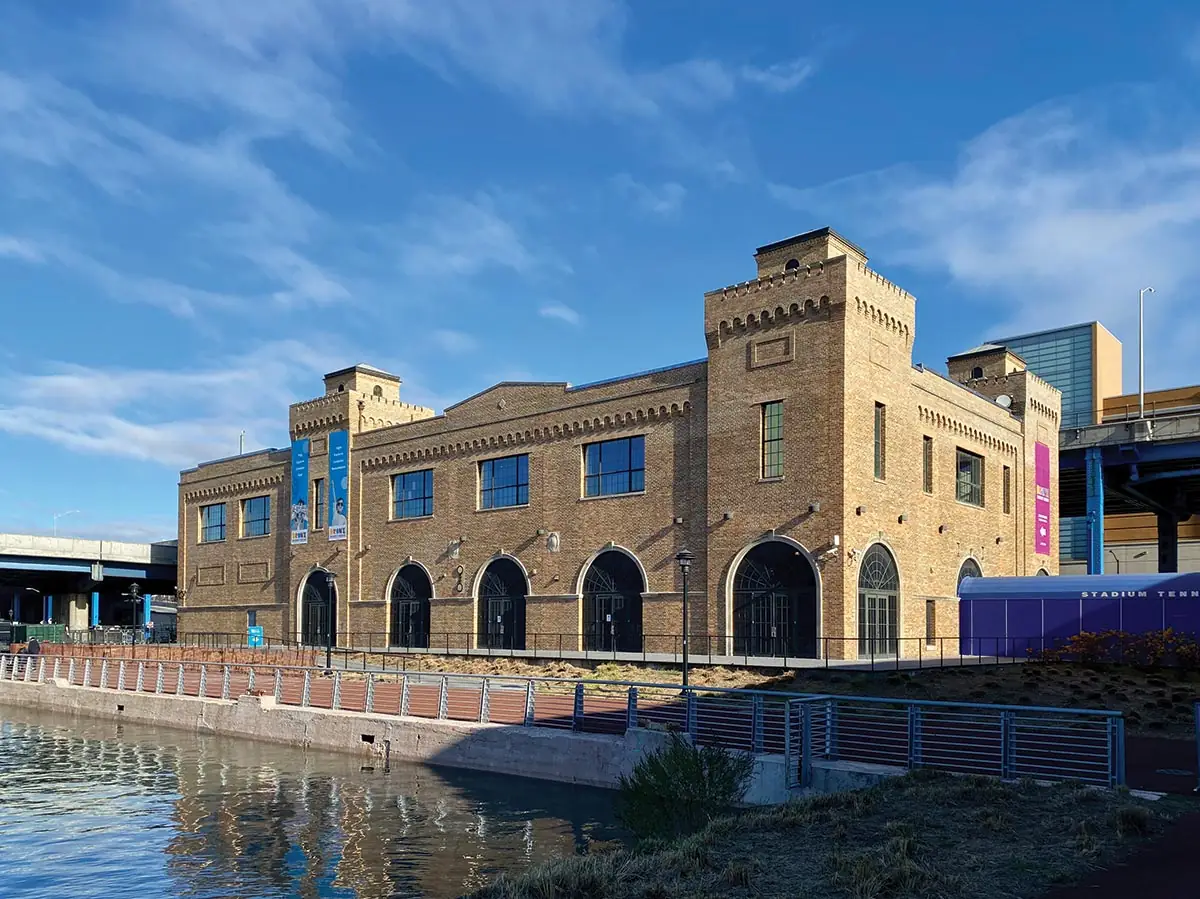
The Bronx Children’s Museum anchors the north end of Mill Pond Park. Photo © Architectural Record, click to enlarge.
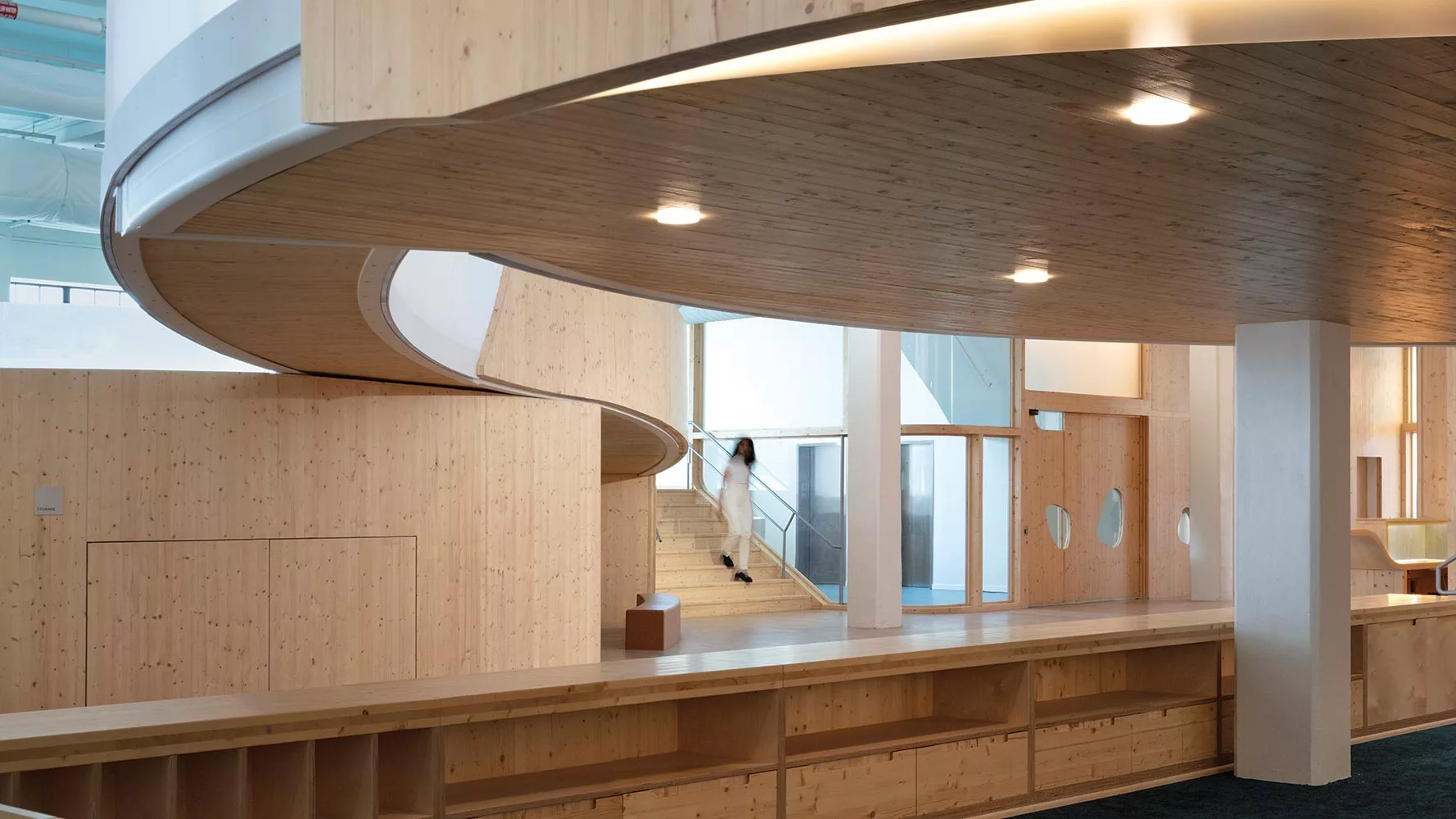
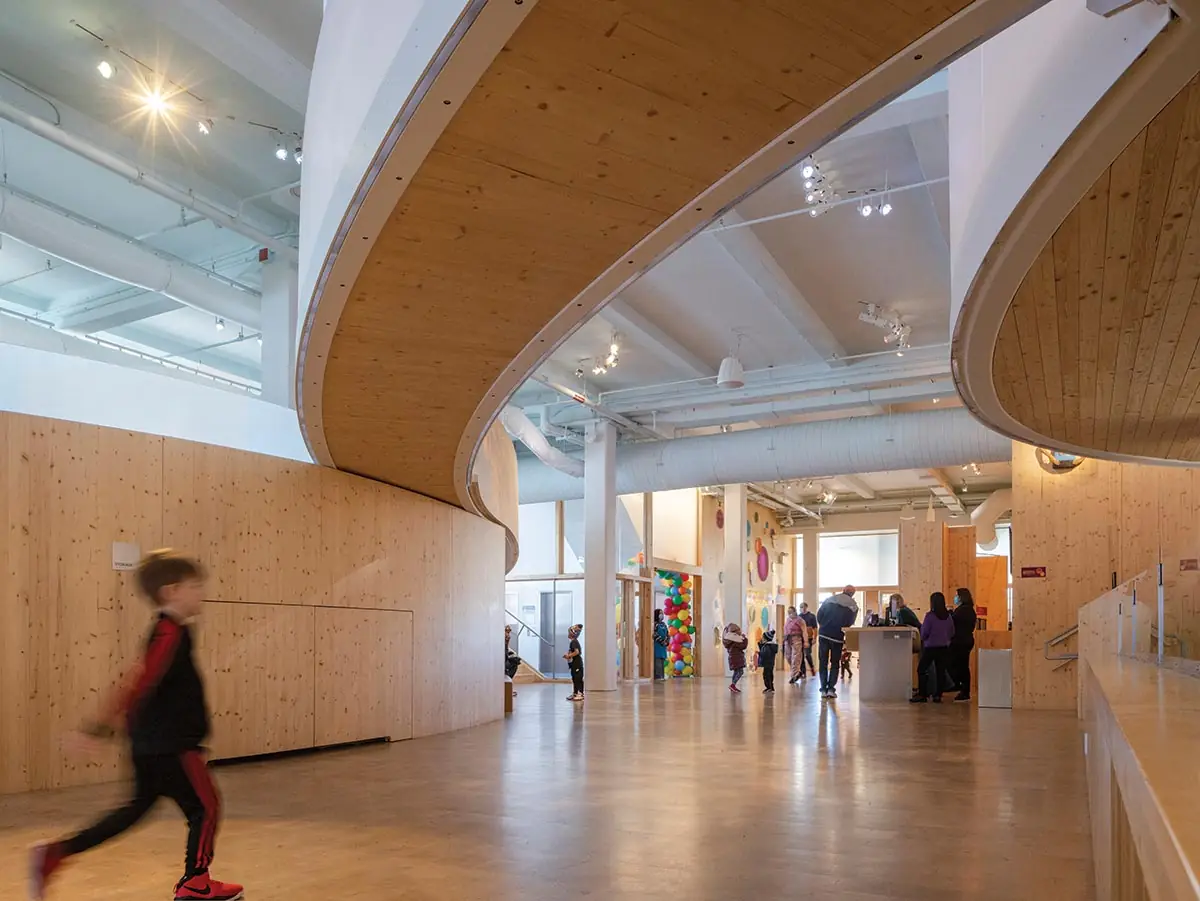
The Bronx Children’s Museum occupies the upper floor of a powerhouse that once supplied refrigeration and electricity to the borough’s nearby terminal market. Built between 1925 and 1929, the market was the first of its kind in New York and intended as a model for the sale of perishable goods in other boroughs. Today, only the powerhouse still stands—and with four crenellated turrets and arched brick corbeling, its castle-like form indeed invites curiosity. In 2010, the building was outfitted with a green roof, high-efficiency insulation and fixtures, and first-floor office space for the New York City Department of Parks & Recreation. Three years later, O’Neill McVoy Architects, led by the husband-and-wife team of Beth O’Neill and Chris McVoy, was commissioned by the Department of Design & Construction to overhaul the top floor. But the bright, in-your-face polychromy typical of children’s museums is noticeably absent from the interior architecture—instead, a subdued palette, natural materials, and winding walls engage the senses. It’s a grown-up approach to design for children.
1
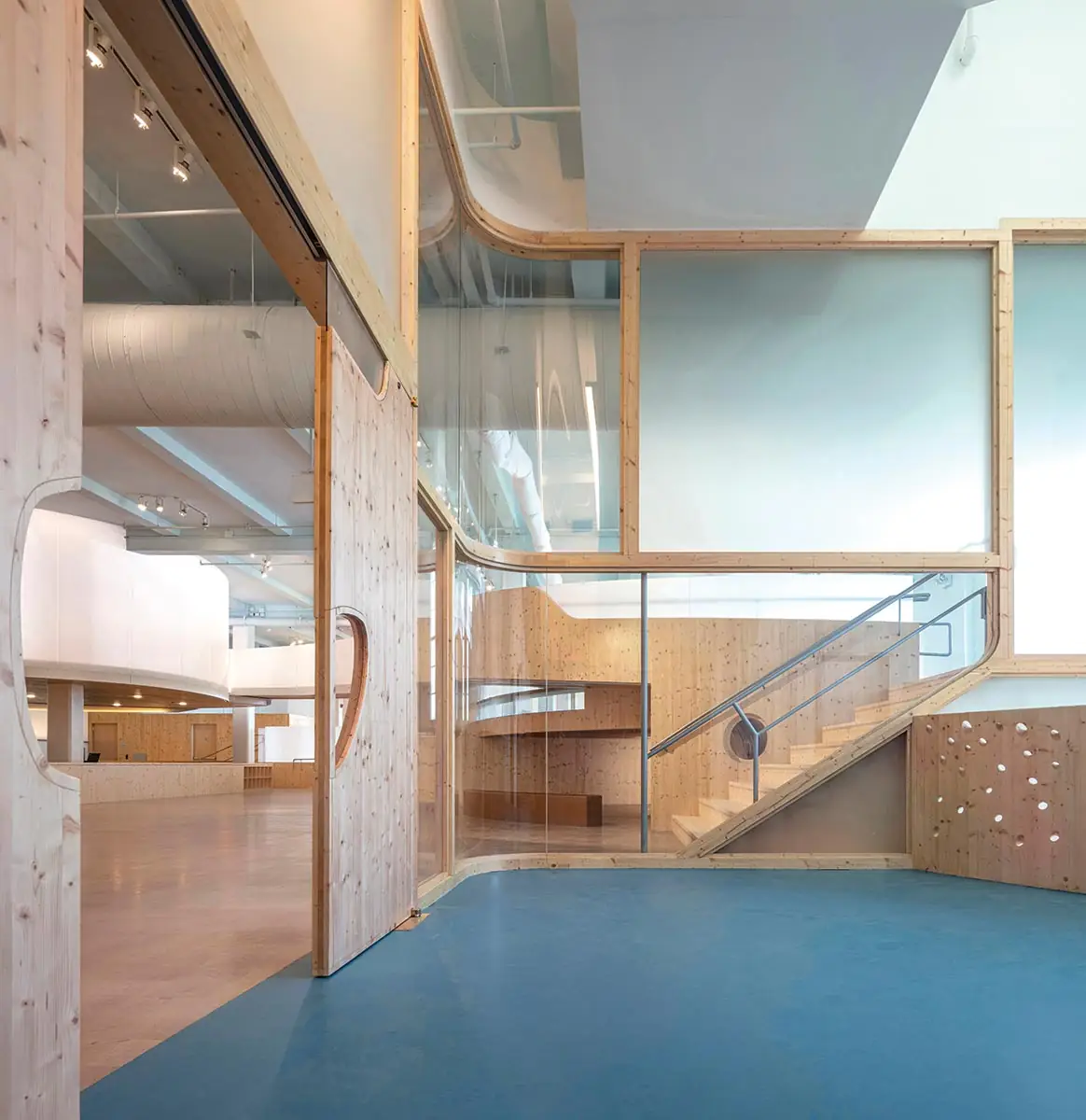
Inside, O’Neill McVoy Architects explore a subdued palette (1 & 2). Photos © Paul Warchol
2
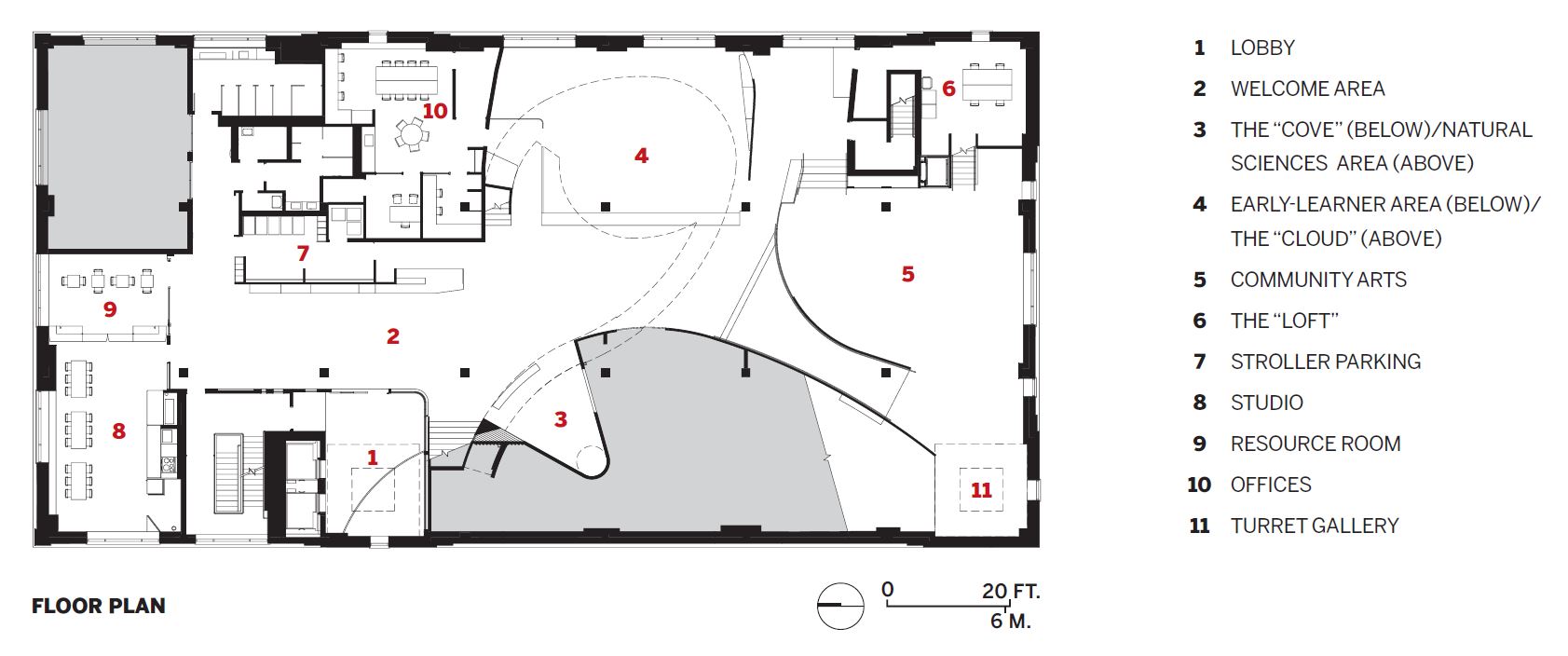
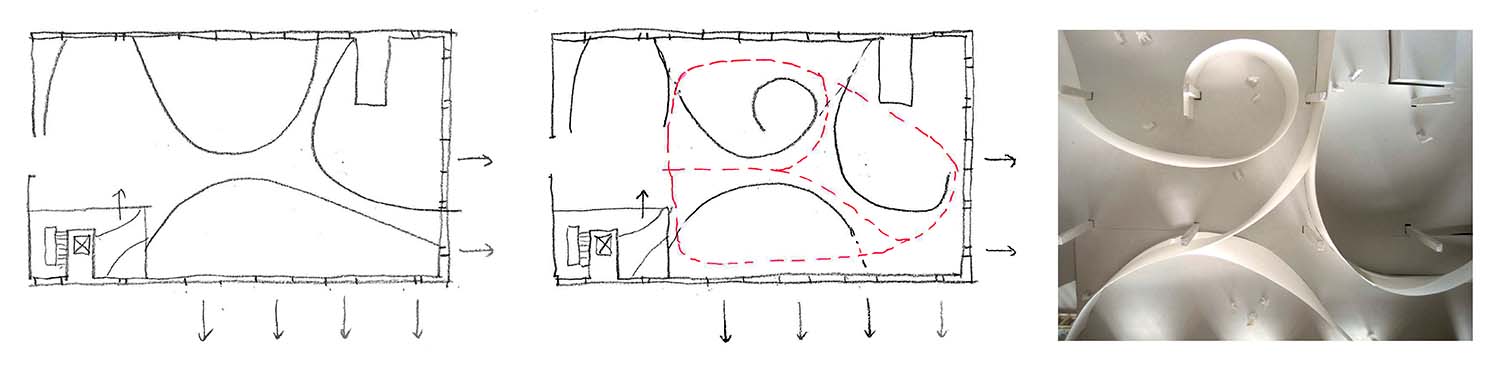
“The kids are coming from apartments, schools, and streets that are all orthogonal. We wanted to create a new kind of space that was open to their imagination,” says McVoy. Set within the 13,660-square-foot rectangular floor plate of the existing powerhouse, curvilinear elements meander, bifurcate, and reconverge to form a topographical playscape of thematic spaces that flow one into the other. “When the children walk in with their parents, it’s clear that they just want to begin exploring,” O’Neill adds.
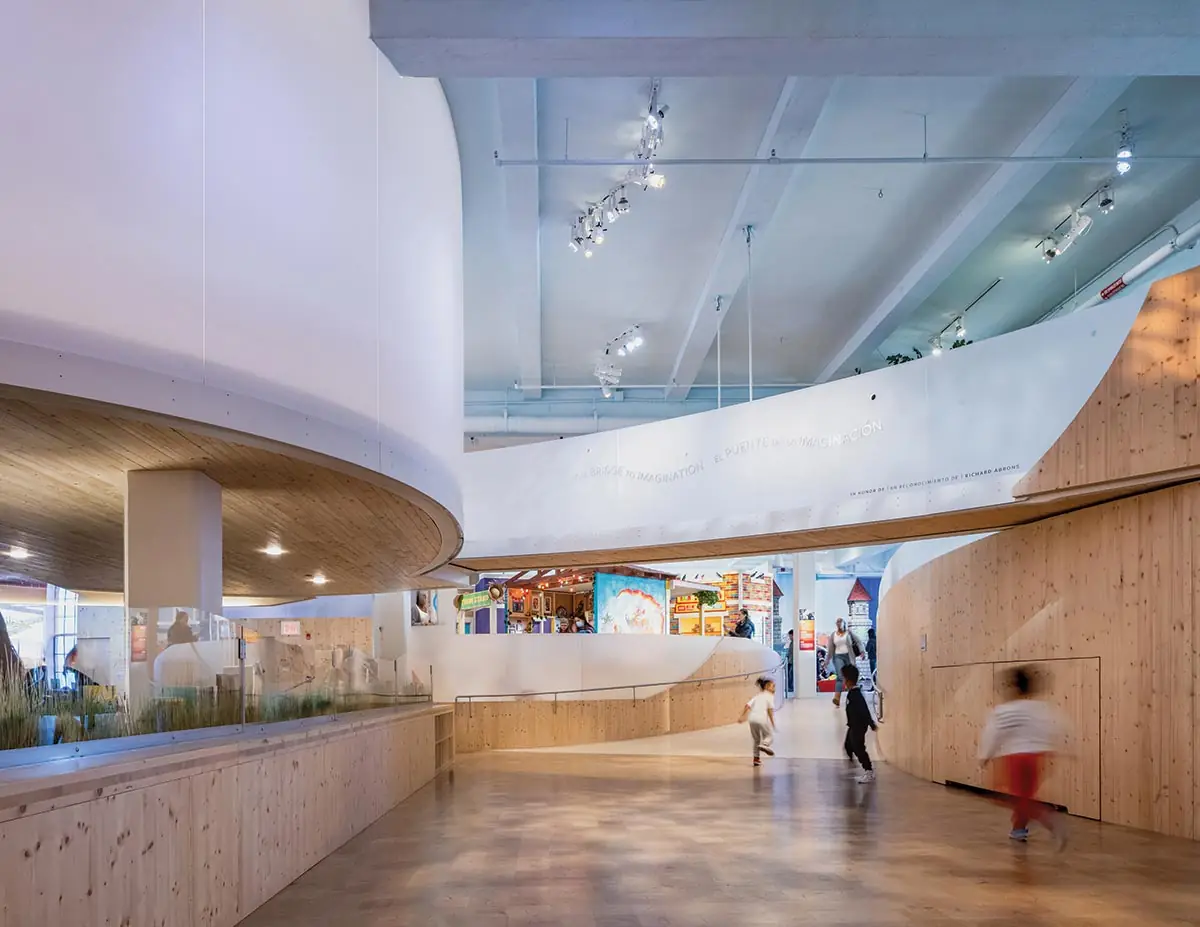
CLT walls, translucent acrylic, and gentle shifts in elevation define the museum’s interiors. Photo © Paul Warchol
From the welcome area, young patrons can go in many different directions. One route takes them past the “cove,” a niche with an inhabitable rabbit hole, and up a small set of stairs to the natural sciences area. Here, the floor has been raised almost 5 feet to make sweeping views of the Harlem River accessible to the museum’s diminutive constituents. The sound of trickling water accompanies the panorama—Waterways, an interactive 35-foot-long exhibit by Boss Display that features a miniature version of the Bronx’s Old Croton Aqueduct, invites playful splashing (willing participants borrow raincoats). Perceptive visitors might even see, through the bottom of the basin, a window offering a glimpse into the cove beneath them. “Water connects us all,” Precht says, a theme that figuratively flows through much of the museum. As kids amble about interactive exhibits and terraria showcasing native flora and fauna, they eventually find themselves in the “Turret Gallery,” a vertical column of space curated by Natalie Collette Wood that stretches upward into one of the building’s towers. Dichroic film on clerestory windows and a torrent of suspended crystals scatter iridescent light onto an assortment of woodland-themed furniture—an arrangement that would please any young reader of Alice in Wonderland. (At night, the four turrets are lit from within, emitting a soft purple glow.)
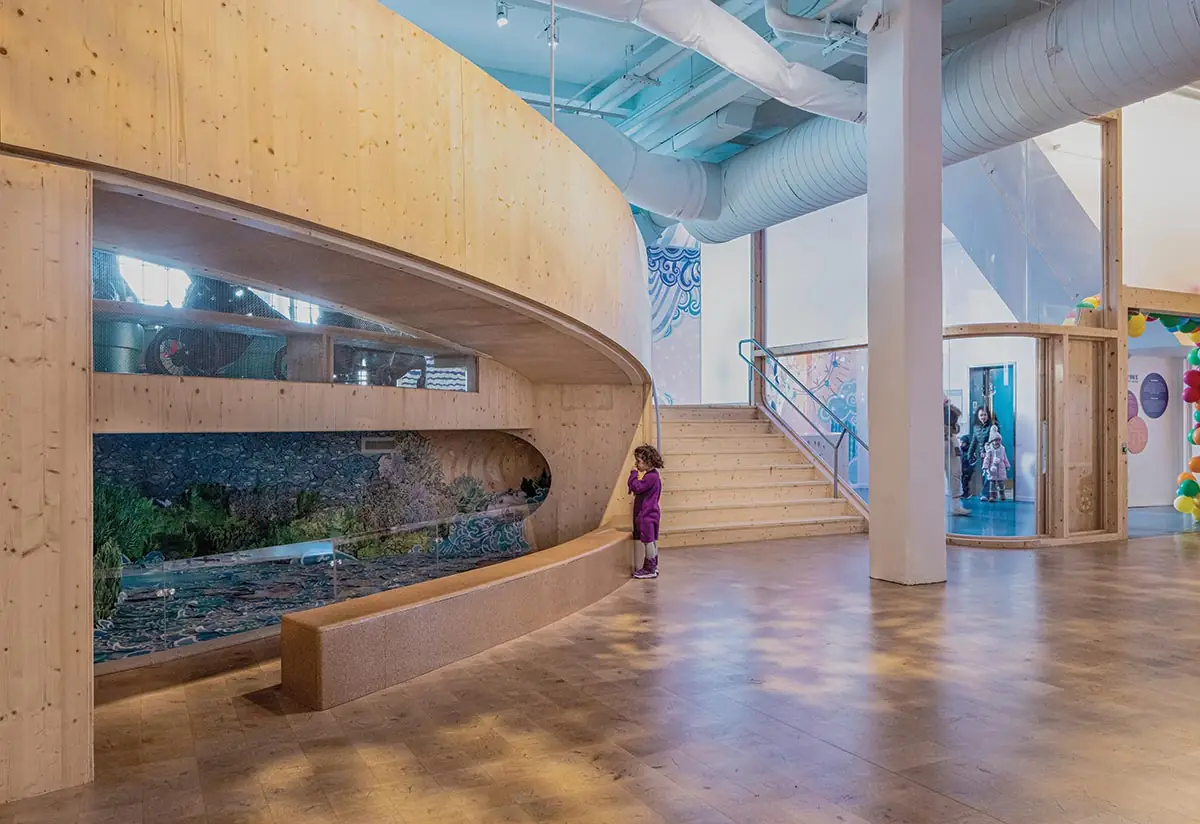
Children as well as artwork can inhabit the “cove.” Artist Rachel Sydlowski’s Invisible River is a dimensional silkscreen using UVA pigment. Photo © Paul Warchol
In the community arts area, the interior architecture takes a back seat as the birthplace of hip-hop comes to life with a casita by artist Charles George Esperanza, as well as caricatures of various storefronts and portraits that pay homage to Bronx streetscapes and borough natives including actor Sonia Manzano, Supreme Court Justice Sonia Sotomayor, and playwright Richard Abrons. With 15-foot ceilings, the architects squeezed in a mezzanine-level “loft” under another of the turrets, where children can survey the entire museum and gather for artist-led classes. Another mezzanine, a multimedia room called the “cloud,” is conspicuously hung from the ceiling (and connected to the natural sciences area via a bridge) and is mostly enclosed for storytelling or digital projection—providing a moment of respite from the scampering below. Tucked underneath the cloud is the early-learner area, an intimate space in which to keep a watchful eye on the youngest of youngsters.
In comparison to the literal yet lively exhibits, the interior architecture is more nuanced in its approach to spatial learning. To buttress their design, architects McVoy and O’Neill leaned on Swiss psychologists Bärbel Inhelder and Jean Piaget, authors of The Child’s Conception of Space (1948). “It’s a dry book,” McVoy jokes, “but Piaget spent an incredible amount of time documenting how children understand space. It’s about here and there, continuity and separation, enclosure and openness, light and dark—fundamental notions.” Translucent acrylic obfuscates views but not the blurs of bodies moving behind it (McVoy spent one afternoon polishing edges to perfect the finish, too). Fabric ductwork evokes a playful spirit and catches light against a pale blue acoustical ceiling. Floors are covered with end-grain red oak tiles that make legible the oft-taught biology lesson that tree rings can be counted to age trees. “And everything was designed from the vantage point of a child,” O’Neill says.
The most noticeable material choice is the curving, knotty spruce cross-laminated timber (CLT). Today, CLT is most often used as a mass-timber building’s primary structure, but O’Neill McVoy Architects deployed it to create walls, guardrails, floor planks, benches, frames, and stair stringers that were inserted within the powerhouse’s existing envelope. These elements not only have their own independent structural properties, but are more slender than typical stud-and-drywall construction. It’s also the first use of curved CLT in the United States, explains Sebastian Popp, technical director at Austria-based KLH, which manufactured the Forest Stewardship Council–certified CLT components. Although walls with shallow curves can be produced flat and bowed in situ, more complex geometries require vacuum forming—a process used by Ray and Charles Eames to produce bent-plywood furniture. These components were produced oversized and milled to final dimensions (plus or minus 2 millimeters) on a CNC machine, giving the designers an opportunity to incorporate pebble-shaped apertures and making installation easier and more cost effective. If scuffed, the wooden walls can be sanded and refinished.
With very few dead ends, visitors inevitably end up where they began. Despite the curious difference between the artists’ and architects’ approaches, the new Bronx Children’s Museum offers up a multisensory feast for voracious kids. Just ask them—on departure, they complete an “exit poll” on a magnetic board. Judging from the results, the kids are having a blast!
Click plan to enlarge
Click drawing to enlarge

Click drawing to enlarge
Credits
Architect:
O’Neill McVoy Architects — Beth O’Neill, Chris McVoy, principals; Ruso Margishvili, associate in charge; Richard Stora, project architect; Penelope Phylactopoulos, Meghan O’Shea, Trevor Hollyn Taub, Irmak Ciftci, project team
Engineers:
Silman (structure); Plus Group Consulting Engineering (m/e/p)
General Contractor:
A Quest Corporation
Consultants:
Tillotson Design Associates (lighting); ADS Engineers (LEED consultant); TM Technology Partners (AV/IT/Security)
Client:
NYC Department of Design and Construction, Bronx Children’s Museum
Size:
15,676 square feet
Cost:
$14 million
Completion Date:
December 2022
Sources
CLT:
KLH
Windows:
NanaWall
Glass:
PPG; Walker Glass; Pilkington; Technical Glass Products
Acrylic:
3Form
Lighting:
Ketra; Feelux; LED Linear; Ecosense; Soraa
Acoustical Ceilings:
Sonacoustic
Ductwork:
Ductsox
Looking for quick answers on architecture and design topics?
Try Ask RECORD, our new smart AI search tool.
Ask RECORD →
Looking for a reprint of this article?
From high-res PDFs to custom plaques, order your copy today!