Höweler + Yoon Completes a Trio of Residential Buildings in Boston
Boston
Architects & Firms
Firm principal Eric Höweler, FAIA, writes about the various approaches to design and construction taken on a series of apartment towers aimed at increasing housing density in the city.
Housing in Boston remains a wicked problem. Lack of supply and insatiable demand have made Boston one of the least affordable major cities in the U.S. Creating new high-density housing, in urban neighborhoods served by transit, has been the focus of the last three mayoral administrations. Affordability is the main topic of conversation at most community meetings and is the centerpiece of current mayor Michelle Wu’s agenda. All residential projects with more than 10 units are currently required to provide a minimum of 13 percent affordable units. Creating more new housing also creates more affordable units.
The critical factors that drive, and sometimes restrict, the creation of housing in Boston are viable sites, the entitlements process, parking requirements, and constructability. Because Boston has been continuously remade over centuries, most of the sites that are easy to develop have already been built up. There is no “as of right” development in Boston, so approvals and entitlements are negotiated through a process that includes input from community groups, city agencies, design-review commissions, and abutters (owners of adjoining properties). To build new housing, thus, requires thinking creatively about sites previously deemed “undevelopable.”
The three projects presented here are recently completed or nearing completion. Located in three different neighborhoods, they represent unique approaches in the entitlements process and illustrate innovations in housing typology and construction.
Less Parking, More Housing
Zero Athens
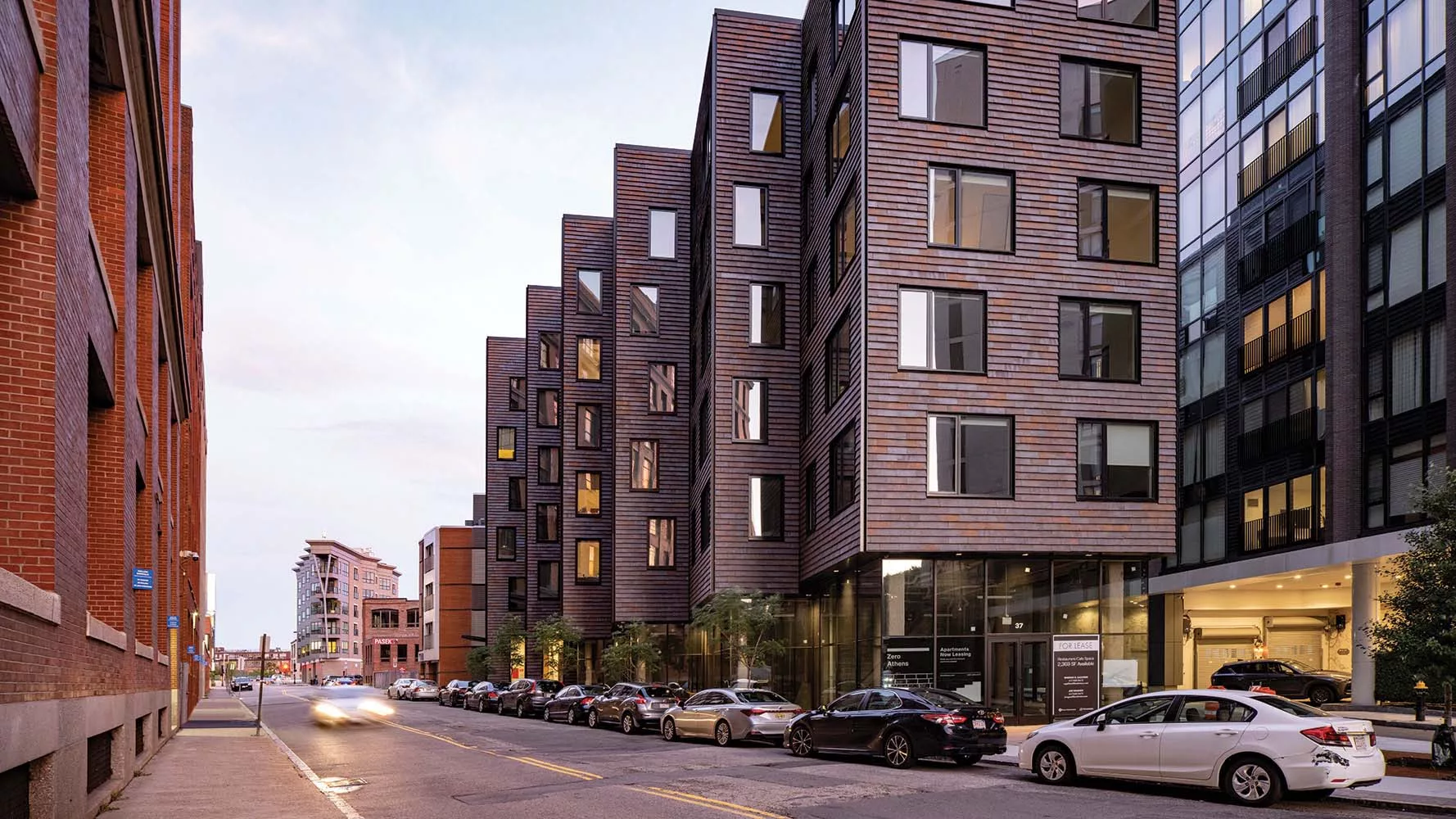
South Boston (“Southie”) has been dramatically transformed by development along the Red Line subway transit corridor (“the T”). Located only a block from the Broadway subway station, the parcel at the corner of Athens and West Second Street had been passed over for development due to its irregular, pie-shaped footprint. Incorporating off-street parking on the small parcel proved inefficient, so the design team proposed a car-share solution with only two parking spaces. This operational answer to the parking problem unlocked the ability to erect a six-story building with 55 units of housing.
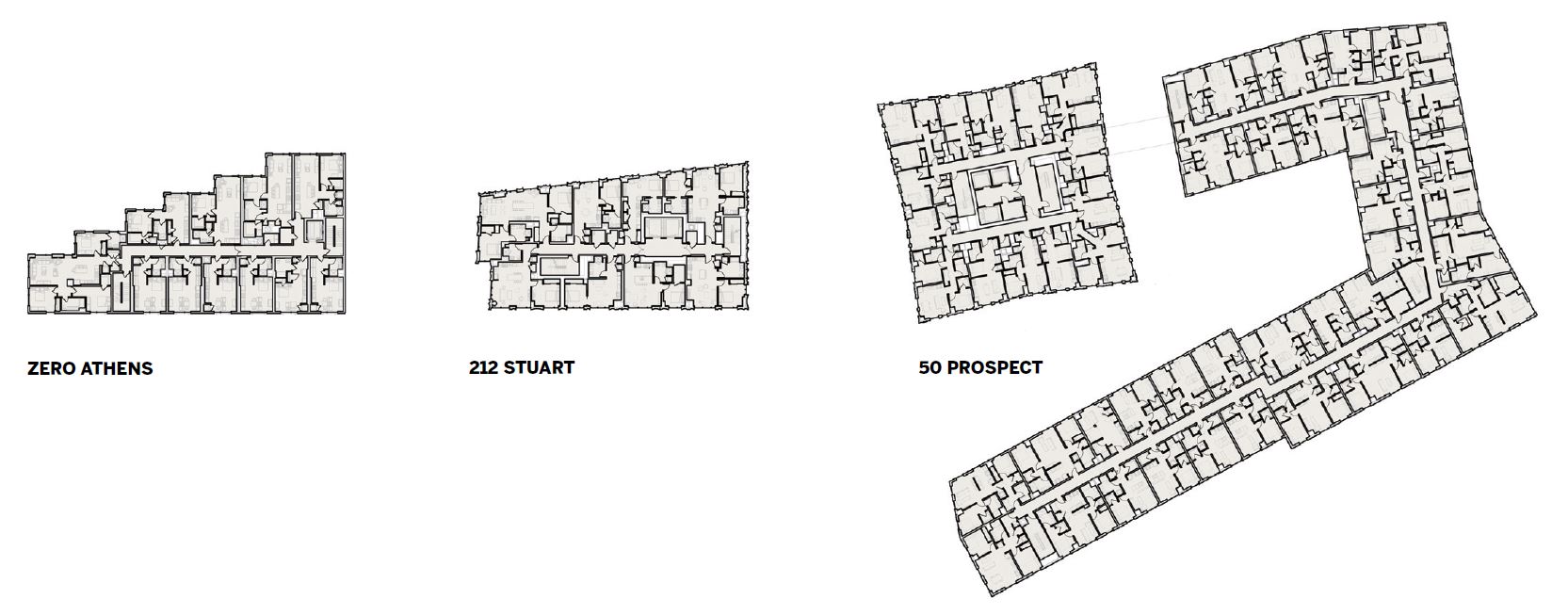
Zero Athens (the building’s address on Athens Street) is a compact building that occupies most of its wedge-shaped plot, but the stepping of the north facade allows it to be articulated as a series of corner units, giving the building massing a distinct granularity that acknowledges that “part-to-whole” nature of housing. The exterior integrates itself into a historic neighborhood through a facade of large terra-cotta shingles that references the earth tones of the brick buildings in Southie while introducing a new tectonic language.
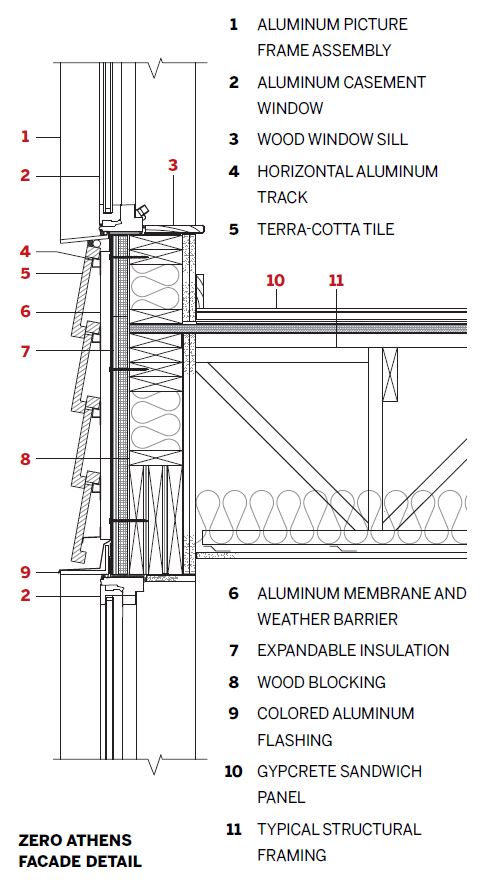
Click drawing to enlarge.
Zero Athens is built with 5+1 construction, consisting of one floor of fire-rated steel and concrete at the base with five floors of stick-built framing above. This cost-effective type allows for the greatest density under the International Building Code. In urban settings, this maximum allowable becomes the minimum viable, making this the default construction type for most urban housing and highlighting the challenges of mid-rise housing, where construction costs and return on investment drive the building massing. For Zero Athens, the ability to work with the city to reduce parking requirements, coupled with the efficiency of the massing and a contextual material palette, enabled the transformation of a residual site into a key part of an emerging neighborhood.
No Back
212 Stuart
Located between Bay Village and Back Bay, the parcel for 212 Stuart Street was assembled from two smaller parcels to total 7,000 square feet, but, still, its small footprint made it nearly impossible to develop efficiently with off-street parking. The development team, led by Transom Real Estate, negotiated to lease 50 spaces from the adjacent hotel garage, illustrating how a creative approach to the entitlements process transformed an empty lot into a 20-story housing project.
Looking for quick answers on architecture and design topics?
Try Ask RECORD, our new smart AI search tool.
Ask RECORD →
1
2
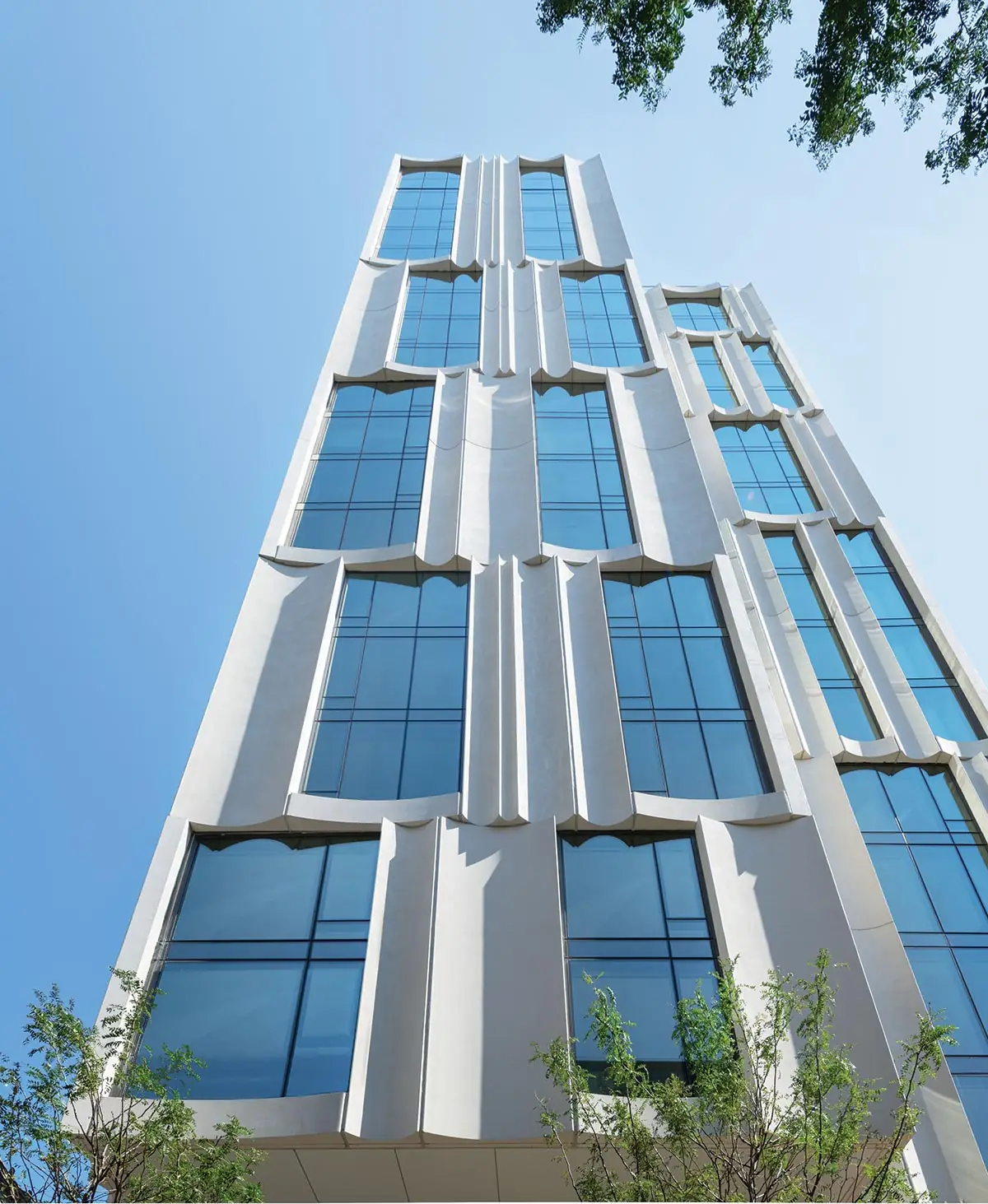
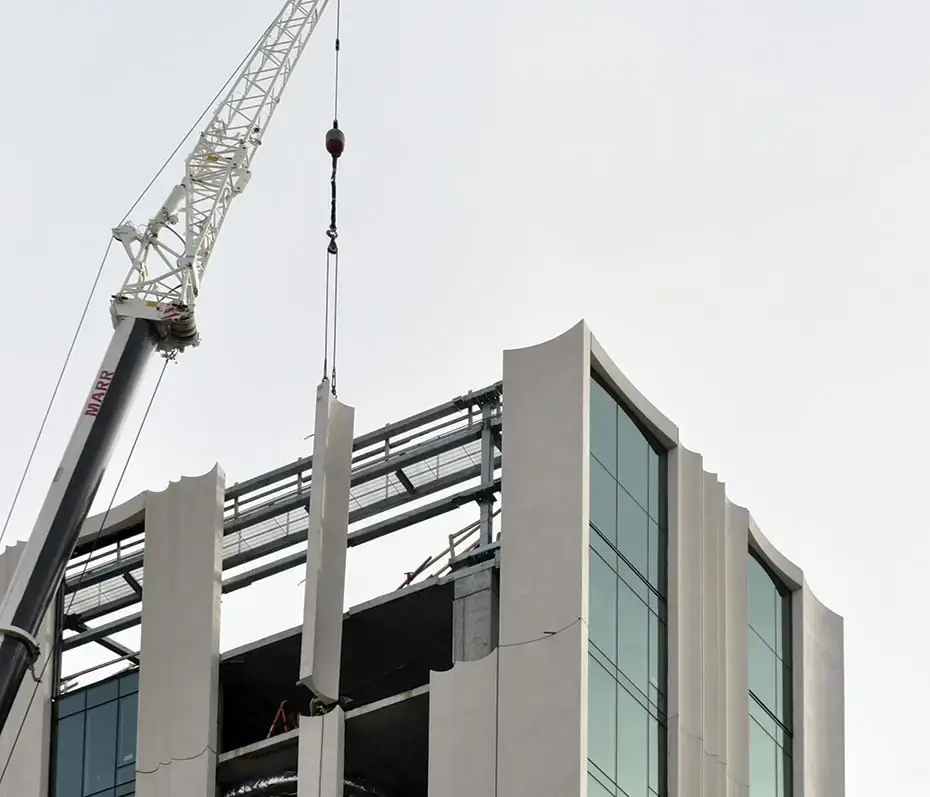
The multistory concave fluted piers of the facade of 212 Stuart (1) were hoisted in place by crane (2). Photos © Chuck Choi (1), Kyle Richard, courtesy Sasaki (2)
The 200-foot-tall residential tower exceeded the allowable zoning height, yet the increased density was supported by city agencies to add more housing in downtown Boston. The multi-year approvals-and-entitlements process highlights the difficulty of adding density in the historic city center. Height, parking, shadows, wind effects, and contextual fit were the consistent issues raised during the community-engagement process.
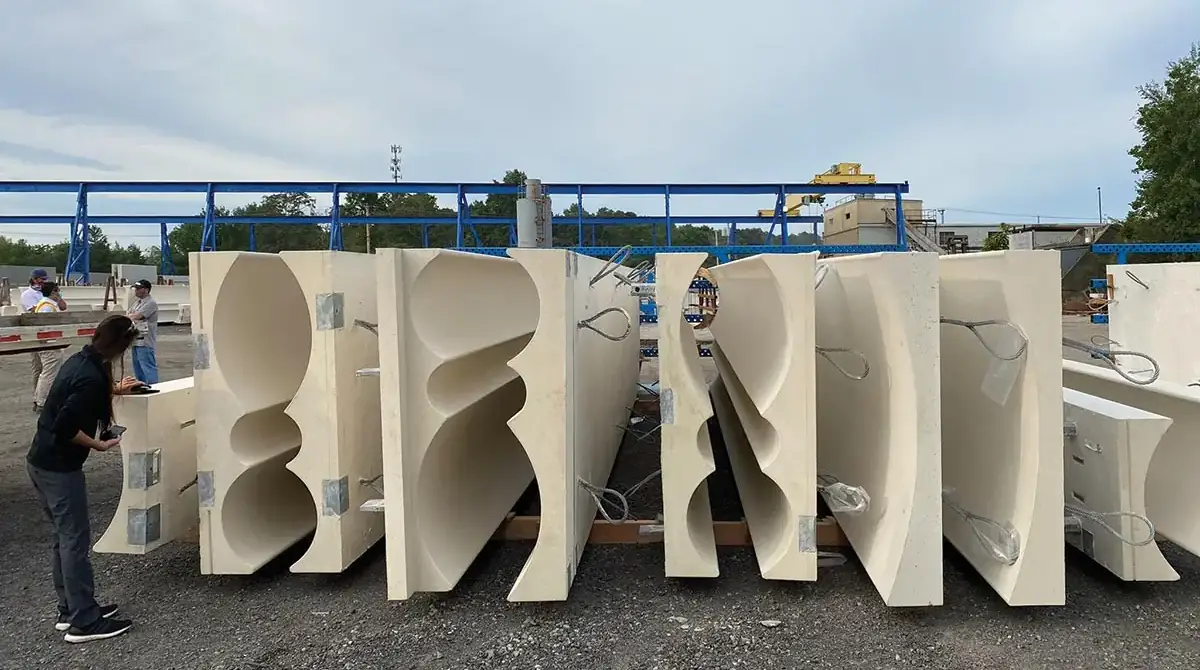
The building massing and facade articulation negotiate the difference between the high-rise scale on Stuart Street and the low-rise context of Bay Village with a facade design of a coursed block, stacked in multistory packages. The facade consists of precast concave fluted piers that stagger across each face, creating different rhythms in horizontal courses, and references the finer-scale details of its immediate neighbors. The concrete piers are 20 to 30 feet long, to maximize a module size that is within the limits of what is transportable on flatbed trucks and the carrying capacity of a construction crane.
3
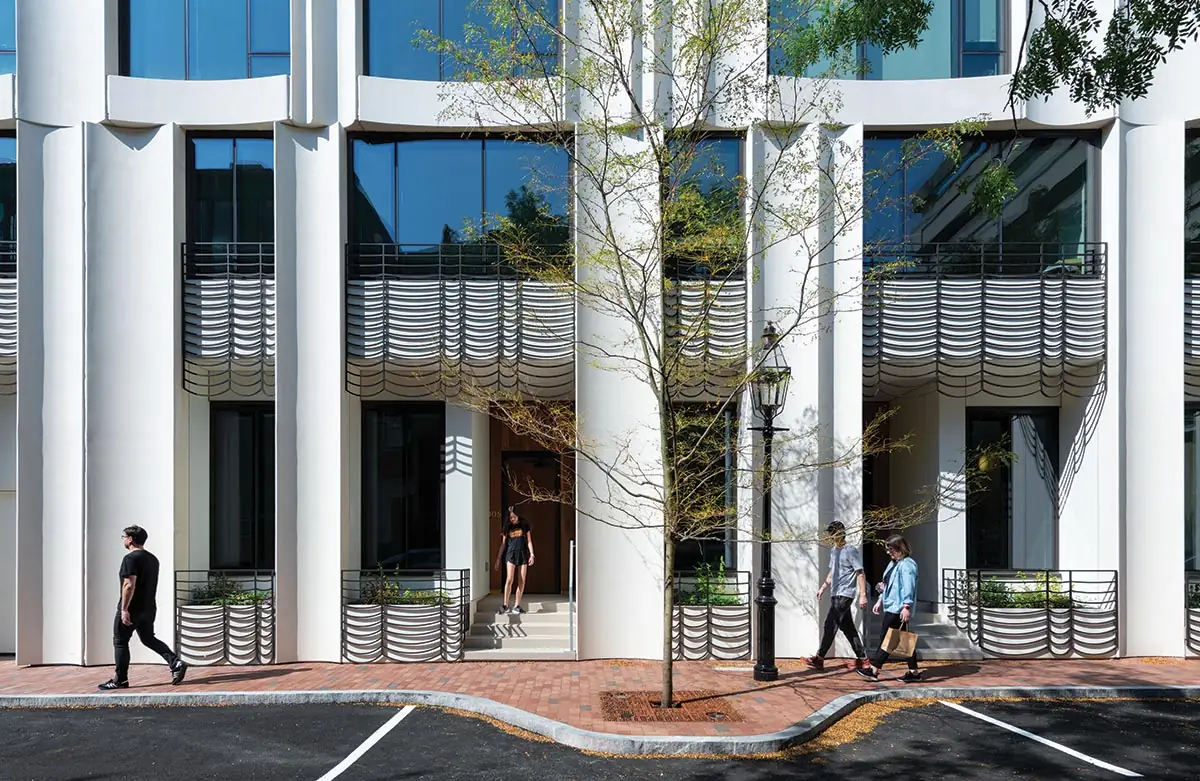
At 212 Stuart, townhouse entrances, complete with stoops and flower boxes, face the low-rise neighbors (3). The precast piers were shipped on flatbed trucks (4). Photos © Chuck Choi (3), Howeler + Yoon (4)
4
The key typological innovation is a response to the community-engagement process. Neighbors residing across the street in a two-story townhouse expressed a concern about facing the “back” of the building, where the mechanical rooms were initially located. In response to this comment, the project was redesigned to feature townhouse duplexes facing the low-rise neighborhood to the south, with the retail and residential lobby facing north onto Stuart Street. The “no back” approach provides townhouse entrances complete, with stoops and flower boxes, facing the existing townhouses. The new building negotiates specific urban conditions to complete the street and contribute to the neighborhood.
Right Place for Height
50 Prospect
Prompted by a new subway-line extension on the Green Line (GLX) that ties the primarily residential neighborhood of Union Square to the center of Boston, 50 Prospect Street is the first phase of a planned 2.3 million-square-foot Transit Oriented Development. The project aims to create density around the new transportation hub, to energize the neighborhood, improve walkability, and increase the amount of urban housing.
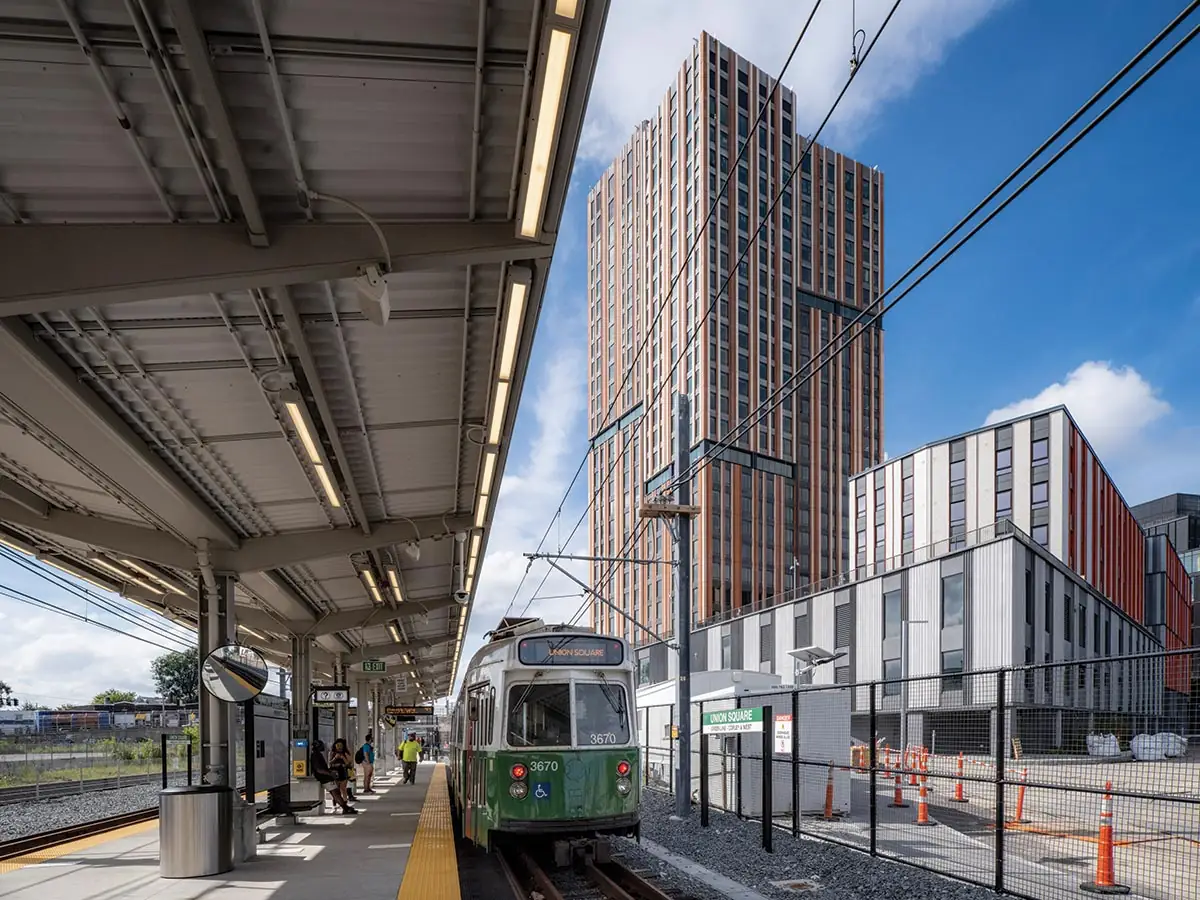
50 Prospect aims to create density around a new transportation hub. Photo © Alex Fradkin
The project combines two known building types, the point tower and the mid-rise bar building, which wraps around and over the concrete parking deck. The high-rise portion of the project is a square-footprint tower with 14 units wrapped around a compact core. The massing of a point tower is less efficient than the typical high-rise bar building, but its small floor plate minimizes the building profile on the skyline and limits the shadows cast on its neighbors. The cost of the elevators, pressurized stairs, and fire-rated construction, is offset by efficiencies achieved by building to a certain height—in this case, 25 stories.
The cladding for the tower is made up of precast panels (known as “donuts”). The facade panels were designed with a vertical texture of alternating bands of color—reds and oranges, creams and grays—derived from the palette of existing buildings in the Union Square neighborhood. The economies of scale of the precast panel facade and a girder slab structure allowed the project to be built quickly and cost-effectively, producing 460 units of housing, 20 percent of which (92 units) are affordable. Boosting density near transit, the new residential tower acts as an “advocate,” marking the terminal station as the right place for height.
Like politics, all design is local. These three projects provide a cross section of housing types in different Boston neighborhoods. They are an outcome of years-long processes of negotiation and engagement, multiple stakeholders, trade-offs, and creative problem solving at multiple scales. Urban housing is a constraint-based process that highlights the agency of architecture as part of a larger collective endeavor of city-making.
Click drawing to enlarge
Looking for a reprint of this article?
From high-res PDFs to custom plaques, order your copy today!