A New Airport Terminal in Bengaluru Brings Nature Inside
Bengalaru, India

Architects & Firms
Well before Bangalore became known as a center of high-tech and information industries, it earned the moniker “the Garden City of India” in response to its plentiful public parks and a temperate climate that nurtures a broad range of flora. The New York office of Skidmore, Owings & Merrill (SOM) leaned into this horticultural legacy in its design of Terminal 2 at Kempegowda International Airport, the rapidly growing transit hub about 20 miles north of the city now known as Bengaluru. “The streets in Bangalore are often lined with trees, and the city has a rich history of landscape design,” says Laura Ettelman, the managing partner for the project. “The idea was to create a terminal in a garden,” says Roger Duffy, a former design partner at SOM.
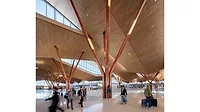
From the moment travelers arrive at the new terminal to the time they spend waiting to board their planes, they find themselves surrounded by trees, plants, and flowers—many hanging from the terminal’s bamboo-lattice ceiling, others growing on green walls, and some in a “forest belt” between the building and the 11 new aircraft gates. Landscaped outdoor spaces play a vital role in the project’s design, establishing a remarkable degree of indoor-outdoor fluidity for a modern airport with all the standard security protocols. The greenery was a response to Indian cultural practices, sustainability concerns, and a local climate that’s comfortable for most of the year, thanks to Bengaluru’s altitude of about 3,000 feet above sea level.
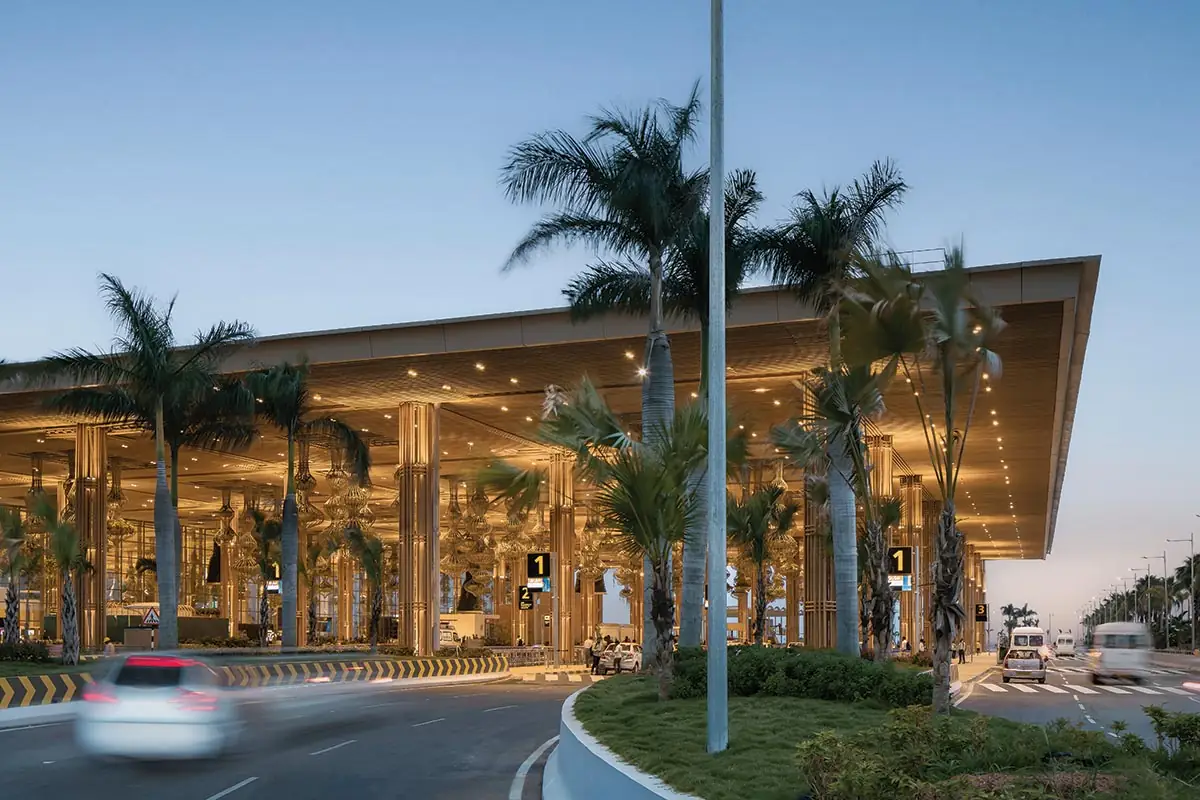
Bamboo cladding and hanging plants add warmth to spaces throughout the terminal, including the drop-off area (above and top of page). Photo © Ekansh Goel, click to enlarge.
The 2.75 million-square-foot terminal will handle 25 million passengers each year and help prepare the airport for additional growth, including a 1.3 million-square-foot multimodal ground-transportation hub on the west, now under construction, and an extension to the south of the new terminal still on the drawing board. Much of the SOM team had previously worked on a new terminal at Chhatrapati Shivaji International Airport in Mumbai that opened in 2014. While the project in Mumbai offered a sculptural response to a complex program—employing an enormous undulating roof—the terminal in Bengaluru takes a more orthogonal approach to the roof structure. Designed for modular construction and structural efficiency, it is one of the lightest large-scale terminal roofs in the world, according to the architects. The portions above the check-in and retail halls use long-span steel moment frames supported by steel columns set on a 59-foot (18-meter) grid. Each column brings together a cluster of four steel posts clad in bamboo, a material that grows rapidly and appears throughout the project. In the gate areas, the design team used long-span steel trusses that push columns to the periphery and keep walkways and sight lines open. For the lower floors, the architects created a uniform grid of reinforced-concrete moment frames that provides large column-free spaces for the baggage-claim and arrival areas.
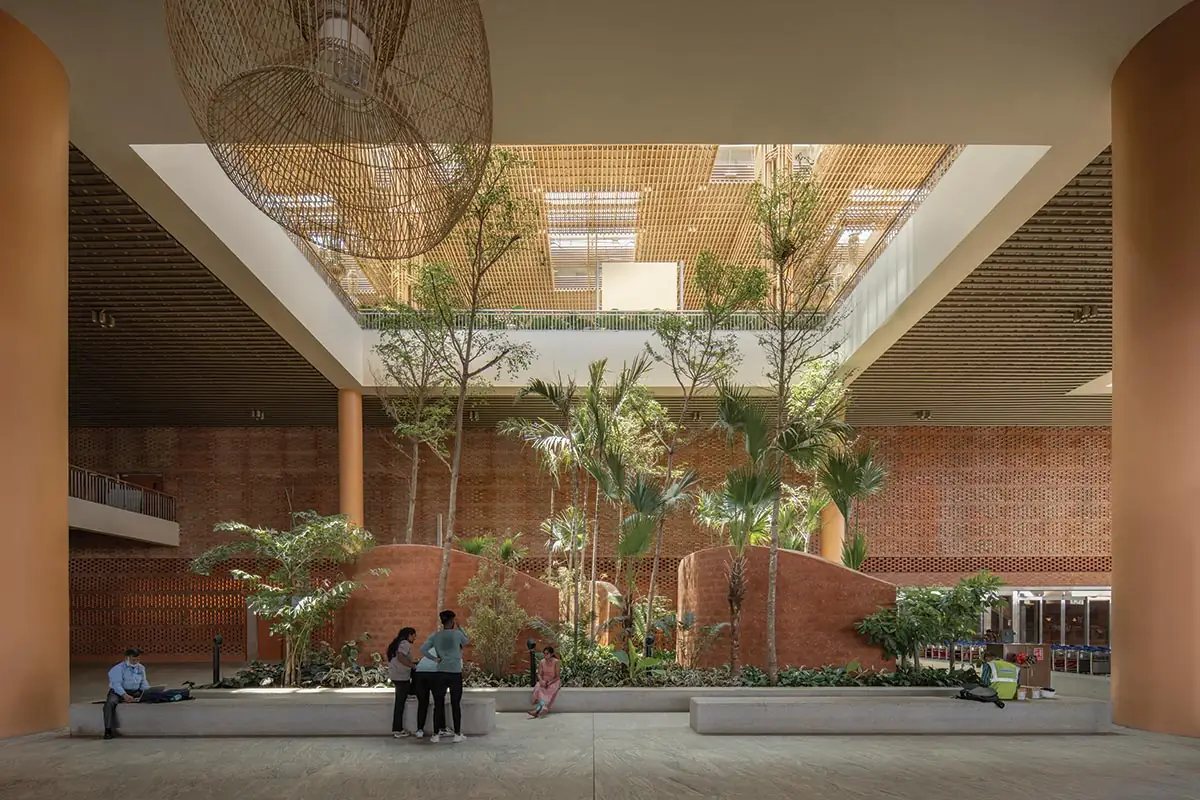
The experience working on the Mumbai airport helped SOM understand how Indian culture affects transportation buildings. For example, it’s common in India for families to accompany travelers to airports, even though people without tickets are not allowed in terminals. So SOM designed a large covered plaza between the multimodal transit hub and the terminal at Bengaluru for families to gather, shop, eat, and wish each other “bon voyage.” “We wanted it to be generous and welcoming,” says Peter Lefkovits, a design principal on the project.
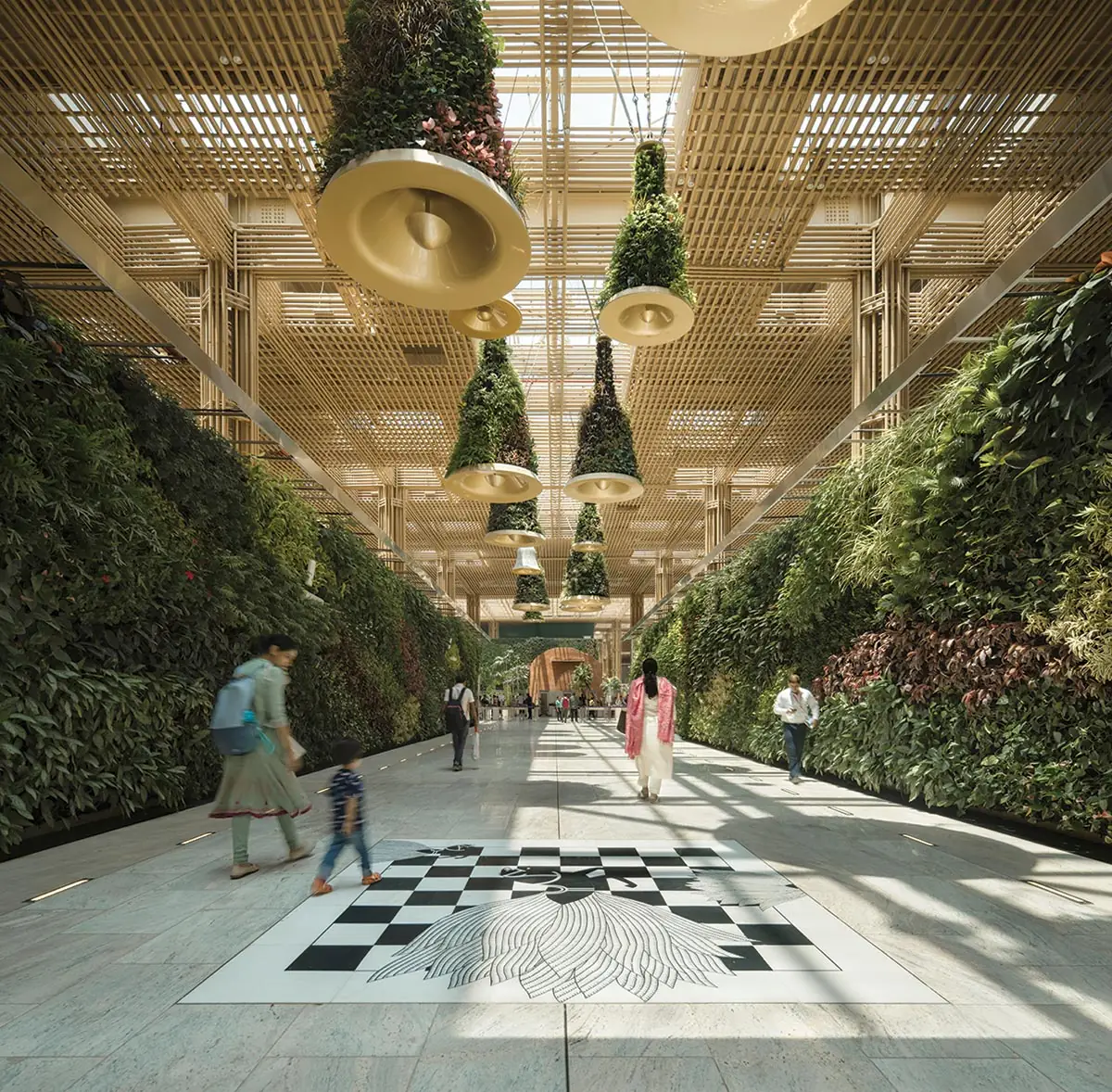
Inside the terminal, the expansive grid structure and bamboo-lattice ceiling provide adaptability so interiors can change as new technologies for check-in and security are deployed. Already, some check-in counters use facial-recognition systems. Instead of installing planters on the floor, SOM and landscape architects at Grant Associates suspended an indoor jungle of plants and flowers from the ceiling, creating a more flexible interior. Skylights above and large perimeter curtain walls bring plenty of daylight inside. Fashion designers Abu Jani and Sandeep Khosla assisted with furnishings that use local materials such as rattan and helped with the design of planters inspired by local bronze bells and hanging baskets reminiscent of Ruth Asawa sculptures. To underscore the seamless flow of outdoors and indoors, the suspended planters extend from the deep roof eaves over the drop-off area in front of the terminal all the way through the building. They also provide directional cues to travelers, forming tighter clusters in high-traffic areas and spreading out in less busy parts of the terminal.
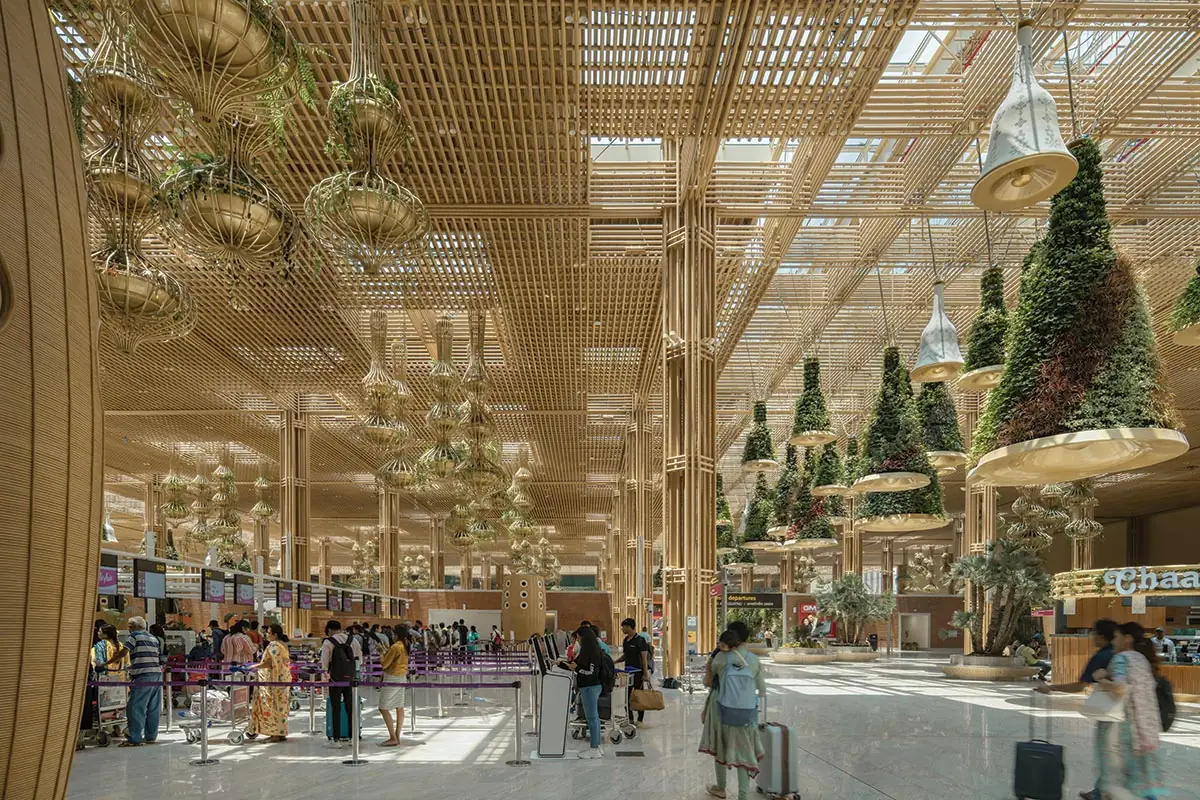
Daylight streams in above the check-in area. To help passengers navigate the terminal, suspended “bells” and planters cluster most tightly in high-traffic areas. Photo © Ekansh Goel
Sustainability was a driving force behind the design, informing the roof eaves shading much of the building’s glazed perimeter and a daylighting system that includes extensive skylights above the main public spaces. The architects say the terminal will rely entirely on renewable energy (mostly solar, supplied by on-site and off-site arrays). The project captures, treats, and reuses rainwater from the building’s roofs and the site to irrigate plantings both indoors and out. To complement the glass, steel, and concrete of the building’s structure, SOM specified brick for interior walls, local granite for flooring, and engineered bamboo (treated for fire protection and insect resistance) for many interior surfaces and roof soffits. These materials give the large public spaces a warm, tactile quality and connect them to the local building tradition. In the retail area, water trickles down freestanding red-stone walls to add another touch of nature. The project is the largest terminal in the world to be precertified as a LEED Platinum building by the USGBC, before it opened. It also earned Platinum certification for sustainable architecture and design from the Indian Green Building Council.
Indian airports operate 24 hours a day, so SOM designed Terminal 2 to adapt to daily changes in the flow of domestic and international flights. All of the terminal’s gates offer “swing” capability, which allows them to handle either one large-body aircraft (most often used for international flights) or two small planes (for domestic travel).
Looking for quick answers on architecture and design topics?
Try Ask RECORD, our new smart AI search tool.
Ask RECORD →
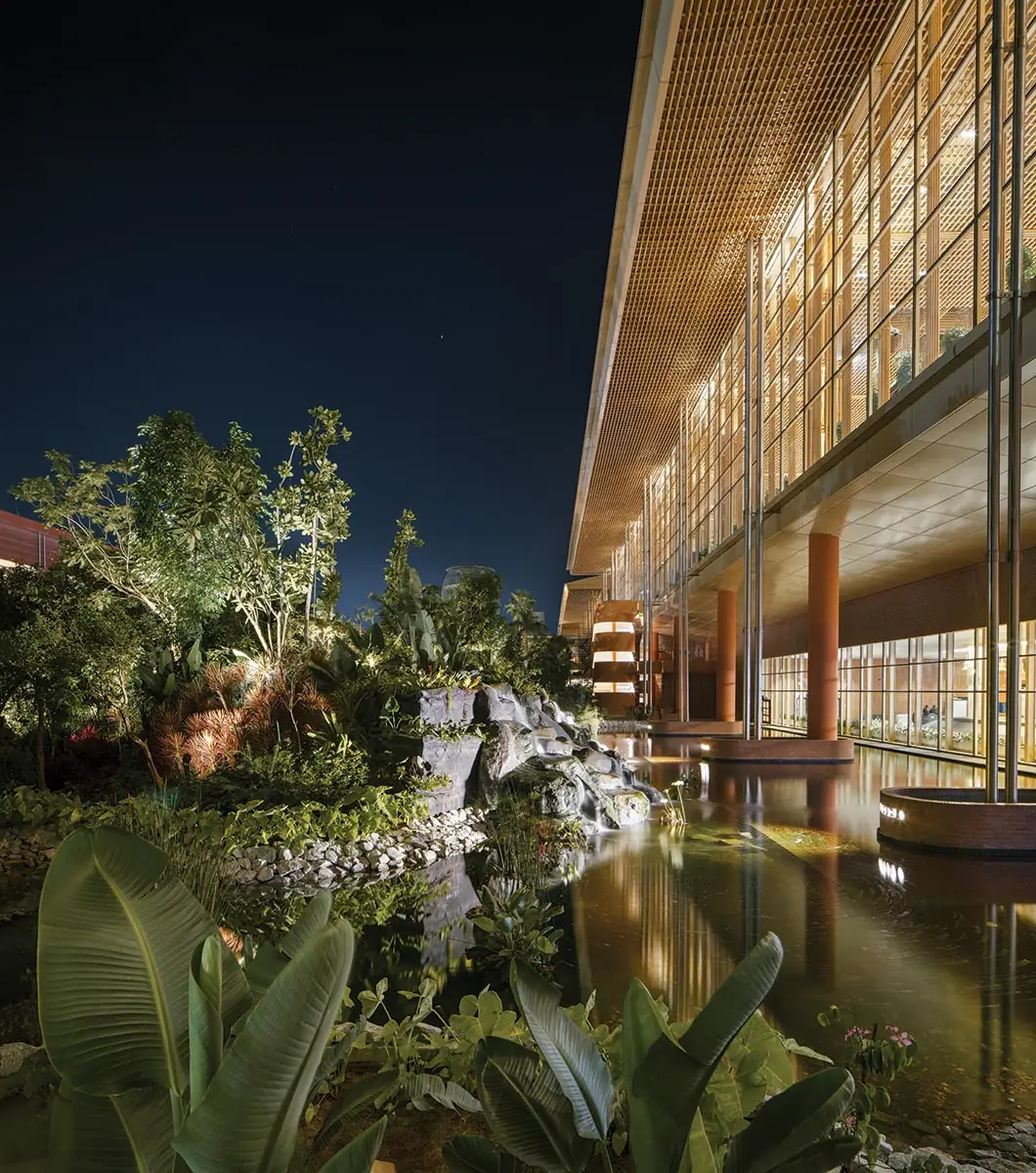
Perhaps the most striking aspect of the project is the so-called forest belt, a 250,000-square-foot landscape separating the “landside” building—the portion before security checkpoints—from the departure gates. Enclosed bridges cross the outdoor area, connecting the landside structure to the gates, while two-story garden pavilions offer places for travelers to relax before their flights take off. SOM worked with Grant Associates on the outdoor feature, using native flora for the landscape and bamboo pavilions inspired by traditional cane weavings.
1
Landscaped spaces such as the arrivals plaza (1) and the “forest belt” (2) adjacent to the departure gates embrace the outdoors as integral parts of the terminal, while green walls and suspended plants bring nature indoors (3). Photos © Ekansh Goel
2
3
Airport terminals are essentially machines for processing travelers and often glorify notions of speed and efficiency. “Don’t worry, we’ll get you there as fast as possible,” they try to say. The new building at Kempegowda Airport has a different message for passengers: “Relax, go outside, enjoy a bit of nature.”
Credits
Architect:
Skidmore, Owings & Merrill — Roger Duffy, Colin Koop, design partners; Laura Ettelman, managing partner; Peter Lefkovits, Derek A.R. Moore, design principals; Jason Anderson, Jordan Pierce, Seok Yoon, William Emenecker, Nick Winter, Christoph Timm, Elizabeth Sennott, Tamicka Marcy, Xialu Xu, Blake Altshuler, Ece Calguner Erzan, Lauren Kosson, project team
Engineers:
Skidmore, Owings & Merrill — Preetam Biswas, Charles Besjak, Georgi Petrov, Alexander Jordan, Stanley King (structural); Arup (m/e/p/f for Terminal 2); Buro Happold (m/e/p/f for multimodal transit hub)
Consultants:
Grant Associates (landscape); Abu Jani and Sandeep Khosla (interior design); STUP Consultants (landside infrastructure); BNP Associates (baggage); Ch2m Hill (airside facilities)
General Contractor:
Larsen & Toubro
Client:
Bangalore International Airport Limited (BIAL)
Size:
4.1 million square feet (including multimodal hub)
Cost:
$600 million
Completion Date:
September 2023
Sources
Curtain Wall:
Geotrix Building Envelope
Roofing:
Kalzip
Interior Brick:
L&T (locally made)
Rattan Millwork:
Sreeji & Rachana Art
Light Fixtures in Gate Lounges:
Rachana Art + Regent (custom)
Elevators / Escalators:
Otis
Looking for a reprint of this article?
From high-res PDFs to custom plaques, order your copy today!