RECORD Forum
Civic Renaissance: Rethinking Municipal Centers
Amid convulsions of political division that dominate headlines, recent projects to revitalize America’s aging civic centers express hope that our citizens, inspired by public-space design that is experiential and community-driven, can come together. Most remarkably, these projects demonstrate a political will and commitment without which the most skillful designs and programming would be for naught.
Across the country, many set-piece Beaux-Arts civic centers and their Midcentury Modern counterparts have worn out their welcome. The notion of a “civic center” has devolved into a hackneyed urbanist conceit conjuring threadbare notions of civic grandeur. Beaux-Arts ensembles like those in San Francisco, St. Louis, and Cleveland embodied the City Beautiful Movement as an antidote to 19th-century urban squalor. As the automobile took over in the 1950s and downtowns hollowed out, they became disused precincts that repelled daily activity yet still commanded vast swaths of real estate and municipal budgets.
Many Midcentury Modern and Brutalist city halls and civic centers—like those in Boston, Dallas, and Long Beach, California—have fared even worse. Their designs often ignored exigencies of climate, accessibility, or community priorities, to promote visions of Great Society optimism and American progress. In his 2013 cri de coeur to demolish Boston City Hall, Boston Globe columnist Paul Murrow observed, “Its great crime isn’t being ugly; it’s being anti-urban.” This “island of inactivity,” in an otherwise bustling commercial district, is perhaps the most famous example. But it is far from alone.
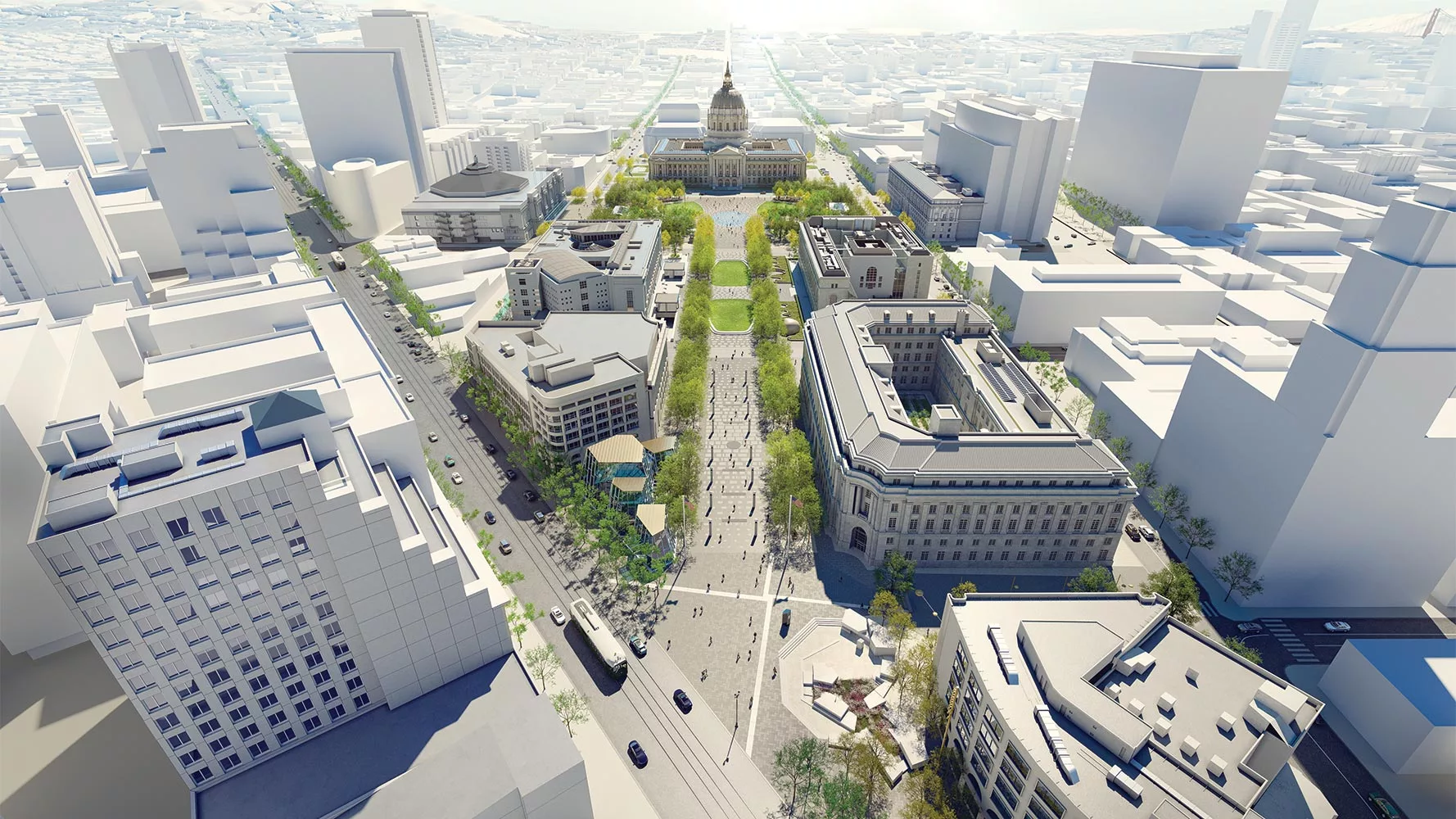
Throughout the U.S., citizens and their local governments have recognized that these ill-conceived spaces hinder the rebirth of their urban cores. Many have joined campaigns to retake their civic centers, to make them accessible and responsive to community needs. Completed rethink projects in Philadelphia, Los Angeles, and Boston, as well as the proposed San Francisco Civic Center Public Space Plan, all aim to turn these imperious bastions into amenities for daily use by all citizens. The challenge is to design open spaces that cultivate new uses, extend invitations to surrounding neighborhoods, and maintain capacity for mass gatherings—all while contending with the array of subterranean garages, transit stations, and other utilities constructed over the years.
A complementary strategy involves reactivating the edge-defining buildings and spaces of these great urban rooms with tactical interventions. Civic buildings of Beaux-Arts, Brutalist, and Modernist conception are typically citadels with single points of access, elevated first floors, or dry moats that drain life from surrounding streets. Interventions that enhance transparency, open new access points, and introduce mixed uses are game changers. The San Francisco Public Space Plan by CMG Landscape and Kennerly Architecture proposes to transform the dead frontage of the Bill Graham Civic Auditorium with new, glazed food-and-beverage pavilions, ticket booths, and a lantern-like access point to the Brooks Hall space below the plaza. These interventions will recharge the adjoining streets and public spaces. Complications include historic-building designations, and code upgrades that can delay approvals, add cost, or obviate the intent of the interventions that triggered them.
When working among beloved structures, a deft remodel within the existing spatial frame can be a transformative strategy. Flanking the west side of Philadelphia’s City Hall, Dilworth Park is a 2014 redesign of a 1972 plaza. Previously a barren blend of Beaux-Arts geometry and a Brutalist stratum of planes and pits, the new park by OLIN and KieranTimberlake is an appealing mix of formal architecture and places for casual interaction. The Center City District and the Central Philadelphia Development Corporation adopted the plaza and partnered with the city to advocate and execute the finished plan.
The alternative strategy is to rebuild outright. In Long Beach, the 1978 modernist superblock by Don Gibbs, consisting of a City Hall tower and a public library sunken beneath a tiered public park, was recently demolished as part of a new master plan by SOM. The new city hall and public library have been completed, the street grid has been restored, and Lincoln Park rebuilt at its original 1880 location. Plenary Edgemoor Civic Partners led the effort under a public-private partnership model. While the restored urbanism is salutary, the lack of architectural ambition is regrettable. The iconic city halls of Philadelphia and San Francisco announce their importance on the skyline and the street. The new Long Beach City Hall could be mistaken for a speculative office block.
Looking for quick answers on architecture and design topics?
Try Ask RECORD, our new smart AI search tool.
Ask RECORD →
Other cities have opted to develop more daring ground-up city hall buildings, like those in Austin by Antoine Predock, Seattle City Hall by Bohlin Cywinski Jackson, and San Jose City Hall by Meier Partners. Their lingua franca is transparency and dramatic gestures that invite pedestrians. No longer stern vessels of governmental self-importance, they aspire to be community hubs.
It may take decades for a movement that can effect action to gather itself. Turnover at stakeholder groups or emerging crises can take wind out of sails. All the thoughtful work that goes into these plans will be marooned in political doldrums without a committed champion or a framework to ride the groundswell of civic pride and frustration. After failed attempts to revitalize New York’s Bryant Park in the 1970s, Dan Biederman and Andrew Heiskell backed its restoration in 1980; 32 years after its reopening in 1992, it is still a gem. In Boston, former mayor Marty Walsh reignited the City Hall Plaza redesign after various concepts marinated for 20 years during his predecessor Thomas Menino’s tenure. Sasaki’s redesigned plaza opened in 2023 as its first phase, with building interventions by Utile Architecture to follow. Current mayor Michelle Wu’s high regard for the building strengthens its chances of success.
In all these examples, landscape and architecture are wedded through two codependent strategies catalyzed by thoughtful community engagement, open-space design and reprogramming, along with the activation of streets and the buildings lining them. This reciprocity among architecture, landscape, and community programming is the secret of successful projects.
In San Francisco, an advocate has yet to emerge around the proposed Civic Center Public Space Plan. Originally conceived and promoted by the late mayor Ed Lee, the plan was crafted in 2020 and rolled into the environmental-review process. Lee’s premature death, along with the onset of the Covid-19 pandemic, presented both loss of a political champion and a sudden shift in civic priorities. As the city lumbers through pandemic recovery with a frayed public realm, the time is ripe to reengage this plan to invigorate the city’s civic heart.
Looking for a reprint of this article?
From high-res PDFs to custom plaques, order your copy today!