Spotlight
The Valentine's New Exhibition in Richmond Confronts the City's Confederate Legacy
Richmond, Virginia
Architects & Firms
On the evening of June 10, 2020, at the height of that year’s nationwide uprising against racial injustice and police brutality, a group of protestors gathered around a statue of Jefferson Davis, the first and only president of the Confederate States of America, on Richmond’s Monument Avenue. The 1.6-mile-long boulevard, lined with Gilded Age–era mansions and studded with memorials to Confederate heroes, had become a focal point of the city’s activists that summer. Tying ropes around the statue’s limbs, the group hauled it off the pedestal to the ground.
Today, the bronze statue, made by Richmond-born artist Edward Valentine (1838–1930), can be seen at the Valentine museum, which was founded at the behest of Edward’s brother Mann S. Valentine II in 1898 and focuses on the history and culture of the city. Splayed out on his back in the museum’s central gallery, Davis is presented in the condition in which he was toppled, spattered in pink paint with the remnants of a paper-tissue noose poking out from around his collar. His head is crushed from the fall, and his right arm, now gesturing at the ceiling, is severed from the shoulder. The statue is on loan from its current owner, the Black History Museum of Virginia, as part of the Valentine’s core exhibit, This Is Richmond, Virginia.
Earlier this year, the museum unveiled a new long-term exhibition titled Sculpting History in Valentine’s 640-square-foot former studio, which reevaluates the sculptor’s legacy in Richmond’s post–Civil War history and contextualizes his work in the formative mythology of the Lost Cause. Nearly four years in the making, the exhibition came together through an intensive co-design process with Richmond citizens, educators, and museum stakeholders, alongside New York–based architecture firm Studio Joseph.
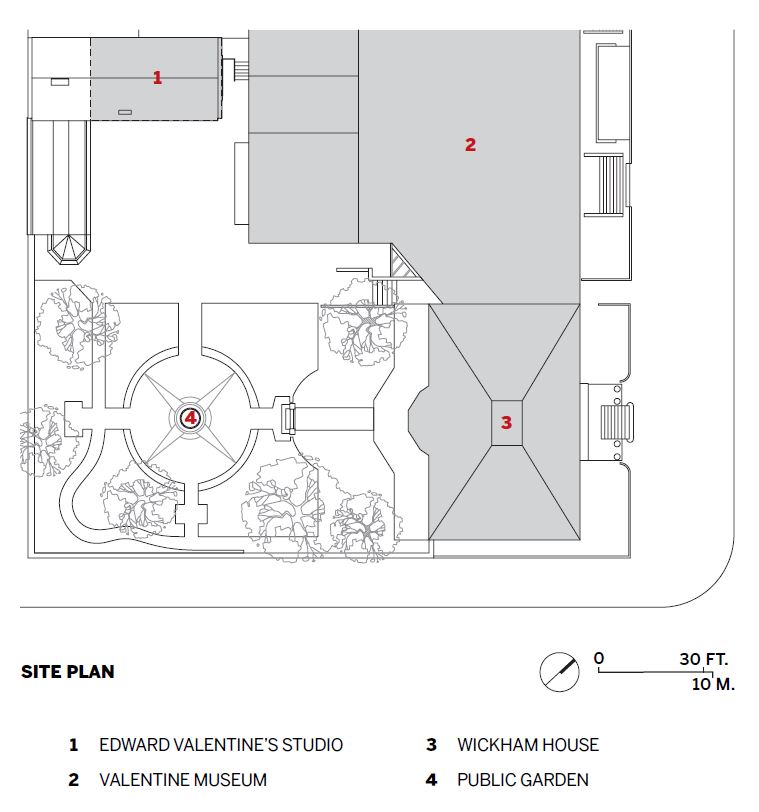
The museum’s studio building, a wood-framed former carriage house, was moved from its original site a mile away to the Valentine campus in 1937; it now abuts the site’s stately 1812 mansion and a 1977 redbrick addition that houses the main galleries and offices, and opens on a public garden. The studio was used as storage space until 1969, when the first exhibition devoted to the life and work of Valentine opened. When the space was shuttered in the summer of 2020, the exhibition hadn’t been updated since 2003. The museum began the process of sending out exploratory surveys to community members that year, and Studio Joseph was brought on as design architect in late 2021. In addition to designing the exhibition, the firm also pulled off a tricky overhaul of the existing historic structure, upgrading all mechanical systems, re-staining and repainting all surfaces, and rebuilding the roof structure.
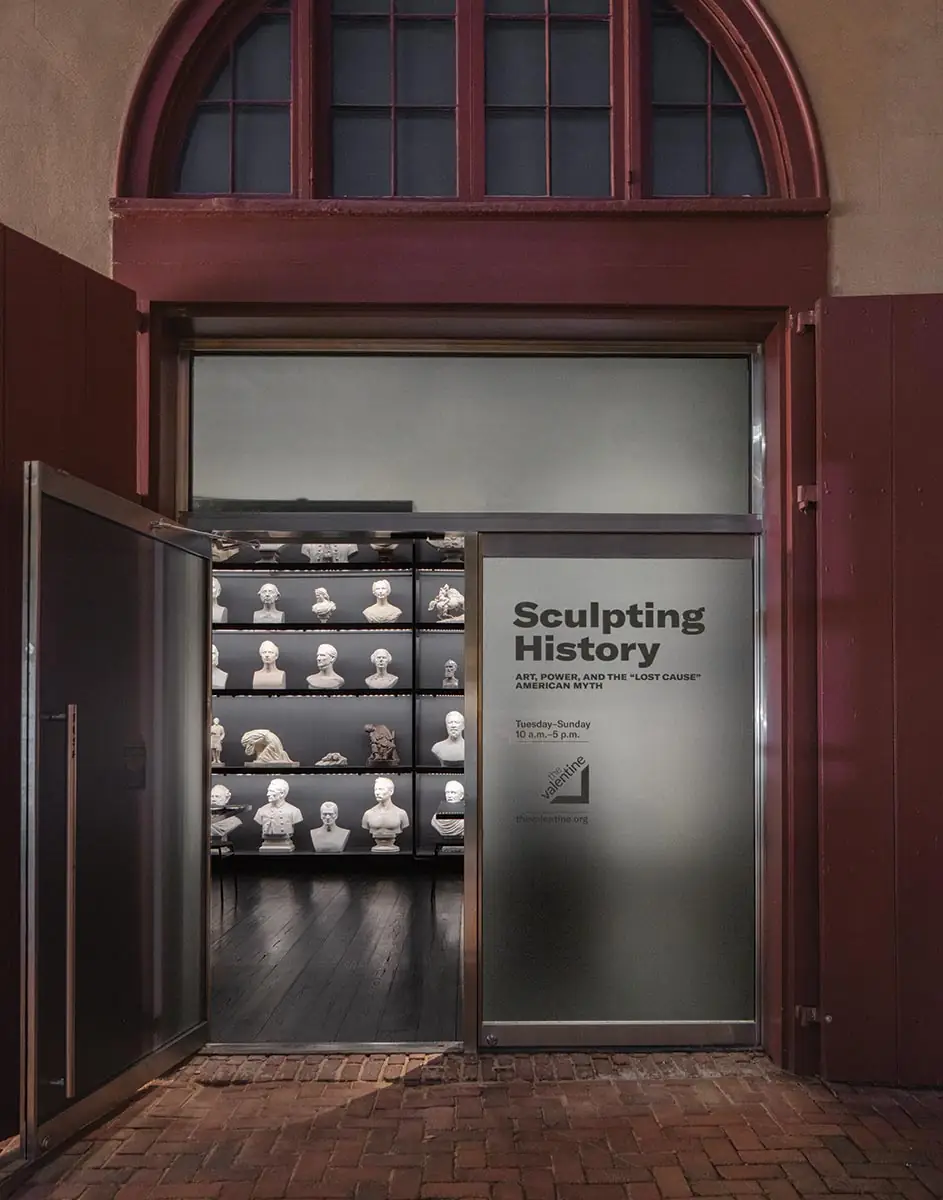
1
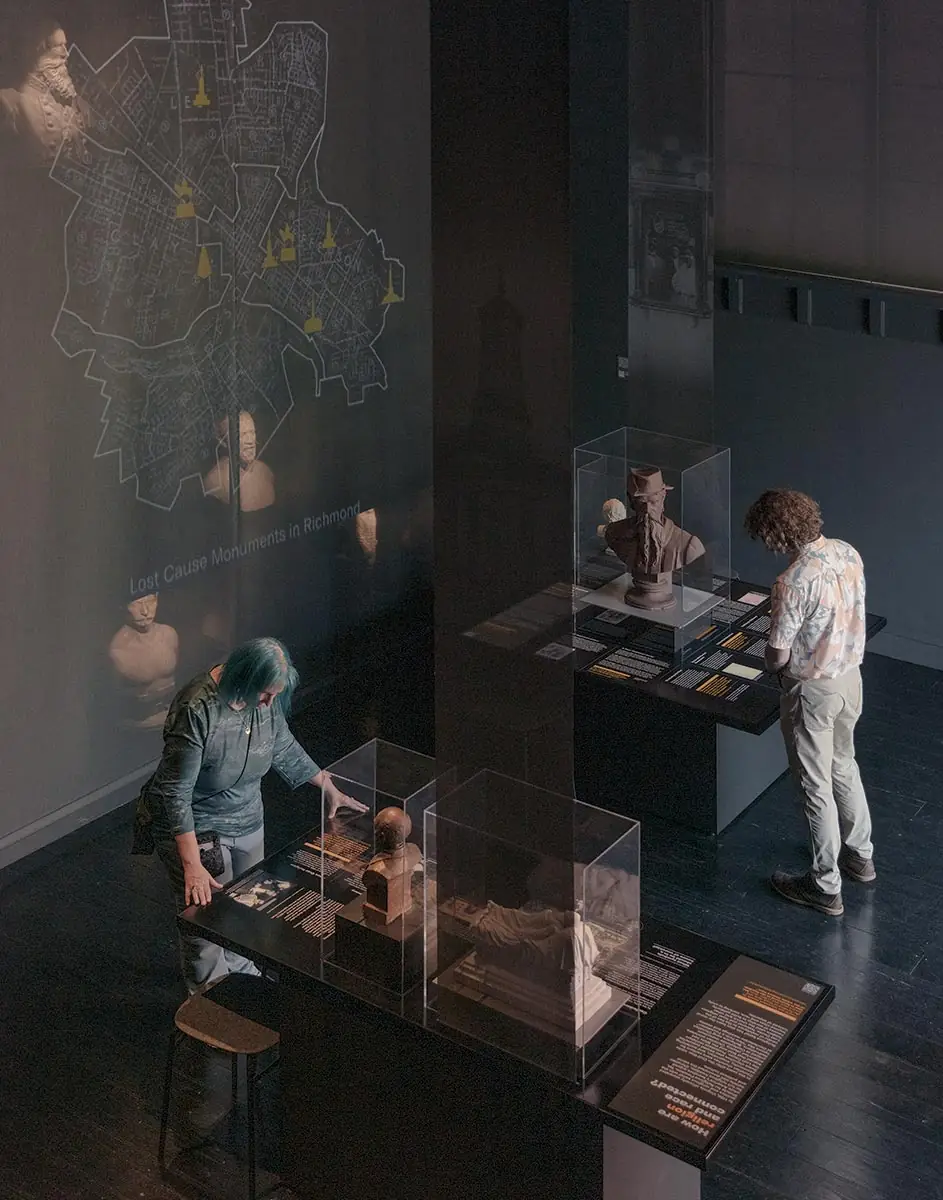
2
In 1877, sculptor Edward Valentine transformed a two-story carriage house (1) into his studio. The space’s current exhibition (2) takes full advantage of the 1830s structure’s high ceilings. Photos © Naho Kubota, click to enlarge.
“Whenever you come into a project, there’s an overall public context,” says Wendy Evans Joseph, who founded Studio Joseph in 1998. “But, in this case, the public context was much more inextricably linked to the project at hand. This was a national conversation that had been ignited in a hyper-local way.”
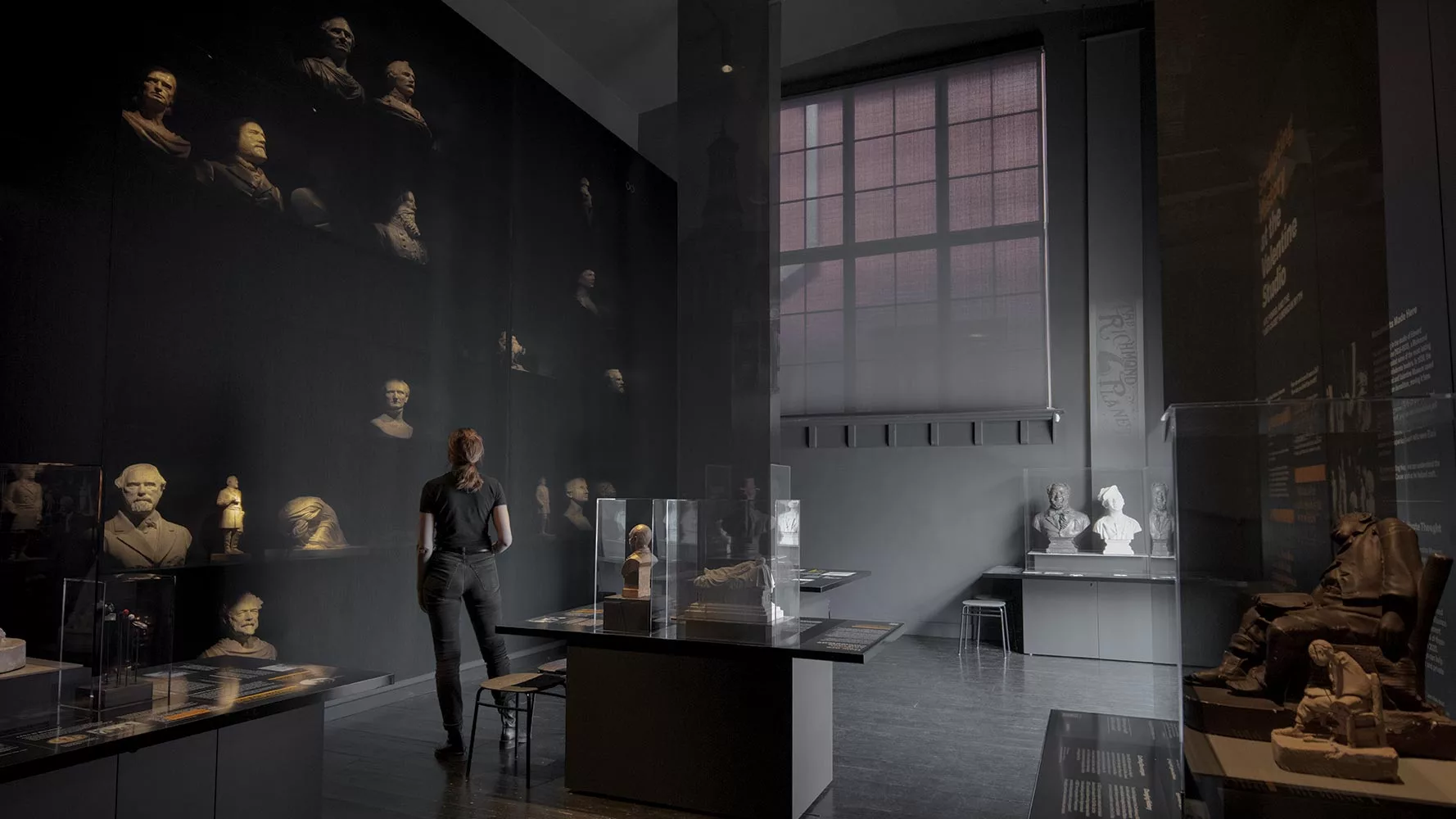
Stepping into the studio today, it takes a moment for your eyes to adjust to the dark—the floors and walls are painted a deep gray, absorbing the sparse light that trickles in from the glass doors at the entrance and from gaps around the edges of the screen covering the space’s sole window high up on the east-facing wall. Attention first goes to the black scrim that covers the far wall, upon which is projected a 15-minute multimedia presentation. Behind the scrim—which takes full advantage of the small space’s 20-foot-high ceilings—are 84 of Valentine’s works, arranged on a steel-framed shelving system. Throughout the presentation, various pieces of statuary are illuminated, then plunged back into darkness as the narrative arc of the exhibition unfolds.
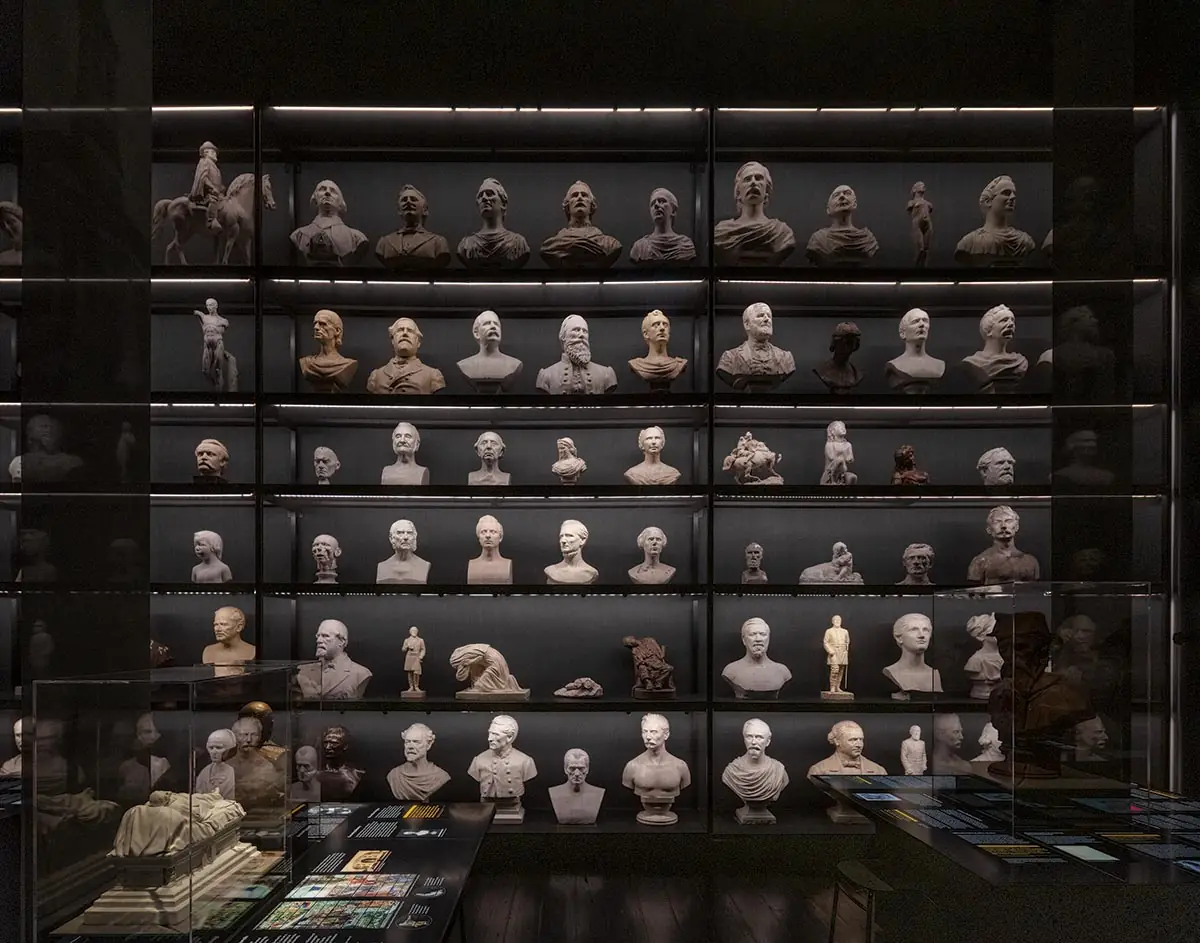
Behind a black scrim, an illuminated shelving display on the studio’s north wall hosts a curated selection of Valentine’s works. Photo © Naho Kubota
“We knew from the beginning that we really wanted to keep Edward Valentine’s statuary in the studio, but in a way that wasn’t overwhelming for the visitor,” says Joseph. “The idea to showcase various pieces under the control of a new narrative allowed us to create a little more breathing space for people.”
Looking for quick answers on architecture and design topics?
Try Ask RECORD, our new smart AI search tool.
Ask RECORD →
Valentine committed his craft to the Lost Cause mythology, which the museum defines as the concerted effort on the part of Southern gentry, from the 19th century to today, to culturally reframe the Civil War as a conflict that was over states’ rights, and slavery as mutually beneficial to enslavers and enslaved.
Over the course of his 50-year career, the sculptor worked in clay, plaster, marble, and bronze to produce portrait busts and public sculptures honoring Confederate heroes—as well as overtly racist caricatures, many of them in the very space now occupied by the exhibition.
“The trick here was to inhabit the space without erasing its presence as Valentine’s studio,” says Joseph. “You needed to understand the whole volume, but in such a way that the historical weight doesn’t come crashing down on you.” Spread throughout the room, at just below waist height, are five tables covered with lightly illuminated graphic panels that explore how racism pervades and intersects with the realms of money, education, religion, media, politics, and violence. Artifacts are set on the table’s surfaces, including 19th- and 20th-century art objects and a display of projectiles shot at 2020 protestors by Richmond police.
“It’s a small space to have a big discussion,” says Christina Vida, the museum’s curator of general collections. “In the end, we’re telling the story of how a fiction was made into an accepted truth.”
During the protests of 2020, which erupted after the killing of George Floyd at the hands of a Minneapolis police officer, at least 90 Confederate monuments were removed from American cities, either by protestors or municipal governments. Three weeks after the Davis sculpture fell in Richmond, the city’s mayor ordered the removal of Monument Avenue’s remaining Confederate statues, as well as 12 others around the city.
Though the street’s symbolic core has disappeared with its monuments, the legacy of what they represented has not. Sculpting History’s narrative scope expands far beyond Valentine’s lifetime, discussing redlining, police violence, and school segregation. “Folks need to leave with this knowledge that the altering of the public’s perspective of the Civil War and slavery has real policy and cultural impacts in our region today,” says Vida.
The Valentine museum sits just a couple of blocks away from the city’s Capitol Square, a public complex which contains the state’s legislature buildings and houses of power, and where a prominent statue of Stonewall Jackson still stands—a poignant reminder that in this former capital of the Confederacy, the work of dismantling the harmful narratives perpetuated by the Lost Cause myth is far from over. As Sculpting History attempts to show, the arc of history cannot be confined to a single avenue or statue; our cities themselves are historical artifacts, preserving the darkness of America’s past in their streets, civic centers, and institutions. Only through a sustained effort to reckon with this embedded history can we begin to build a more just and equitable future.
Click plan to enlarge
Credits
Architect:
Studio Joseph — Wendy Evans Joseph, project lead; Monica Coghlan, design lead; Anthony Roy, graphic design lead; Ksenia Dynkin, media and content strategy; Ruben Gomez, Alexandra Adamski, Brandon Studer, Fiorella Basso, designer team
Consultants:
Barbizon (lighting design); CYI Studio (media animation); Josh Epperson, Kate Sunderlin (curatorial content)
General Contractor:
Kjellstrom + Lee
Client:
The Valentine
Size:
640 square feet
Cost:
$673,000 (exhibition design); $244,000 (construction)
Completion Date:
January 2024
Looking for a reprint of this article?
From high-res PDFs to custom plaques, order your copy today!