Architectural Record
search
cart
facebook twitter linkedin youtube
  • Sign In
  • Subscribe
  • Sign Out
  • My Account
Architectural Record
  • NEWS
    • Latest News
    • Awards
    • Interviews
    • Obituaries
    • Podcasts
      • Design:Ed Podcast
      • Sponsored Podcasts
  • OPINION
    • Book Reviews / Excerpts
    • Exhibition Reviews
    • Forum
  • EXCLUSIVES
    • Videos
    • Design Vanguard
    • Top 300 Firms
    • Sponsored Content
    • Sponsored eBooks
    • From the Archives
  • CONTINUING ED
    • Editorial Continuing Ed
    • CE Center
    • CE Academies
  • PROJECTS
    • Buildings By Type
    • Reuse & Renovation
    • Museums & Arts Centers
    • Colleges & Universities
    • Multifamily Housing
    • Interiors
    • Lighting
    • Kitchen & Bath
  • HOUSES
    • Record Houses
    • House of the Month
    • Featured Houses
  • PRODUCTS
    • Products by Category
    • Record Products of the Year
    • Latest Products
  • EVENTS
    • Dates & Events
    • Record on the Road
    • Innovation Conference
    • Sustainability in Practice
    • Women In Architecture
    • Webinars
    • Ad Excellence Awards
    • Submit an Event
  • CONNECT
    • Ask RECORD AI
    • Newsletters
    • Contact
    • Advertise
    • Editorial Calendar
    • Store
    • Customer Service
  • SUBMIT
    • Submission Guidelines
    • RECORD Competitions
  • MAGAZINE
    • Subscribe
    • My Account
    • Digital Edition
    • Current Issue
    • Firm Pass
    • Historic Archive
Architectural TechnologyArchitect Continuing EducationResidential Architecture

Continuing Education: Prefabrication

Polyhaus’s Tiny Mass-Timber ADU Offers a Possible Solution to a Very Big Housing Problem

San Diego

By Russell Fortmeyer
Polyhaus
The first Polyhaus. Photo © Andy Cross and Cody Cloud
January 3, 2025
✕
Image in modal.

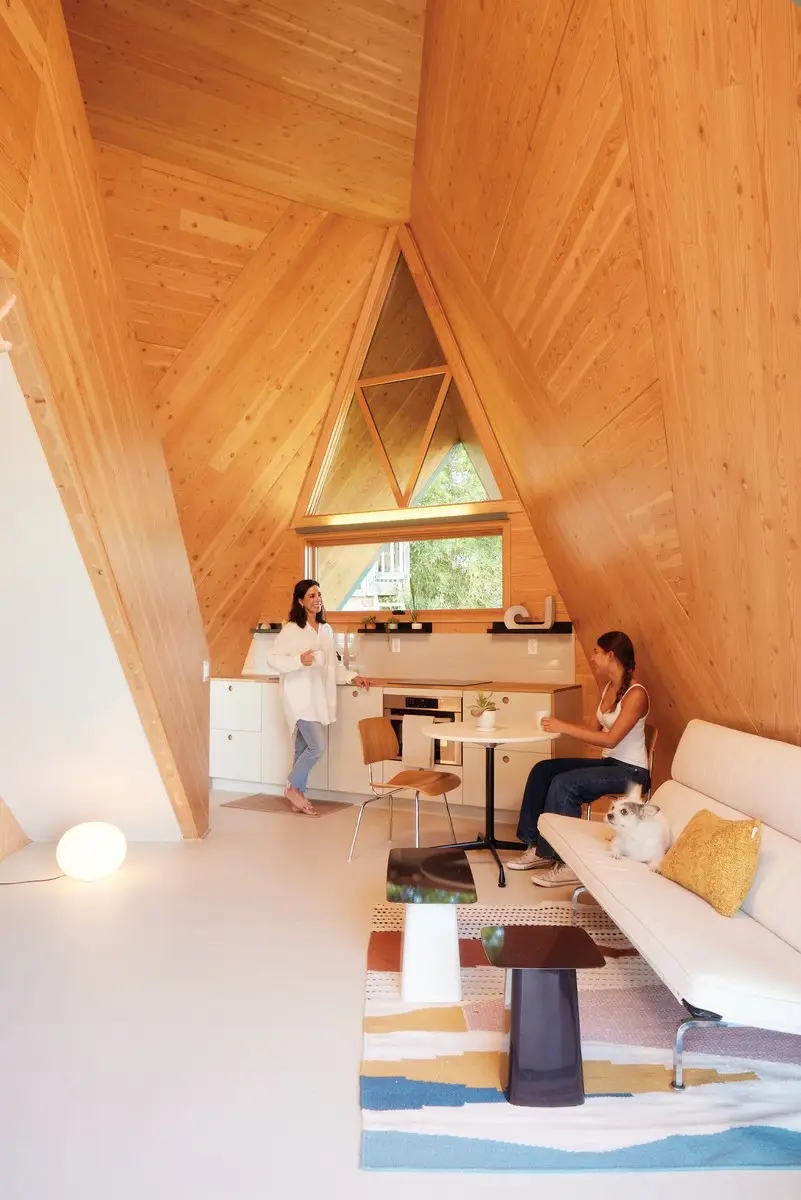
Unlike many of the prefabricated accessory dwelling units (ADUs) flooding the California market, the Polyhaus does not fit on a flatbed truck fully assembled. The polyhedron-shaped house was conceived by Daniel López-Pérez as a solution for expediently producing quality housing at scale in the smallest footprint possible, rather than as a rectangular box for ease of shipping. With his wife and Polyhaus LLC cofounder, Celine Vargas, López-Pérez built the first two-story, 540-square-foot proof-of-concept in 2024 in the backyard of the couple’s 1962 Palmer & Krisel house, in San Diego.
Polyhaus.

The first Polyhaus (above and top of page), a 540-square-foot, two-story metal-clad and CLT structure, was built last year in San Diego. Photo © Andy Cross and Cody Cloud, click to enlarge.

López-Pérez, who is professor and architecture-program director at the University of San Diego, developed the Polyhaus system by starting with a simple cube and then repeatedly truncating the edges until he optimized the form for the largest volume and smallest footprint. The 440-square-foot ground floor includes a living room, kitchen, bathroom, and nook for a desk and washer/dryer, with the bedroom on the 100-square-foot mezzanine. “Polyhaus is a design and construction-technology company,” says López-Pérez, which he contrasts to ADU manufacturers that provide a built product. The couple view their 17-foot, 4-inch-tall Polyhaus as a research-and-development investment to bring the timber innovations revolutionizing large-scale construction down to smaller scales.

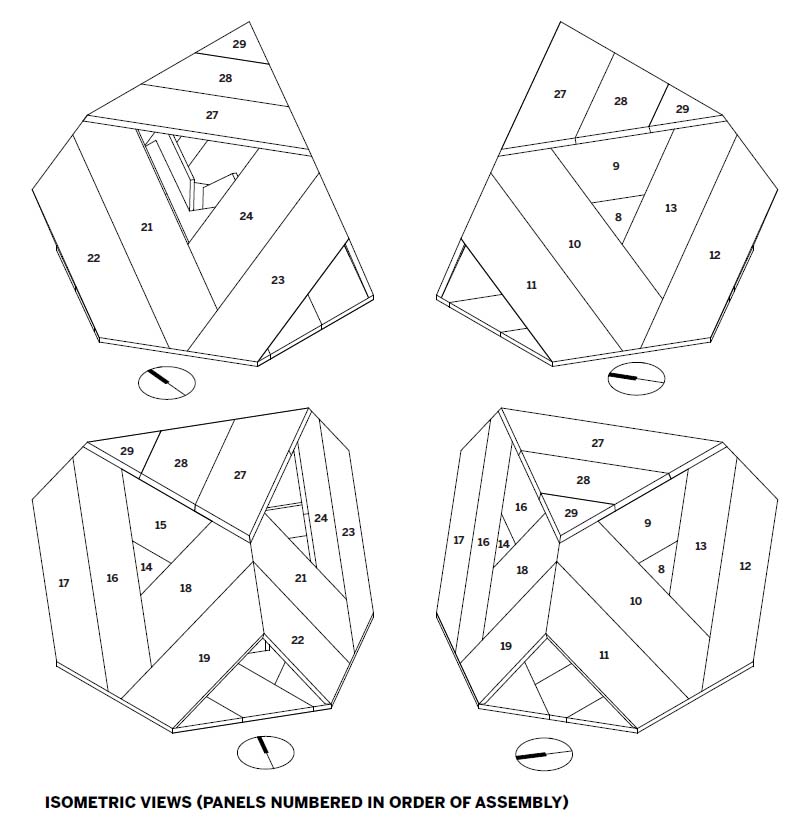
The house’s primary structure and envelope consist of 64 individually cut Douglas fir cross-laminated-timber (CLT) panels, produced by Vaagen Timbers in Colville, Washington. López-Pérez says the structural engineer, Fast + Epp, from Vancouver, British Columbia, estimated that the nonlinear structure of the CLT panels provides significant redundancy compared to a simple stud-framed house. The floor panels are five ply, 7½ inches thick, while the rest are three ply, 4½ inches. “The virtue of this truncated polyhedron shape is that we have 25 panel shapes that repeat themselves, so it reduces details immensely,” says López-Pérez. In his view, the project has only two architectural details—the structural connections fastened with bolted metal plates, and the simpler splines between panels that slot together.

Site preparation took one week, which included pouring a concrete foundation stem wall. Electrical and plumbing services were installed under the floor and extend up to two conventionally framed walls serving the kitchen and the bathroom. With the platform floor installed, work could begin on piecing the walls together until they formed a self-supporting diaphragm. Vaagen stacked each panel on the truck in the order in which it would be unloaded with a crane and set into place. Installation of the panels took a crew of three workers only three days on-site. Following that, a vapor barrier was applied, seams sealed, and Kingspan insulated metal panels were screwed directly into the CLT.

A predictable, kit-of-parts supply line helped the couple reduce the price significantly, with the smallest model costing approximately $300,000—including San Diego permitting and other development fees—with a construction schedule of 12 weeks, from site work to turning the key in the door. The couple estimates 40 percent of that cost is labor. “We scheduled each trade separately for this project, but we were also testing things as we went through construction,” Vargas says. One way to save time would be to eliminate the concrete-foundation requirement, which the couple allowed for by also pre-permitting a version of the house that sits on 26 earth screws. Vargas estimates they could get the construction time down to eight weeks or less. Building a single-family house can easily cost between $600 to $1,200 per square foot in California, compared to $550 per square foot for Polyhaus, which is comparable to more conventional ADUs.

The couple recently secured a patent for the Polyhaus system, and plan to offer a business model for licensing the technology to builders this year. Vargas says, given San Diego’s lack of housing supply, the licensing model would allow them to accelerate production. They also envision small-scale developers, who could build six or more on a lot, as the primary market. Since California land costs are so high, López-Pérez suggests that infill lots could be developed along the lines of a bungalow court, providing a “missing middle” with a density between apartment buildings and houses. “It would open up the possibility of houses that are more flexible to multigenerational families,” he says, “with people at different stages in life.”

Click graphic to enlarge
Polyhaus.
Back to Continuing Education: Prefabrication

Looking for quick answers on architecture and design topics?
Try Ask RECORD, our new smart AI search tool.
Ask RECORD →

KEYWORDS: mass timber modern residential architecture prefabrication San Diego timber construction

Share This Story

Looking for a reprint of this article?
From high-res PDFs to custom plaques, order your copy today!

Russell fortmeyer
Russell Fortmeyer, a contributing editor to RECORD, is a Los Angeles-based sustainability principal at Arup and adjunct professor at the University of Southern California School of Architecture.

Post a comment to this article

Report Abusive Comment

Subscription Center
  • Create an Account
  • Start a Subscription
  • Manage My Account
  • Sign Up for Newsletters
  • Visit Customer Service
  • Update Preferences

More Videos

Sponsored Content

Sponsored Content is a special paid section where industry companies provide high quality, objective, non-commercial content around topics of interest to the Architectural Record audience. All Sponsored Content is supplied by the advertising company and any opinions expressed in this article are those of the author and not necessarily reflect the views of Architectural Record or its parent company, BNP Media. Interested in participating in our Sponsored Content section? Contact your local rep!

close
  • TAMLYN XtremeTrim Exterior Trim
    Sponsored byTamlyn

    Designing Cleaner Panel Facades: Why Exterior Trim Details Matter

  • Building with Vapor Barriers
    Sponsored byReef Industries, Inc.

    Vapor Barriers Help Control Moisture in Tighter Building Designs

  • Duct Interior with Prodeq System
    Sponsored byHenry, a Carlisle Company

    Designing Resilient Water Containment Systems

DESIGN:ED Podcast
Listen to Architectural Record’s DESIGN:ED Podcast

Events

June 16, 2026

Focus on the Façade: Exploring Steel, Timber & Fire-Rated Curtain Walls and Channel Glass Systems

Credits: 1 AIA LU/HSW; 1 AIBD P-CE; 0.1 ICC CEU

Explore modern façade and glazing systems that enhance daylighting, fire safety, and thermal performance while expanding architectural design possibilities.

June 18, 2026

Rebooting the Aging Office Building

Credits: 1 AIA LU/HSW; 1 AIBD P-CE; 0.1 ICC CEU; 1 PDH

Explore façade retrofit strategies and award-winning design concepts that can transform aging office buildings into healthier, higher-performing workplaces for today’s hybrid workforce.

View All Submit An Event

Products

2026 Architect's Square Foot Costbook

2026 Architect's Square Foot Costbook

See More Products

Popular Stories

SanDiegoAirport

Top 300 Architecture Firms of 2026

Coronado Bridge

The Architect’s Guide to San Diego

House A on a Hill

Design Vanguard 2026: Santiago Valdivieso

Dusk House

Design Vanguard 2026: ONO

Crystal Bridges Museum of American Art expansion

Safdie Architects Returns to the Crystal Bridges Museum of American Art for Major Expansion

Focus on the Facade - Free Webinar - June 16, 2026

Related Articles

  • Houses with One Pillar

    A Pair of Houses by Buero Wagner Offers a Clever Solution to Multi-Generational Living Near Munich

    See More
  • Rosa O. Valdes STEM + Innovation Center

    Bohlin Cywinski Jackson's Mass-Timber Addition to a Texas School Offers a Lesson in Sustainable Design

    See More

Events

View AllSubmit An Event
  • May 13, 2026

    Steel and Wood Together? Really? How Mass Timber Turns This Combination Into a Winning Strategy

    NOW ON DEMANDCredits: 1 AIA LU/HSW; 1 AIBD P-CE; 0.1 ICC CEU; 1 PDHDiscover how combining mass timber and steel can optimize structural performance, fire safety, and carbon outcomes in modern building design.
View AllSubmit An Event
×

The latest news and information

#1 Source for Architectural Design, News and Products

SUBSCRIBE
  • RESOURCES
    • Advertise
    • Contact Us
    • Submit
    • Store
  • ACCOUNT CENTER
    • Create an Account
    • Start a Subscription
    • Manage My Account
    • Sign Up for Newsletters
    • Visit Customer Service
    • Update Preferences
  • PRIVACY
    • PRIVACY POLICY
    • TERMS & CONDITIONS
    • DO NOT SELL MY PERSONAL INFORMATION
    • PRIVACY REQUEST
    • ACCESSIBILITY
  • SERVICES
    • Marketing Services
    • Reprints
    • Market Research
    • List Rental
    • Survey/Respondent Access
  • STAY CONNECTED
    • Linkedin
    • Facebook
    • Instagram
    • YouTube
    • X (Twitter)

Copyright ©2026. All Rights Reserved BNP Media, Inc. and BNP Media II, LLC.

Design, CMS, Hosting & Web Development :: ePublishing