Sustainability in Practice
Bucholz McEvoy and ZAS Create a Mass-Timber Showcase for a Toronto Environmental Agency
Toronto
Architects & Firms
Just over 70 years ago, in October 1954, Hurricane Hazel cut a path of destruction through the Caribbean, the eastern United States, and Canada. In Southern Ontario, the storm dumped 11 inches of rain on Toronto and nearby communities in 48 hours, killing 81 people, washing out bridges and roads, and displacing more than 1,800 families.
Out of the disaster was born the Toronto and Region Conservation Authority (TRCA). The organization’s mission includes regulating development to ensure responsible management of water, land, and natural habitats, and protection from extreme weather events, especially flooding. Its jurisdiction encompasses nine watersheds and their Lake Ontario shorelines and spans multiple municipalities representing almost 5 million people. “It is what government would look like if it were defined by water,” explains Steve Heuchert, a planner and an associate director at TRCA.

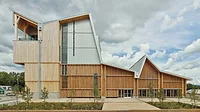
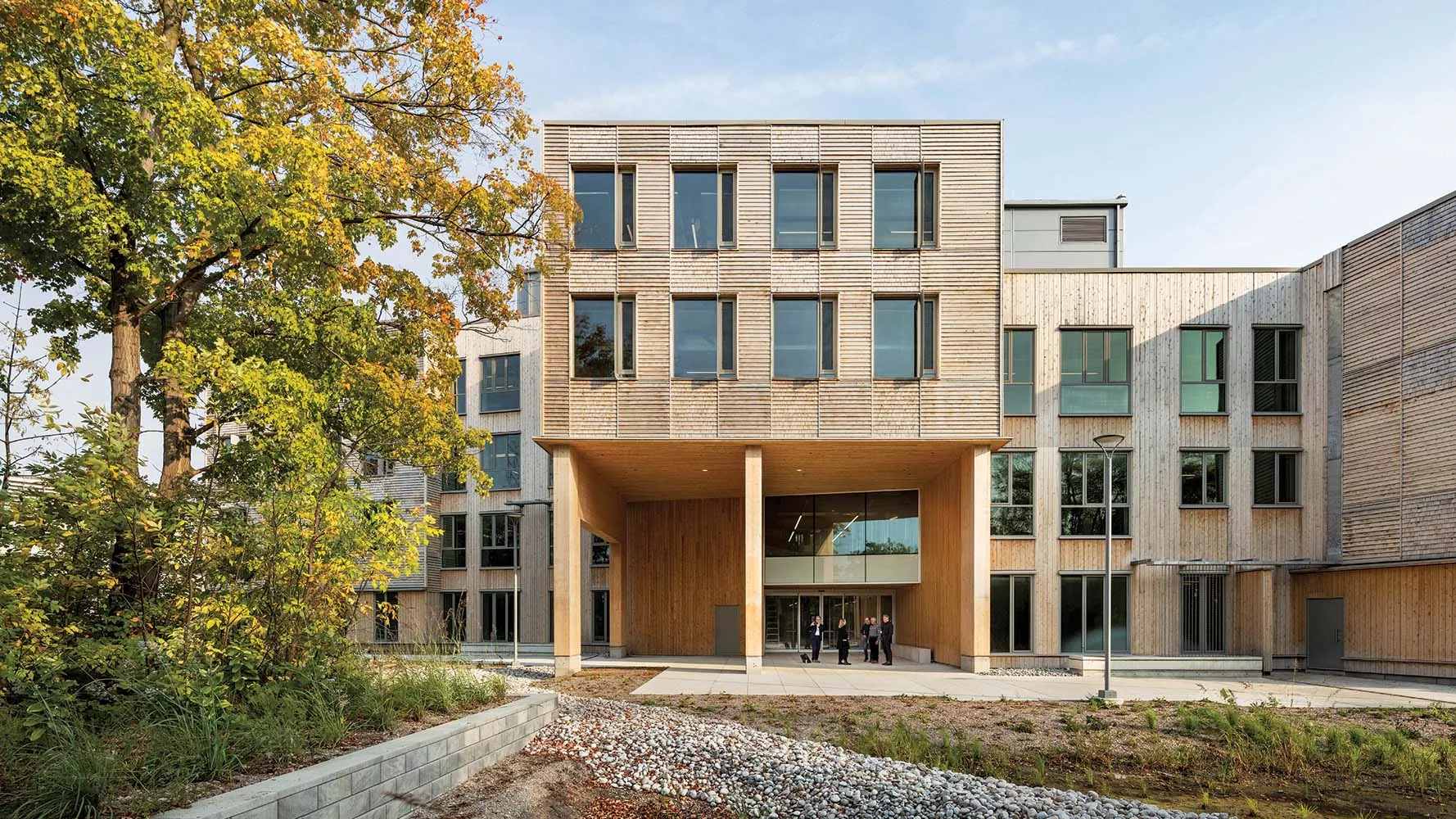
The new TRCA headquarters, clad in Ontario-sourced white cedar (top of page), comprises splaying office bars (above). Photo © Michael Moran, click to enlarge.
Heuchert was a member of the committee that selected the team of Dublin-based Bucholz McEvoy Architects and local firm ZAS Architects to design a new TRCA headquarters in 2017. The authority, with a current staff of about 450, had long outgrown its one-story, timber-framed offices in North York, about 15 miles from downtown Toronto. In addition to needing more space and a building that would support its collaborative culture, the agency hoped for a headquarters that would be a “superstar environmentally, that would speak to what we wanted others to do,” says Heuchert. “The TRCA desired,” adds Marek Zawadzki, ZAS senior principal, “a project that would serve as a demonstration to developers.”

The building’s generously glazed southeastern corner affords views of Black Creek Ravine, which winds past the site. Photo © Michael Moran
After several years’ working out of rented offices, the staff is about to move into its new 80,000-square-foot headquarters, which sits on the same suburban site once occupied by the agency’s former home, at the edge of Black Creek Ravine—the location a part of the network of streams, rivers, and winding wooded corridors that contribute to the watersheds the TRCA oversees. The $39.5 million building has already earned zero carbon certification from the Canada Green Building Council and is on track for LEED Platinum and WELL Silver status.
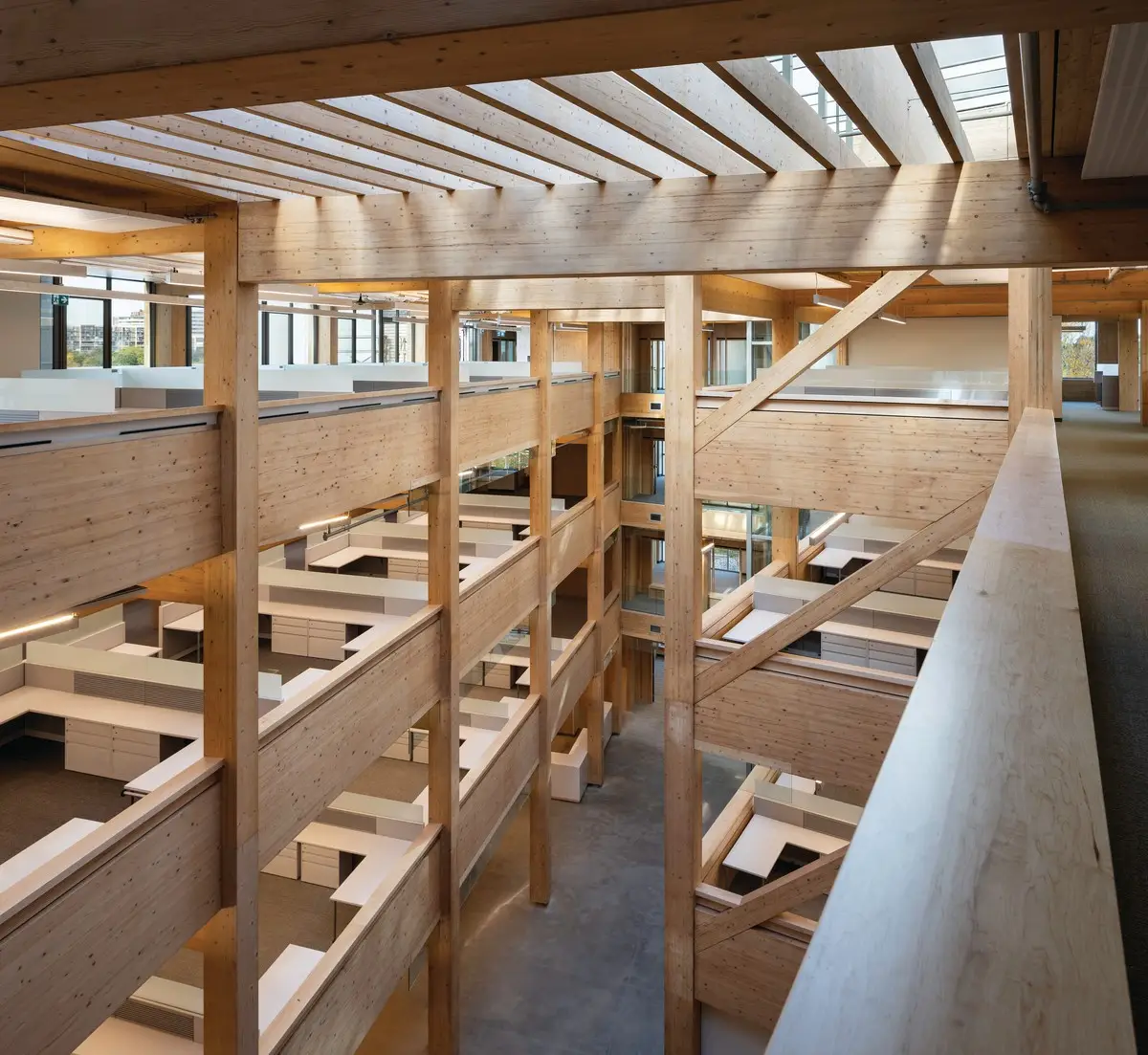
Despite the project’s big green ambitions, the building doesn’t shout. Instead, it has a quiet expression of stepping and subtly skewed volumes enclosed within a gridded shingled facade of Ontario-sourced white cedar. This geometry was largely determined by a client mandate to preserve the site’s mature sugar maples, recognizing their importance to the ecological health of the nearby ravine. In early project meetings, “there was a lot of talk about urban woodlands, hydrology, and natural systems,” says Karen McEvoy, founding director of Bucholz McEvoy with Merritt Bucholz. So, respecting the drip lines of the trees, the architects configured the mass-timber structure to create three office “fingers”—three and four stories tall—splaying them in a fan-like fashion so that atria could be inserted in between. The multistory skylit voids allow visual connections between the office areas, and they “crack the building open,” explains Bucholz, allowing fresh air and daylight to penetrate deep into the interior.

1
2
The architects have inserted multistory atria (1 & 2) between the office areas and punctuated the ends of these skylit voids with glass-enclosed “waterwall” towers (1). Photos © Michael Moran
Arguably, the building’s most unusual feature is its set of four glass-enclosed towers, each about 6 by 7 feet in plan and extending through the roof. Once fully operational, water will run down sheets of metal mesh suspended within. These “waterwalls,” which punctuate opposing ends of each atrium, resonate with the agency’s mission, McEvoy points out. But they are more than merely symbolic. With integrated solar chimneys, they are part of a highly optimized environmental-control system, explains Erik Olsen, managing partner with Transsolar, the project’s climate-engineering consultant.
The waterwalls are coupled with geothermal wells. Taking advantage of the relatively stable temperature of groundwater, they first precondition outdoor air that is brought through the top of each glazed shaft. From there, ventilation units pull off the fresh air at each level, delivering it to the office areas at low velocities through an underfloor plenum, with integrated radiant panels providing additional heating or cooling as needed. Return air is also channeled through the ventilation units, which are equipped with energy-recovery technology, before being expelled through vents located above each tower.
Looking for quick answers on architecture and design topics?
Try Ask RECORD, our new smart AI search tool.
Ask RECORD →

Windows include operable lites. Photo © Michael Moran
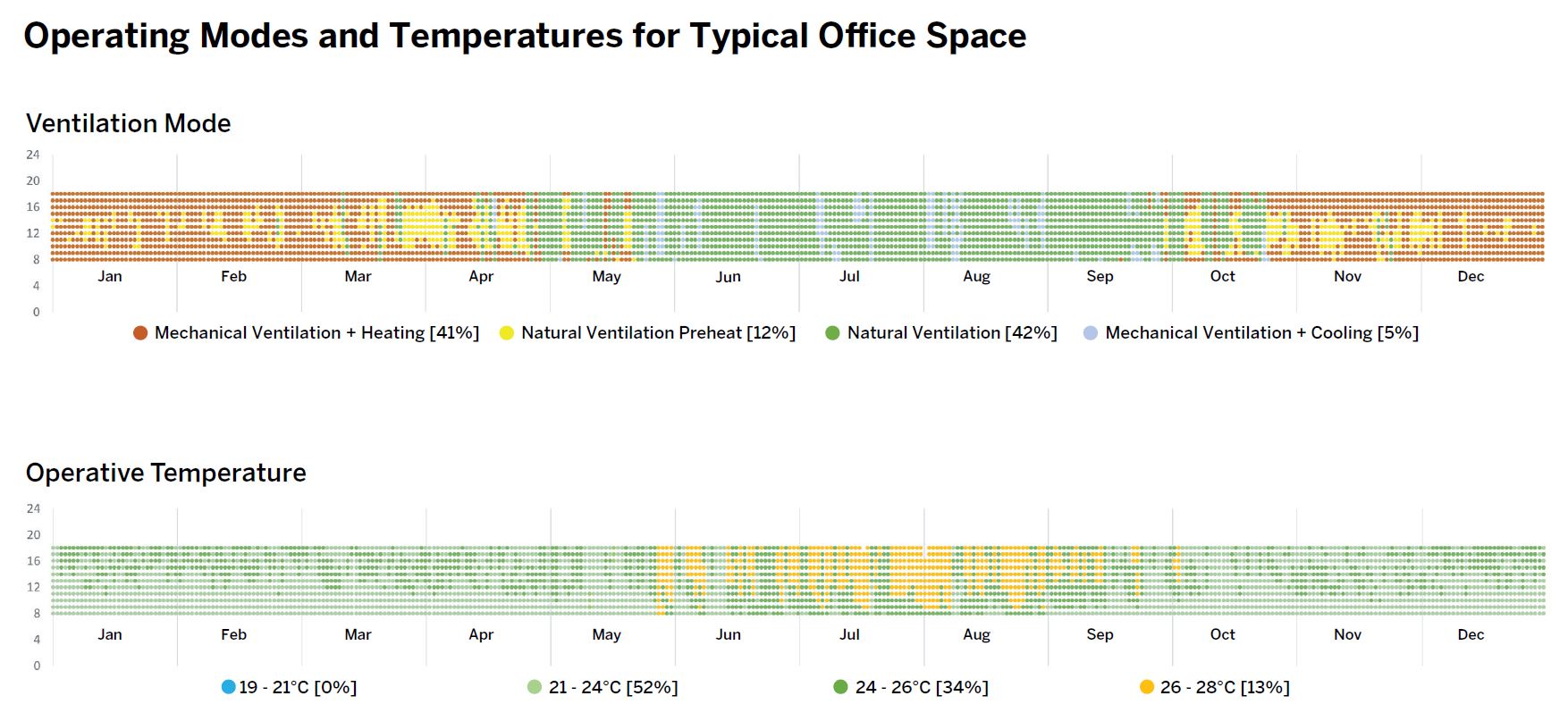
The project team expects the use of operable windows to be a viable comfort strategy much of the year, even beyond the shoulder seasons of spring and fall. One feature that will help extend the use of natural ventilation into the colder months is an additional layer of glazing mounted a few inches outboard of the south-facing windows. When conditions are right, the sun will preheat air trapped within the resulting cavity, allowing occupants to comfortably open the windows. The extra glazing also protects external blinds, which will automatically lower to prevent summertime heat gain. Along with features like a highly insulated and airtight envelope and triple glazing, the designers calculate that the building’s climate-control systems and comfort strategies will produce an energy-use intensity of 25 kBTUs per square foot, or 50 percent below baseline.
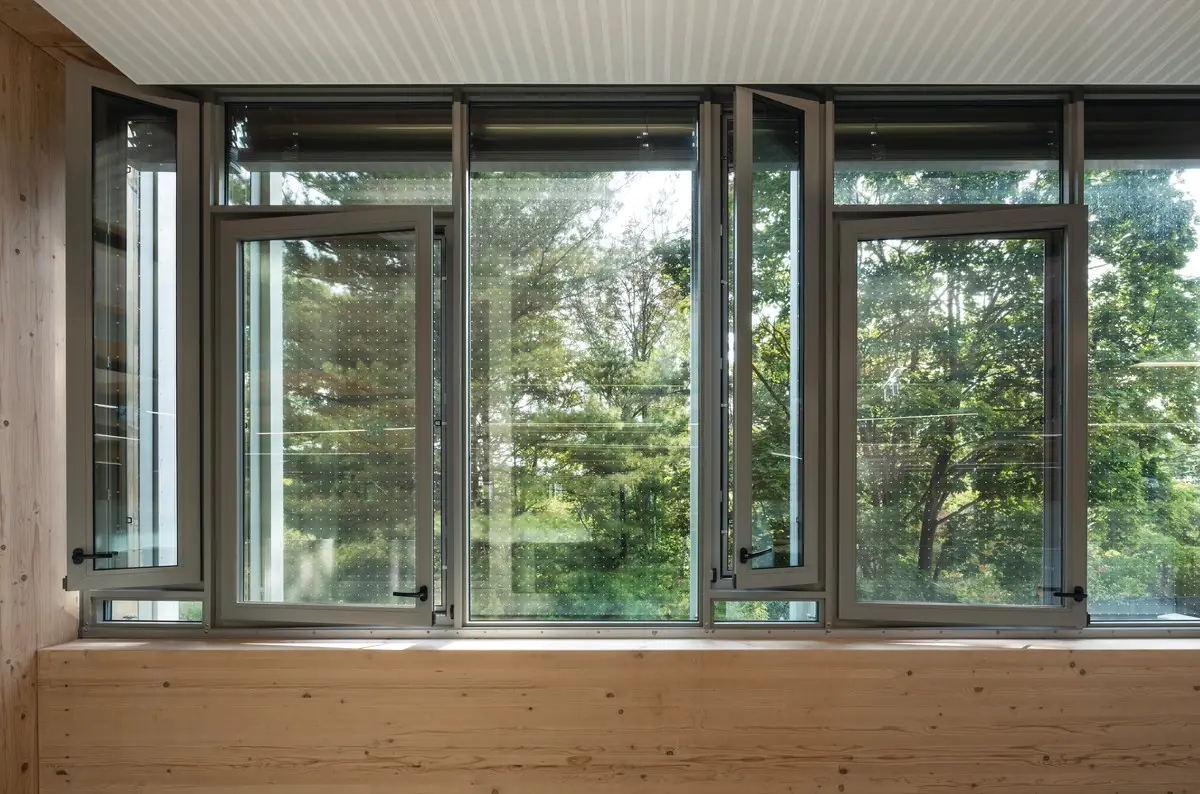
An additional layer of glass, outboard of the south-facing windows (above) makes natural ventilation viable for much of the year (below). Photo © Michael Moran
Click chart to enlarge
Its embodied-carbon footprint is also impressive, with a 75 percent reduction compared to an average Toronto building. In no small part, the savings are due to the building’s structure, with nearly all its elements above the ground slab derived “from plants,” says Bucholz. Of course, he is referring specifically to trees. Except for the connections, which are concealed, the building frame is almost exclusively mass timber, with glue-laminated columns and beams from Austria and cross-laminated-timber floor slabs from Scandinavia. Even the lateral bracing and the building’s cores, as well as the egress stairs they enclose, are mass timber.
As the TRCA moves into its new home, staff will find reminders everywhere around them—from its exposed timber frame to elements like waterwalls—of the broader environment and their stewardship mission. But even before employees settle in, the new building has begun to function as anticipated, with local universities setting up research studies to monitor aspects like changes in the moisture content of the wood and the indoor air quality. “The building is meant to be a living lab,” says Bucholz. Let the experiment begin.
Click plans to enlarge

Click section to enlarge

Click drawing to enlarge

Credits
Architects:
Bucholz McEvoy Architects — Karen McEvoy, Merritt Bucholz, design leads; Diane Harrington, project architect ZAS Architects — Marek Zawadzki, principal; Andrzej Gortat, project architect; Carmine Canonaco, technical lead
Consultants:
RJC (structure); Transsolar (climate); Introba (mechanical); MBii (electrical); TYLin (civil); Schollen & Company (landscape); Green Reason (sustainability certification)
Construction Manager:
Eastern Construction
Client:
Toronto and Region Conservation Authority
Size:
80,000 square feet
Cost:
$39.5 million
Completion Date:
January 2025
Sources
Mass-Timber Structure:
Element 5, Sora Enso, Hasslacher
Ontario White Cedar Cladding:
Taylor Sawmill
Curtain Wall, Skylights:
Stouffville Glass
Roofing:
Bothwell Accurate
Windows:
Inline Fiberglass
Exterior Blinds:
Hella Blinds
Radiant Panels:
Messana
Ceiling Fans:
Big Ass Fans
Waterwall:
Acapulco Pools, GKD Metal Fabric
Elevators:
Schindler
Lighting:
Acuity Brands
Looking for a reprint of this article?
From high-res PDFs to custom plaques, order your copy today!