Architectural Record
search
cart
facebook twitter linkedin youtube
  • Sign In
  • Subscribe
  • Sign Out
  • My Account
Architectural Record
  • NEWS
    • Latest News
    • Awards
    • Interviews
    • Obituaries
    • Podcasts
      • Design:Ed Podcast
      • Sponsored Podcasts
  • OPINION
    • Book Reviews / Excerpts
    • Exhibition Reviews
    • Forum
  • EXCLUSIVES
    • Videos
    • Design Vanguard
    • Top 300 Firms
    • Sponsored Content
    • Sponsored eBooks
    • From the Archives
  • CONTINUING ED
    • Editorial Continuing Ed
    • CE Center
    • CE Academies
  • PROJECTS
    • Buildings By Type
    • Reuse & Renovation
    • Museums & Arts Centers
    • Colleges & Universities
    • Multifamily Housing
    • Interiors
    • Lighting
    • Kitchen & Bath
  • HOUSES
    • Record Houses
    • House of the Month
    • Featured Houses
  • PRODUCTS
    • Products by Category
    • Record Products of the Year
    • Latest Products
  • EVENTS
    • Dates & Events
    • Record on the Road
    • Innovation Conference
    • Sustainability in Practice
    • Women In Architecture
    • Webinars
    • Ad Excellence Awards
    • Submit an Event
  • CONNECT
    • Ask RECORD AI
    • Newsletters
    • Contact
    • Advertise
    • Editorial Calendar
    • Store
    • Customer Service
  • SUBMIT
    • Submission Guidelines
    • RECORD Competitions
  • MAGAZINE
    • Subscribe
    • My Account
    • Digital Edition
    • Current Issue
    • Firm Pass
    • Historic Archive
ProjectsBuildings by TypeTall Building Projects

KPF’s Design for the New TP-Link Headquarters in Shenzhen Emphasizes Connectivity
By Matthew Marani
exterior of TP-Link headquarters in China
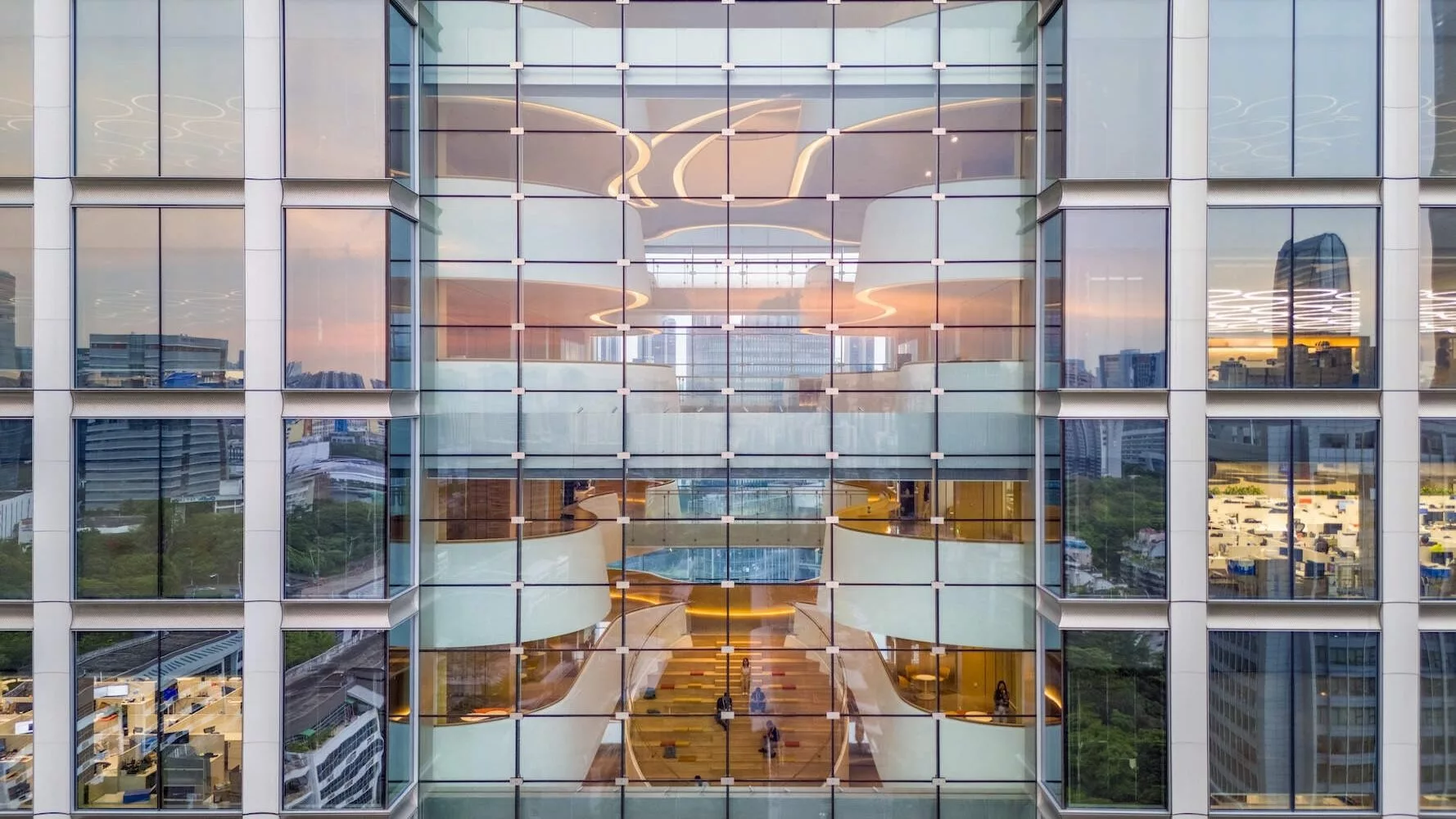
TP-Link's new headquarters in Shenzhen features a full-height atrium with undulating balconies. Photo © Virgile Bertrand
May 20, 2025

Architects & Firms

Kohn Pedersen Fox
✕
Image in modal.

Corporations often spend a fortune hiring consultants hawking the latest advice on achieving departmental synergies, from the newest project management software to nebulous company culture recommendations. But, at the end of the day, the most straightforward solution for the mingling of disciplines is to simply place sometimes-siloed employees together in the same space.

Image of TP Link HQ exterior.

The tower is located within Shenzhen High-Tech Industrial Park, and its glazed curtainwalls provide expansive views of nearby greenery. Photo © Virgile Bertrand

The new 688,000-square-foot headquarters of TP-Link, a global technology company that designs and manufactures network equipment and smart home products, does just that. Located within Shenzhen High-Tech Industrial Park, an approximately 4.5-square-mile district near the Chinese city’s waterfront and numerous belts of parkland, the building was designed by Kohn Pedersen Fox Associates (KPF) with structural engineering services from Arup and completed in April. Its flexible spaces and 30-story atrium with undulating balconies respond to TP-Link’s desire that its new corporate home encourage collaboration between the traditionally divided engineering and design departments while maximizing daylight and natural ventilation.

“There are many different sides to any technology company, and they all have unique programmatic demands” explains KPF principal Marianne Kwok. “Here, there are floor plates that can be used by any division, and, through design, a culture of being familiar with who you are working with.”

The headquarters comprises two, distinct rectangular volumes—clad in glass, terra-cotta, and perforated metal—linked together by the full-height, glazed atrium. The first and second floors are quasi-public, with a café, 180-seat auditorium, and meeting spaces welcoming visitors and employees alike. Rather than bifurcate the office floor plates above by professional role, each half of the building, nearly 6,500 square feet and column free, is fitted with both computer lab facilities and desk-oriented work areas. The setup allows for a certain fluidity between departmental zones, and, hopefully, intellectual cross pollination. In a bid to promote a kind of flattening of divisions and ease of access, a cafeteria is located at the center of the building. The tower is topped by a terrace open to employees, and there are plans to add an amphitheater to the top floors.

Interior image of TP Link atrium and balconies.
1
Interior image of TP Link atrium and balconies.
2

The atrium balconies are linked together by bridges (1). They join together intermittently to form structural diaphragms and points of fire egress (2). Photo © Virgile Bertrand

TP Link Headquarters.
3
TP Link Headquarters.
4

The office spaces include computer labs and desk-oriented work zones (3). The balconies are furnished with informal work spaces (4). Photo © Virgile Bertrand

The atrium balconies, linked by bridges, alternate layouts and configurations to optimize sun exposure and reduce glare. At intermittent levels, they join to serve the dual purpose of code-mandated fire egress and structural diaphragms between the two volumes. The tectonic role of the diaphragms is supplemented by structural steel beams that run crosswise to help stiffen the cable-stayed atrium walls. Both the balconies and diaphragms are furnished with flexible workspaces, high tables, and soft seating for informal collaboration and gathering.

The building’s mechanical systems are normative, although they stand out for their passive strategies. Fresh air flows through approximately 18-by-148-inch operable windows placed behind the perforated metal soffits, that, with exposure across three elevations, provides cross ventilation. The center of the atrium, away from the collaborative spaces, is unconditioned, dramatically reducing energy demand.

Diagram of balcony configurations.
5
Diagram of building floor plates.
6

The balconies are configured to maximize daylight and visual interaction (5). The building is composed of two distinct volumes, with column-free floorplates, linked by the atrium (6). Images courtesy © KPF, click to enlarge

Realizing the open floorplates and soaring atrium required out-of-the-box thinking. The structural core is placed on the east elevation rather than at the building center to make room for the tower’s many balconies. The heavy lifting of the building core, with its thick jackets of concrete, primarily encircle restroom embankments at each level, freeing up the eastern face of the tower’s elevator shafts and stairwells to be entirely glazed. Concrete perimeter columns are spaced nearly 15 feet apart to support, with the help of crossbeams and the building core, the floorplate’s nearly 60-foot, column-free spans.

Looking for quick answers on architecture and design topics?
Try Ask RECORD, our new smart AI search tool.
Ask RECORD →

Exterior shot of TP-Link HQ.

Within the building side core, the eastern faces of the elevator shafts and stairwells are glazed. Photo © Virgile Bertrand

“The client was clear they didn’t want a solid, concrete core as a back wall,” explains Arup principal David Farnsworth. “Our solution shifted the shear walls inward for greater daylight and outward views for the tenant spaces.”

The headquarters is the first of three projects designed by KPF for TP-Link. Currently under construction in Shenzhen is the 1.34-million square-foot TP-Link LXD building, which, similarly, will feature three buildings linked together by communal spaces and ascending landscaped terraces. Designs are also underway for a research and development building in Hangzhou.

Video by Rex Zou, courtesy KPF

KEYWORDS: China

Share This Story

Looking for a reprint of this article?
From high-res PDFs to custom plaques, order your copy today!

Matthew marani

Matthew Marani is a senior editor at Architectural Record. Previously, he served as program manager at The Architect’s Newspaper and has several years of experience as a freelance writer specializing in urban planning, historic preservation, and architectural technology. Matthew is a born and raised New Yorker and holds an MSc in Architectural Conservation from the University of Edinburgh.

Post a comment to this article

Report Abusive Comment

Subscription Center
  • Create an Account
  • Start a Subscription
  • Manage My Account
  • Sign Up for Newsletters
  • Visit Customer Service
  • Update Preferences

More Videos

Sponsored Content

Sponsored Content is a special paid section where industry companies provide high quality, objective, non-commercial content around topics of interest to the Architectural Record audience. All Sponsored Content is supplied by the advertising company and any opinions expressed in this article are those of the author and not necessarily reflect the views of Architectural Record or its parent company, BNP Media. Interested in participating in our Sponsored Content section? Contact your local rep!

close
  • TAMLYN XtremeTrim Exterior Trim
    Sponsored byTamlyn

    Designing Cleaner Panel Facades: Why Exterior Trim Details Matter

  • Building with Vapor Barriers
    Sponsored byReef Industries, Inc.

    Vapor Barriers Help Control Moisture in Tighter Building Designs

  • Duct Interior with Prodeq System
    Sponsored byHenry, a Carlisle Company

    Designing Resilient Water Containment Systems

DESIGN:ED Podcast
Listen to Architectural Record’s DESIGN:ED Podcast

Events

June 16, 2026

Focus on the Façade: Exploring Steel, Timber & Fire-Rated Curtain Walls and Channel Glass Systems

Credits: 1 AIA LU/HSW; 1 AIBD P-CE; 0.1 ICC CEU

Explore modern façade and glazing systems that enhance daylighting, fire safety, and thermal performance while expanding architectural design possibilities.

June 18, 2026

Rebooting the Aging Office Building

Credits: 1 AIA LU/HSW; 1 AIBD P-CE; 0.1 ICC CEU; 1 PDH

Explore façade retrofit strategies and award-winning design concepts that can transform aging office buildings into healthier, higher-performing workplaces for today’s hybrid workforce.

View All Submit An Event

Products

2026 Architect's Square Foot Costbook

2026 Architect's Square Foot Costbook

See More Products

Popular Stories

Coronado Bridge

The Architect’s Guide to San Diego

SanDiegoAirport

Top 300 Architecture Firms of 2026

Crane Cove, ONO

Design Vanguard 2026 Winners

House on a Hill

Design Vanguard 2026: Forma

House A on a Hill

Design Vanguard 2026: Santiago Valdivieso

Focus on the Facade - Free Webinar - June 16, 2026

Related Articles

  • KPF Korean Super Tower

    KPF Unveils Design for Korean Super Tower

    See More
  • DLANDstudio Gowanus Canal Sponge Park

    Sponge-Worthy Design for the Gowanus Canal in Brooklyn

    See More
  • Architects & Urban Leaders

    Architects and Urban Thought Leaders on Design for the Public Realm

    See More

Related Products

See More Products
  • 0470126736.gif

    Modern Sustainable Residential Design: A Guide for Design Professionals

  • superlux.jpg

    SuperLux: Smart Light Art, Design & Architecture for Cities

See More Products
×

The latest news and information

#1 Source for Architectural Design, News and Products

SUBSCRIBE
  • RESOURCES
    • Advertise
    • Contact Us
    • Submit
    • Store
  • ACCOUNT CENTER
    • Create an Account
    • Start a Subscription
    • Manage My Account
    • Sign Up for Newsletters
    • Visit Customer Service
    • Update Preferences
  • PRIVACY
    • PRIVACY POLICY
    • TERMS & CONDITIONS
    • DO NOT SELL MY PERSONAL INFORMATION
    • PRIVACY REQUEST
    • ACCESSIBILITY
  • SERVICES
    • Marketing Services
    • Reprints
    • Market Research
    • List Rental
    • Survey/Respondent Access
  • STAY CONNECTED
    • Linkedin
    • Facebook
    • Instagram
    • YouTube
    • X (Twitter)

Copyright ©2026. All Rights Reserved BNP Media, Inc. and BNP Media II, LLC.

Design, CMS, Hosting & Web Development :: ePublishing