Record Reviews
Osaka‘s World Expo Arrives, Out of Step with Its Moment
Osaka
Architects & Firms
It has been nearly a century since an international exposition opened at a moment as fraught as today. Like the 1939 World’s Fair in New York, the 2025 World Expo in Osaka, Japan, is shadowed by a breakdown in global relations, war in Europe, and extreme rhetoric everywhere. The notion of gathering 158 nations to exchange visions of peace and progress feels naïve right now. Instead of looking to the future, this Expo seems stuck in the past—a time capsule of possibilities imagined a year or two ago, when participants planned and designed their venues.
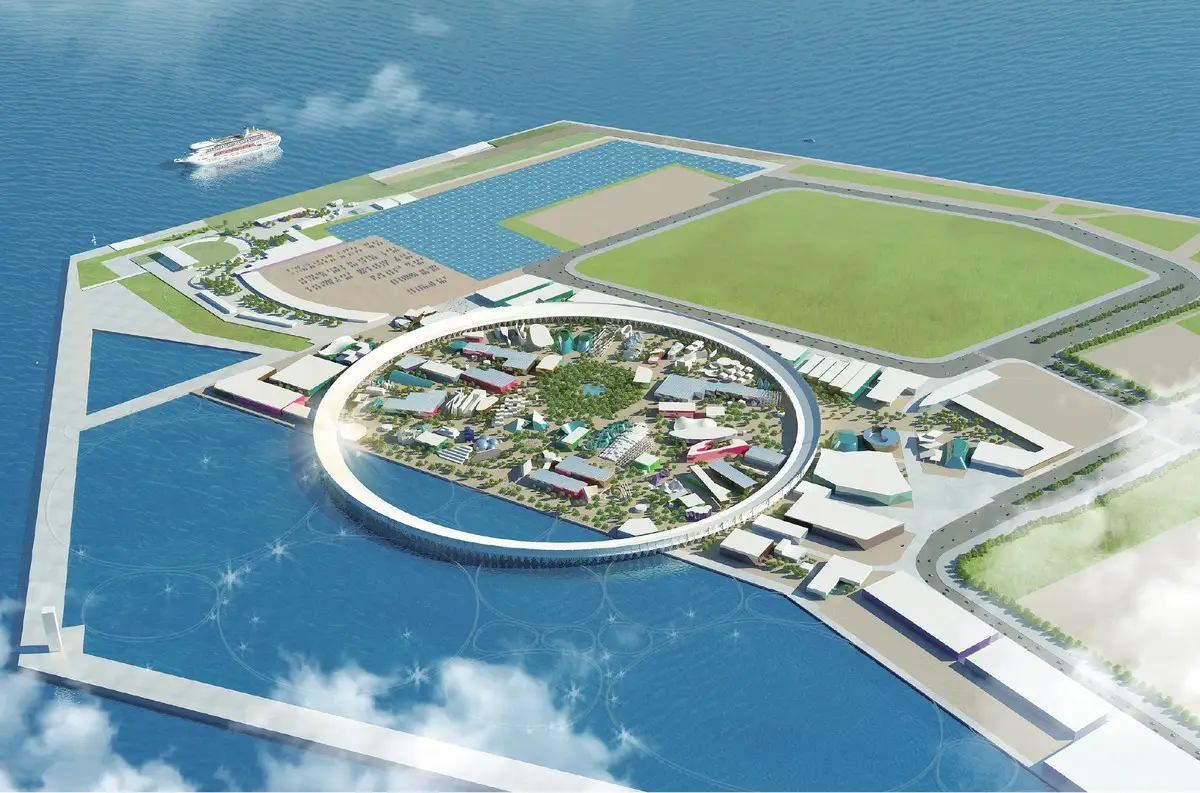
Plan for 2025 World Expo in Osaka. Image © Japan Association for the 2025 World Exposition, click to enlarge.
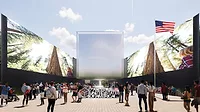
Nowhere is this truer than at the USA Pavilion, blessed with the best piece of real estate at the fairgrounds, just inside the east gate and closest to the new subway station on Yumeshima, an artificial island in Osaka Bay. The pavilion greets crowds streaming out of the subway with a pair of triangular wings on either side of a generous courtyard and a translucent cube hovering in between. The wings serve as giant LED screens presenting iconic images of America: the Statue of Liberty, Grand Canyon, the Hollywood Hills, amber waves of grain, purple mountain majesties. Designed by Trahan Architects with BRC Imagination Arts in charge of the interior exhibition program, the pavilion smartly leverages its key location to welcome attendees with a pair of open architectural arms and draws them to the enigmatic cube at its center. The pictures of America dancing on the screens are clichéd, but it’s hard to deny their allure.

Trahan Architects’s USA Pavilion gets prime position in the Expo plan. Photo © Hufton+Crow
Inside, visitors walk along a single-directional pathway adorned with information on Fulbright Scholars and advances in American agriculture and science—the very programs the Trump administration is furiously dismantling. Videos present images of American diversity—in terms of its people and skills—that now seem ironic, at best. One room surrounds visitors with projections of a space launch, placing them first under a giant rocket as it blasts off and then taking them into the wild blue yonder with astronauts and all the marvelous technology that makes such travel possible. It’s a fun five minutes, a reminder of the kind of know-how and can-do spirit that has made America a magnet for the world’s best minds and hardest workers. It ends with the message, “Join Us!,” which flies in the face of current events.
Behind the floating cube, the pavilion’s triangular wings almost touch, leaving a sliver of space for daylight to slide into a simple garden. A sculpture made of hinoki cypress and designed by 2019 Design Vanguard Spiegel Aihara Workshop and Tamotsu Teshima Architect stands at one end of the garden and alludes to fire-lookout towers in the U.S. and Japan.
When groundbreaking for the pavilion occurred a year ago, everyone understood the strong bond Japan has had with America since the end of World War II. No one was surprised that the U.S. got prime positioning to show off its cultural and scientific achievements, placement which now feels misguided, with America’s reputation, in the world and among longtime allies, on shaky ground.

Foster + Partners’ Saudi Arabia National Pavilion is canyon-like. Photo © Roland Halbe
The Expo opened April 13 and runs until October 13. Its theme—Designing Future Society for Our Lives—offers a conceptual umbrella large enough for countries, international organizations, and private companies to do pretty much whatever they want with their pavilions while incorporating three official subthemes: Saving Lives, Empowering Lives, and Connecting Lives. Set on 960 acres of landfill in Osaka Bay, the Expo cost $1.65 billion and drove the expansion of the city’s metro system to Yumeshima Island. In 1970, when Osaka hosted the first World Expo in Asia and showcased a resurgent Japan, transformed after WWII, the event galvanized the nation and drew 64 million people. Organizers hope the investment in the 2025 fair attracts 28 million visitors to the Expo, though early ticket sales have been disappointing, part of a longer-term trend of declining interest in such fairs.

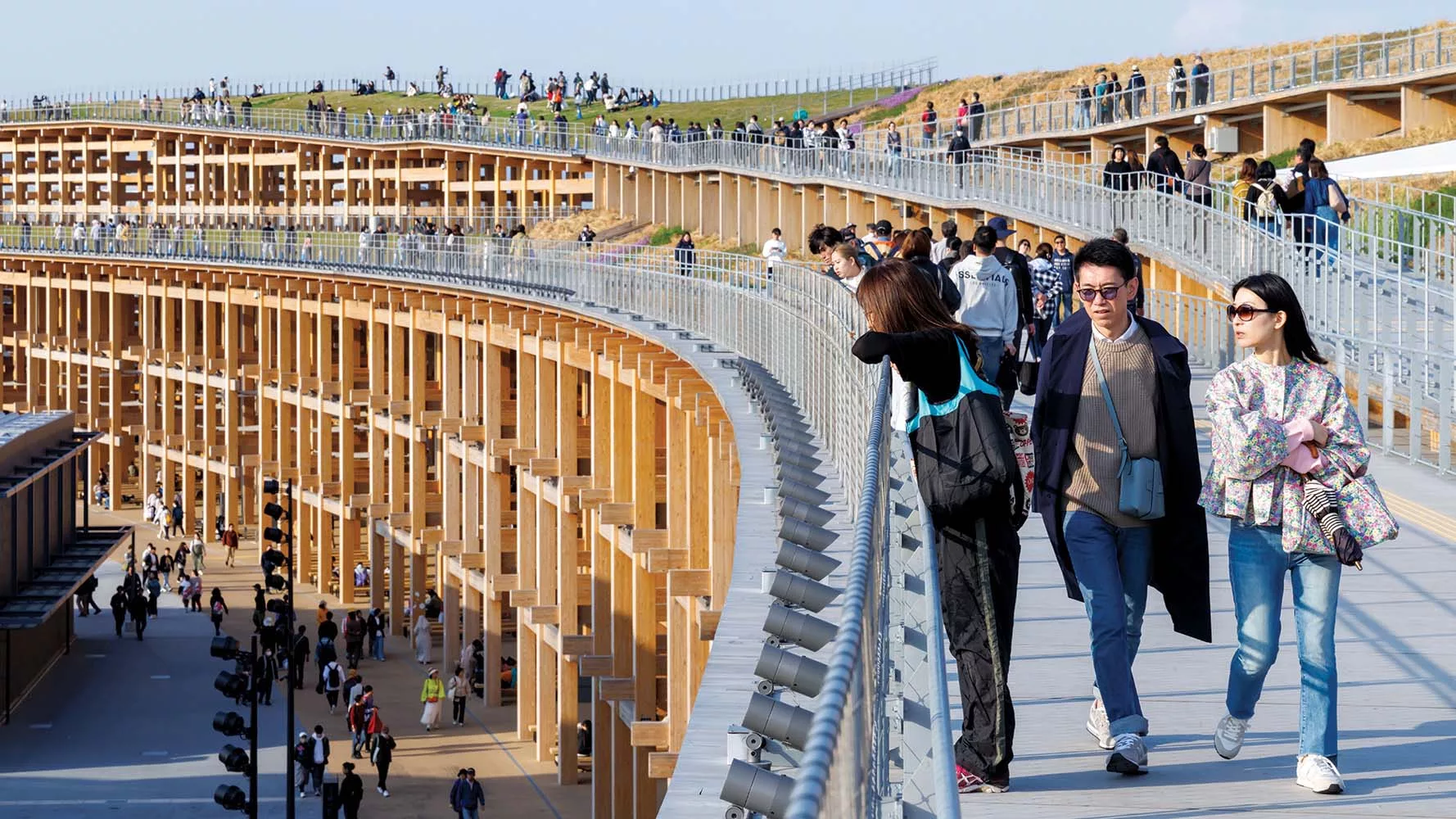
Visitors stroll under the Grand Ring. Photo © Roland Halbe
The best expos deliver at least one structure that leaves an indelible mark in the minds of attendees. Osaka 2025 has such a star: Sou Fujimoto’s Grand Ring, the world’s largest wood structure at 1.2 miles in circumference and ranging in height from 40 to 66 feet. Made of Japanese cedar and cypress, as well as Scots pine, using traditional interlocking joints and steel reinforcing, the ring encircles all the national pavilions and gives the fair an instantly recognizable icon. It works as a unifying visual element that helps orient visitors and as a dazzling work of architecture that rewards scrutiny up close and from afar. You can walk under it for protection from the elements or on top to get spectacular views of the Expo and Osaka Bay. It’s a worthy successor to Joseph Paxton’s Crystal Palace at London’s Great Exhibition of 1851, Eiffel’s tower at the 1889 Exposition Universelle in Paris, and Buckminster Fuller’s Biosphere at Montreal’s Expo 67.
Looking for quick answers on architecture and design topics?
Try Ask RECORD, our new smart AI search tool.
Ask RECORD →
A standout pavilion is the Blue Ocean Dome, designed by Shigeru Ban for ZERI Japan, a nonprofit dedicated to zero-emissions research. It’s actually three domes, each made of a different material—laminated bamboo, carbon-fiber-reinforced plastic tubes, and Ban’s signature cardboard tubes—wrapped in a polycarbonate skin. Visitors proceed from one soap-bubble-like enclosure to another, learning about the role oceans play in our planet’s environment and about pollution’s impact on them. Designer Kenya Hara, Muji’s longtime art director, created the hauntingly beautiful images that animate the interiors of two of the domes and wordlessly convey what’s happening to the planet’s bodies of water.

Shigeru Ban’s Blue Ocean Dome. Photo © Takumi Ota

Visitors exit the Blue Ocean Dome. Photo © Roland Halbe
Oceans and environmental dangers are a recurring theme, unsurprisingly for an Expo built on a bay and happening at a time of rapid climate change. The Bahrain Pavilion, designed by Lebanese architect Lina Ghotmeh, alludes to the Kingdom’s seafaring heritage and the construction of dhows, traditional trading ships. Made of 3,000 pieces of nonengineered wood, it’s a lightweight structure that requires minimal foundations and can be disassembled, so its pieces can be reused. The building employs passive-cooling strategies and seems to float elegantly above the ground.

Lina Ghotmeh’s Bahrain Pavilion. Photo © Roland Halbe

SANAA’s Better Co-Being Pavilion. Photo © Roland Halbe
Some of the most interesting structures aren’t buildings at all. At the center of the Grand Ring, SANAA’s Better Co-Being Pavilion is a diaphanous canopy of three-dimensional metal grids resting on slender steel columns. It sits within the Expo’s Forest of Tranquility, hovering above trees and initiating a dialogue between artifice and nature, the orthogonal and the organic. Another covering that’s not an enclosure is a wonderful playground/outdoor lounge by onishimaki+hyakudayuki (o+h), a young husband-and-wife team based in Tokyo and Kyoto, who used unsold “deadstock” fabric to create a colorful yurt-like folly that grabs attention while protecting the kids underneath from sun and rain.

A bright, colorful playground and lounge designed by o+h. Photo © Takumi Ota
The Osaka Expo is an earnest effort to rally the world around critical issues such as climate change and the building of a brighter future. It brings together some talented architects and designers. It’s a showcase for national pride and technological innovation. Nothing wrong with any of that. But such earnestness feels out of step with the moment, when the world is burning with conflict and transnational recrimination. And what happens to the goodwill when the event ends? After the Expo, plans call for most buildings to be torn down and replaced by a 55-story mixed-use tower, varied development, and the country’s first casino—perhaps an apt metaphor for a future in which everything seems to be a gamble.
Looking for a reprint of this article?
From high-res PDFs to custom plaques, order your copy today!