Pierluigi Serraino Pays Tribute to the Late Chuck Davis, Founding Partner of EHDD

When a principled architect passes on, that loss becomes a community matter. This is certainly the case for Charles Medley Davis, who died on May 7, 2025, at 90. Affectionately known as “Chuck,” he built an impeccable track record in architecture. He could boast a seven-decade-long career of recognized accomplishments constitutive of the glorious legacy of California Modernism. But vanity was an absent trait in his character. He was a content-oriented activist who chose the trenches of design to battle for the lasting improvement of the human condition, remaining impervious to ephemeral press adulation. Chuck had an acute sense of the social footprint that architecture had in community building. He assertively entered the playing field with an authoritative presence, shielding the design intent of his visions from adverse forces that could diminish the outcome, yet tempered with disarming gentleness and a belly laugh that caught off-guard anyone who met him.
Born in Omaha, Nebraska, on September 23, 1934, his family moved to San Francisco when he turned twelve. His formative years were consequential for his value-system as a designer. Enrolled in architecture school at UC Berkeley in 1951, a year after William Wurster restructured the curriculum from the ground-up, he took classes, audited, and had direct exchanges with Charles Eames, Paul Rudolph, and Eric Mendelsohn, among others. Following his 1955 graduation, he apprenticed for two years with Roger Lee, designing the Slattery Residence in Berkeley and the Endo Residence in San Leandro, both completed in 1958.
A turning point in his life was his attendance at the 1961 “Eyes West” conference held in Monterey, California. Among the speakers was Louis Kahn, whose unique speeches mesmerized him. After that fateful encounter, Chuck told his first wife, “I need to go back to school.” Accepted in the master’s program of his alma mater, he took classes with Joseph Esherick, his ultimate lifelong mentor. Their relationship would eventually lead to a 52-year tenure in the firm he started working for in 1962 and was made partner in 1972: Esherick Homsey Dodge & Davis (EHDD). Leitmotif of Chuck’s production was the revisioning of existing structures historically charged. He raised adaptive reuse to an art form. His record in leading the organic transformation of existing built environments into spaces of profound relevance to the local and international communities is virtually unmatched in architects of his generation. The 1967 transformation of the Cannery at Fisherman’s Wharf in San Francisco into a shopping complex, a scheme of Peter Dodge’s conception, uncovered Chuck’s critical skills in optimizing information flow between contractors and architects, making him an active participant in the first project in the country that reassessed at its roots the built heritage and assigned new relevance to past architecture in the evolving city fabric. Only after ten years of employment, did Esherick let Chuck lead his first project, the FarWest Laboratories in San Francisco, completed in 1974.
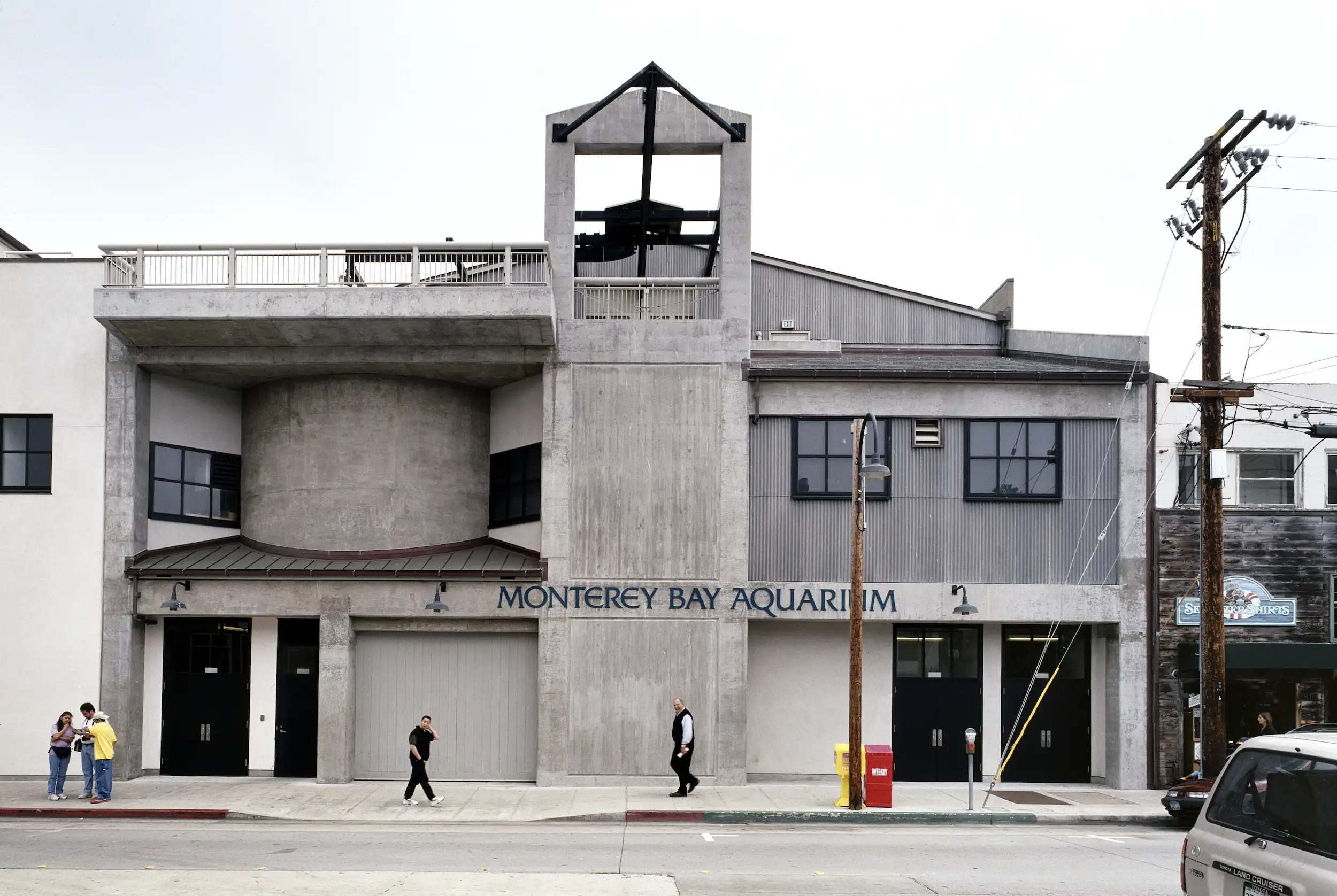
Davis visits the Monterey Bay Aquarium, completed in 1984. Photo courtesy EHDD
The turning point in his career, however, occurred with the Monterey Bay Aquarium, a project he won in 1978 and brought to completion in 1984. Chuck’s exposure to the client, David Packard, was transformational. With Packard, he learned firsthand that the making of lasting architecture required the energetic engagement of a savvy patron. It was a design adventure he shared with his brother Harold, structural engineer at Rutherford + Chekene. Together they overcame the enormous technical challenges in maintaining the original image of the old cannery with the voluminous equipment necessary for the functional requirements of the program to find a durable built rendition. Through that project he acquired in-depth knowledge in aquarium and science/education exhibition design.
His mastery in this unique building type opened unforeseen opportunities in Chuck’s career. The Shedd Aquarium in Chicago was a milestone in blending the modularity of neoclassical buildings with the fluidity of the aquatic environment. Internationally, for the Taiwan Water Resources Museum he exported his expertise in community building through exhibition design on a prominent site on the southern tip of the island. In his home state, the relocation of the Exploratorium at Pier 15 in San Francisco revived a moribund fragment of the city harbor into one of the most vital places in the Bay. The Long Beach Aquarium, one of his later contributions prior to his retirement, demonstrated his ability to sync architectural massing with the latest sensibilities in form-giving without losing sight of the program.
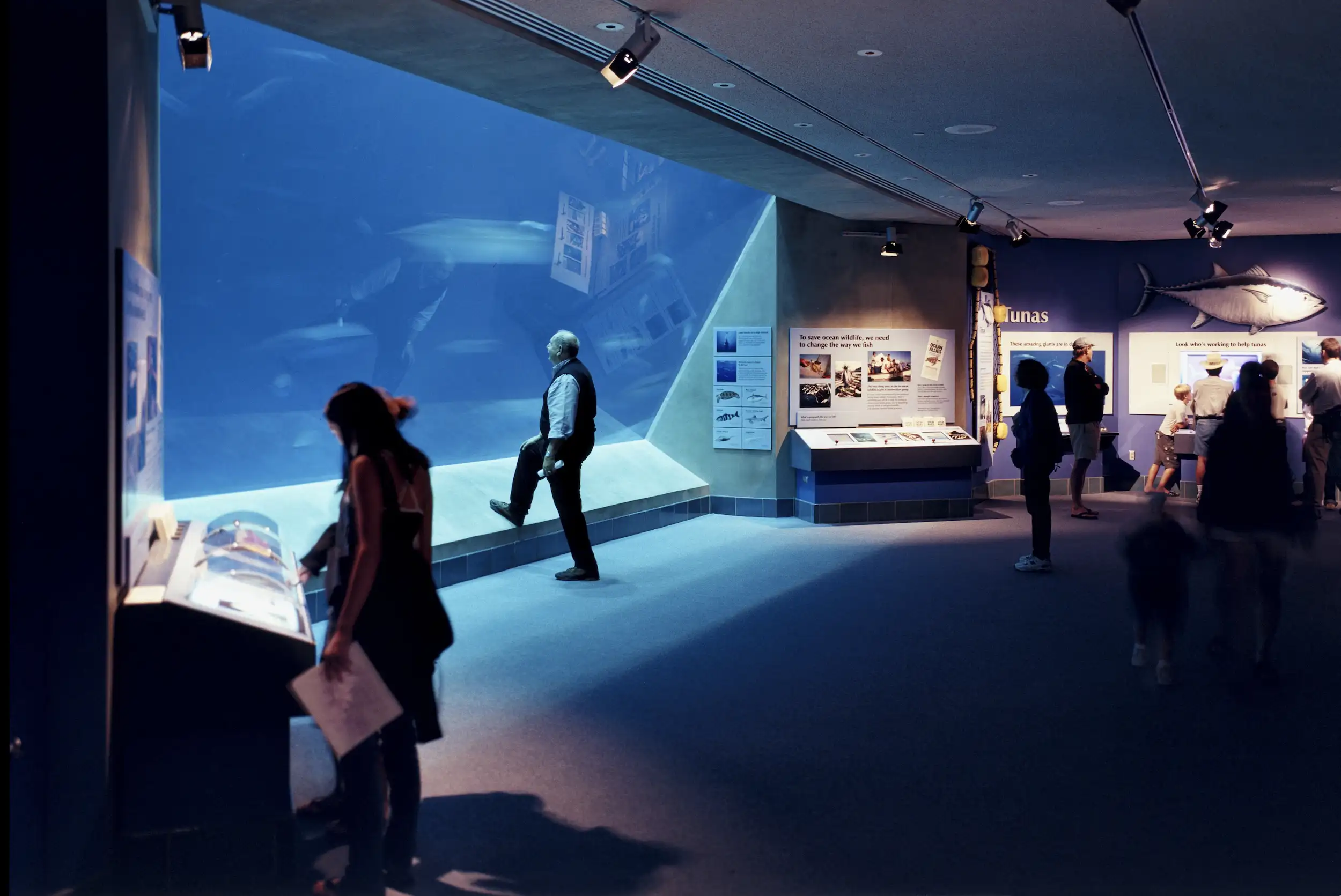
Davis inside The Monterey Bay Aquarium. Photo courtesy EHDD
Works of distinction within the UC system and at Stanford are a constant of Chuck’s career. From his early days with Esherick, academic buildings became another specialty of his. The Science and Engineering Library at UCSC is one of the most context-sensitive buildings on campus. There the architecture is at the service of the commanding nature surrounding it. The Doe Library at UC Berkeley was a complete do over of a structure reorganized sectionally, while being respectful of the existing historicist enclosure. Similarly, Chuck’s longstanding relationship with Stanford gave him the chance to tactfully intervene on its grounds; Stanford History Corner, Building I-120, and Stanford Geology Corner renovation on the quad.
Together with his impressive design legacy, Chuck leaves a deep void with his loved ones—son, Hayden Davis, brother Harold (Hal), sister Carolyn Davis.
Looking for quick answers on architecture and design topics?
Try Ask RECORD, our new smart AI search tool.
Ask RECORD →
Being a figure of authority, earned entirely through hard-won merit, Chuck commanded attention, while being utterly approachable. He was a sage and a child merged into a rare synthesis of innate artistic talent and unbound generosity of spirit, transparent to anyone who experienced the joy and the privilege of meeting him. Chuck’s ability to recall names, places, and facts was uncanny, revealing his deep engagement in the events that he was witnessing. He was always ready to design, to visit buildings, to talk about architecture with the same passion as a student who had just enrolled in college.
And that was Chuck.
Looking for a reprint of this article?
From high-res PDFs to custom plaques, order your copy today!