Sustainability in Practice Summer 2025
In Toronto, The Well Aims for Environmental and Social Responsibility on a Grand Scale
Toronto
Architects & Firms
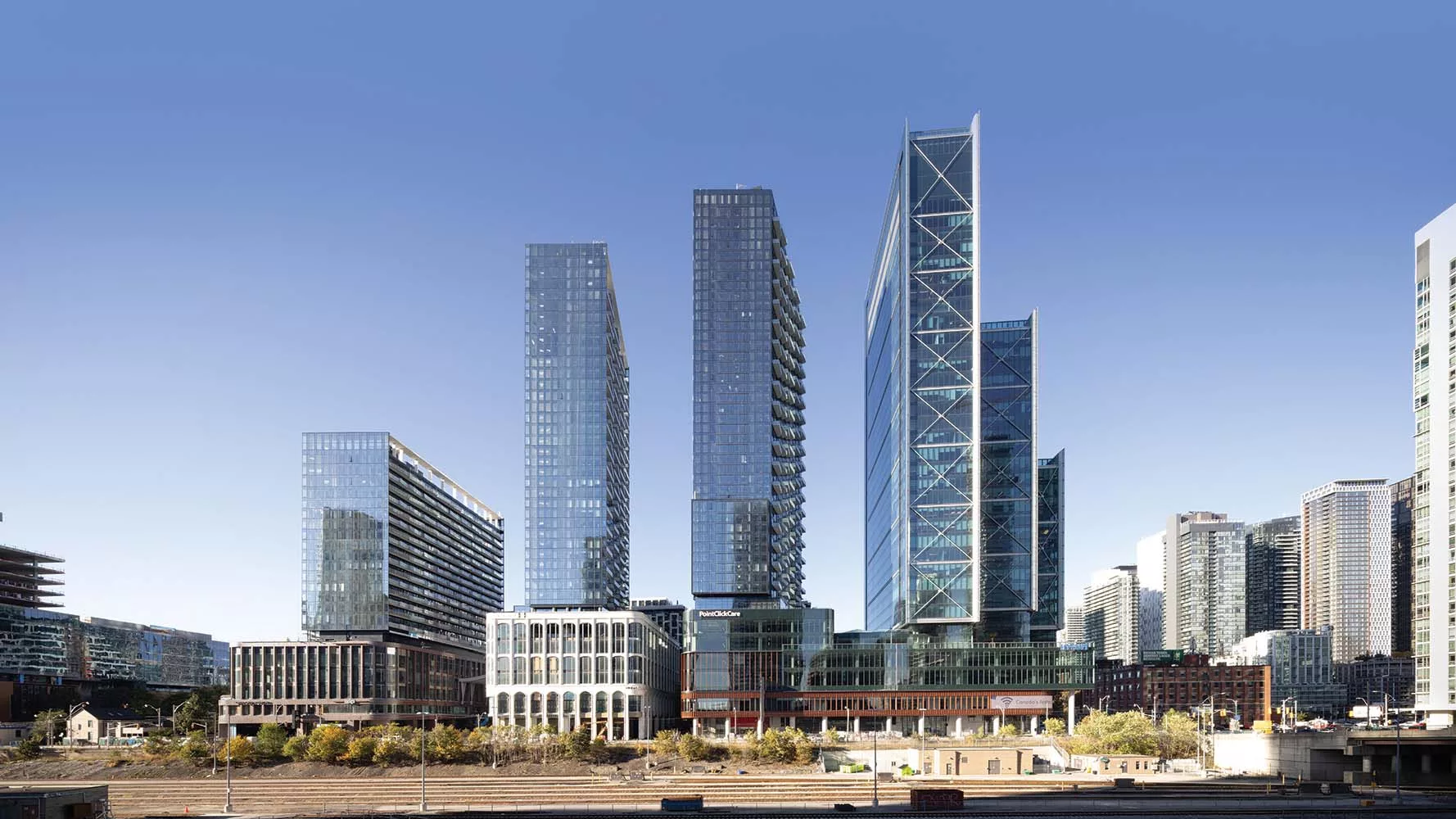
In its best new megaprojects, Toronto has developed a distinct approach to urbanism that aims for environmental and social sustainability, but the characteristic modesty of local architects sometimes makes their city-building style difficult to see. This conundrum is epitomized by The Well, a 3 million-square-foot mixed-use development just completed at the edge of downtown, which involved six architects from Toronto and beyond. One office tower, three residential towers, and three stepped residential volumes sit atop seven chunky masses, all calibrated to fit the site’s many different adjacencies.
The civic importance of the development required careful negotiation among the players involved and added further complexity. The eight-acre site along Front Street—up until the 1850s, a waterfront promenade—was vacated by the Globe and Mail newspaper in 2016 following acquisition of the property in 2012 by a partnership of the real-estate investment trusts RioCan and Allied and the developer DiamondCorp. It was a rare large plot next to the financial district and along a major thoroughfare. “Potentially a once-in-a-career opportunity,” says Andrew Duncan, chief investment officer of RioCan.

A shopping street covered by a glazed canopy connects the towers at ground level. Photo © BDP / Nick Caville, click to enlarge.
The vision for the site was settled in 2014 by a master-planning team of Hariri Pontarini—a Toronto-based architecture practice founded in 1994 by Siamak Hariri and David Pontarini—plus the Montreal-based landscape architecture firm CCxA (formerly Claude Cormier et Associés), and the Toronto planning firm Urban Strategies. Early renderings promised a combination of mid- and high-rise, old and new, commercial and residential to bridge the divide between downtown and the surrounding neighborhood. In the architects’ site model, slabs of walnut established a roughly five-story datum matching nearby mid-rise buildings, with paper and plexiglass extrusions meant to echo the skyline of the financial district to the east. A pedestrian zone cutting through the center of the site completed the parti. “Blocks in this area were zoned industrial and are some of the biggest in the city,” says Michael Conway, Hariri Pontarini associate partner. “We wanted to make it porous by connecting to the alleyways of the neighborhood, and create the potential for discovery—like finding a hidden nightclub.”
Since then, all eyes in the city have been on the intersection of Front and Spadina Avenue. The Well is the most prominent of Toronto’s many current mega-projects. Its location is only half the reason. Just down the street is Fort York, where Americans achieved a pyrrhic victory in 1813. The other way is Union Station, and across the below-grade rail yard alongside Front Street is the most conspicuous development of a previous boom, CityPlace. The other half of the reason for The Well’s notoriety—at least among urbanists—is this juxtaposition. Completed between 2003 and 2020, CityPlace’s expanse of 30 residential towers on 45 acres with only 200,000 square feet of retail is functionally homogenous, and it often feels bereft of life. In comparison, The Well’s 320,000 square feet of retail on a site less than a fifth the size practically guarantees an energetic bustle.
The Well could easily have become a shopping island. Peering east, a stadium, an arena, and a convention center are all within walking distance—but close is still too far away for retail. Is The Well sufficiently enticing to draw in the crowds ambling home after a Jays game? The project’s big move is to open cavernously at the corner. Escalators invite pedestrians both up and down to shops and eateries in a three-story midblock atrium capped by a glass-and-steel canopy. The whole thing is open-air—in a big way at the three endpoints of its overall T shape, and through alley-like passages along the way. It’s not a mall, typologically, and not a shopping street either, but a distinct urban retail type fitting Toronto’s climate and population. Though not conditioned, a pleasant breeze cuts through the canopied atrium in the summer. In the winter, “you can unzip your parka, but you don’t need to take it off,” remarks Adrian Price, a principal at BDP, the British firm that designed the canopy and the retail environment. BDP has experience with similar spaces—for instance at Westgate in Oxford, England—but such glass-covered atria are also a Toronto specialty: the largest downtown mall is covered with one, and so is a nearby galleria by Santiago Calatrava.
Visitors to The Well might think that the canopy, especially following a few years of patination, was fit between mostly existing buildings, but, save for a single brick-clad holdout at the northeast corner, everything is newly built. Seen through a glass wall, the lobby of Hariri Pontarini’s office tower is the most obviously new feature encountered from the street, its Carrara-marbled opulence made less imposing by granite floors and furniture of timber reclaimed from buildings previously on the site. The levels above are wrapped in glass and held tight by thin cross-bracing elements. Most of the other buildings in the development are covered in hand-laid brick on their lower levels, with subtle variations in tone and pattern suggesting the happenstance of time. A significant exception is an elegant block at the center of the atrium clad in creamy glazed terra-cotta tiles and with an arched colonnade. It suggests a distant era of prosperity, even though Toronto’s ascent is relatively recent: it only overtook Montreal in population and financial clout a half-century ago.
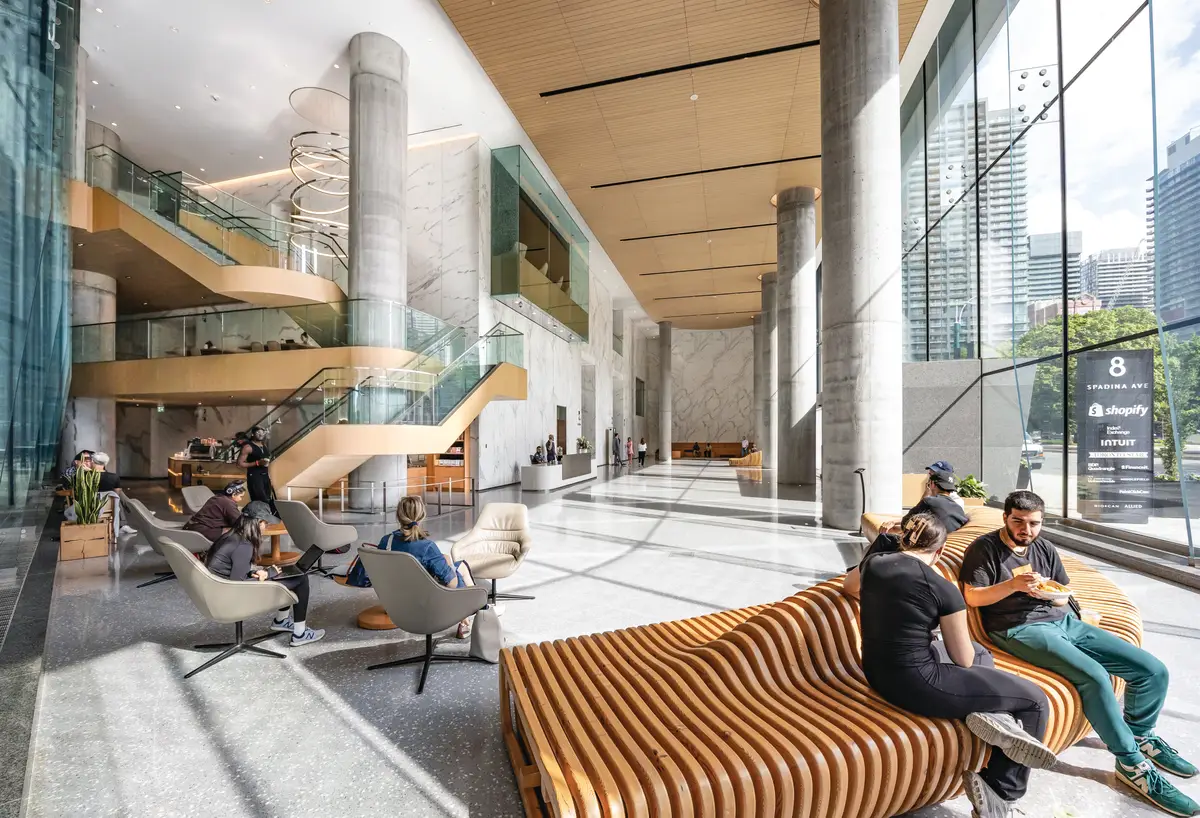
The office tower lobby features reclaimed wood furniture. Image © Hariri Pontarini Architects
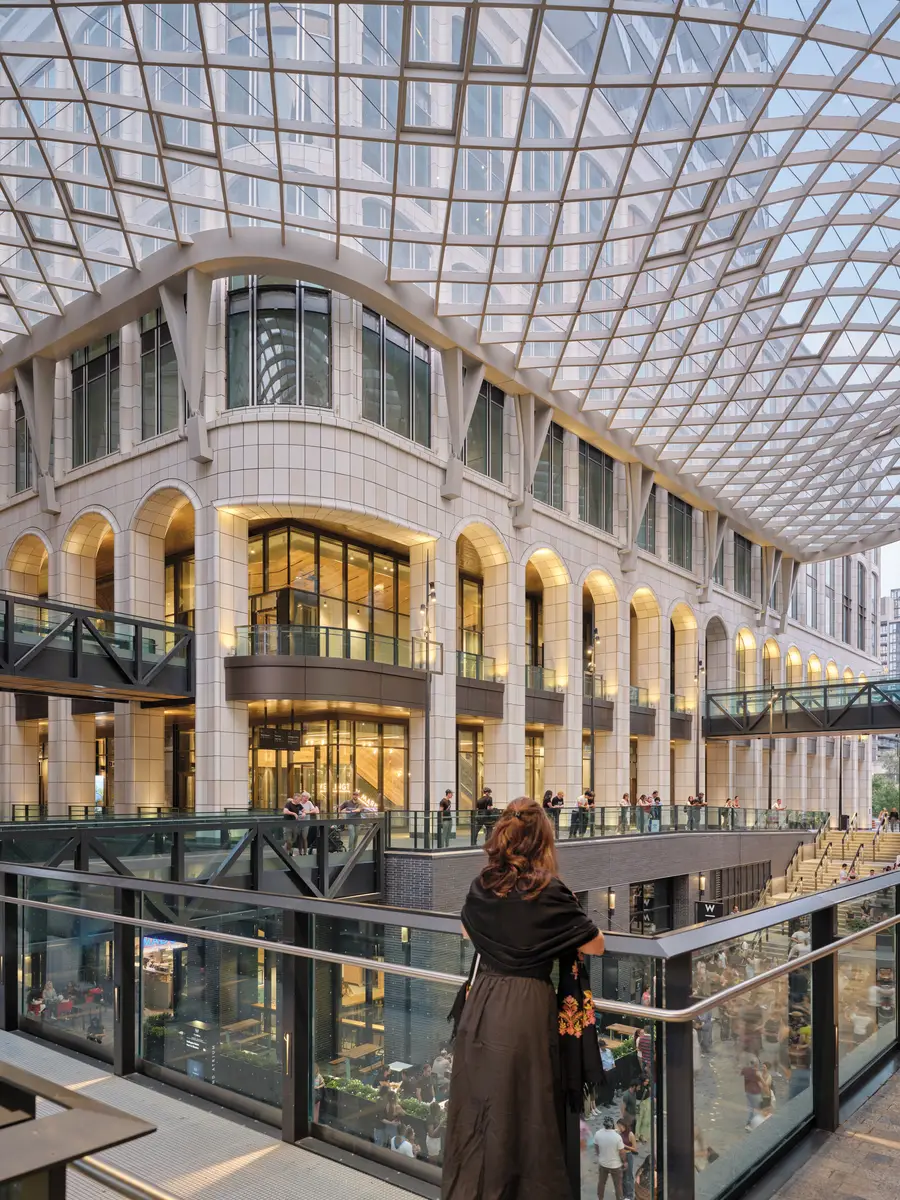
The atrium provides perches for people-watching. Image © Doublespace / Younes Bounhar
Visitors probably don’t linger on the thought, however, distracted as they are by Toronto’s greatest asset—its people! The city has a foreign-born population of nearly 50 percent, and it is therefore relatively young and visibly diverse. This makes people-watching a lively sport, and The Well provides many perches from which to participate. A few visits indicate wide-ranging programming, from pop-up markets to Mexican freestyle-wrestling matches. Visitors are meant to filter in and out of The Well—a surprising gesture of urban generosity that works counter to the conventional retail logic of total immersion. The name of the project comes from Wellington Street, along its northern edge, which CCxA transformed into a grand pedestrian boulevard. The Well bets on social sustainability, pegging its commercial success to the vitality of the surrounding neighborhood.
Looking for quick answers on architecture and design topics?
Try Ask RECORD, our new smart AI search tool.
Ask RECORD →
The project’s energy sustainability plays out invisibly: below The Well is a 2 million-gallon water tank that plugs into an energy-efficient cooling and heating system run by Enwave Energy Corporation. Cold water is pumped in from the depths of Lake Ontario and stored on-site as a thermal battery, which can cool 17 million square feet of space (The Well plus the equivalent of five more projects its size). Enwave shares infrastructure with Toronto’s water utility, and its network of pipes already extends throughout the downtown core to more than 200 buildings. It is the largest deep-lake-water cooling system in the world, a centerpiece of the city’s net zero ambitions, and it makes good business sense, says Duncan: “Enwave runs the system, so I have less infrastructure to maintain.” From The Well’s water tank, the system is now poised to expand into a new part of town. This, and other features like green roofs, drought-resistant plantings, high-efficiency drip irrigation, rainwater harvesting, low-flow plumbing fixtures, and on-site stormwater management earned the project LEED Platinum certification; although impressive in aggregate, such features are relatively common for new developments in Toronto.
Questions remain about the future of The Well. Will a possible park capping the adjacent rail yard send the property’s value into the stratosphere? Or will nearby projects by BIG and Frank Gehry overshadow the development with the spectacle of ostentatious form and exorbitant cost? Whatever the case, The Well is succeeding by accentuating the city’s strengths. It’s sustainable, but it has no need to flex its muscles, and it offers a gentle manifesto for an urbanism that draws upon a deep reserve of multicultural vitality. Cosmopolitanism comes easily to Torontonians, and The Well simply serves it back.
Image © Enwave Energy, click to enlarge.

Credits
Design Firms:
Hariri Pontarini Architects (master plan + commercial office design); Adamson Associates Architects (executive architect + below grade); BDP (retail + concourse); architects—Alliance (residential towers, Front St. W.); Wallman Architects (residential towers, Wellington St. W.); CCxA Architectes Paysagistes (landscape + public realm); Urban Strategies (urban planners); Giannone Petricone Associates (food hall)
Consultants:
RJC Engineers (structural); Jablonsky Ast & Partners (structural, residential); Mulvey & Banani (electrical); The Mitchell Partnership (mechanical); Novatrend (mechanical/electrical, residential); EQ Building Performance (sustainability); LRI Engineering (fire/code/life safety); Odan/Detech Group (civil)
General Contractor:
EllisDon, Deltera Construction Management
Client:
RioCan REIT, Allied Properties REIT, Tridel, RioCan Living, Woodbourne Capital Canada
Size:
3 million square feet
Cost:
Withheld
Completion Date:
November 2023
Sources
Masonry:
Glen-Gery, Boston Valley Terra Cotta
Curtain Wall:
Antamex, CGI
Skylights:
Gartner
Looking for a reprint of this article?
From high-res PDFs to custom plaques, order your copy today!