House of the Month
StudioAC Orients Bricks to Suggest the Inner Workings of a Gabled Rowhouse in Toronto
Toronto
Architects & Firms
In the neighborhoods that ring Toronto’s downtown core, skinny houses on narrow lots are the norm. When a husband and wife with two small children offered Canadian firm StudioAC latitude to reconsider this type, the architects responded with flair: they organized a three-story house with a long vertical atrium that brings daylight from roof to ground and from front to back.
The house sits in Trinity-Bellwoods, where its neighbors occupy roughly 20-foot-wide lots and rely on front and rear exposures for daylight. In recent renovations, the usual response is “to leave a void in the center and let light through,” explains StudioAC partner Andrew Hill. This west-facing site, previously occupied by an undistinguished 1980s dwelling, offered more than the usual width and opportunity to try a different strategy: “We saw that there was enough room to make a linear atrium and gallery on the second floor,” he adds.
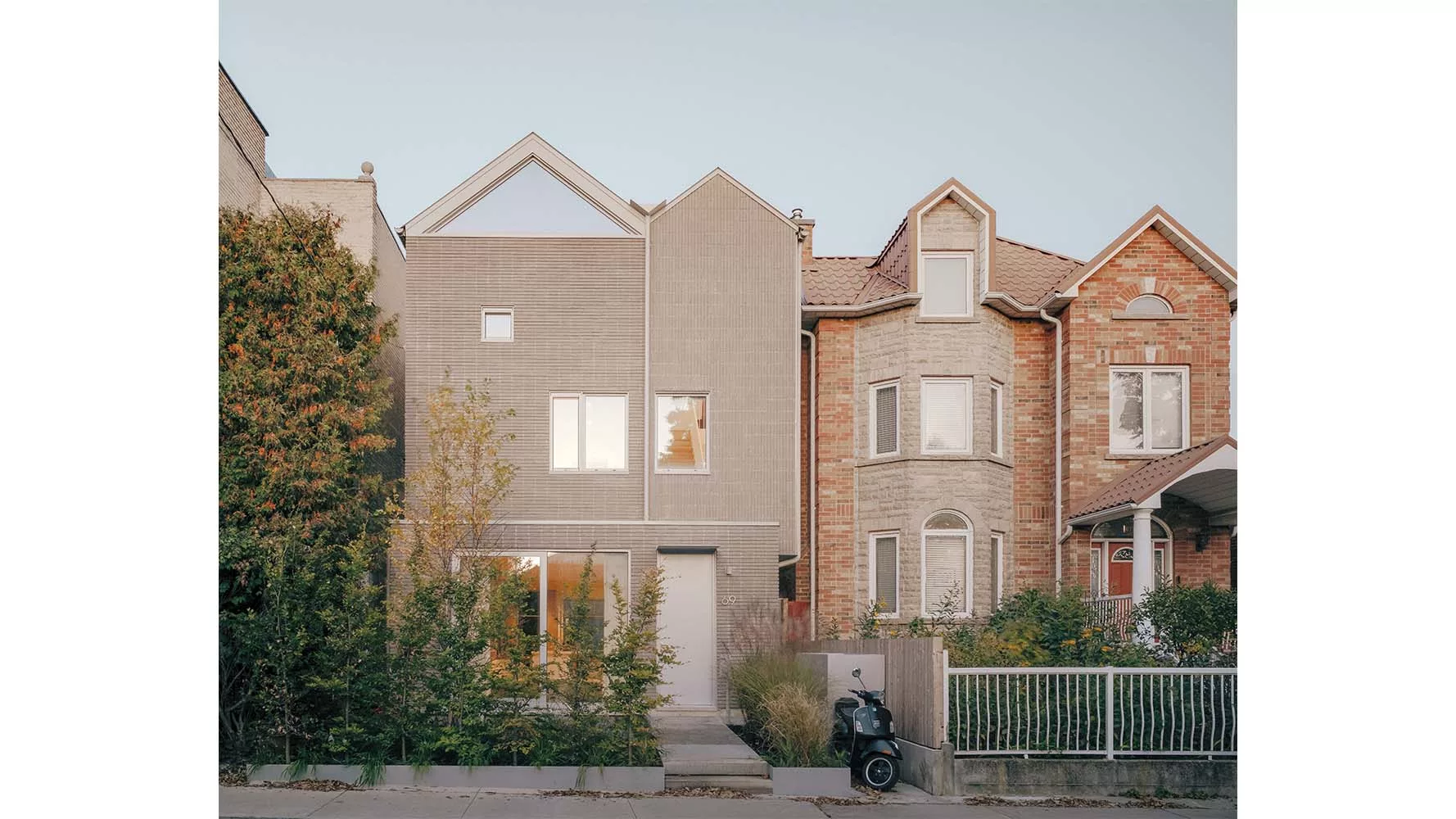
The resulting composition consists of two side-by-side gabled forms clad in a beige Belgian brick. The wider volume, positioned to the north, contains the living spaces and two floors of bedrooms; the narrower one, to the south, accommodates the stairs, gallery, and vertical void.
StudioAC orients bricks to telegraph this internal logic to passersby. Horizontal courses ground the living volume, while a vertical stack bond defines the stair tower, making a subtle twist on the area’s masonry tradition.
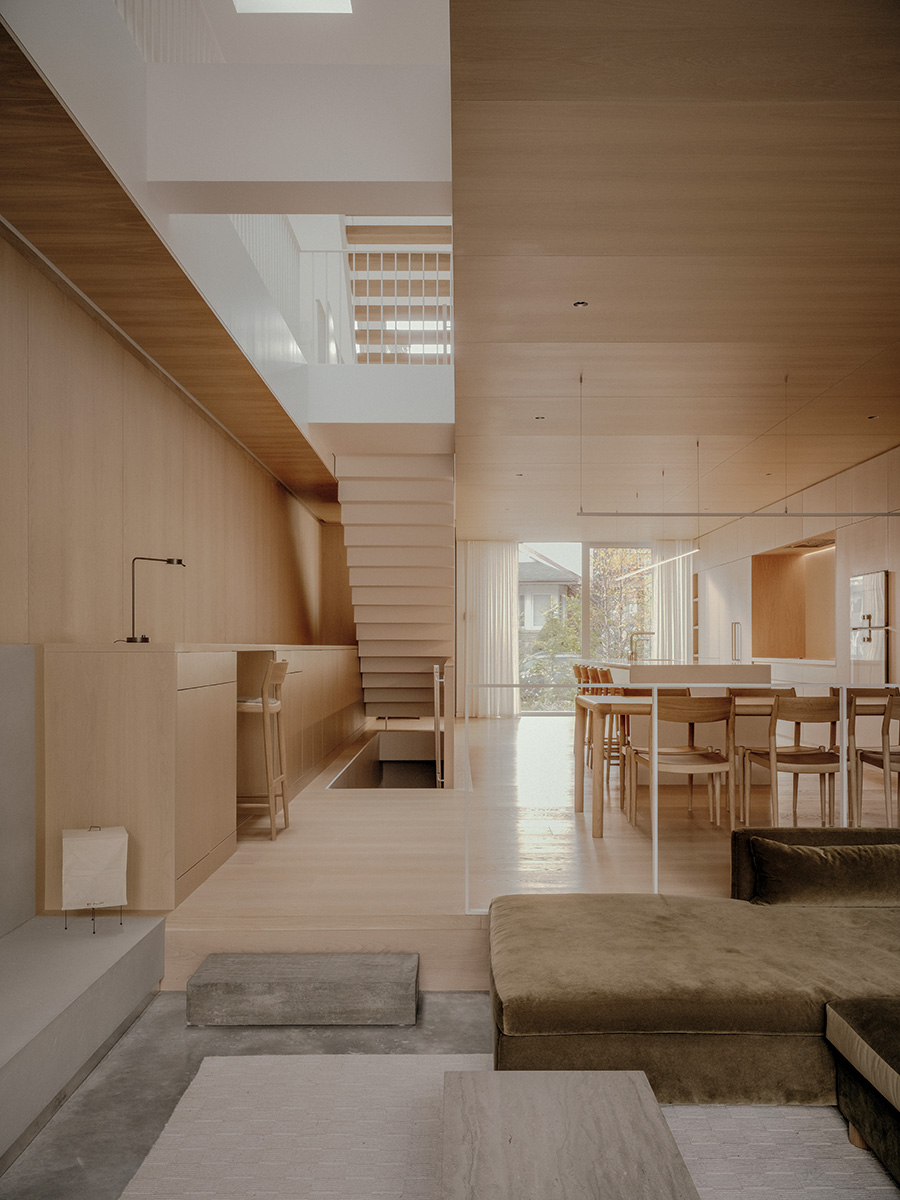
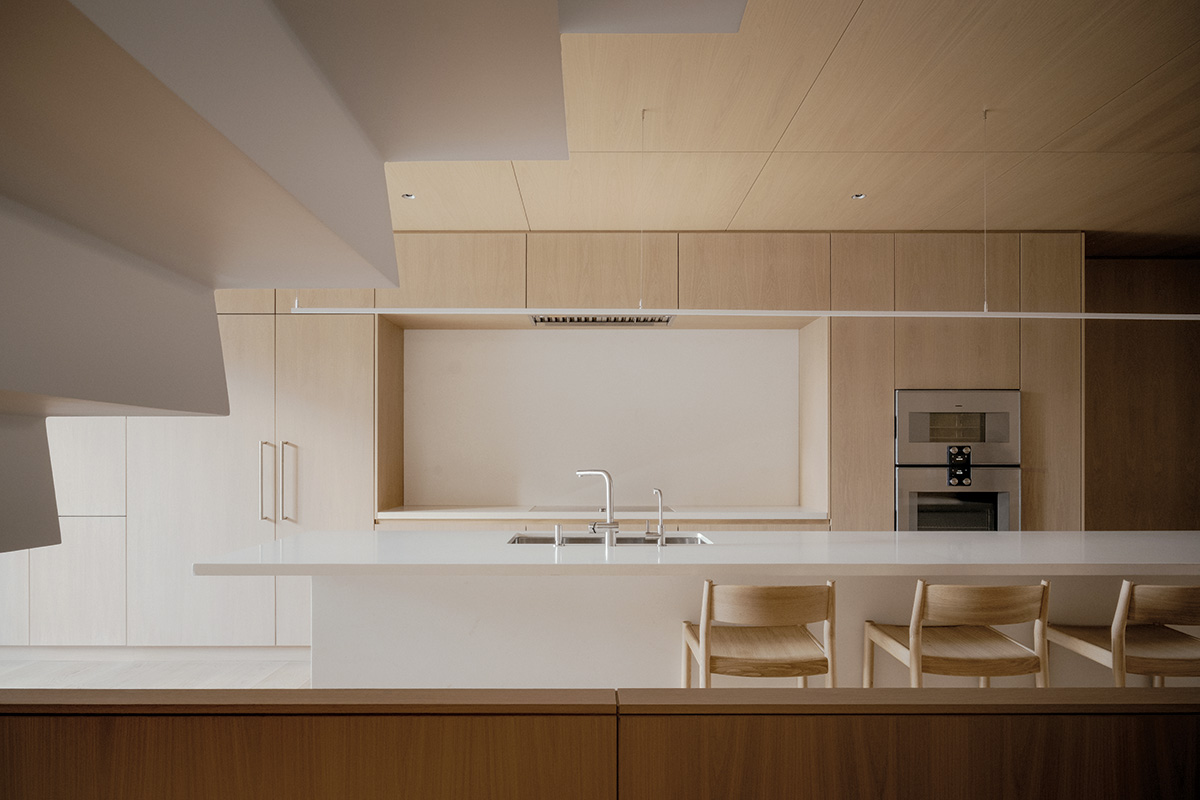
Inside, the ground floor unfolds as a long volume whose floor, ceiling, and millwork are dressed in white oak. At the front, two easy chairs face a sliding door, defining a sort of porch; past that is a kitchen with an island, before the layout shifts to the right, steps down a level, and stretches back to the rear, where a green velour sofa defines a sunken living area.
1
2
3
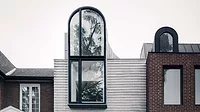
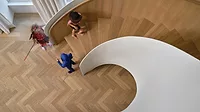
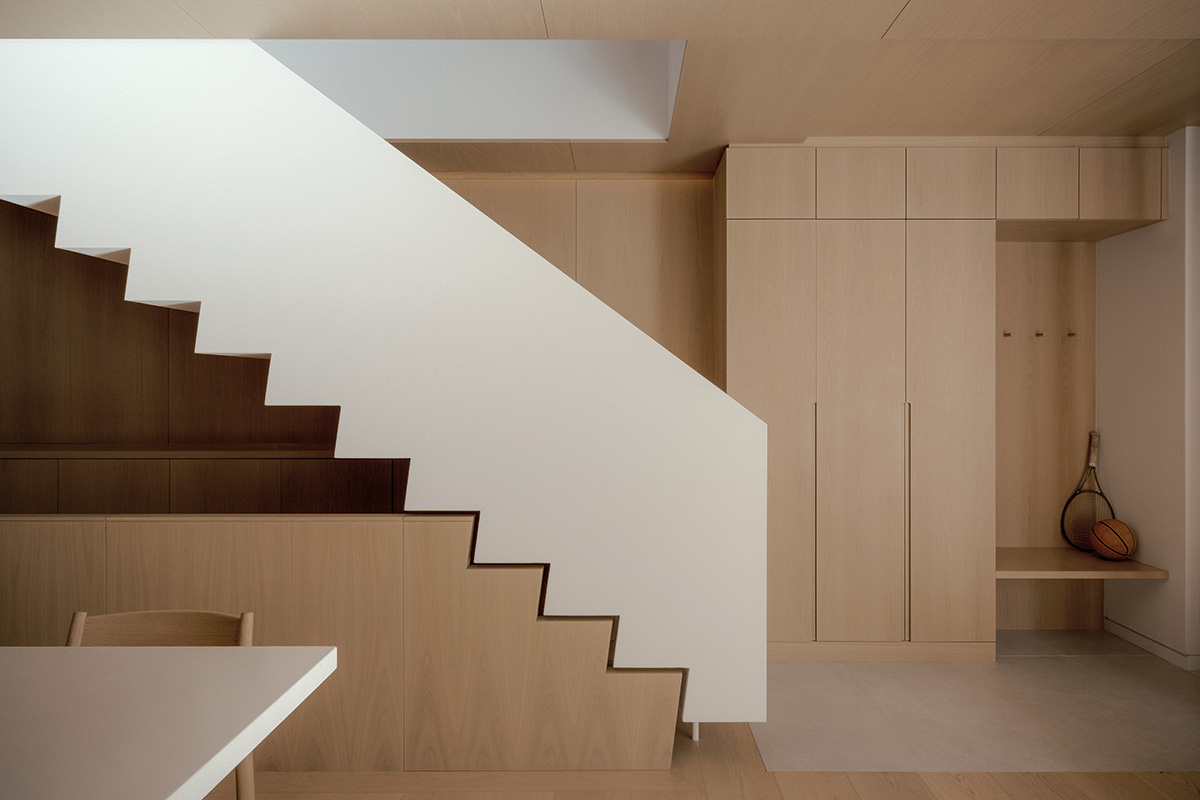
Oak lines the ground floor (1 & 2), where the material converges with a white-painted steel staircase (3). Photos © Félix Michaud, click to enlarge.
That green tempers the house’s austere color scheme of white and white oak. So too do two more spaces. A powder room at the back of the house features green fixtures and penny-round mosaic on all surfaces, including the door, while a pantry off the kitchen is finished in dusty-rose paint and a matching tile backsplash. “The clients are very playful, and there was a desire to have a few fun and singular moments,” says StudioAC partner Jennifer Kudlats. “In these secondary spaces, you open the door into a bit of Narnia.”
Beyond these hidden polychromatic surprises, the project is anchored by a sectional move. The atrium establishes a visual connection among all levels, introducing both direct and reflected light. A white-painted metal stair descends through this void to the ground floor; its steel plate meets an oak guard in a zigzagging reveal that registers the intersection of materials and systems, as project architect Sarah Reid describes.
Looking for quick answers on architecture and design topics?
Try Ask RECORD, our new smart AI search tool.
Ask RECORD →
Upper-floor spaces extend this idea. The second level’s office borrows sun from the atrium, while the kids’ rooms look to the back and front. On the third floor, the primary bedroom sits beneath a wood-lined gabled ceiling, its perimeter glazing filtered by floor-length curtains.
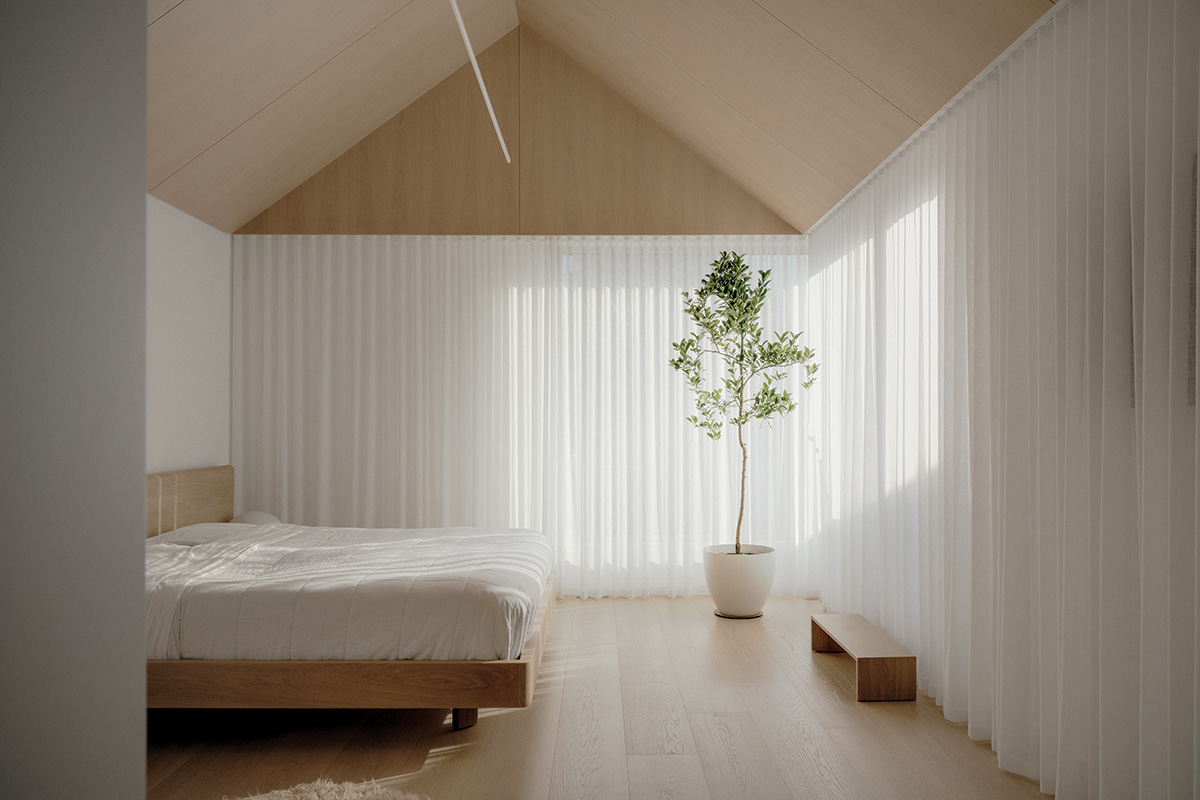
The primary suite sits beneath a gable. Photo © Félix Michaud
Brick from the exterior continues here into the primary bathroom, where it is set against smooth microcement flooring and counters in a matching pale green. A high triangular window introduces daylight from above and frames a view of a spruce tree; a smaller opening next to the bathtub provides ventilation and a view. That move picks up on the small, irregularly placed windows that pop up in the area’s Victorian vernacular houses.
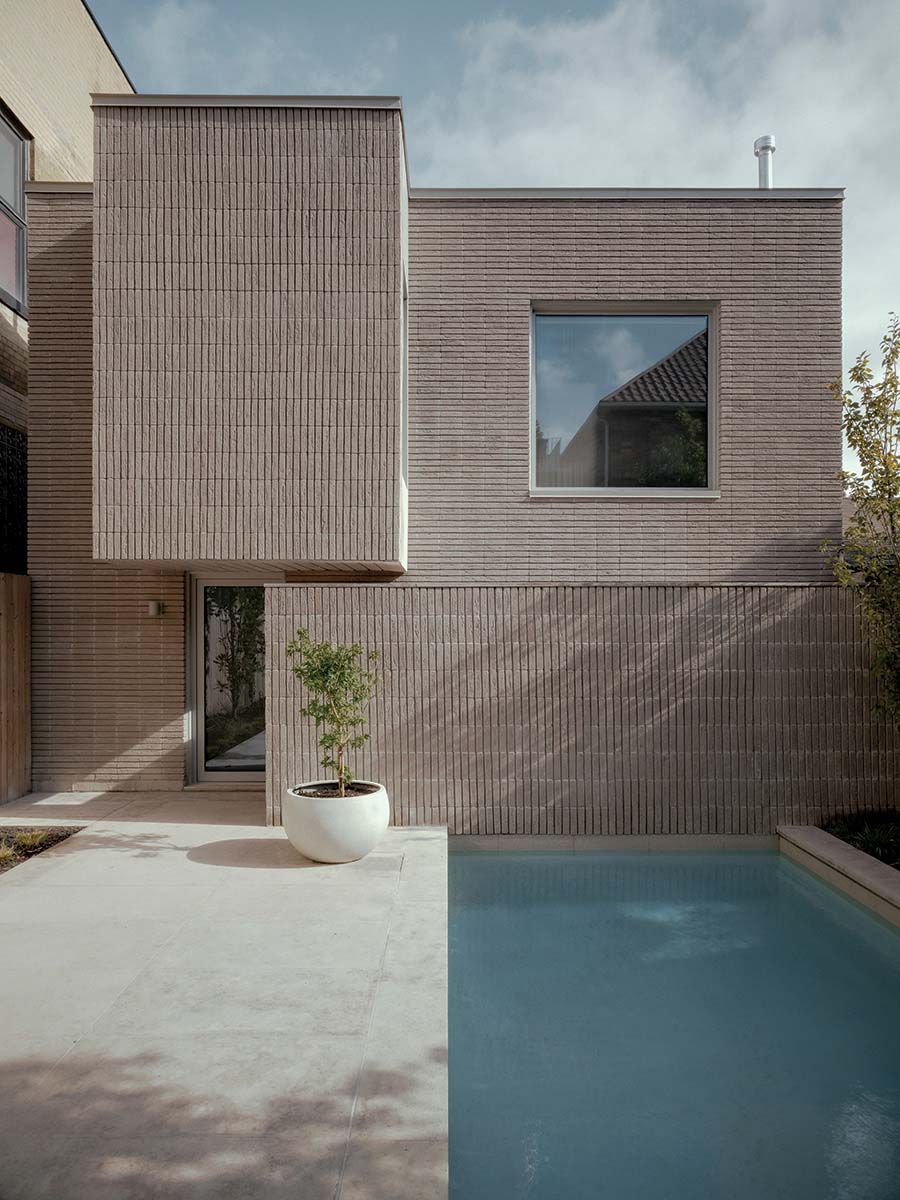
The property includes a laneway house. Photo © Félix Michaud
At the rear, a so-called laneway house repeats the material palette and massing scheme of the main building. A side stair leads from a double garage up to a well-lit apartment, which enjoys views across the yard and the back lane. Here the project takes advantage of recent Toronto planning changes that legalize such accessory structures. The owners plan to use the suite to house extended family, returning to a practice of multigenerational living that was the norm in middle-class households here for a hundred years.
In between the two buildings, a garden wall screens the pool’s equipment and shapes the edge of the outdoor space, which is sunken, 3 feet lower than the surrounding lots, establishing a degree of privacy on a busy, varied block. The house does not escape the limits of its lot so much as it recasts them into a poetic and complex spatial order.
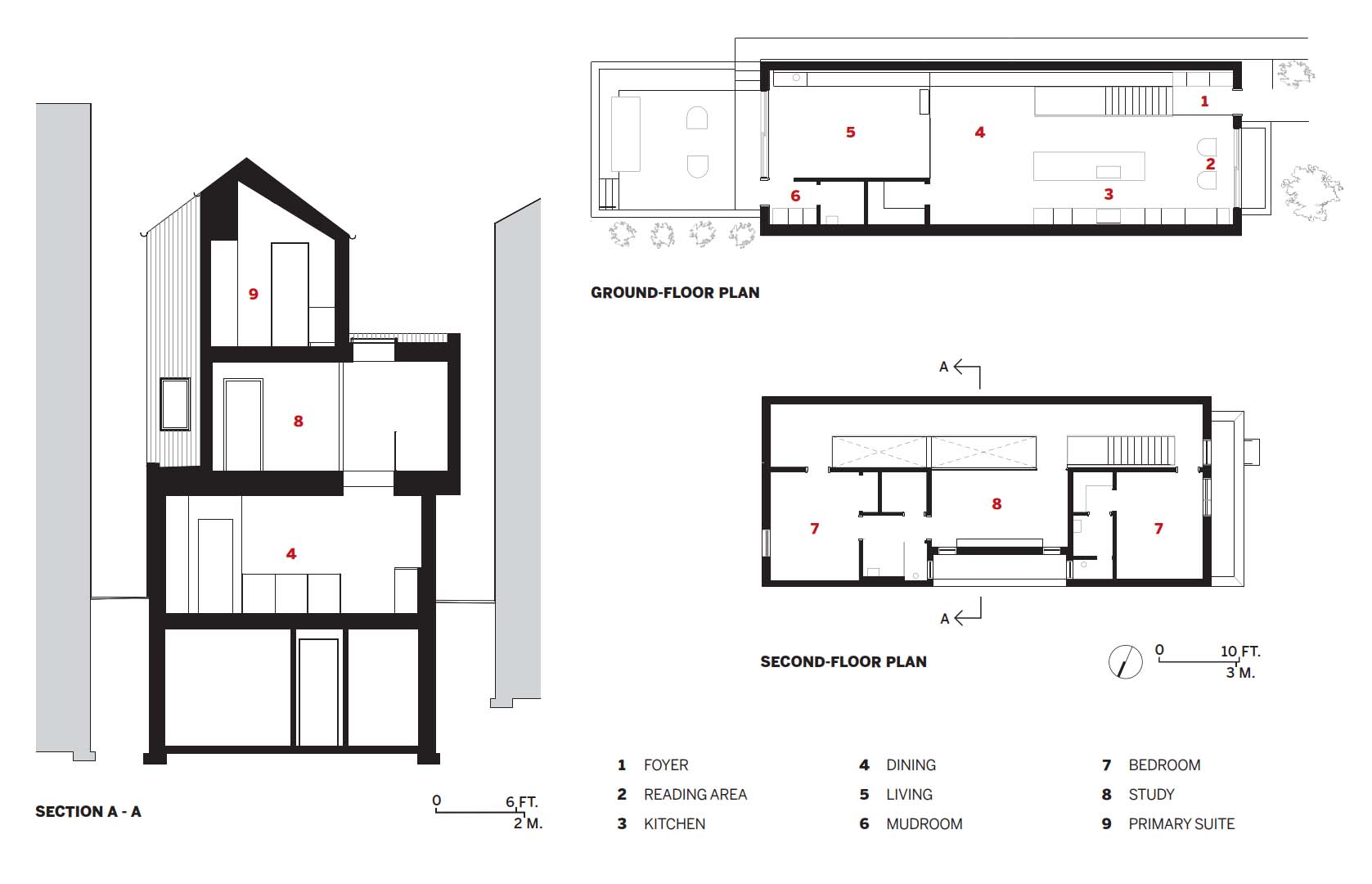
Image courtesy StudioAC
Credits
Architect:
StudioAC — Andrew Hill, Jennifer Kudlats, Sarah Reid
Engineers:
Honeycomb Group (structural); McCallum HVAC Design (mechanical)
Consultant:
Gravenor (landscape)
General Contractor:
Nouveau Property Group
Client:
Withheld
Size:
3,280 square feet
Cost:
Withheld
Completion:
March 2025
Sources
Cladding:
Nelissen (masonry); Agway Metals (panels)
Windows/Doors:
EPAL Windows
Skylights:
Velux
Cabinetry:
Etherington Designs
Flooring:
Unik Parquet
Lighting:
Liteline Potlight, Lumentruss
Plumbing:
Franke, Watermark
Looking for a reprint of this article?
From high-res PDFs to custom plaques, order your copy today!