Entertainment
A New Dance Venue Rises on the Site of a Theater Fire at Jacob’s Pillow in the Berkshires
Becket, Massachusetts

RECORD is saddened to learn of the tragic accidental death of production manager Kat Sirico on the grounds of Jacob’s Pillow. As a result of the accident, Jacob’s Pillow has decided to cancel the remainder of its 2025 season.
The Berkshires campus of Jacob’s Pillow, the dance center founded in 1933, is picture-postcard beautiful. Thirty-six buildings, many of them pitched-roof rustic-farmhouse-style performance spaces, are spread across 220 acres of bucolic Massachusetts woodlands. It’s a near-total immersion in both dance and nature—a sanctuary or, at least, a respite from the always-on hurly-burly of contemporary life.
On November 17, 2020, that serenity was violently disrupted when a fire engulfed the Doris Duke Theatre, reducing to ash an 8,500-square-foot space built in 1990. It was a beloved piece of the Jacob’s Pillow summer festival experience, a venue for major performances, and a focal point of community. But after a period of grieving, Pamela Tatge, executive and artistic director, began strategizing how to not only rebuild but to turn the tragedy into an opportunity to establish Jacob’s Pillow as the future-forward leader in global dance.
In 2021, Tatge tapped Dutch firm Mecanoo, which has a robust portfolio of theater designs, to lead the project of building a bigger, better Doris Duke. Mecanoo in turn partnered with New York–based Marvel as its architect of record and landscape designer. Two years later, ground was broken on a new 20,000-square-foot facility. And, last month, on July 9, this year’s dance festival officially began with the opening of the new theater, the organization’s most flexible, accessible venue to date, and one that upends the design tradition at Jacob’s Pillow while retaining the spirit both of its context and the previous space.
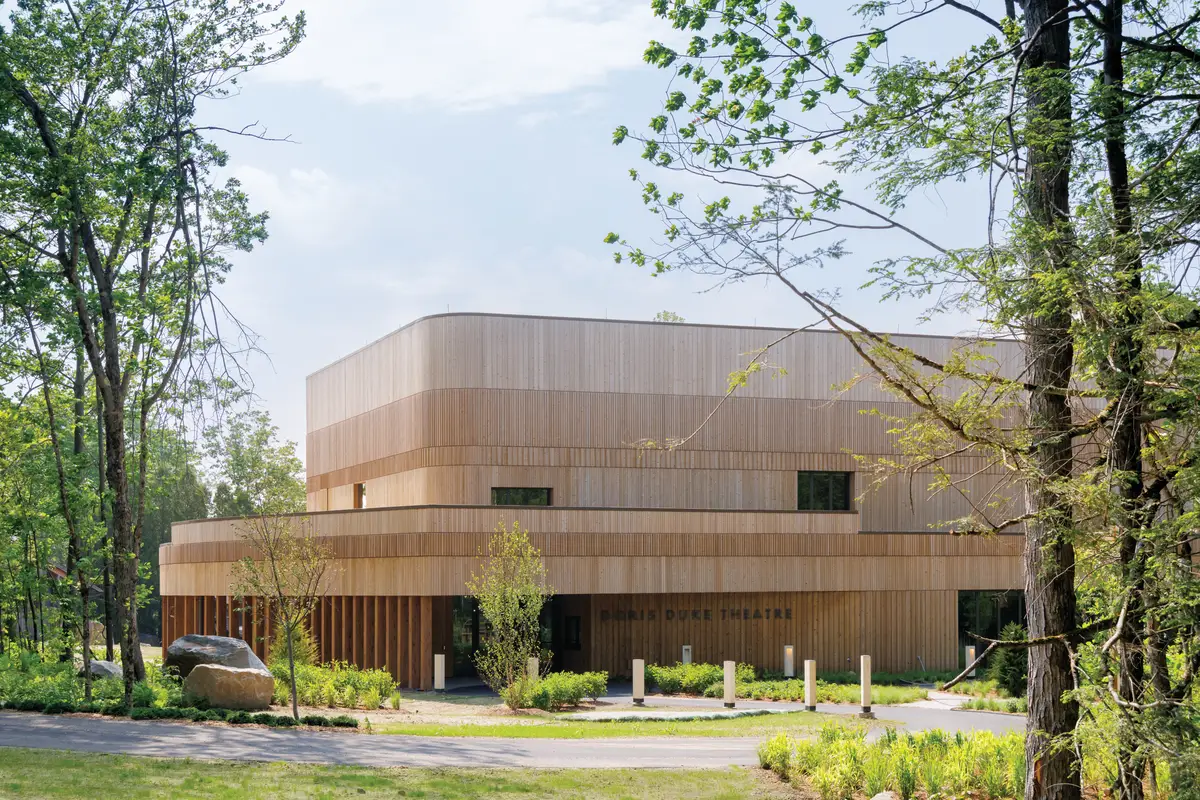
Timber cladding is organized into horizontal bands. Photo © Iwan Baan, click to enlarge.
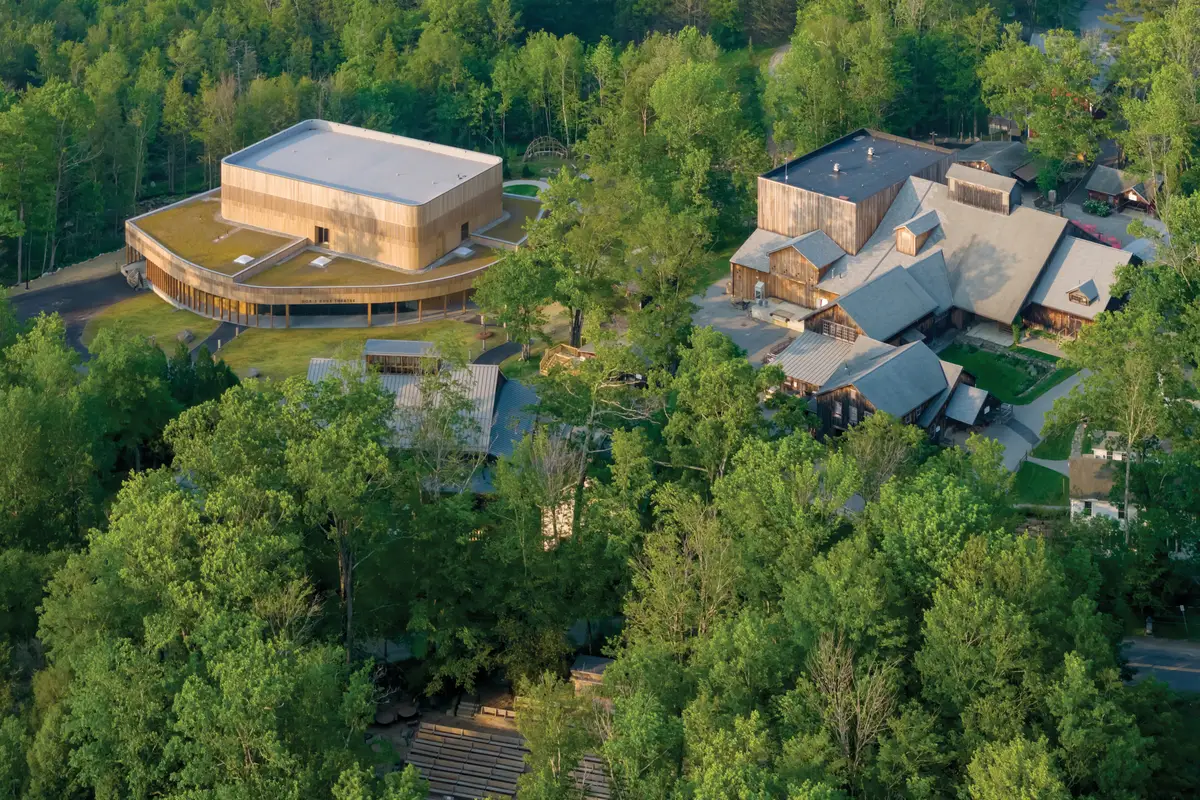
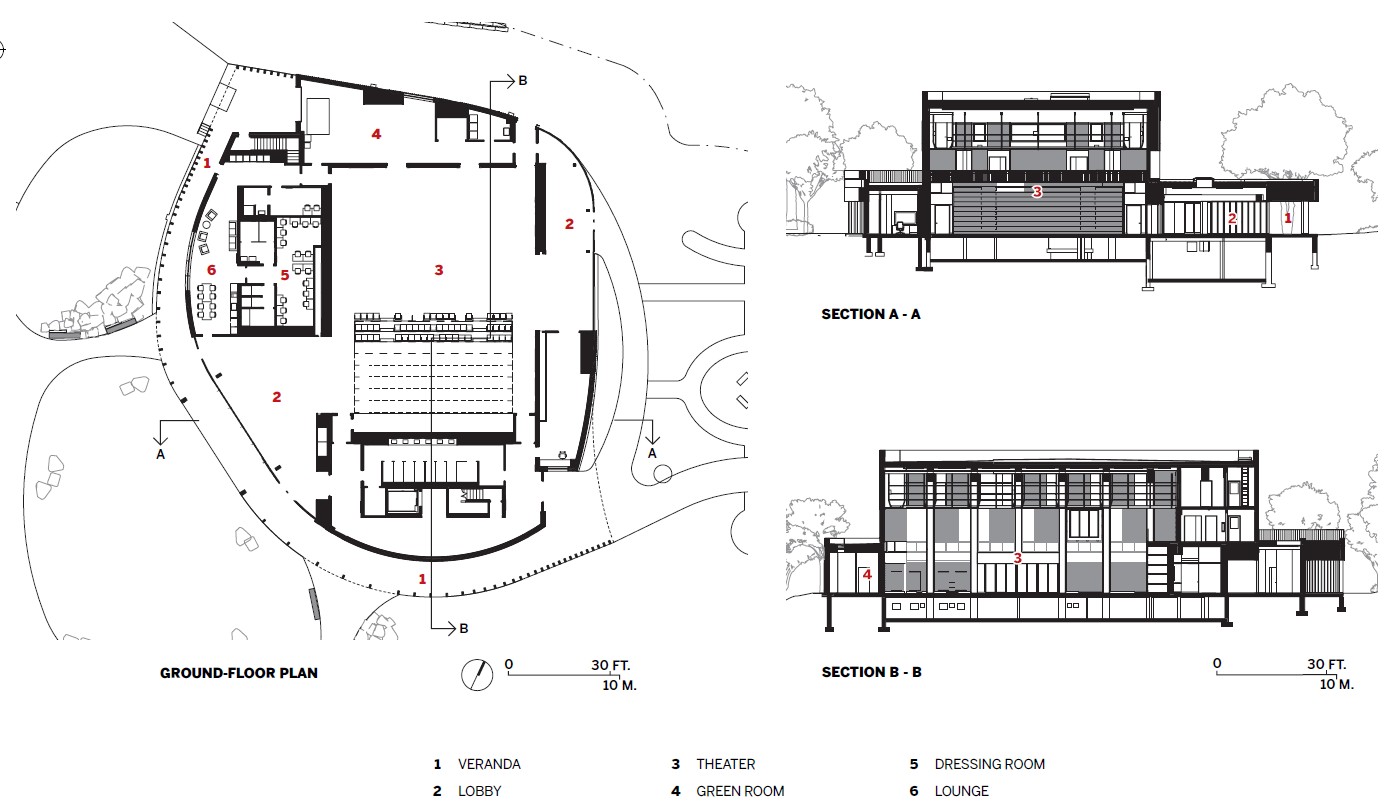
Located on the site of the old theater, which is lower in elevation than the rest of the campus, it’s easy to miss the Doris Duke among the older, angular silver-wood-clad theaters. But as one follows a path down and approaches from the east, the mass-timber building, jacketed in seven horizontal bands of wood, begins to reveal itself. The ground level is formed by a ribbonlike veranda that curves around the building, connecting the theater’s two lobbies and wrapping a single-story plinth. It has an organic shape when seen from afar, helped along by the presence of a green roof. The auditorium—what Mecanoo founding partner and design lead Francine Houben calls “a magic wooden box”—rises above.
1
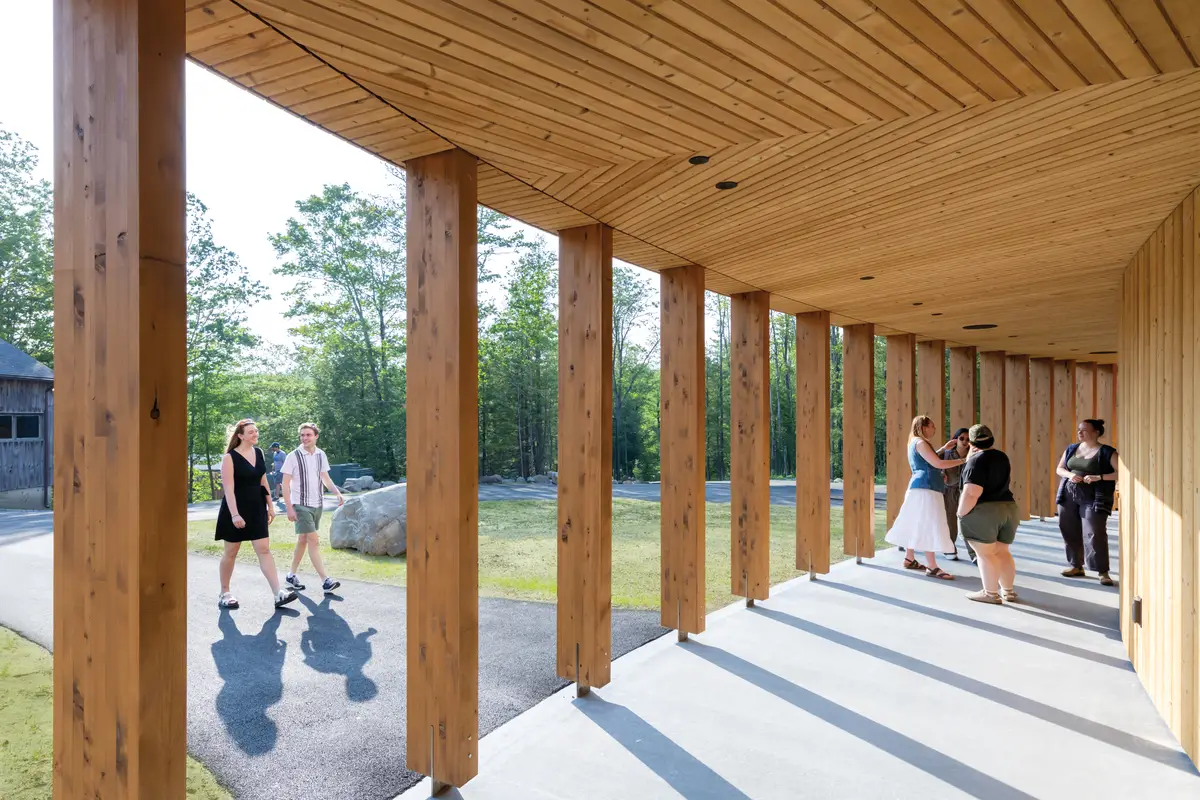
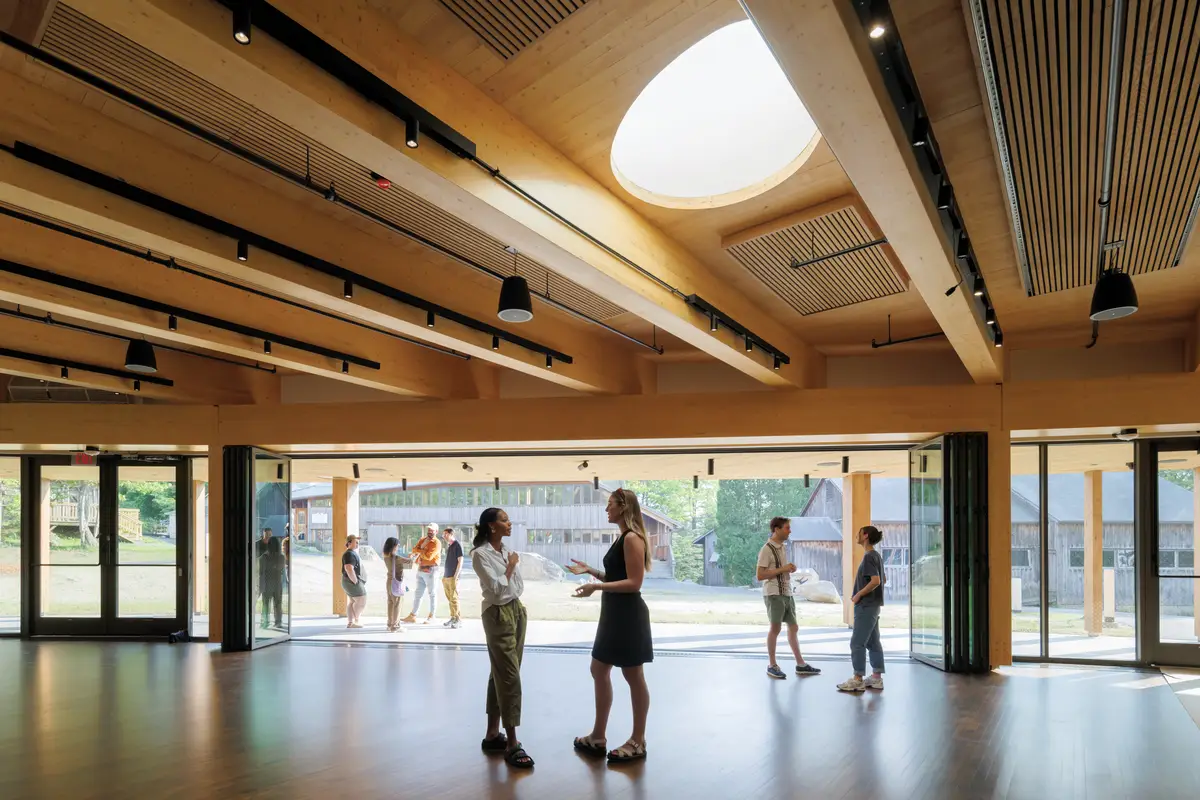
A veranda encircles the theater (1 & 2) and leads guests to a lobby (3). Photos © Iwan Baan
2
3
The scale of the structure is imposing, especially from the west, where the veranda is most present and faces a large meadow. Yet its sinuous profile helps make the building’s presence manageable and less severe. It also creates a sense of movement—it’s a “dancing building,” Houben says. “The veranda was very important,” she adds. “That, for me, is the Berkshires. This theater is inspired by this climate. It really fits in the culture of being here.” The architect says the decision to implement passive-design strategies came with practical benefits as well, such as treating the space as an all-season venue, unlike many of the other older, drafty structures on the campus that are only in operation during the summer festival.
Inside the building, walls of windows on the east and west visually connect the theater to nature and can be opened to create more expansive performances, replicating a beloved feature of the previous building. However, it was the introduction of the plinth and the decision to eschew the architectural style that characterized the campus that allowed Houben to not only realize multiple elements of the project brief but also address the shortcomings of its predecessor. “The old Duke was not really hospitable to artists and staff. The spaces were really cramped,” Tatge adds.
Looking for quick answers on architecture and design topics?
Try Ask RECORD, our new smart AI search tool.
Ask RECORD →
At the southern end of the building, a sequence of flexible spaces (lobbies, an art gallery) flows into expanded amenities to the north (including bigger dressing rooms, warm-up areas, and a large workshop), which not only improves performer experience but expands what they can accomplish at the theater. Now dancers can navigate around the auditorium and enter it from multiple points. Accessibility is increased throughout, and Pillow staff can better and more efficiently support increasingly sophisticated and digitally minded performance demands. “The opportunity was to not be in a situation where we would have to compromise the vision of an artist,” Tatge says. “Now we have everything we need.”
The auditorium, slightly larger than the previous space at 60 feet by 80 feet, is state-of-the-art, “incredibly wired,” and “not married to a single type of technology,” Tatge says, to ensure it can host as wide a range of events as possible, from analogue dance performances to those that involve robots and incorporate artificial intelligence. The box is defined by wood walls with acoustic paneling, rounded corners, retractable seating, and enough flexibility to accommodate a variety of configurations for up to 400 audience members. Perhaps the least expected design element, though, is one of the most subtle. Look up and you’ll see a series of functional catwalks, camouflaged with timber-clad undersides. Aesthetically, it makes the space feel more intimate, while simultaneously vastly expanding what’s possible in the kinds of events the theater can host. It’s an experience that would not have been possible, Houben says, with a pitched-roof building.
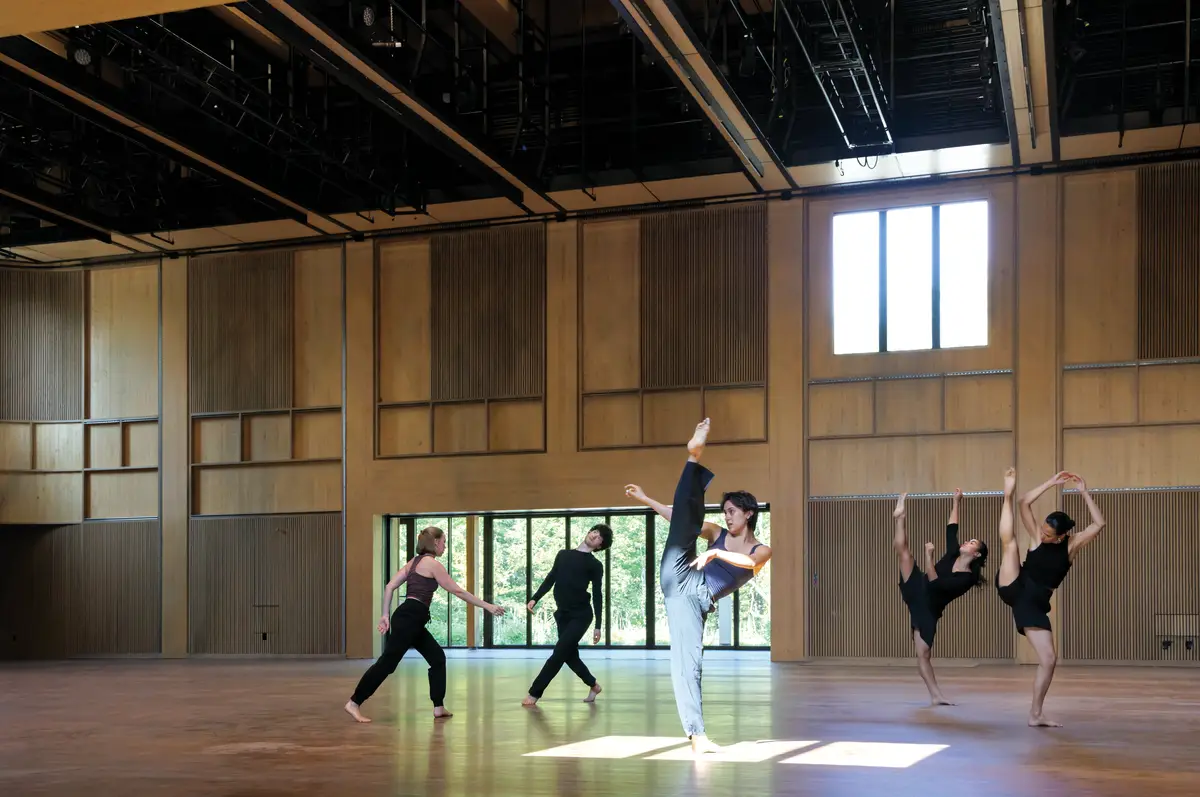
4
The main theater space (4) includes windows that introduce daylight, exposed catwalks, and retractable seating (5). Photos © Iwan Baan
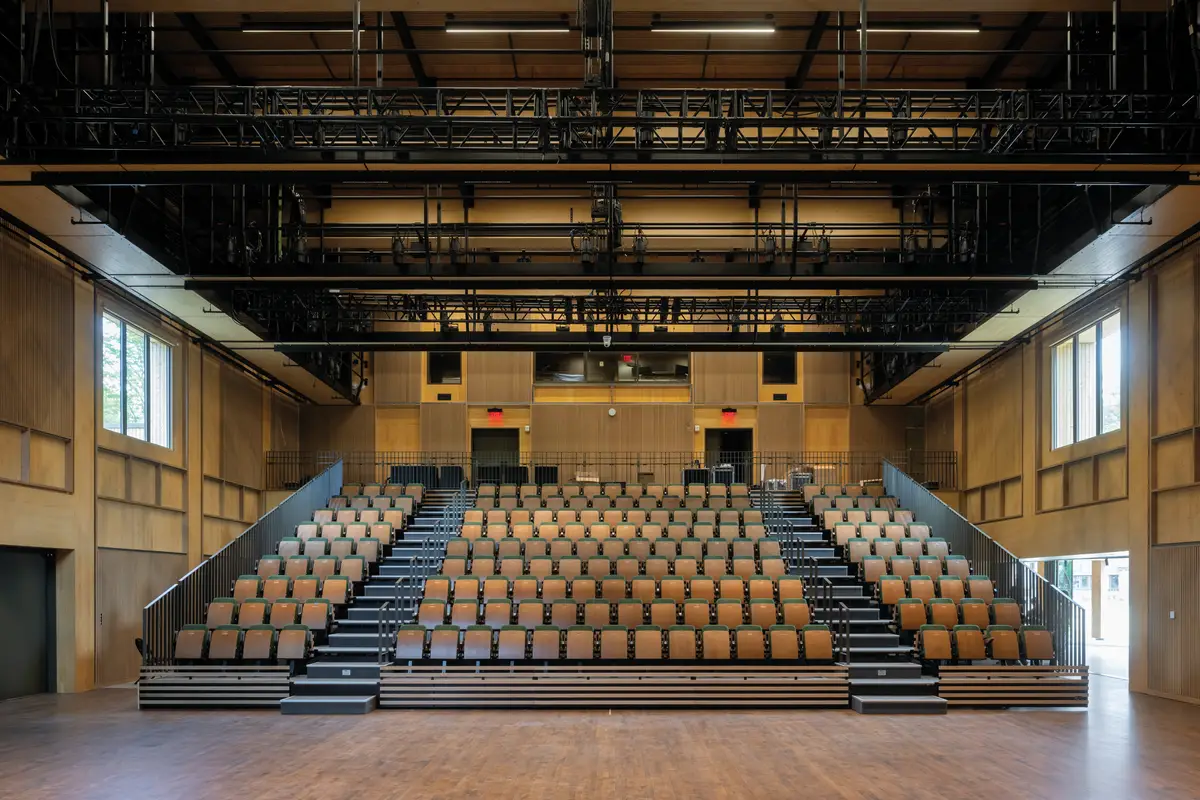
5
“The domain of the catwalk feels very industrial once you get up there, but from below, by incorporating CLT underneath them, it really allowed for the preservation of the purity of the box,” adds Marvel director Danielle Cerone. “We wanted this to be a very simple volume that also has the infrastructure in place for the Jacob’s Pillow team to change this in a weekend and make it a new configuration.”
The grounds to the west of the Duke are defined by the large Artist Quad, where visitors can gather and dancers can perform outdoors. The eastern approach is more ambitious and guided by Tatge’s requirement for incorporating Indigenous values. Together with artist Jeffrey Gibson as the project’s Indigenous consultant, Marvel mapped out a sequence leading into the main lobby. Organized around a central grassy oval is a medicine garden planted with native flora and a communal fire pit, with seven stepping stones connecting each component. Even the seven horizontal bands of the facade are a symbolic nod to an Indigenous philosophy about building sustainably for seven generations.
“There was so much we learned about the meaning of common plants that helped make the garden an integral part of the entry experience. We really wanted to immerse people in it,” says Marvel project manager Juan Guzman Palacios. Adds partner-in-charge Yadiel J. Rivera-Díaz: “I hope the ideas that emerge from this one part of the campus spread to the rest of it. I can’t wait to see how it evolves over time.”
Seen from above, the landscaping and pathways form the Mohican Many Trails symbol, signifying endurance and strength. It’s a fitting marker for the site. Out of the ashes of the 2020 fire has risen a new, more resilient, and more innovative Doris Duke Theatre. Houben’s “magic wooden box” is a space that “can have surprises, that performers can play with, and where the whole atmosphere, inside and outside, is unique,” she says. “We wanted to create something that is forever and for everyone.”
Click drawings to enlarge
Read about other entertainment projects from our August 2025 issue.
Credits
Architect:
Mecanoo
Architect of Record:
Marvel
Engineers:
TYLin (structural); Altieri (m/e/p/fp/IT/AV); Foresight Land Services (civil)
Consultants:
Charcoalblue (theater/acoustics); Jeffrey Gibson, Heather Breugl (Indigenous); MW-Skins (envelope); Fisher Marantz Stone (lighting); Afreeman (signage)
Artists:
Misty Cook, Kathi Arnold (garden); Andre StrongBearHeart Gaines Jr. (firepit); Brenda Mallory (visual art)
General Contractor:
Allegrone Companies
Client:
Jacob’s Pillow Dance Festival
Size:
19,300 square feet
Cost:
$30 million
Completion Date:
July 2025
Sources
Mass Timber:
Nordic, Bensonwood
Cladding:
Kawneer (curtain wall); NanaWall (retractable wall); Delta Millworks, Lunawood (wood); Sure-Weld (TPO); WallGuard (wall panels)
Glazing:
Guardian
Interior Finishes:
Jezet (theater seating); Forbo (resilient flooring); Robbins Dance Floor (floor system)
Looking for a reprint of this article?
From high-res PDFs to custom plaques, order your copy today!

Joe-Fletcher.webp?height=200&t=1719286630&width=200 "BatesSmart_Embassy_50S6112_flag_(c)Joe Fletcher.jpg")