Entertainment
KPMB Maximizes a Narrow Site to Add State-of-the-Art Facilities to a Storied Toronto Concert Hall
Toronto

Architects & Firms
Fitting any building into an alleyway is a remarkable feat, and it’s doubly bold to position a transformative institution for Toronto’s booming entertainment industry within an interstitial space. But Canadian firm KPMB has done just that with its design for the seven-story Allied Music Centre, which provides vital back-of-house functions for the restored Massey Music Hall and offers some of the most sophisticated spaces in the city for audio production and performance.

The 130-year-old concert hall is located in downtown Toronto. Photo © Tom Arban, click to enlarge.

KPMB’s intervention rises above a former alleyway. Photo © Salina Kassam
Clad in corrugated aluminum that mimics the rhythm of an undulating curtain, the building rises above a new loading dock placed along Massey’s former, south-facing back door. Following preliminary sitework from 2012 to 2018, the restoration of the historic building and the addition both wrapped up in February 2024. Together, the two structures count some 124,000 square feet of performance space, along with the studios, lounges, and behind-the-scenes areas necessary to support an entertainment community.
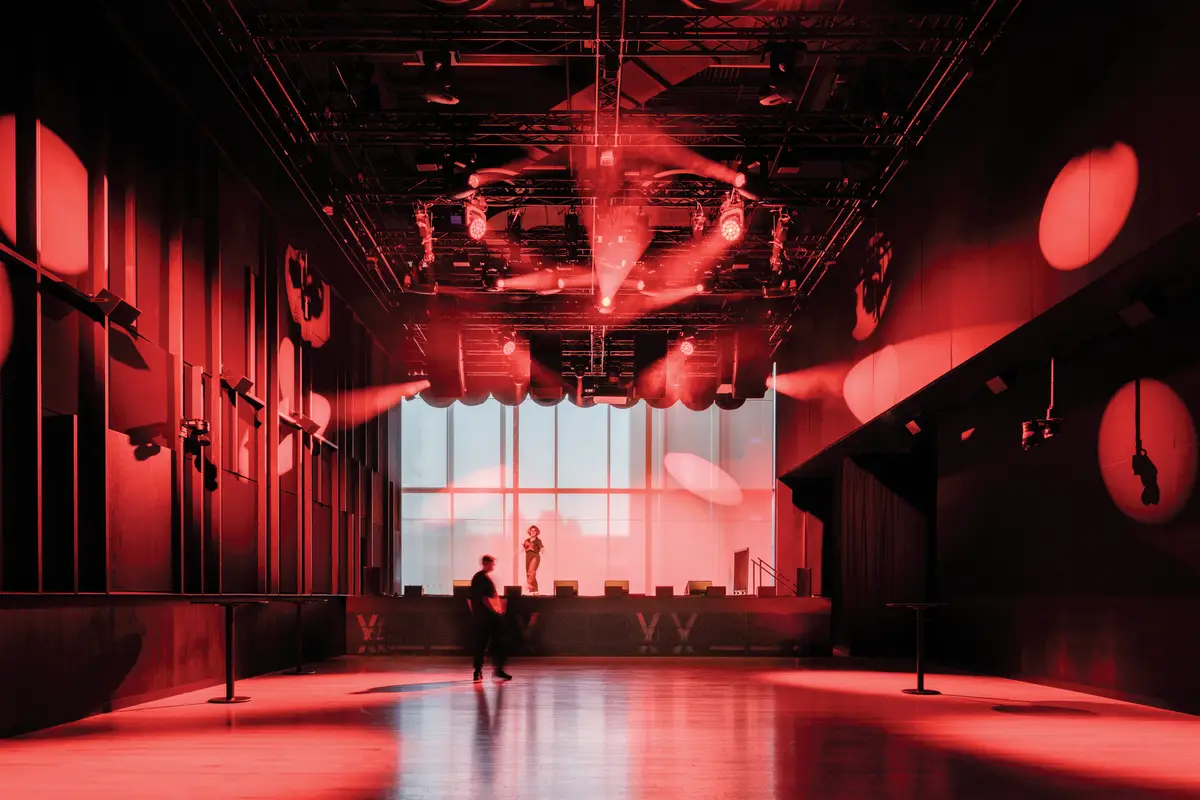
Additional performance spaces are located within the expansion. Photo © Salina Kassam
Massey Music Hall opened its doors in 1894 within sight of City Hall; over the succeeding century-plus, artists from Neil Young to Harry Styles lauded its intimate acoustics, cementing its place as Toronto’s most beloved music venue. Despite its storied past, charming traditional details, and distinctive sound quality, the hall had become easily outmatched in scale and visual effect by most stadium shows. It was booked only sporadically and no longer functioned as a creative hub.
Carving out enough space for a community of artists was always the trouble for Massey. The lot was more than filled by the auditorium, a small lobby, and egress stairs that were crammed into the site’s corners. The lack of even basic support spaces, such as a loading dock, left artists out in the cold: bands lugged their equipment in through the front door. At one point, a portal cut through a wall shared with a neighboring building opened space for musicians to hang out, but it never became more than a warren of dressing rooms and staff offices. “The symphony couldn’t play at Massey, because there was nowhere to put their instruments,” says Marianne McKenna, who cofounded KPMB in 1987.

1

2
Bars and circulatory routes support the visitor experience (1 & 2). Photos © Salina Kassam
Planning for the present-day project began in 2012, when the adjacent plot was gifted to the nonprofit that owns Massey as part of a development proposal for a 60-story tower, with a stipulation that an easement would be left for a driveway to connect through the site. KPMB drew up plans for the new building, and, the following year, the old backstage portion of the edifice was torn down and below-grade construction began. By 2018, the federal and provincial governments had offered $38 million each, and renovation and new construction began in earnest.
Although the envelope of the Allied Music Centre had been fully determined—by lot lines, the easement and vehicle access, and a height cap due to an air-ambulance flight path—the program remained nebulous for some time. “We initially designed the top two stories as spec office space, which became a problem when inches of insulation had to be added for acoustic isolation from the studios, theaters, and practice rooms,” says Graham Baxter, principal at KPMB. The building’s larger program finally clicked with funding from Allied, a real-estate investment trust that specializes in office-rental space. Allied’s vision for the music center falls somewhere between philanthropy and market speculation. Community-development initiatives like artist residencies and specialized high school programs, which are supported by nonprofits and government grants, fit within the schedule alongside touring rock musicians.
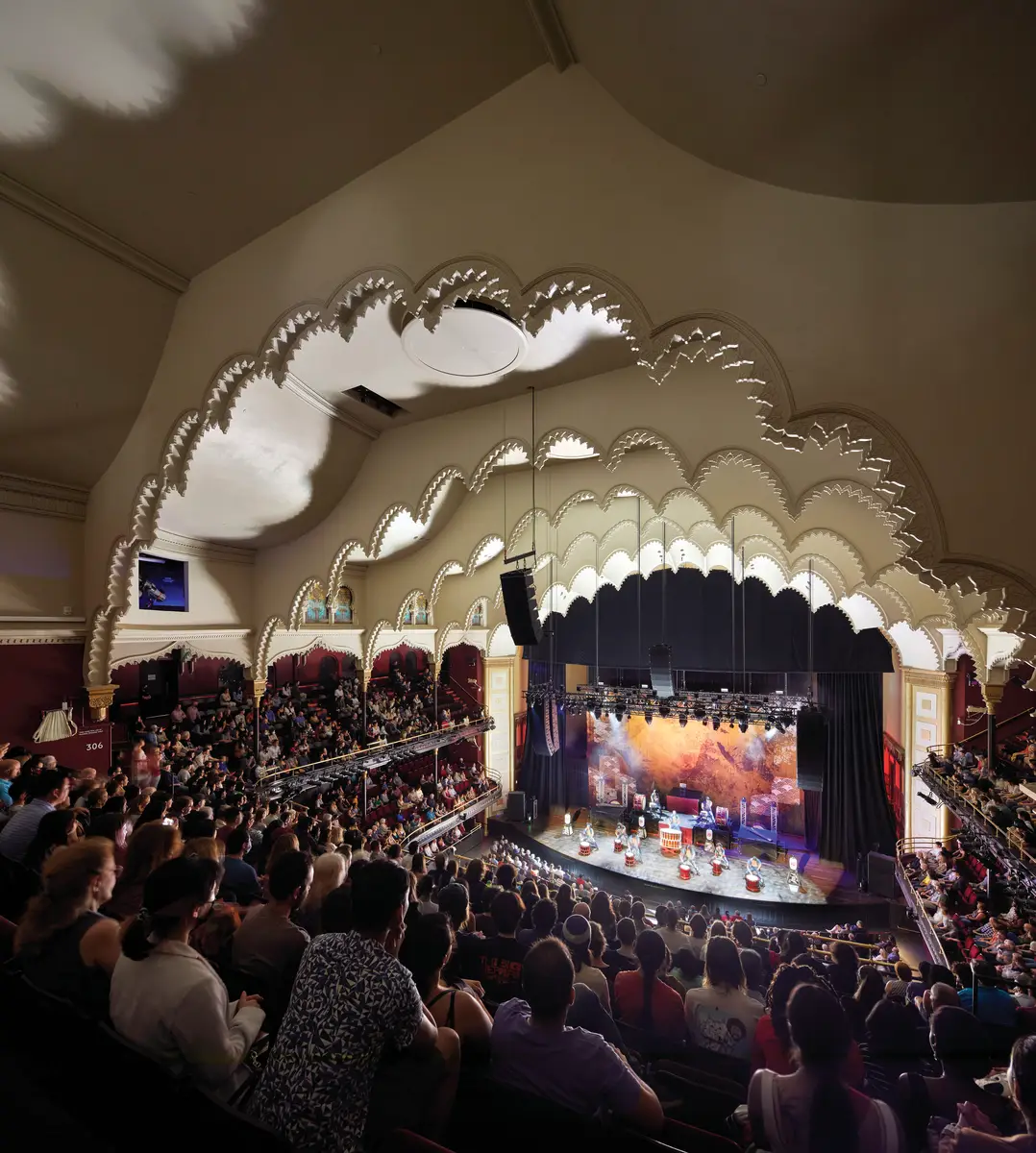
The historic auditorium is renowned for its intimate acoustics and Moorish Revival architectural details. Photo © Tom Arban
At 67 feet deep, the newly built addition spans the alleyway and fills an area suitable for the back-of-house needs of the historic 2,550-seat auditorium at the heart of the institution. Within, besides a large performance space—its ceiling a technician’s paradise of AV gadgetry—the new building houses a studio for immersive audio production and a small, flexible auditorium. To isolate each from the others, these three spaces are staggered rather than stacked, with a buffer of lounges and dressing rooms in between. Snaking hidden passageways allow multiple artists to enter dramatically on their respective stages throughout the building at the same time. All these new spaces complement the formula for the historic auditorium: big room plus big artist plus cheap tickets equals packed crowds. KPMB kept this intact, and concertgoers can still look in through red double-doors from the sidewalk, down the central aisle, and find themselves staring Sting in the face as he tunes his guitar.
Looking for quick answers on architecture and design topics?
Try Ask RECORD, our new smart AI search tool.
Ask RECORD →
Renovations had to confront the history hanging everywhere in the air. “There was an exit sign with a dent where Robert Plant hit his head,” muses Baxter. “Plaster on the ceiling was being held in place by steel netting—maybe adding something to the acoustics. There was no ideal state to return to.” Improve everything, change nothing became the motto for the project, and so KPMB modernized the auditorium invisibly—for instance, installing new seating on the lower level that looks like the old but is entirely demountable, so it can be retracted under the stage.

A state-of-the-art recording studio is found at the top of the building. Photo © Salina Kassam
To passersby, the most prominent features of Allied Music Centre are its curtainlike facade and a glass catwalk providing an accessible route to the upper level of Massey Hall’s auditorium. McKenna emphasizes that the latter is “an incredible intrusion into the public realm” that required negotiation with municipal planners. It provides a practical amenity by acting as a canopy to protect lined-up customers from the rain, but its more important consequence is symbolic. Part of the old building is now behind the glass of the catwalk and therefore like an object in an elevated museum vitrine. At night, when the building is lit, the concert crowd is milling in too, also along the sandstone Ionic capitals and reset stained-glass windows (protected behind panes that make them safe from any roughhousing).
These efforts reconnect the hall to the city and position the music center as a lively addition to the local entertainment ecosystem—one meant to be used, and used vigorously. Torontonians, once concerts are playing there, will have their hearts set aflutter when they can see the crowds and look to what each night’s program will reveal.
Click plans to enlarge

Click section to enlarge

Read about other entertainment projects from our August 2025 issue.
Credits
Architect:
KPMB Architects — Marianne McKenna, partner in charge; Chris Couse, founding principal; Graham Baxter, Matthew Wilson, Carolyn Lee, senior associates; Clementine Chang, associate, project architect
Engineers:
Entuitive (structural, envelope); The Mitchell Partnership (mechanical); Crossey Engineering (electrical); WSP (civil)
Consultants:
GBCA Architects (heritage); Charcoalblue (theater); Sound Space Vision (acoustics)
General Contractors:
EllisDon, Tucker HiRise
Client:
The Corporation of Massey Hall and Roy Thomson Hall
Size:
124,000 square feet
Cost:
Withheld
Completion Date:
February 2024
Sources
Masonry:
Atwill-Morin (restoration); Clifford Masonry
Metal Panels:
Flynn
Glazing:
Applewood Glass; Inkan, Nupress (structural); EDG Glass Studio, Vitreous Glass (stained glass)
Hardware:
Upper Canada Specialty Hardware
Interior Finishes:
Wilsonart (plastic laminate)
Looking for a reprint of this article?
From high-res PDFs to custom plaques, order your copy today!