Entertainment
Andrea Steele Architecture Inserts a Cultural Hub into the Podium of a Downtown Brooklyn Tower
Brooklyn, New York
Architects & Firms
Downtown Brooklyn has experienced tremendous growth since its 2004 rezoning, having undergone some 32 million square feet of new development. The area is also home to a long-established cultural scene, anchored by numerous institutions, including the Brooklyn Academy of Music (BAM) and Museum of Contemporary African Diasporan Arts (MoCADA). But the introduction of new venues for creative expression has not kept pace with the many high-rises and residents that now populate the neighborhood. That is, before January, when the L10 Arts and Cultural Center (named after its address on 10 Lafayette Avenue), designed by Andrea Steele Architecture (ASA), opened its doors.
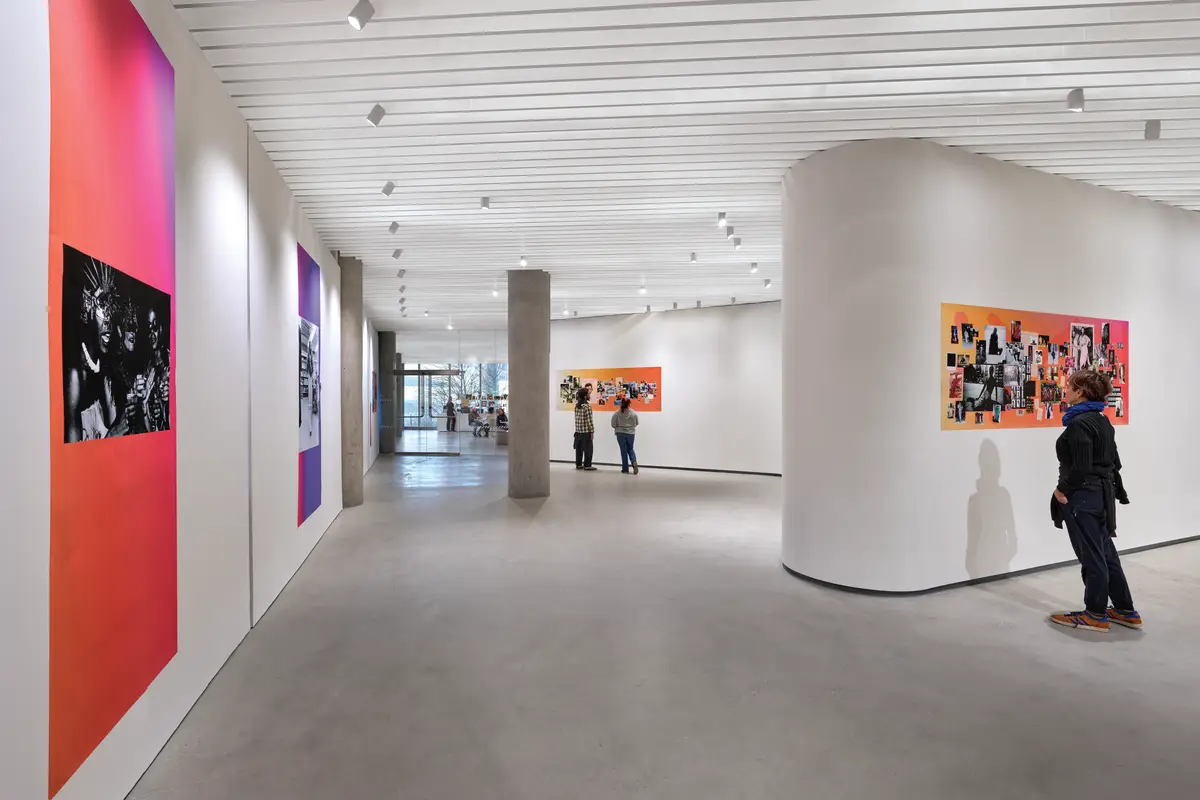
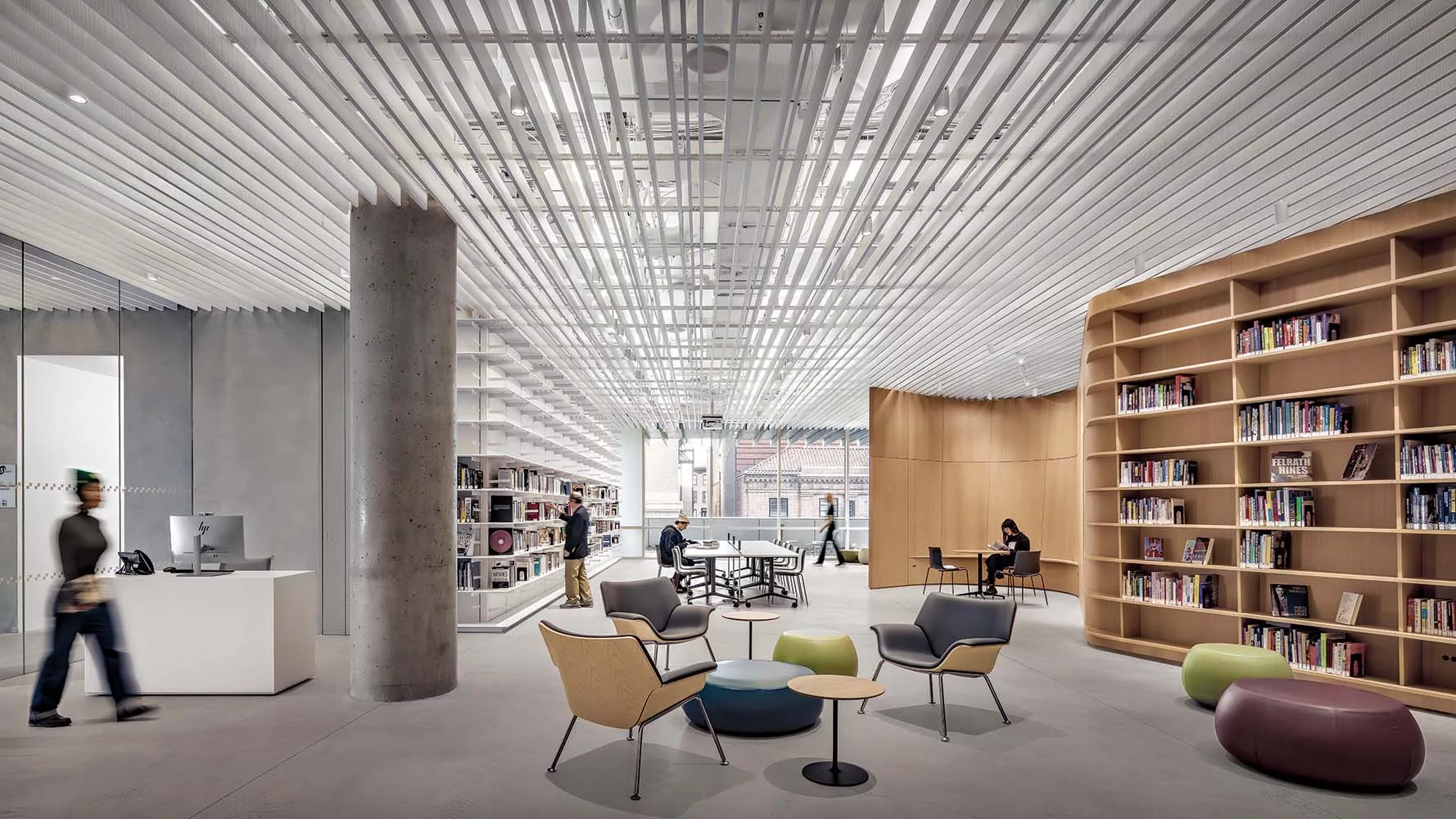
The gallery and library feature a baffle ceiling, with AV, lighting, and other elements tucked above (top of page and above). Photo © Alan Karchmer / Otto, click to enlarge.
Within its relatively tight 65,000-square-foot confines, L10 incorporates a branch of the Brooklyn Public Library (BPL); an expansion of BAM’s cinema and live-performance programming; and new homes for MoCADA and 651 Arts, an organization devoted to the contemporary performing arts of the African diaspora, replete with dance studios and a performance hall.
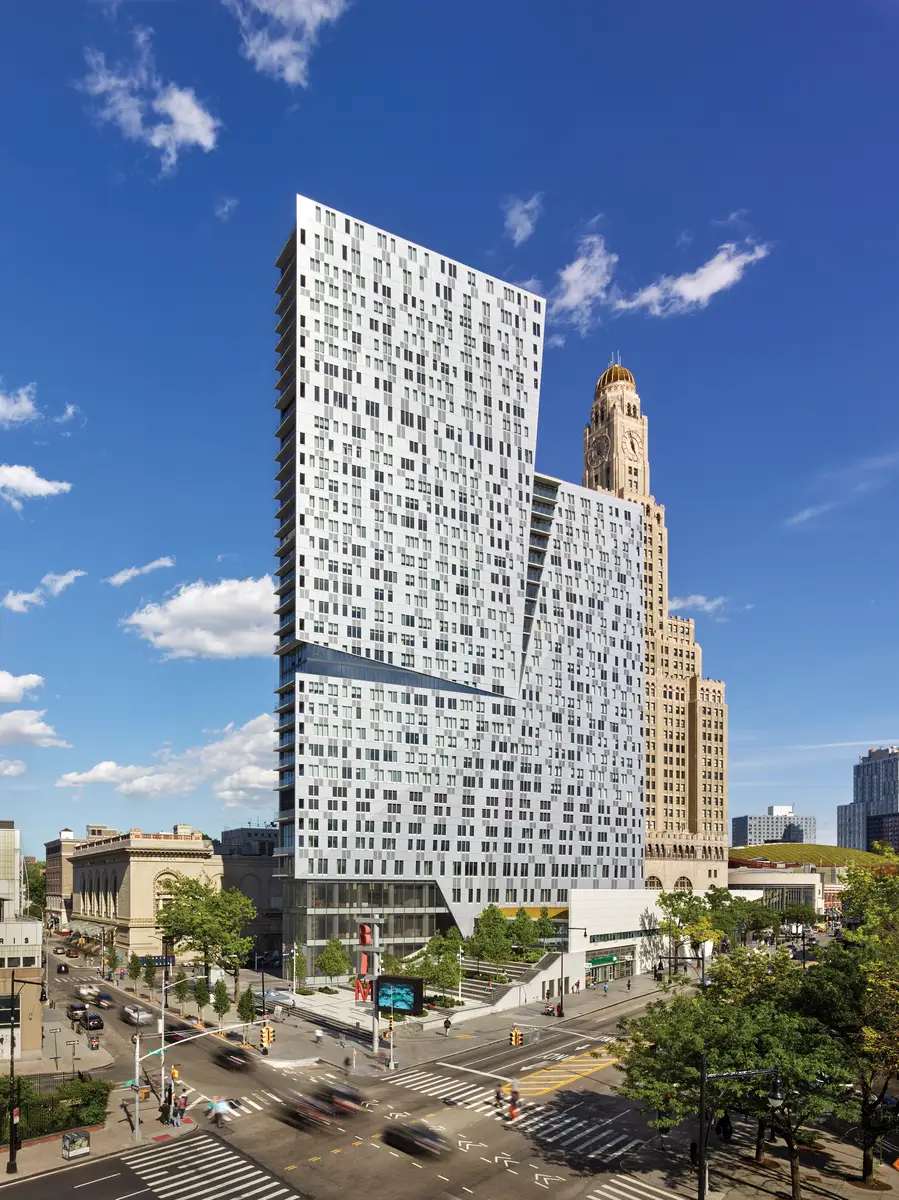
L10 is located within 300 Ashland. Photo © Alan Karchmer / Otto
The center is located within the second to fourth floors of 300 Ashland, a 32-story residential tower with a retail component, designed by TEN Arquitectos. That project broke ground in 2014 on a municipally owned parking lot, in a joint effort between developer Two Trees and the New York City Economic Development Corporation (NYCEDC). Their RFP called for the inclusion of a cultural center, operated by the New York City Department of Cultural Affairs (NYCDCLA) and occupied by nearby nonprofit organizations.
NYCEDC and Two Trees received a special zoning permit for the parcel from the City Planning Commission to accommodate an increased floor-to-area ratio, a 15,000-square-foot public plaza, and a podium with varied street-wall conditions and setbacks. Those moves increased the number of allowable residential units and created more space for the nascent arts-and-cultural center—or, in the lexicon of developers, it helped the project pencil out.
NYCEDC and NYCDCLA launched L10’s request for proposals in 2015 and awarded TEN Arquitectos’ New York studio the project; the firm’s selection was dependent on approval by the future tenants. The office, led by Andrea Steele, became its own practice in 2019. The fit-out of the cultural center, a shell within the tower, began that same year, though pandemic-related delays, bureaucratic hurdles, and the unique arrangement between NYCEDC and Two Trees led to its drawn-out construction schedule (it was originally scheduled to open in winter 2020).
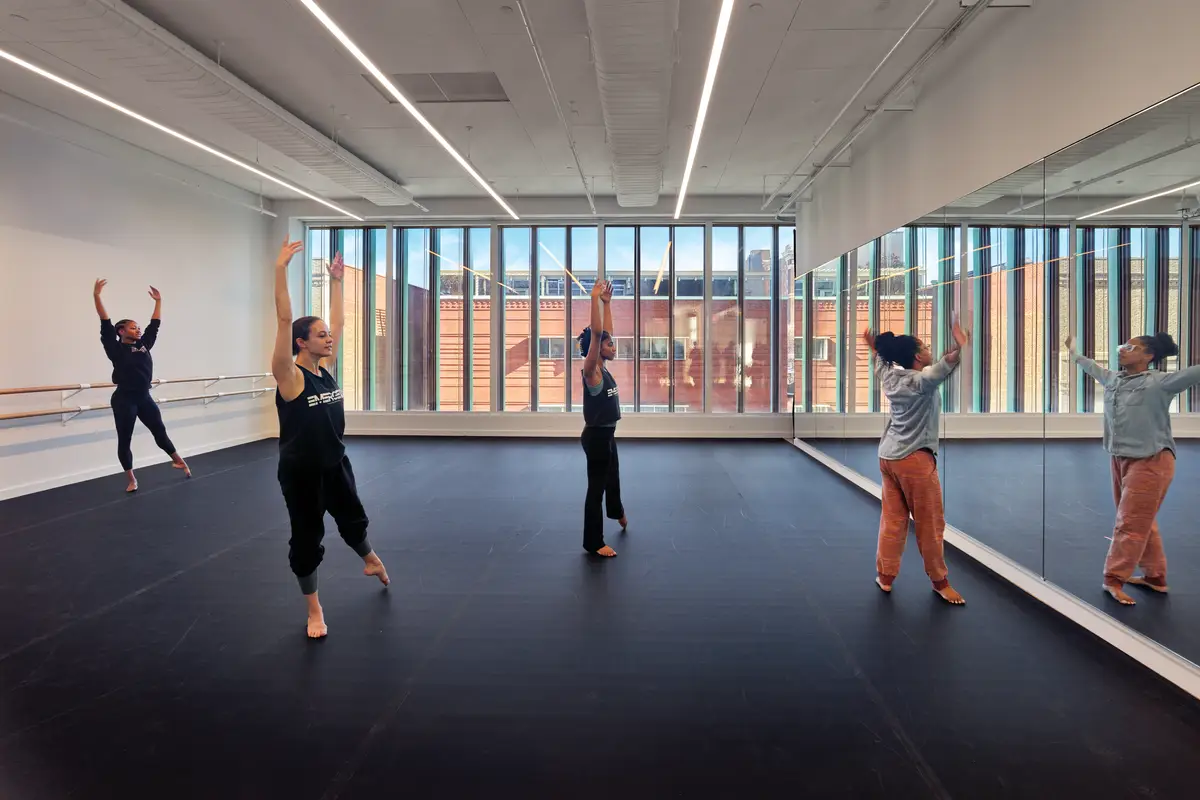
Dance studios have outward views. Photo © Alan Karchmer / Otto
The project scope included the reinforcement and infill of the existing concrete floor plates, to accommodate the final design and program requirements and the installation of escalators and steel stairs with precast-concrete treads.
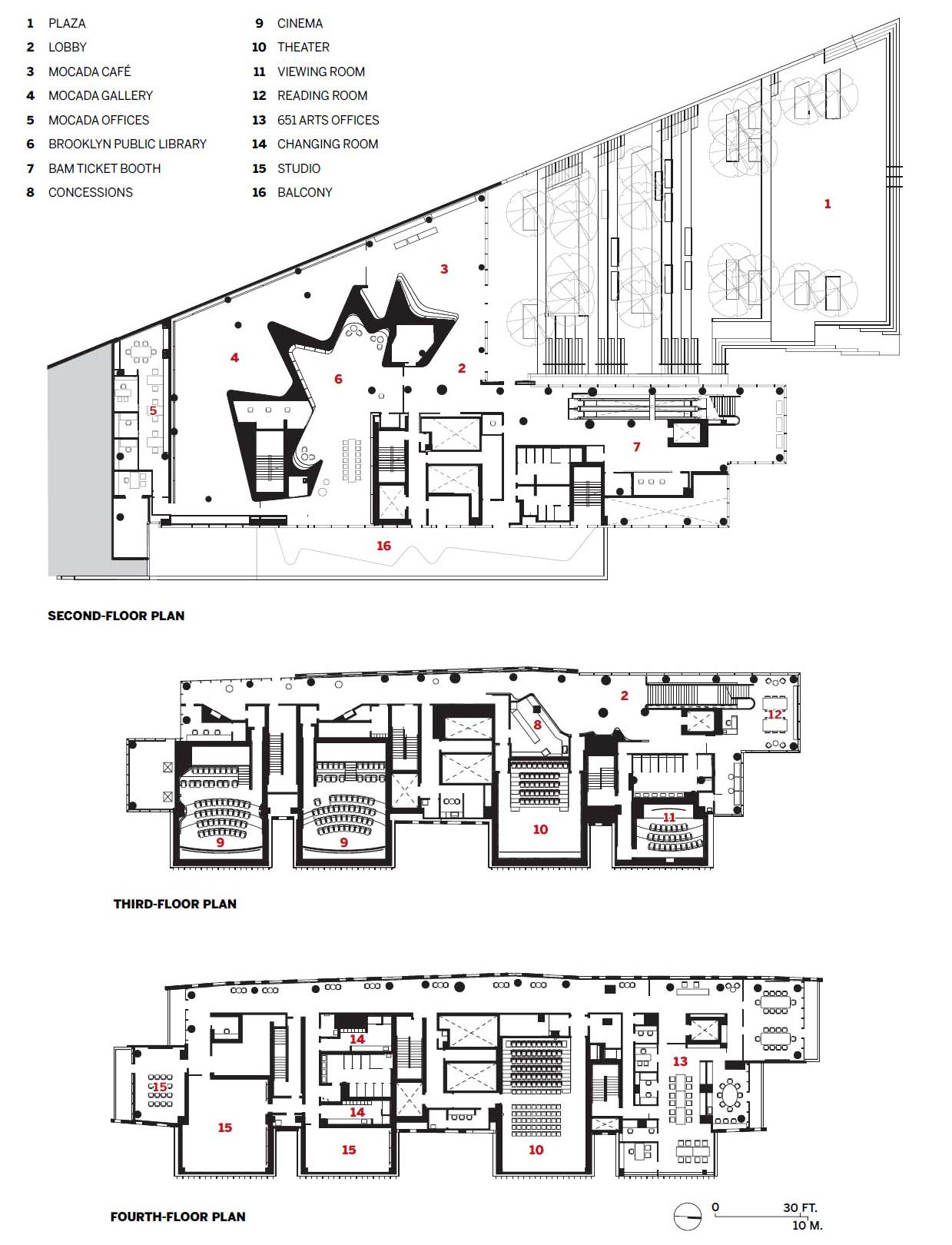
L10’s main entrance is approached through the landscaped and stepped plaza located on the northwest corner of the site, and a storefront entryway, placed on the north elevation, provides access to an escalator and elevator that whisk visitors to the second floor. The bulk of that level is occupied by the Brooklyn library, with a collection devoted, for the first time, just to the arts, and MoCADA, which comprises a café, offices, and gallery space.
Looking for quick answers on architecture and design topics?
Try Ask RECORD, our new smart AI search tool.
Ask RECORD →
The original concept for the second floor called for a relatively formal demarcation of zones between the tenants, but, following extensive roundtables facilitated by the architect, a more harmonious plan came to fruition. “Initially, in an early space-allocation drawing, occupants and visitors would have arrived immediately in one of the tenant spaces, without a transition through a lobby, as each was keen to secure as much square footage as possible,” explains Steele. “We held biweekly to monthly meetings, and, through those conversations, we were able to carve out neutral zones of joint habitation.”
The design team, in collaboration with Brooklyn-based Situ Fabrication, inserted an undulating oak wall that threads the library and MoCADA programs together. In BPL’s reading room, shelving and individual nooks are tucked into the wooden monolith’s many folds while, for MoCADA, tiered seating permits the café to be used as a performance space on a dime. The curvilinear motif extends into MoCADA’s galleries, albeit with drywall rather than millwork, nearly doubling the amount of exhibition-wall surface while providing more flexibility in terms of curation. Notably, the oak installation and the drywall also shroud elements, like structural columns and m/e/p infrastructure, and offer storage.
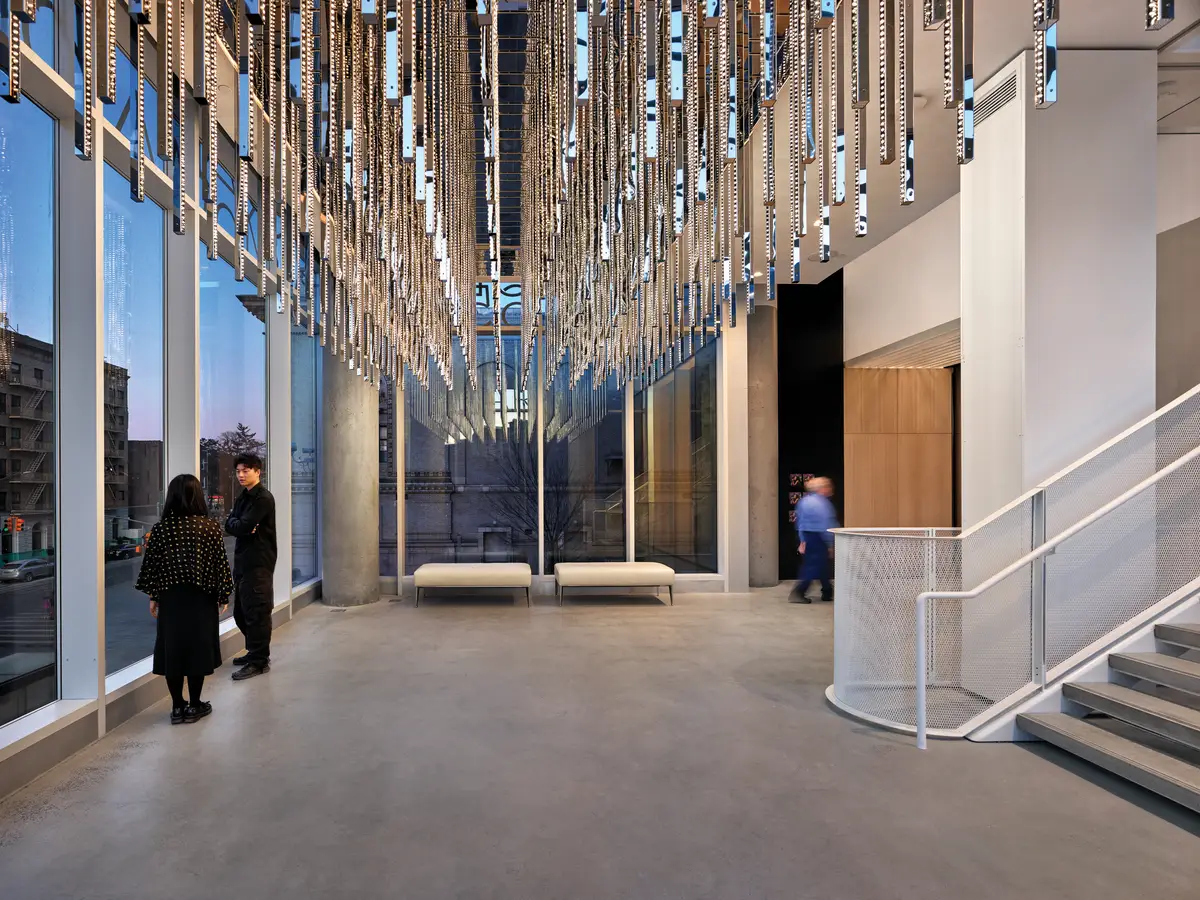
A Leo Villareal installation dangles from the ceiling. Photo © Alan Karchmer / Otto
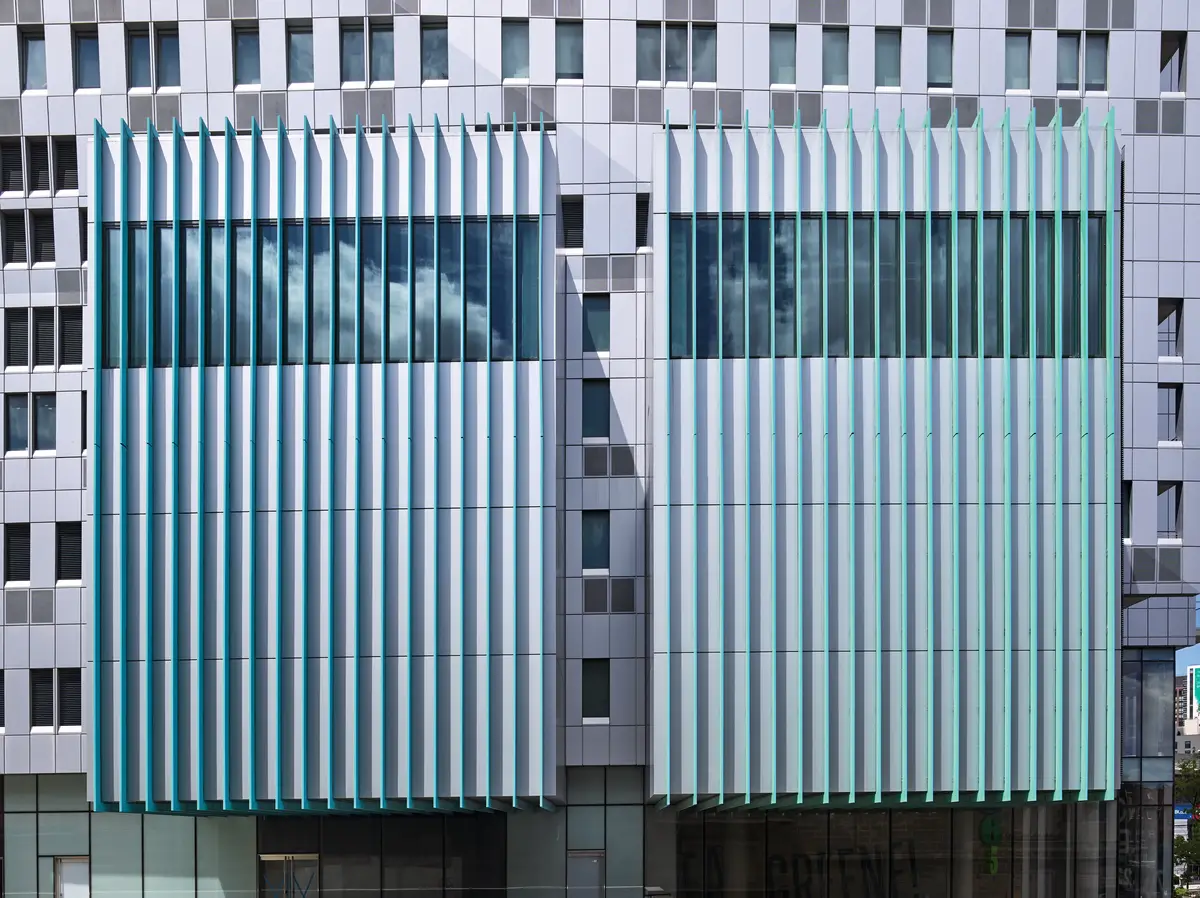
The north flank of the second floor is apportioned to BAM’s ticket office, similarly detailed in oak paneling, and its cinema lobby, which is illuminated by Volume, a mirrored LED sculpture designed by Leo Villareal, whose earlier piece, Stars (2007), sparkles within the double-height arched windows of BAM’s facade, located across the street. A grand stair and an escalator lead to the third floor, where moviegoers immediately encounter the concessions stand, which is flanked by curved millwork. That repeated motif is mirrored by a wavelike metal-mesh curtain shading a corridor leading to two cinemas, a black-box theater, and a small rentable viewing room. Each of the programmable areas is located within one of four oversized bays that cantilever off 300 Ashland’s east elevation. A mezzanine level is tucked above the cinemas to make room for projection booths, a control room, and the institution’s archival stacks.
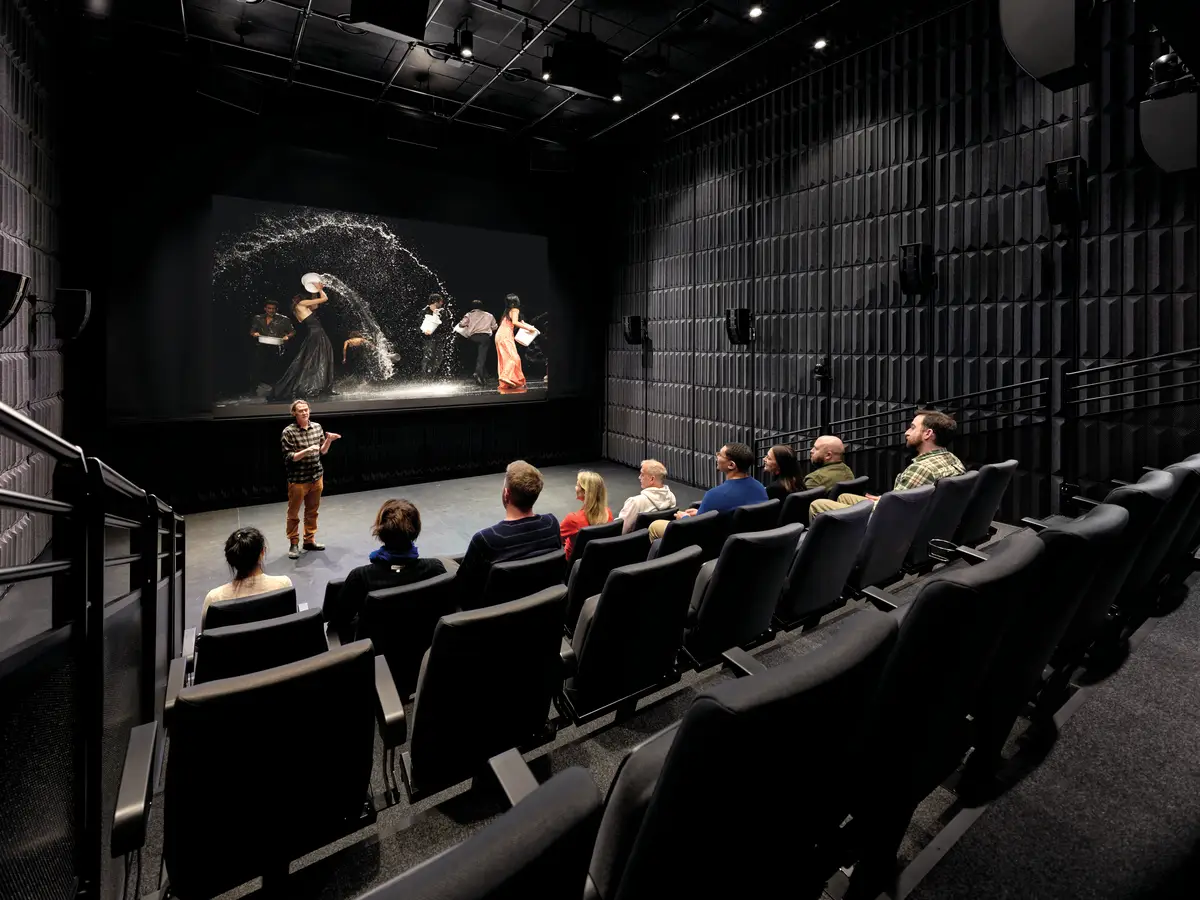
BAM’S branch within L10 includes a black-box theater, cinemas, and a viewing room, among spaces for other kinds of use. Photo © Alan Karchmer / Otto
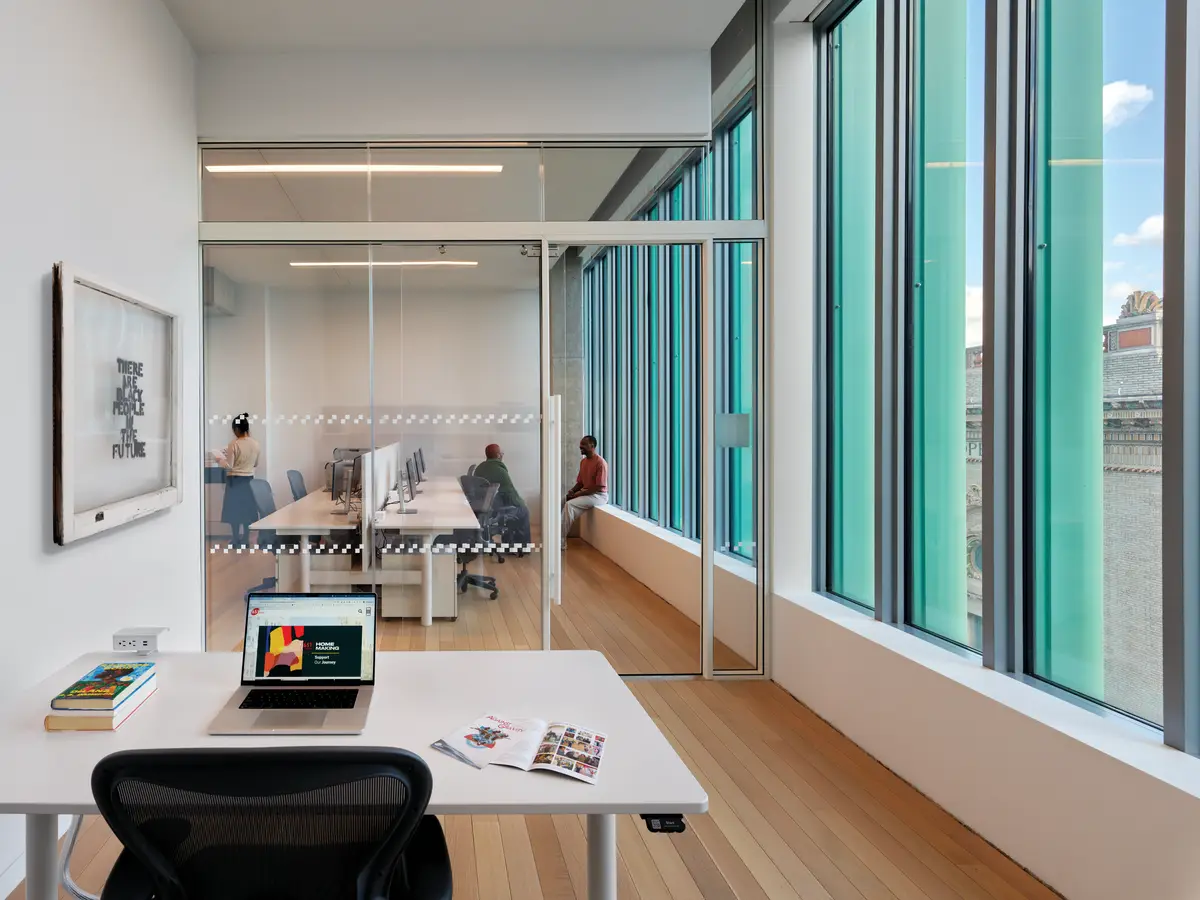
Occupying the entirety of the fourth level is 651 Arts, with a more utilitarian palette of unadorned drywall and wood and vinyl flooring. Its office spaces are centered on the northern portion of the floor plate, while its dance studios and performance space are placed similarly to those for the other organizations, in the tower’s cantilevered bays.
1
2
Cantilevered bays support the building programs. Photo © Alan Karchmer / Otto
Stacking all these disparate programmatic elements and keeping them acoustically isolated required substantial detailing. The cinemas and performance spaces are heavily blanketed in acoustic padding, and they are isolated from one another through box-in-box construction. In the case of 651 Arts’ studios and performance spaces, which have outward views of Downtown Brooklyn, the substantial window openings are fitted with double-layered acoustic glazing.
“We conducted a sound test toward the end of construction, and, of course, everyone was simultaneously anxious and excited to hear the results,” says Steele. “So the operators of the cinema projection rooms blasted ear-piercing Michael Bay–like sounds, and 651 Arts hosted numerous performances, with dancers jumping around the studios. Thankfully, the library and the gallery below were dead silent, and the third and fourth floors were unable to hear one another.”
The harmonious coexistence of these varied institutions could be a model for future such mixed-use developments, in Downtown Brooklyn and across New York.
Click plans to enlarge
Read about other entertainment projects from our August 2025 issue.
Credits
Architect:
Andrea Steele Architecture — Andrea Steele, principal in charge; Dichen Ding, project manager; Charles Mattern, technical director; Enrique Norten
Engineers:
RGCE (structural); Ettinger Engineering Associates (m/e/p)
Consultants:
Fisher Dachs Associates (theater planning and design); Boyce Nemec Designs (AV); Lally Acoustical Consulting (acoustics); Situ Fabrication (millwork)
General Contractor:
Skanska USA Building
Client:
NYCEDC and NYCDCLA
Size:
65,000 square feet
Cost:
Withheld
Completion Date:
January 2025
Sources
Glazing:
McGrory Glass
Hardware:
Von Duprin (exit devices); Allegion Zero International (specialty)
Acoustical Ceilings:
Rockfon, Armstrong World Industries
Paints and Stains:
Benjamin Moore
Wall Coverings:
Kirei
Plastic Laminate:
Formica, Wilsonart
Flooring:
Madera (wood); Interface (carpet)
Plumbing:
ASI Accurate Partitions; Koala Kare (baby-changing station); Bradley (dispensers)
Energy Management:
Delta Controls
Looking for a reprint of this article?
From high-res PDFs to custom plaques, order your copy today!