No Fun at the Drive-in: Tesla Diner is a Dud
The corner of Santa Monica Boulevard and Orange Drive in Hollywood was for many years known for two things: the location of a tired outpost of the Shakey’s Pizza Parlor chain and the trans sex workers who had claimed the intersection as their own.
In 1997, the site got a splash of publicity when Eddie Murphy was stopped after police witnessed the actor and comedian picking up the late Shalimar Seiuli, who was arrested, while Murphy was released. The street’s culture was memorialized in Academy Award–winning director Sean Baker’s excellent 2015 film, Tangerine.
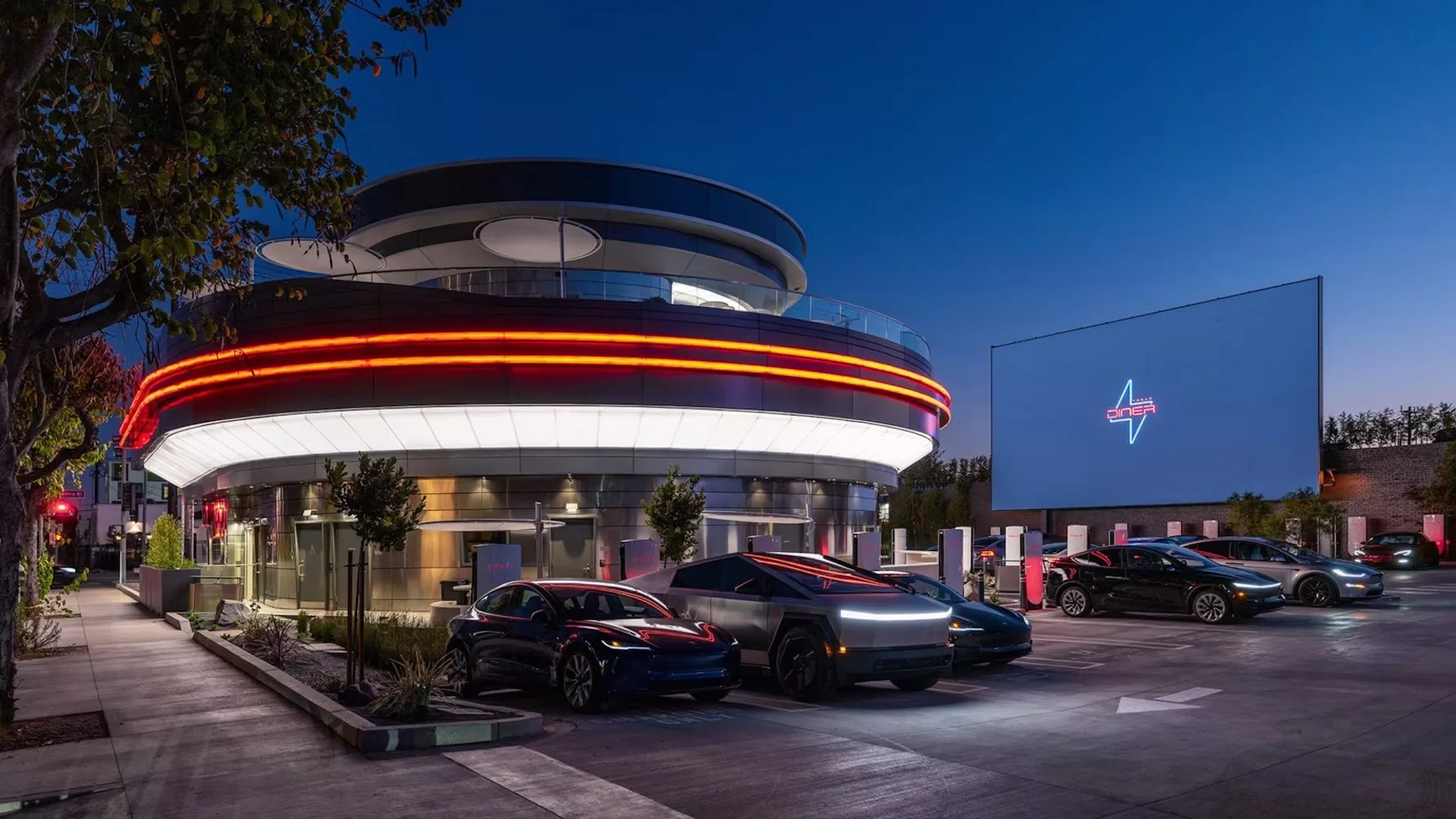
Of course, most sex work has since moved online and in 2018 Elon Musk announced the Shakey’s site would be home to the first Tesla Diner, teased as a prototype to combine a classic roadside diner with electric vehicle charging—think American Graffiti meets The Jetsons. The initial media coverage focused on the project’s most notable feature—a parking lot overshadowed by two large outdoor LED screens that would show movies to entertain drivers while they charged their cars and ate cheeseburgers delivered to their windows.
That, needless to say, was a different time, when you could be forgiven for thinking Tesla was a progressive, future-focused company. In those days, it was perhaps not unforeseeable that one day Teslas would don bumper stickers proclaiming “I bought this before Elon went crazy,” but the events leading to the sentiment were as yet blissfully unimaginable. (Full disclosure: I own a Model 3 and I support that bumper sticker; I also lived up the street from Shakey’s on Orange Drive in the early 2000s).
When the diner finally opened this year on July 21, public interest ran the gamut from Musk groupies clamoring for selfies to protesters reminding us of the incalculable damage Musk and his team wreaked on the federal government and, by extension, every corner of the globe. If that’s not grim enough, consider Tesla’s shareholders as they watch car sales decline year-over-year.

Photo courtesy Tesla
That said, this may be a good time for a new diner to inject some fun back into the party that is the on-going electrification and automation of the American good life. But what of the diner itself? For a corporation ostensibly run by an entrepreneurial billionaire with a teenage mindset and an immigrant’s view of American success, the Tesla Diner has all the appeal of a Soviet Union-era pavilion at a forgotten world’s fair.
My party arrived to the diner in a Tesla, so we were granted parking lot access and directed to a charging station where we could plug in and access the diner’s menu on the car’s screen. As we parked, a friend remarked that the 66-foot drive-in screens were showing an old episode of Space: 1999, a 1970s-era British television show with a classic gleaming-white-interior vision of future human space colonies. The show felt like a wish then and now—could a diner deliver a better future? Aside from the drive-in movie aspect, which makes the charging experience appreciably better, the parking lot has little relationship to the diner, to the point where we found ourselves walking through spartan landscaped plots to get to sidewalks that wrapped around the grey metal circular building, in search of the actual entrance.
Looking for quick answers on architecture and design topics?
Try Ask RECORD, our new smart AI search tool.
Ask RECORD →
We decided to walk around the exterior before going inside. While the metal rain screen lacked precision in execution, most confounding was the building’s disregard for the street, with small strips of darkly tinted windows and a confusing entrance and exit choreography that requires most visitors to line up along the parking lot in whatever the elements might be—typically blasting sun but occasionally pouring rain—as if they were waiting for a carnival ride about a sad future. Compared to the joie de vivre in the outdoor line for Pink’s hot dogs, a classic stand just down the street, this was a lot of mental work for a cheeseburger.
Since we pre-ordered from our car, we were allowed to skip the line to enter the diner itself. In most fast-food restaurants, the lobby is the most generous space—a place where you read the menu, order, and get drinks before picking up your food. At the Tesla Diner, you are immediately bottlenecked into a postage-stamp of a space where taxed staff explain the over-complicated system of retrieving your order.

Photo courtesy Tesla
The interior is antiseptic to the point one longs for the charm of the line at Disneyland’s Space Mountain. The dining room follows the circularity of the building, with a banquette of booths against the exterior and a long curving counter fencing off the service area and a small window to the kitchen beyond. A service counter in a diner is almost required by architectural law, but this one is superfluous: patrons don’t sit down to order and no one brings you anything. It may be the worst place to sit in the joint, but the booths are a close second since an inexplicable design decision resulted in extremely small table widths and booths so crammed that it is impossible to sit across from a dining companion without intertwining your legs.
The layout is so confounding that you must remind yourself this was a new build from the ground up. Did no one from the design team visit the Apple Pan in West Los Angeles, humming since 1947, with its classic counter seating and delightful open kitchen?
Things got better once we walked up the very narrow stairs to the roof deck, which includes its own outdoor food service counter, and a series of tables spread around the smaller circular second-story structure. The deck affords decent views of Hollywood and the movie screens, including speakers for a real movie experience. But the corporate sterility of the overall design doesn’t invite lingering, especially if you’re in direct sun or under one of the small shade canopies (now since removed). Given the poor quality of the food (outrageous in a burger mecca like L.A.), if you must visit, just get a root beer float and head to the roof. By the time we did, Rebel Without a Cause was playing.
Is this really the best we can do? Why does corporate America over-complicate what so many mom-and-pop restaurateurs figured out decades ago across Southern California? This should have been the project to rethink L.A.’s iconic Googie architecture, invented by John Lautner in 1949 with the construction of the original Googie’s Restaurant at the corner of Sunset Boulevard and Crescent Heights (demolished in 1989). That restaurant distilled modern architecture into a roadside blast, with wide walls of glass opening the dining room to the street and a structural envelope, designed with the great engineer Richard Bradshaw, extending skyward as a flashy sign.

Photo courtesy Tesla
Why not take inspiration from any of the fabulous restaurants designed by Armet & Davis Architects that are still standing, like the 1955 Times Square Diner (now a defunct Johnie’s) at Wilshire Boulevard and Fairfax Avenue, or more directly related to cars, consider architect Gin Wong’s Union 76 Gas Station, from 1965, in Beverly Hills, with its wide swoop of a canopy roof that just begs you to stop and stare. L.A. is chock-full of successful examples of roadside architecture. From a hot-dog-shaped shack to a donut-festooned hut, there is an architectural precedent in every neighborhood.
The late L.A. architect and critic, John Chase, considered “novelty” as the primary concern for commercial vernacular architecture, especially in L.A. In his 2000 book, Glitter Stucco and Dumpster Diving, Chase noted how as the “forces of mass production and distribution take over larger and larger sectors of daily life, anything that seems individual or different takes on enhanced importance.” It’s not a long walk in Hollywood from novelty to kitsch and it’s well worth the journey. Chase surely would have rolled his eyes at what Tesla considers novel.
Instead, the Tesla Diner lazily attempts to adopt the smooth, seamless, digitally connected ethos of a Tesla car, but that proves a tired trope, especially when applied to an actual fixed place with architecture rather than something that must perform aerodynamically. One imagines the many strained client presentations that the Stantec team, which delivered the architecture and engineering for the project, underwent to arrive at this, but there is a great project to be built somewhere else with this concept. The urban mash-up of EV charging, drive-in movies, and eating still sounds great to me. It would be even better if that project connects to the social realities and cultural legacies of the fascinating and evolving city around it. In 2025, an old Shakey’s and a street lined with trans sex workers is still a more novel, radical, and real concept of urbanism in L.A.
Looking for a reprint of this article?
From high-res PDFs to custom plaques, order your copy today!