Record Houses 2025
In Miami, Brillhart Architecture Wraps a Series of Pavilions Around a Junglelike Setting
Miami
Architects & Firms
Cruising up Biscayne Boulevard, one could easily mistake Miami for a city predominated by glass-clad, often wavy, concrete high-rises. In contrast, Morningside is a verdant historic enclave just a mile north of the city’s Design District, tucked between the boulevard and Biscayne Bay. The neighborhood was largely developed during Florida’s first land boom a century ago and comprises a motley crew of houses. Many are breezy Mission or Mediterranean Revival structures that, like other residential tracts across Miami, embody the contradictory pursuits of maximizing exposure to the enviable tropical environment while ensuring comfort during hotter months, when the sun’s harsh glare and an oppressive humidity descend upon the city.
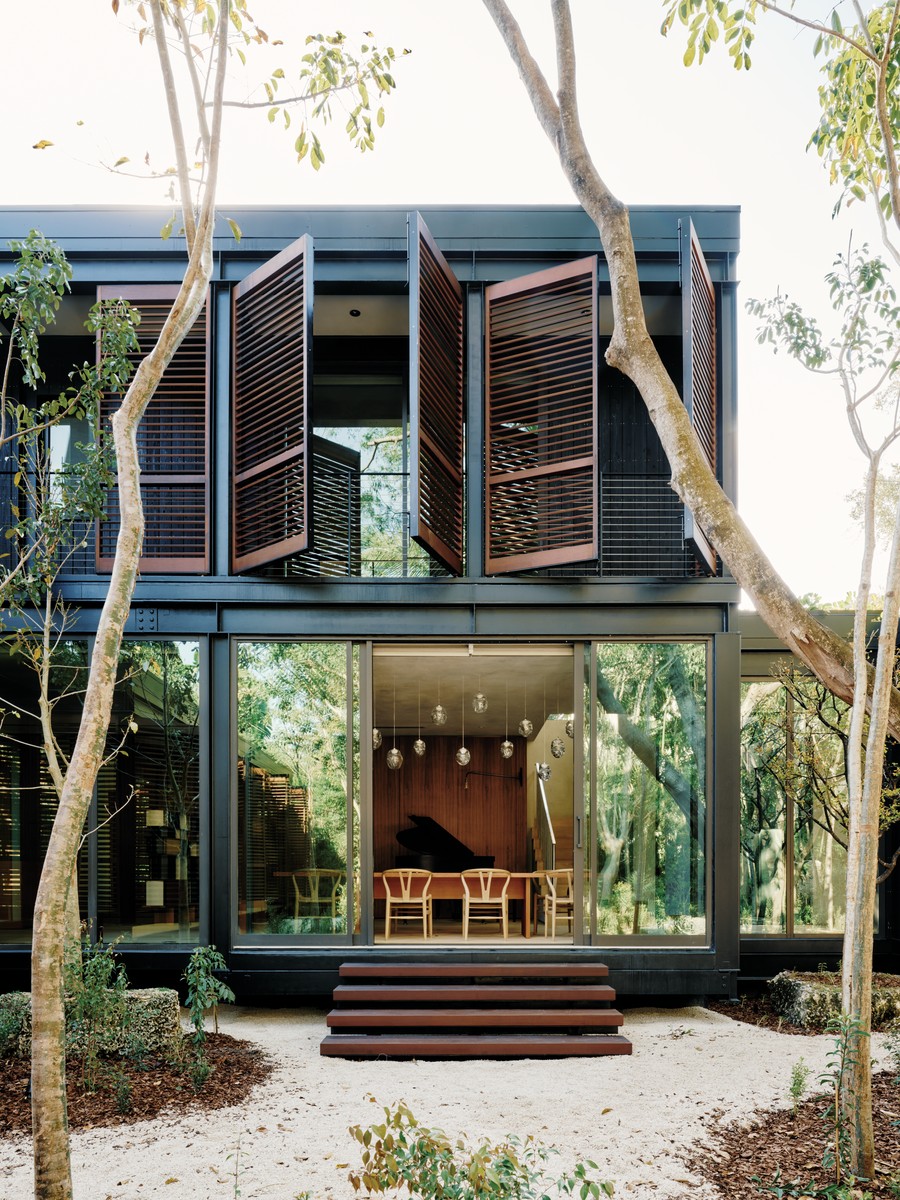
The living/dining room opens to the courtyard. Photo © Joe Fletcher, click to enlarge.
Walkways tie the home together. Photo © Joe Fletcher
The Morningside Residence is a recent addition to the area. Designed by Brillhart Architecture—a Miami-based practice, with an office in Savannah, led by Jacob and Melissa Brillhart—the house ably balances the climatic demands with a contemporary approach deeply influenced by Sarasota Modern design principles.
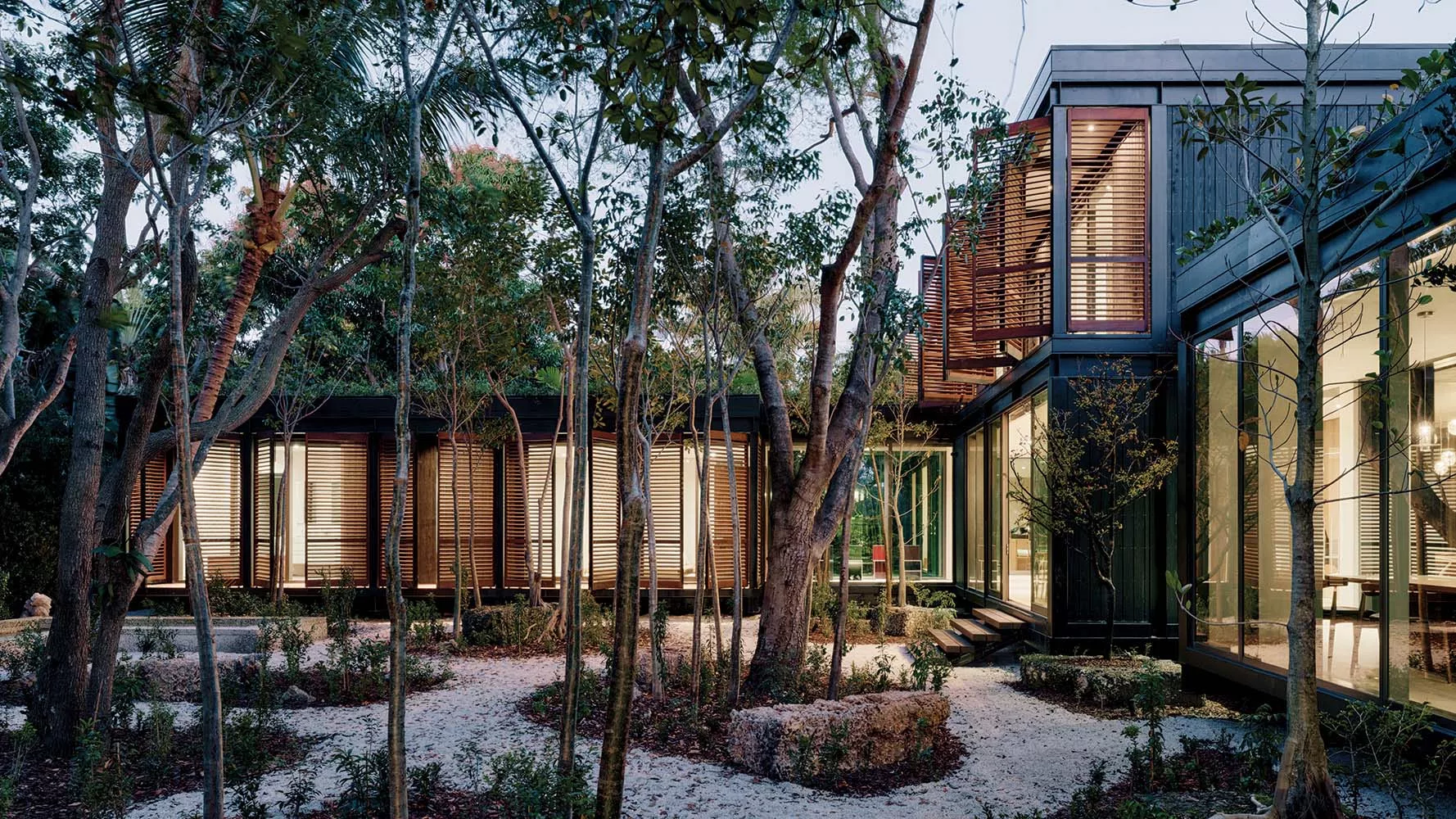
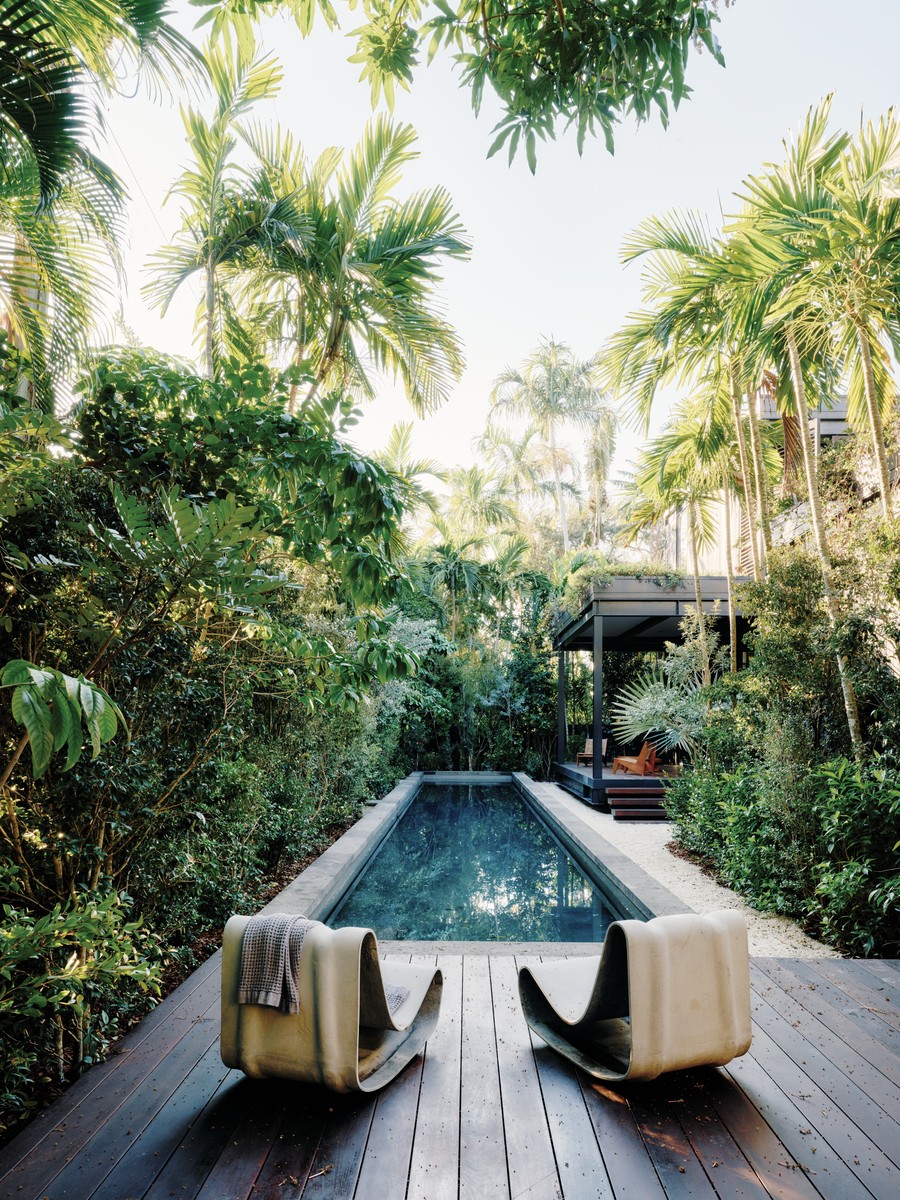
On a lush 15,000-square-foot site with 800 trees (600 of which are saplings) and hundreds of native plants, it was important for the client and the design team to conserve and strengthen the parcel’s natural qualities. “The idea was to break the house up into smaller pavilions that sit lightly on the land and to connect them with bridges, two glazed and the other exposed to the elements, so it is almost like living in a small park,” notes Jacob Brillhart.
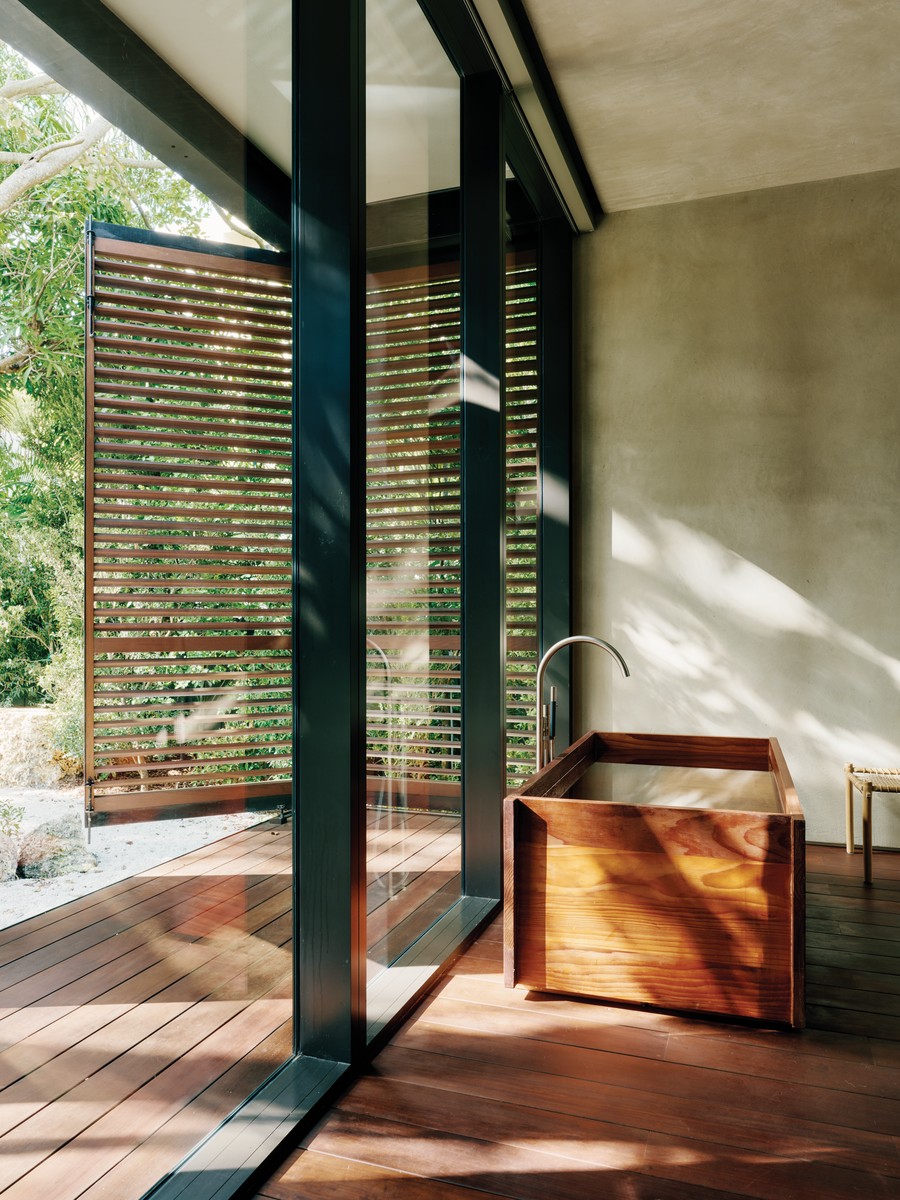
1
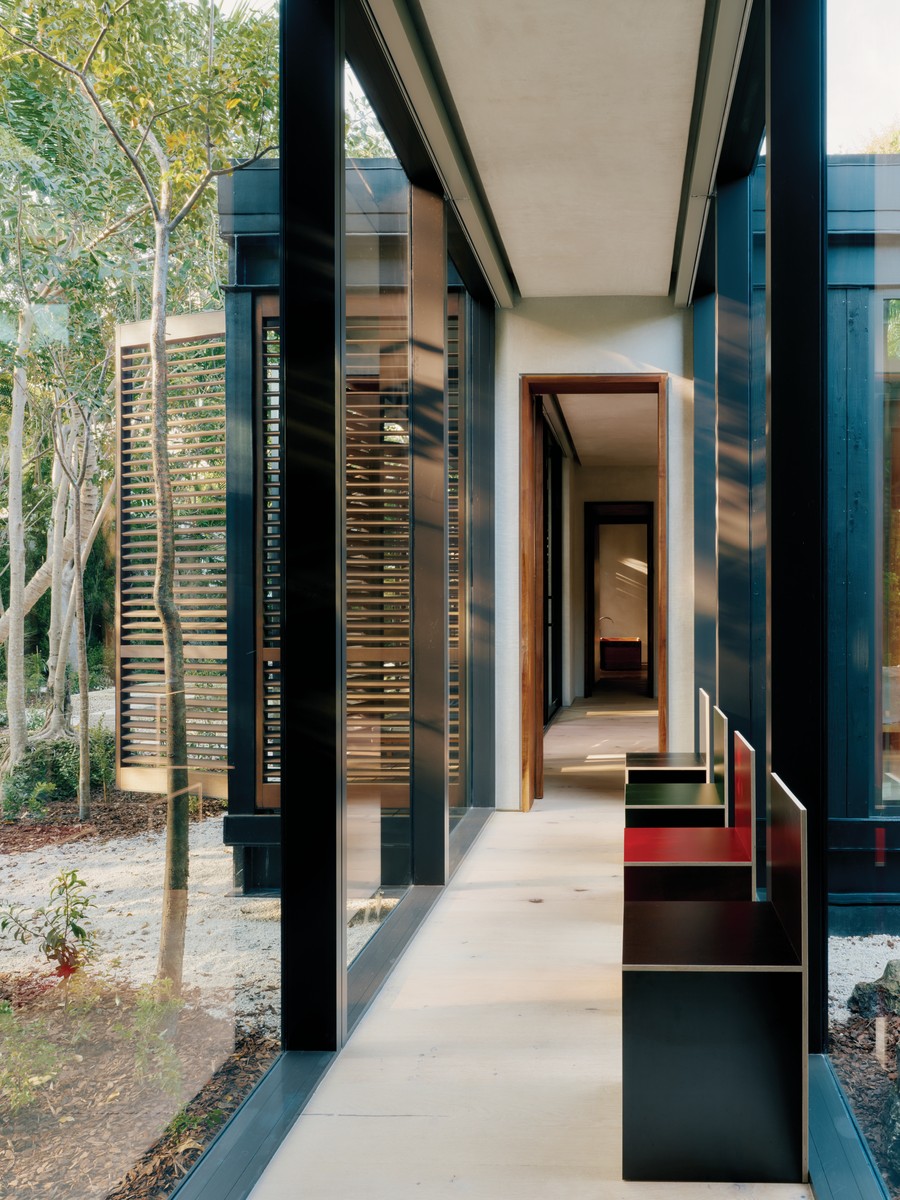
2
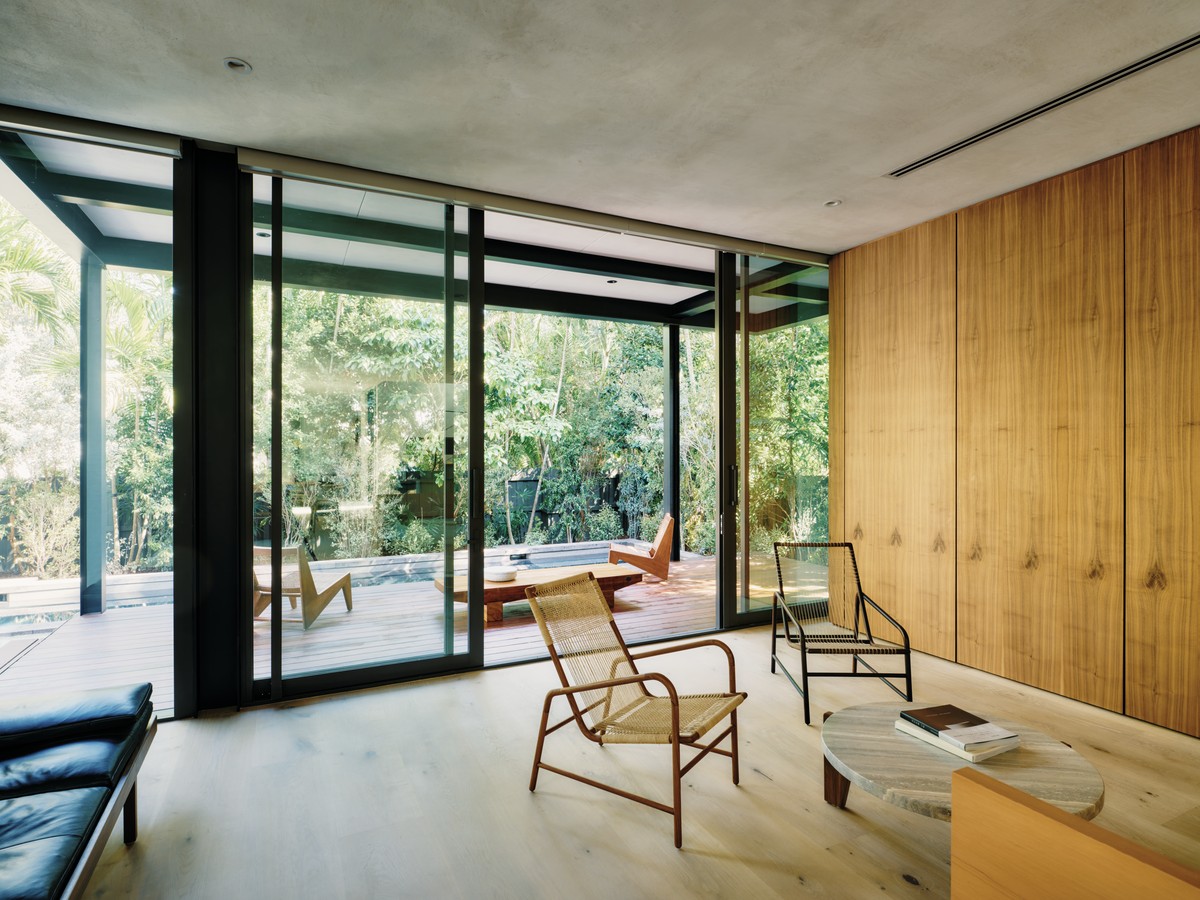
Glazing offers verdant views (1 & 2). Photos © Joe Fletcher
The 4,100-square-foot residence consists of four connected volumes (two that have two stories and two one-story) arranged in a U-shape around a central courtyard. The design utilizes a structural-steel system that rests some 30 inches off the ground, to keep existing root networks intact. Each volume is enveloped in charred-timber panels and large expanses of hurricane-grade floor-to-ceiling windows or sliding doors. The latter open to the courtyard, or to porches and balconies, shaded by cantilevers or operable ipe louvers. Narrow floor plates throughout ensure ample cross ventilation and natural light.
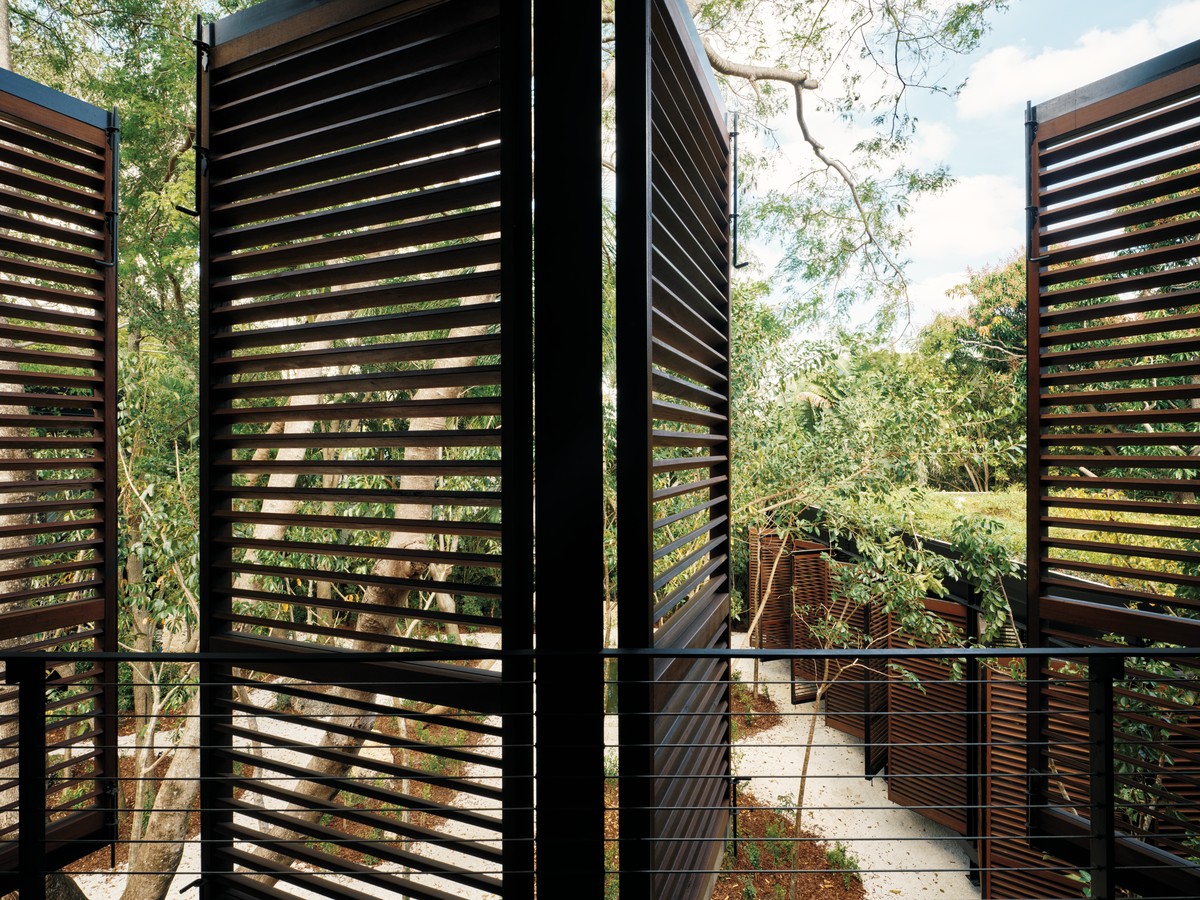
Louvers enclose porches and balconies, and green roofs top each volume. Photo © Joe Fletcher
The house was built for a young couple, Theodore and Belinda Stohner: he moved to Miami in 2016, after being based in the office of an investment-management company in London for many years, while she, a professional violinist and leader of a string quartet, has lived in Miami for decades. Theodore, with an interest in design, had long wanted to build his own home. In 2018, on a walk, he serendipitously encountered the plot of land for sale, which was being used as a garden by an adjacent property and had grown wild and junglelike.
Those qualities, attractive to the would-be buyer, rendered the site prohibitively expensive to develop; the city requires payment for every tree that is knocked down. “There was no interest from the developer community, so, on a lark, I offered the owner half of what he was asking for, and, surprisingly, he countered with a slightly higher price,” says Theodore. “So, I went home to Belinda, and told her, ‘I think we just bought some land.’”
Theodore was familiar with the work of Brillhart Architecture, having read of their DIY Miami home, Brillhart House, when it was published. The residence, Jacob explains, was heavily inspired by the Paul Rudolph and Ralph Twitchell–designed Healy Guest House (1950), in Sarasota, Florida. The project, like the Morningside Residence, is bordered by local flora and features an open floor plan, with building-length glass walls that are shaded by overhangs and louvered shutters. Those lessons and moves are applied here, though at a larger scale and with more luxurious, but not ostentatious, finishes.
Looking for quick answers on architecture and design topics?
Try Ask RECORD, our new smart AI search tool.
Ask RECORD →
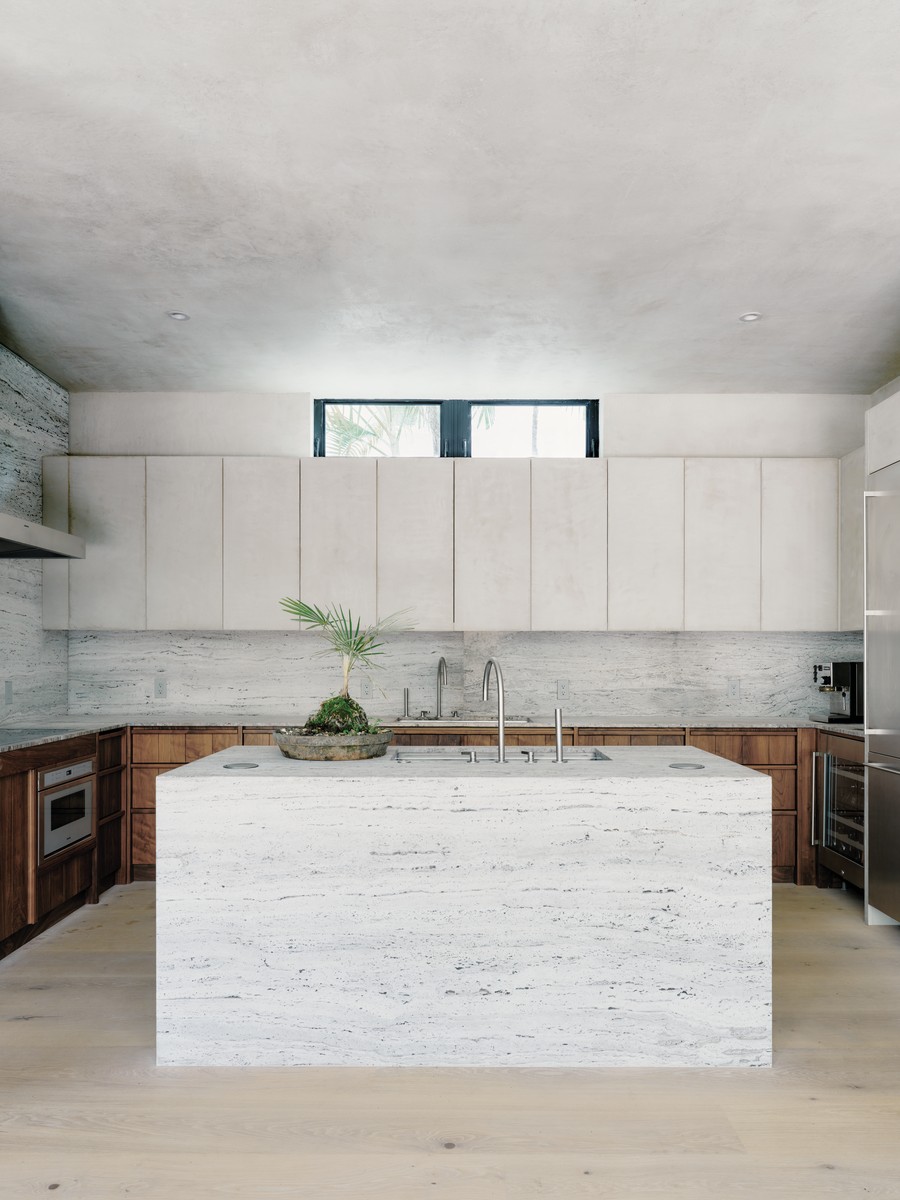
The kitchen features travertine surfacing. Photo © Joe Fletcher
The Morningside Residence is accessed from the south, through a gateway. The garage is located to the immediate west, with a home office above it that can double as a guest bedroom. A one-story volume on the eastern flank of the lot is linked to the garage via an open walkway, and it contains the complex’s sizable kitchen—the Stohners are enthusiastic cooks, often inviting friends—and a guest bedroom. Countertops and the kitchen island are surfaced in a coral-white travertine, and the cabinetry is fashioned of black walnut. The upper cabinet faces are coated with a gray cement-based plaster, used as a wall treatment throughout the home.
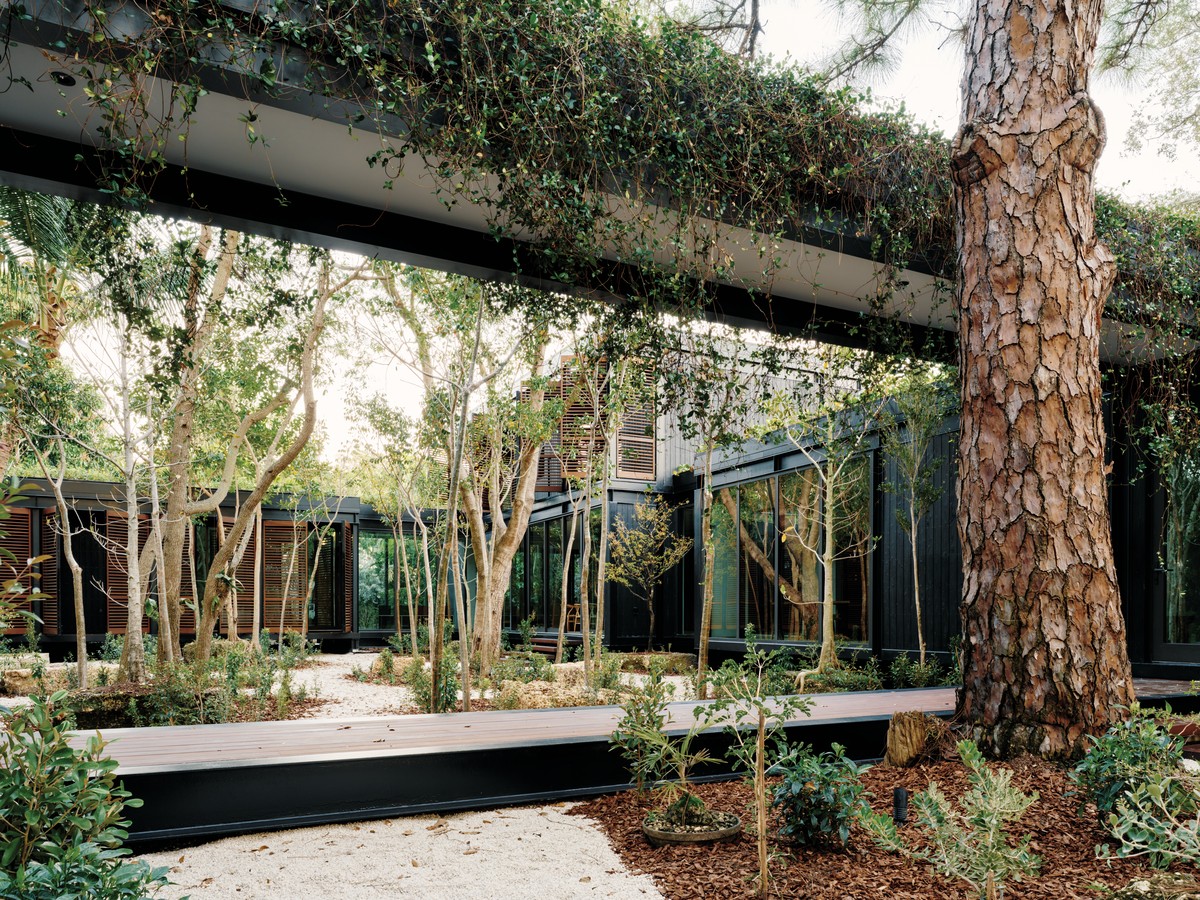
Walkways tie the home together. Photo © Joe Fletcher
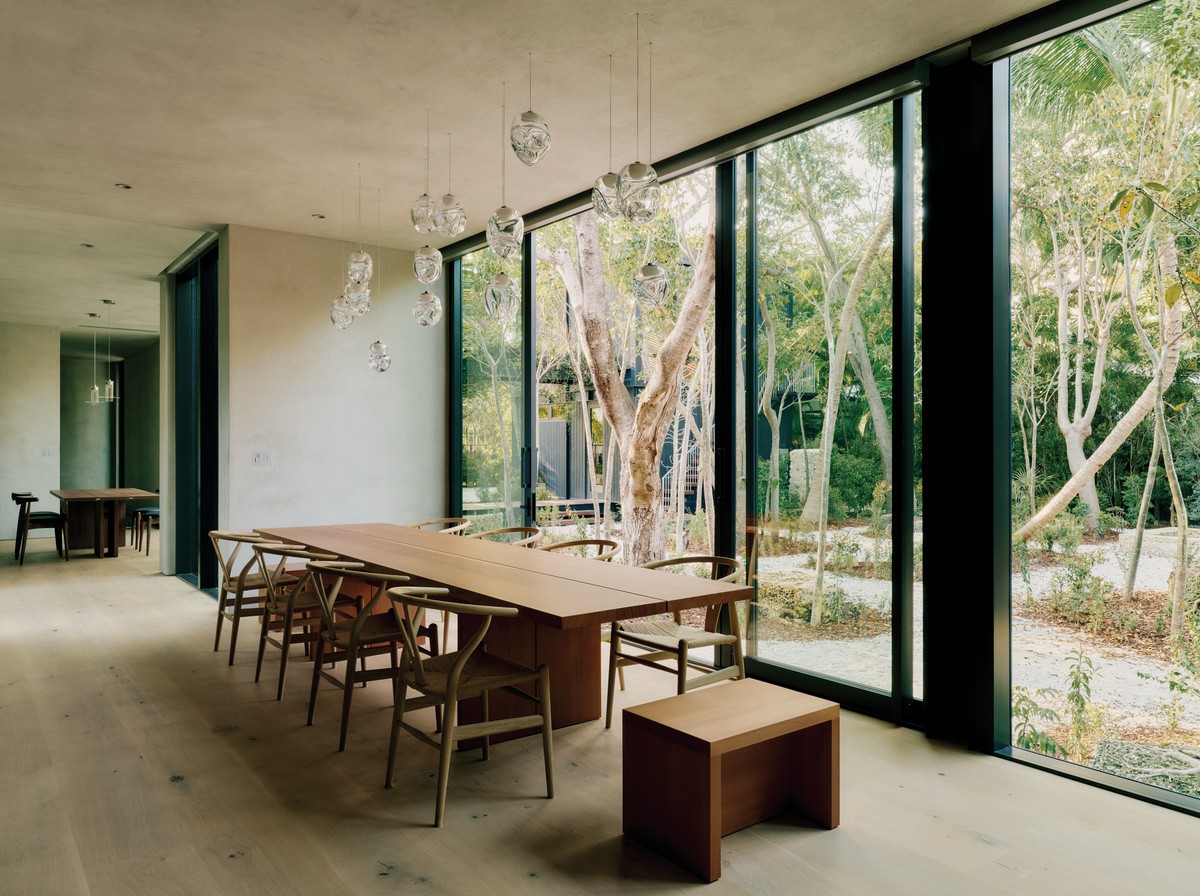
A glassed-in hallway leads to the third volume, the house’s primary living space. It is an approximately 800-square-foot room that can be opened to the elements through courtyard- and rear-yard-facing sliding doors. Within, the design reflects Theodore and Belinda’s interests. For Belinda, there is enough room for a grand piano and for her quartet to perform, and the space allows Theodore to put his collection of modern furniture (designed by Donald Judd and Charlotte Perriand, among others) to good use; together, they can entertain guests or work on jigsaw puzzles at their John Pawson–designed 13-foot-long dining room table. Above, on the volume’s second story, there are two bedrooms with a Jack-and-Jill bathroom in between.
3
The owner collects contemporary furniture (3 & 4). Photos © Joe Fletcher
4
The primary bedroom is located within the northernmost volume, connected to the living space through a glass-enclosed hallway. It is, like the other bedrooms in the house, sparsely decorated, save custom-fabricated bed platforms, with nightstands, designed by Theodore. The near-Spartan quality of the bedrooms could prove too severe in a less well-positioned project, but the design team, in maintaining a minimalist approach, successfully allow for plentiful outward views of the site’s landscaping, complete with reflecting and lap pools, to command all the attention.
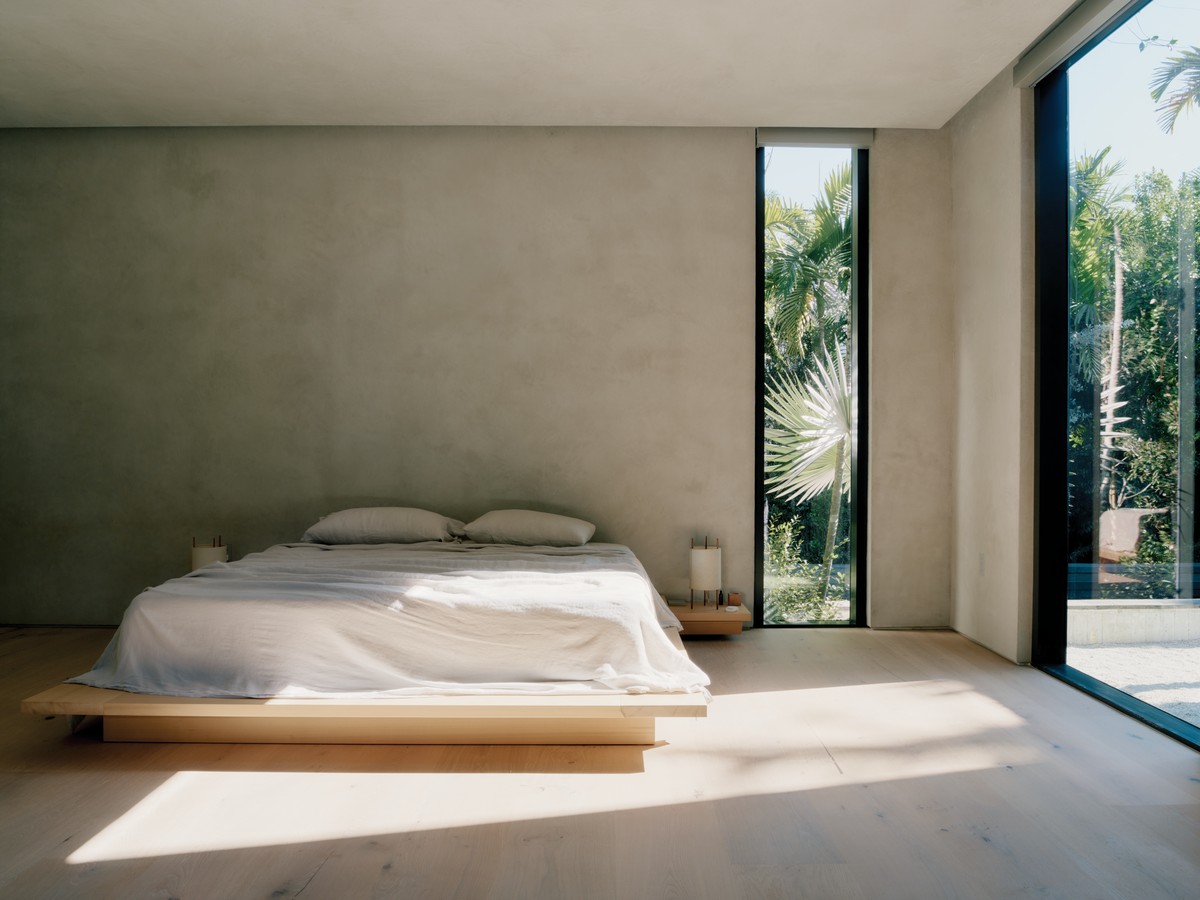
The bed platforms were designed by the owner. Photo © Joe Fletcher
Visiting on a sweltering July afternoon, I stayed cool on the shaded second-floor balcony as a breeze rustled the leaves of the courtyard’s oak and pine trees. Several geckos wound their way across multiple sets of louvers, and a sandhill crane flew overhead. Biscayne Boulevard, heavy with traffic and just 150 feet west, felt worlds away.
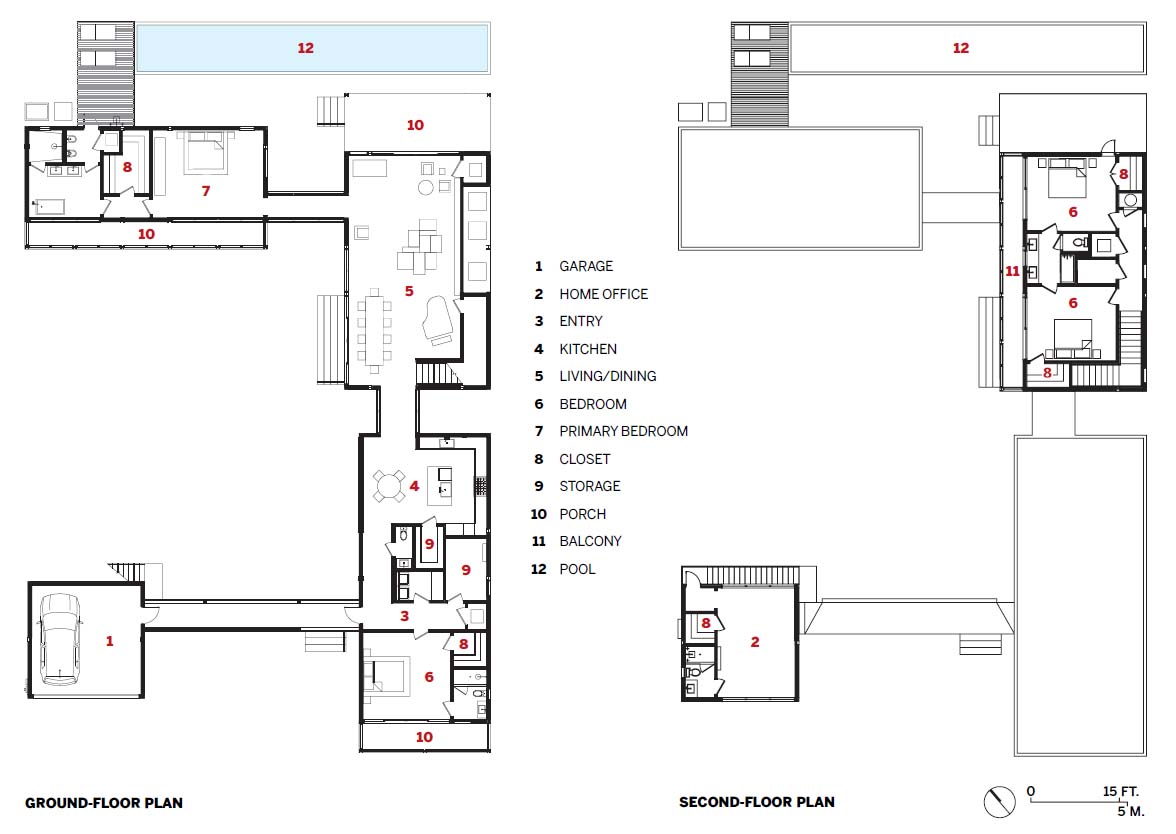
Image courtesy Brillhart Architecture, click to enlarge.
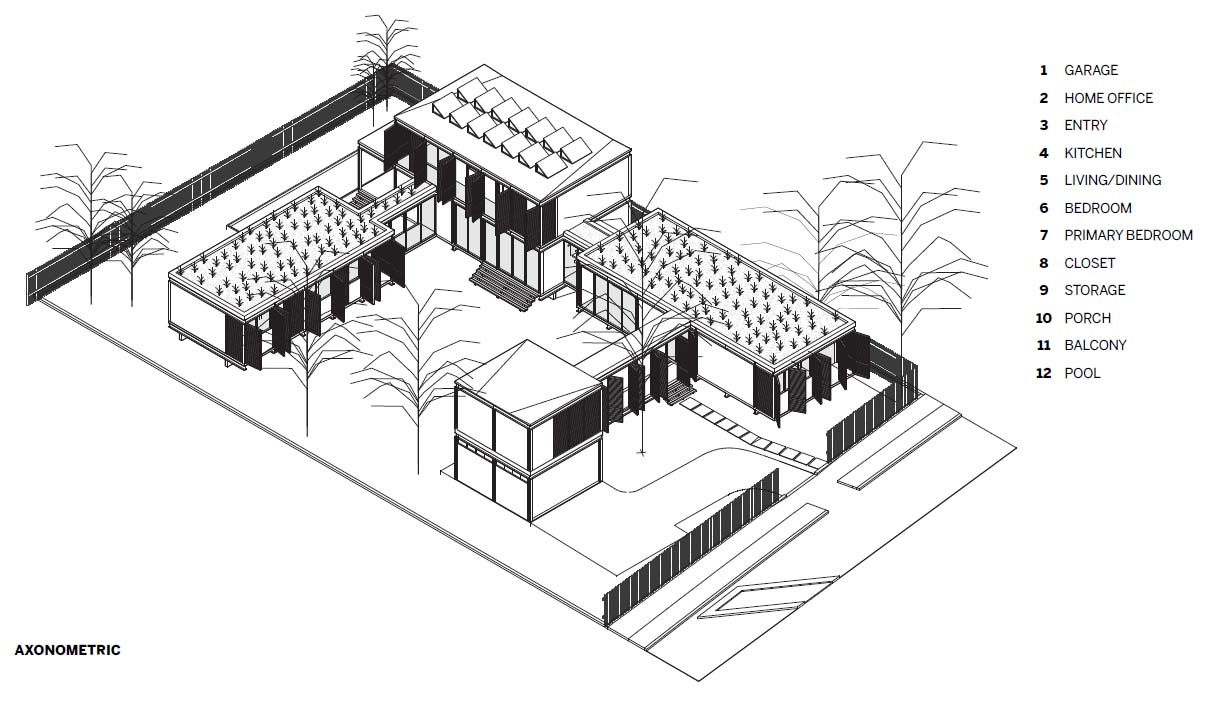
Image courtesy Brillhart Architecture, click to enlarge.
Credits
Architect:
Brillhart Architecture — Jacob Brillhart, founder and lead designer; Andrew Aquart, project manager
Interior Designer:
Brillhart Architecture
Engineers:
ASD Consulting Engineers (structural); FAE Consulting (m/e/p); Cherokee Consulting (civil)
Landscape Architecture:
Tropica; Christopher Cawley Landscape Architecture
General Contractor:
iBuild
Client:
Theodore and Belinda Stohner
Size:
4,100 square feet
Cost:
Witheld
Completion Date:
December 2024
Sources
Wood Cladding:
Nakamoto Forestry
Millwork:
Craftworks Woodworking, B.L. McDonough Construction Consulting
Plasterwork:
Alternative Constructors, Texston
Door Hardware:
FSB
Lighting:
Analog Glass, Studio Philipp Weber, Lightology, Wonderglass
Photovoltaic System:
Qcells, Solar Edge, Tesla
Looking for a reprint of this article?
From high-res PDFs to custom plaques, order your copy today!