Foster + Partners’ Zayed National Museum in Abu Dhabi Meets the Sky with a Series of Splayed Solar Chimneys
Abu Dhabi, United Arab Emirates
Architects & Firms
On December 2, 2025—the 54th anniversary of the country’s founding—the United Arab Emirates inaugurated its Zayed National Museum (ZNM) with light shows, drone formations, and much official pomp. Located in the capital, Abu Dhabi, the 610,170-square-foot building is the kingpin in a collection of museums and cultural buildings on Saadiyat Island, among them Jean Nouvel’s Louvre Abu Dhabi, David Adjaye’s Abrahamic Family House, Mecanoo’s just-inaugurated Natural History Museum, and the late Frank Gehry’s under-construction Guggenheim. Named for and commemorating the legacy of U.A.E. founder Sheikh Zayed bin Sultan Al Nahyan, the museum opens at a time when, after half a century of accelerated development, native Emiratis make up just 11 percent of the country’s population of 11 million (the others are expatriates and migrant workers of one kind or another). An exercise in nation building, the institution tells a cautiously curated story of the lands it represents, with exhibitions ranging from Bronze and Iron Age archaeology to the arrival of Islam, Bedouin traditions, pearl fishing, and a hagiographic account of Sheikh Zayed’s life. Divided across six galleries, with a seventh for temporary shows, the displays are housed in a monumentally spectacular building by Foster + Partners, winner of the 2006–07 international design competition back in what seems like another age.
1
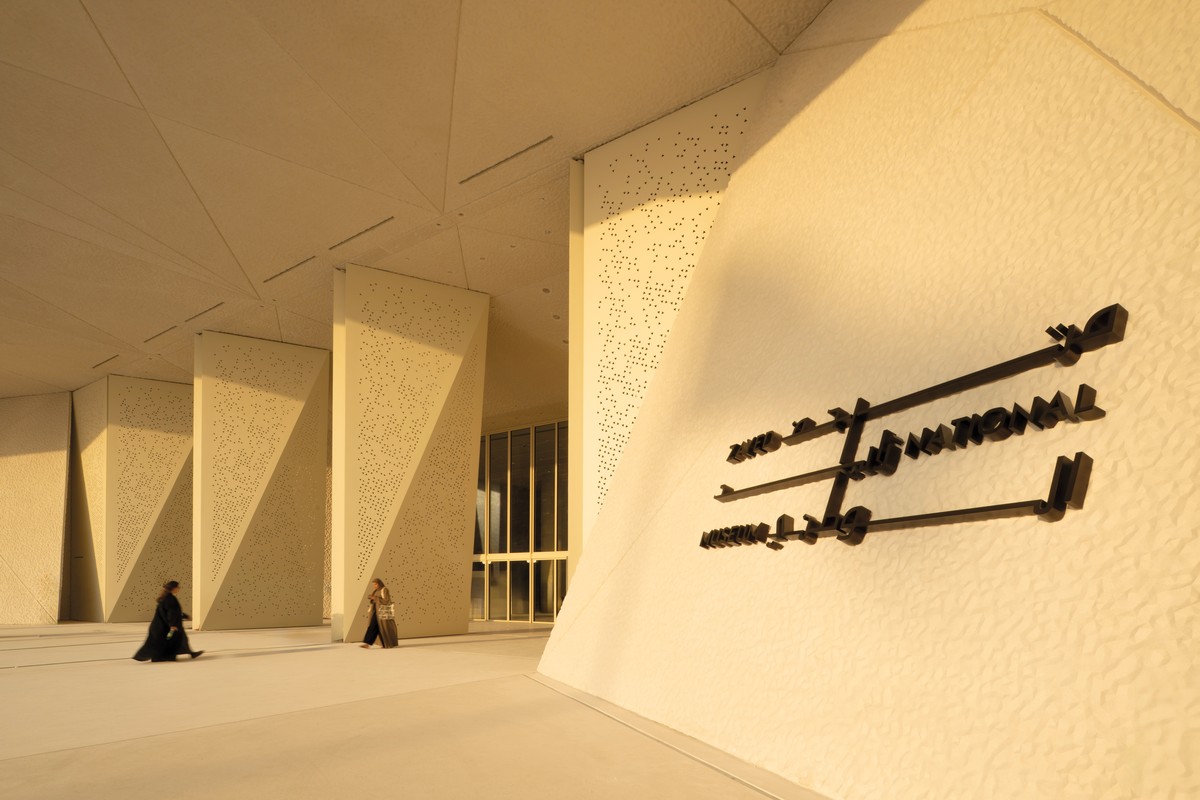
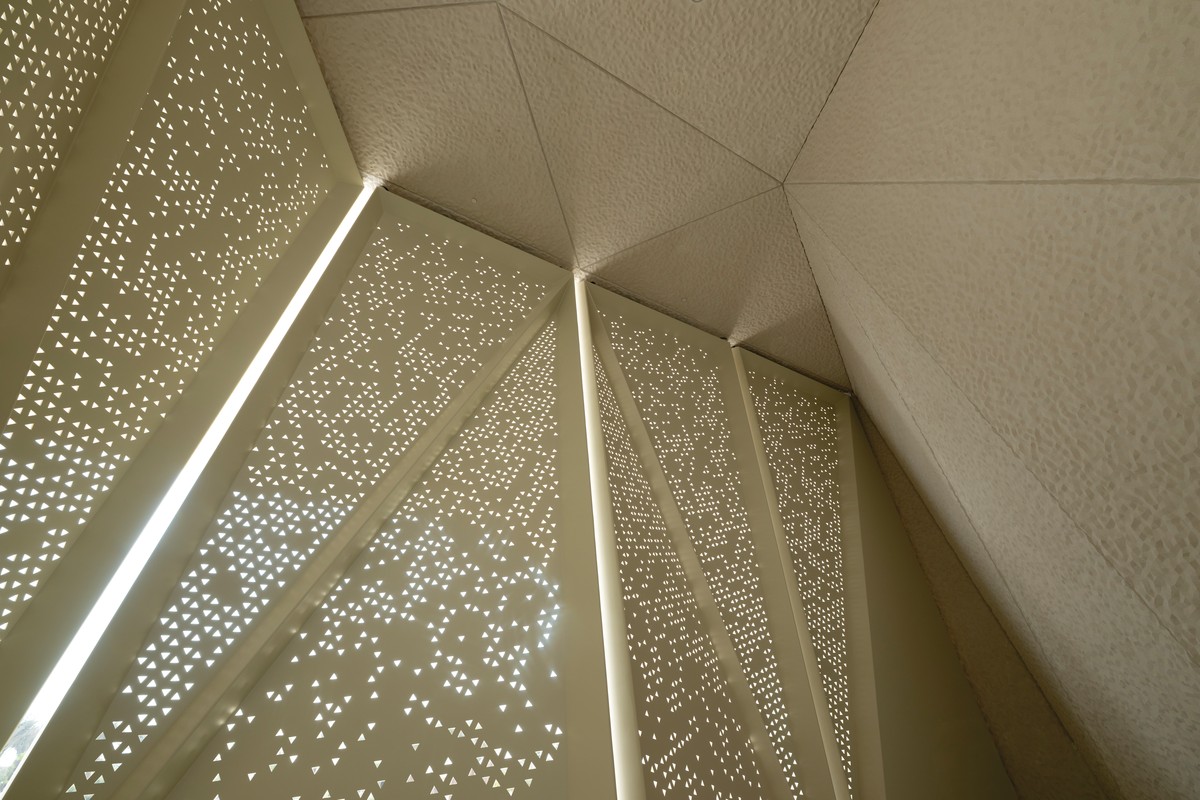
Perforated folding panels (1) delineate the main entrance (2) and forecourt. Photos © Nigel Young / Foster + Partners, click to enlarge.
2
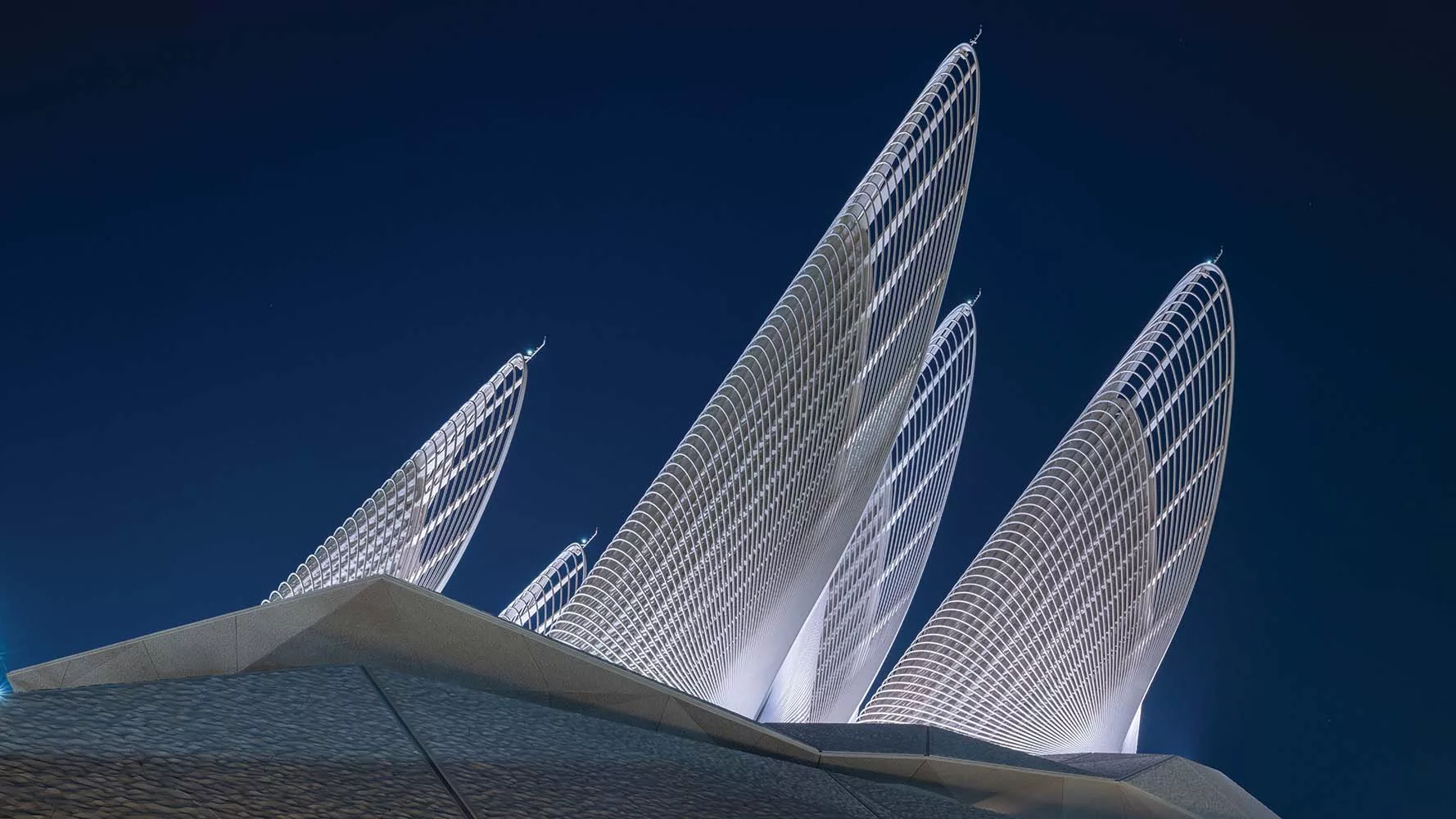
Now a nonagenarian, Norman Foster was a youthful 71 when the project began, and Saadiyat just a vast expanse of sand accessible only by helicopter. “In the absence of context,” he recalls, “the starting point was the desert.” Rising from the flat landscape like one of the rocky outcrops in the eastern Emirates, the “mound,” as the firm calls the main part of the building, contains the museum proper, realized, as one would expect, in reinforced concrete. Set slightly above it, to create a ventilated gap, a triangulated covering of over 3,000 textured GRC panels helps shield the building from solar gain. Fabricated in the U.A.E. with immaculate precision, this sand-colored casing incorporates covered paths leading to the roof, where visitors can enjoy views across the city. Crowning this piece of artificial landscaping, five soaring steel towers mark the skyline, their feathery forms representing, according to the well-rehearsed ZNM myth, the wing of a bird. Fortuitous or not, this evocation of falconry—a Bedouin tradition that was Sheikh Zayed’s passion—is the product of practical concerns. Reversing the local tradition of wind towers, the architects built a headdress of solar chimneys that, thanks to the triple-laminate glass at their summit, superheat the air up top so that a current is drawn in through vents in the mound below. Forced down into underground concrete ducts, it cools before entering the building. In winter, Foster + Partners hope, it will be sufficient to ventilate the main atrium naturally, while in spring and fall it will feed into the museum’s air-conditioning, helping to reduce running costs.
3
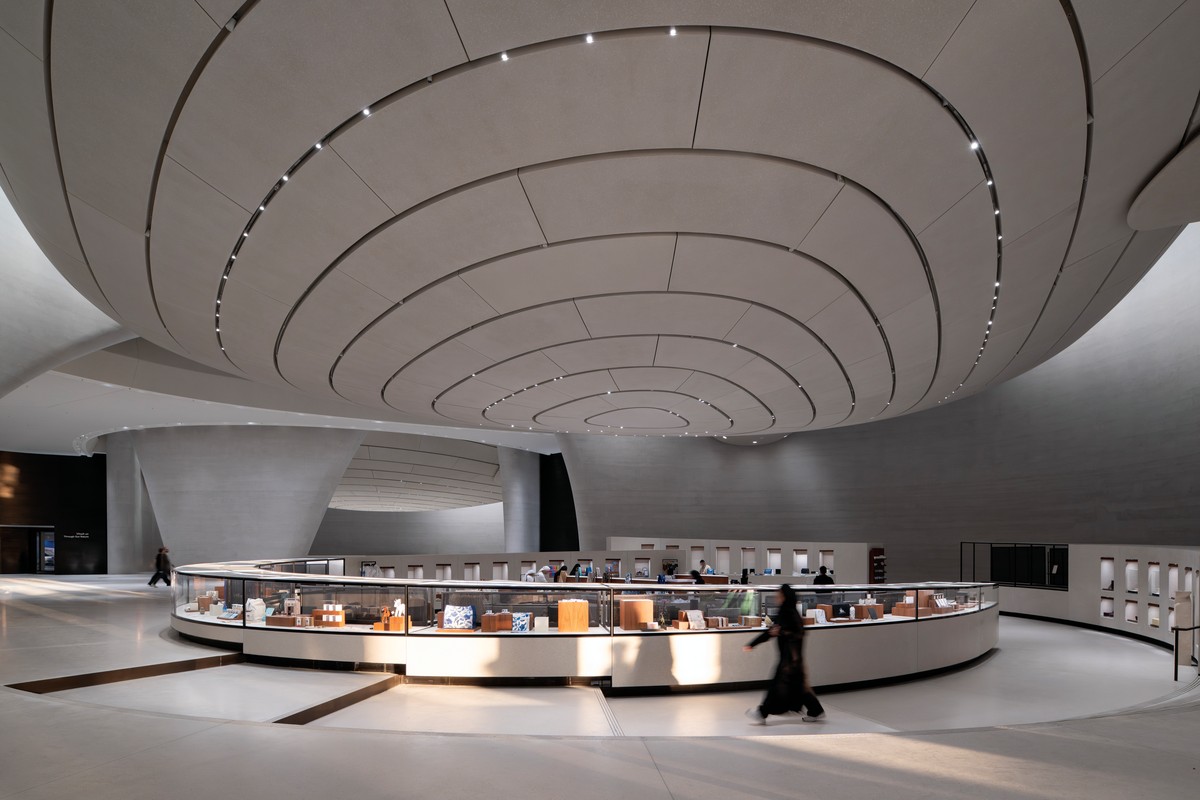
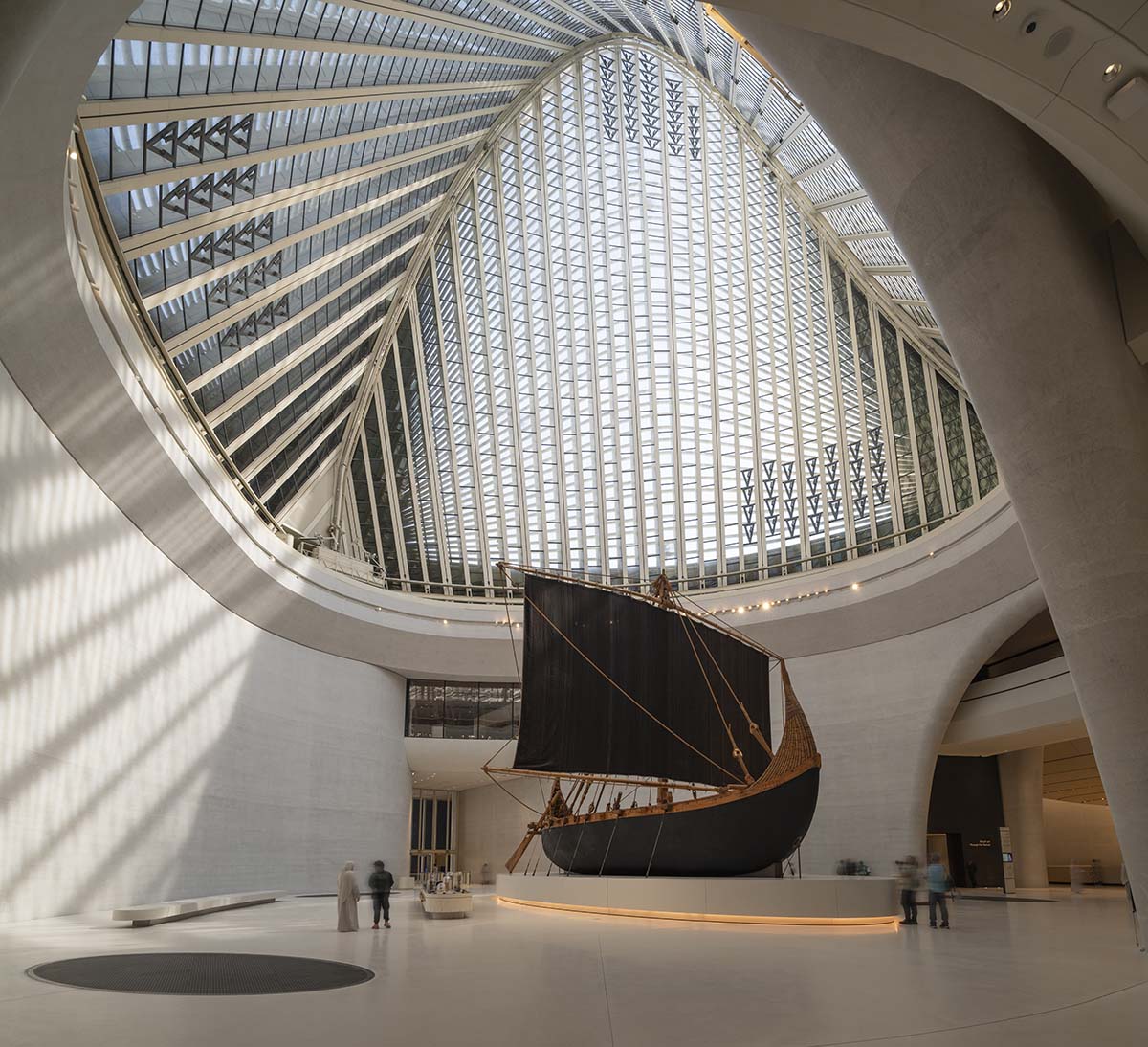
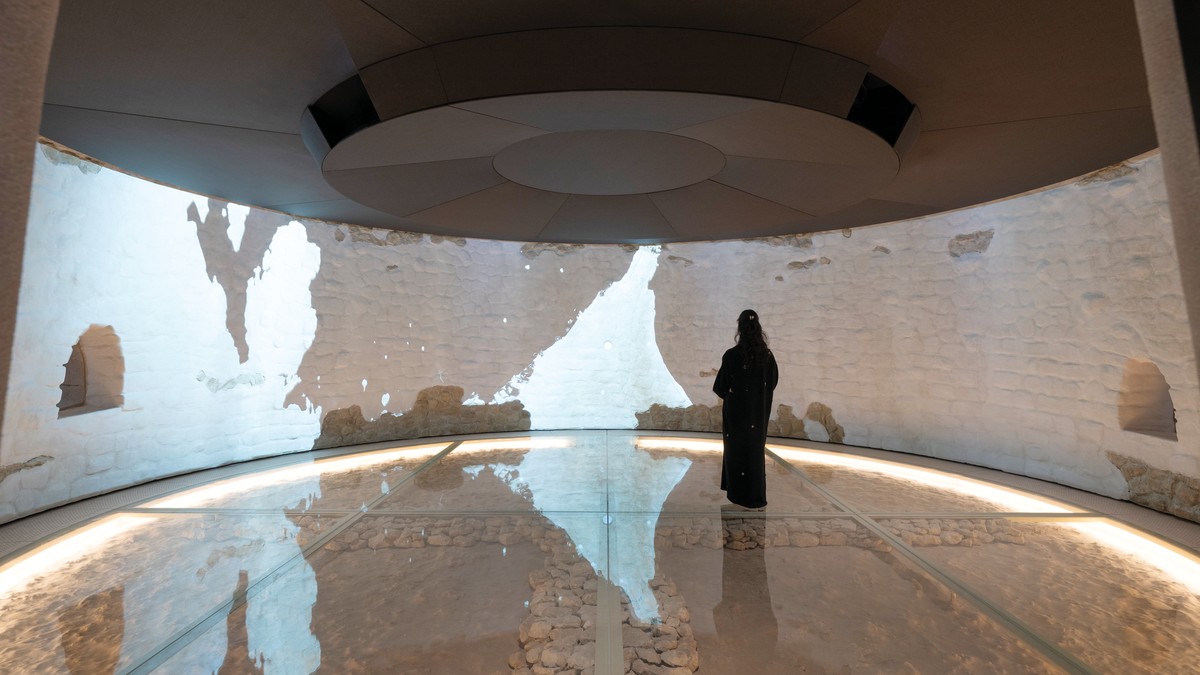
Visitors can wander the expansive and daylit ground floor and beneath five bulbous upper-level galleries (3). A replica Bronze Age boat is placed in one of the atriums (4). Photos © Nigel Young / Foster + Partners
4
Preceding the museum, the 2,000-foot-long Timeline Garden, which the architects describe as the “eighth gallery,” celebrates Sheikh Zayed’s “greening of the desert,” which involved planting 60,000 acres of arid land as a forest irrigated with groundwater. At the gardens’ climax, greeting visitors on the museum’s polished-concrete plaza, a mighty fountain froths and roars, cooling the air around it through the evaporation effect. An extravagant display in a country where water was traditionally scarce, it stands as a symbol of abundance and good governance. In a classic architectural sequence of compression and dilation, the museum funnels visitors into its cave-like porch, from which they pass through the deliberately banal security control before emerging into the building’s grandiose atrium. Here they discover the steel towers’ other function, which is to bring daylight into a windowless building, its much-filtered rays washing down the beautifully cast and finished concrete “drum walls,” as the architects call them. These serve to support the steel towers as well as four of the museum’s galleries, which take the form of egg-shaped steel-framed GFRC-clad “pods” hovering over visitors’ heads—suspended within the solar chimneys, they attach to the drum walls at just three points via cantilevering steel connectors.
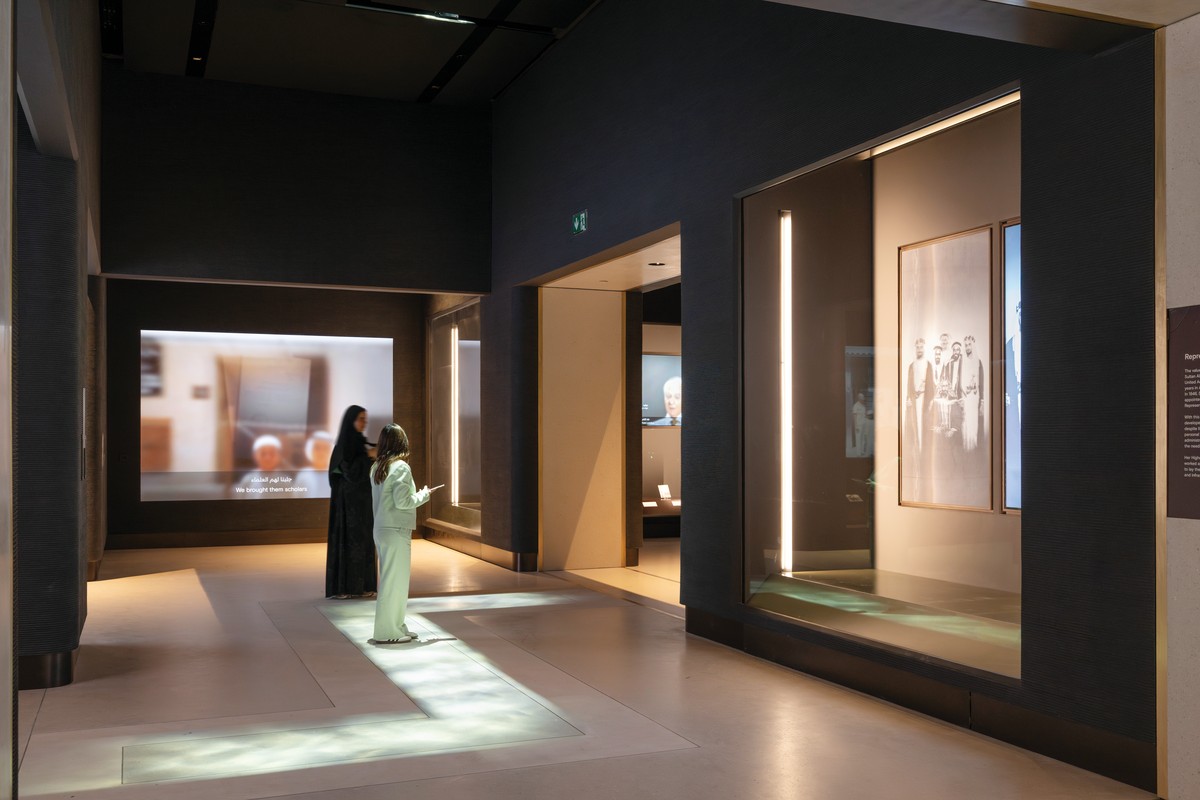
More conventional areas feature multimedia displays. Photos © Nigel Young / Foster + Partners
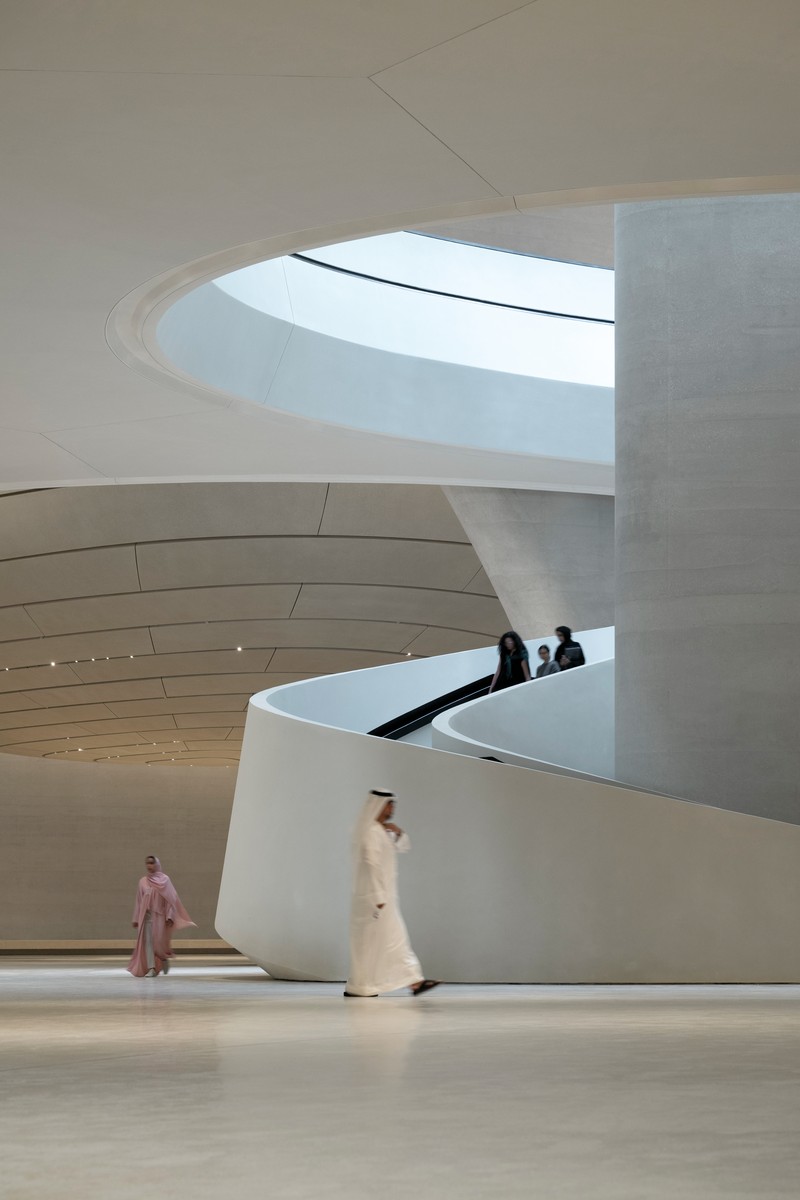
“A modest man, Sheikh Zayed didn’t live in marble-clad palaces,” says Gerard Evenden, Foster’s lead partner on the project. “That’s why, when thinking about what the museum should be, we looked at traditional Emirati mud-brick buildings, which came from the ground they stood on.” Unable to use Saadiyat’s sand due to its impurities, the architects sought other ways of tying the building to its context, for example by including beige Omani marble aggregate in their concrete mix, which, for the drum walls, they cast in three continuous horizontal pours to produce a layered effect, like sedimentary rock’s. “To get it right, the whole team was literally living in the formwork,” recalls Foster. This attention to detail is visible throughout the museum, from the abundant bronze the architects chose for doors, elevators, handrails, and openings to the clever dissimulation of HVAC and the sophisticated display-case design inside the pods. Fully air-conditioned to museum standards, the latter are soaring spaces crowned with skylights, offering a rather tenuous connection to the firmament above. To reach them, a bravura central stairway, winding around a freestanding elevator bank, leads up to broad, sinuous walkways that offer vertiginous views into the atrium below.
5
Curvilinear geometries are a leitmotif in spaces large and small (5 & 6). Photos © Nigel Young / Foster + Partners
6
Although ZNM builds on experience gained on past Foster + Partners projects, like the naturally ventilated Commerzbank (Frankfurt, 1991–97) or 30 St. Mary Axe (London, 1997–2004), not to mention the many top-lit atriums the firm has designed over the years, the building is a formal departure. In place of the clear geometry on which the office built its reputation, we find a sort of freestyle baroque, a Bilbao moment designed to ensure that the building held its own among the neighbors. Moving through this right-angle-free zone, one experiences a certain disorientation, as though lost among the vast expanse of ever-shifting desert sand dunes. For in contrast to the domestic intimacy of a traditional mud-brick home, ZNM is bombastically cavernous, at once exhilarating and slightly intimidating, its public spaces bloated in a way clearly intended to impress. It remains to be seen how the atrium, with its integrated museum shop and sunken amphitheater, fares as an events space.
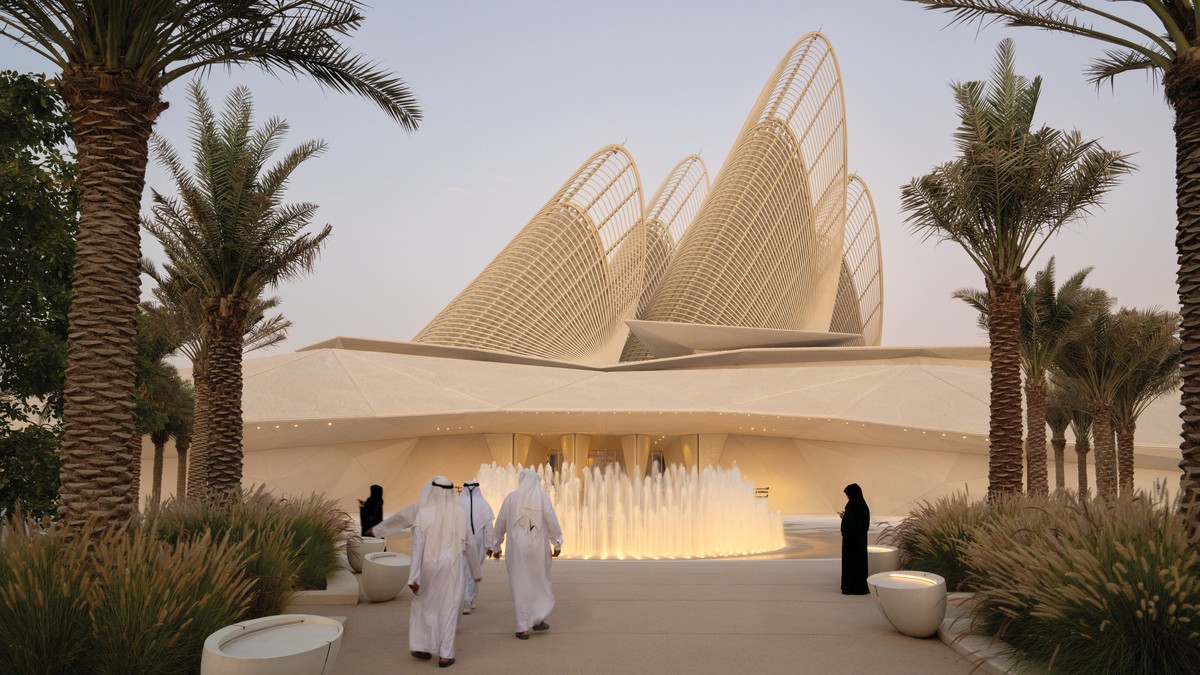
Palm trees and grasses surround the fountain at the center of the entry court. Photos © Nigel Young / Foster + Partners
At almost 20 years in the making, ZNM could have been one of those buildings that seemed like a dated hangover from a bygone era. Instead, it appears at once fresh and rather familiar, which is arguably a definition of “timeless.” Whatever kind of regime builds one, a national museum is by definition a paradox: the curatorial process involves a degree of mummification, whereas nations must remain alive and vibrant. Aimed at both local and international audiences, ZNM seeks to fix an image that is consensual enough to unite an entire country behind it. “This museum informs a young nation of its extraordinary destiny,” declares Foster, implacably on message. “To be able to see what one individual and society have done in such a remarkably short space of time has to be inspirational and empowering for younger generations.”
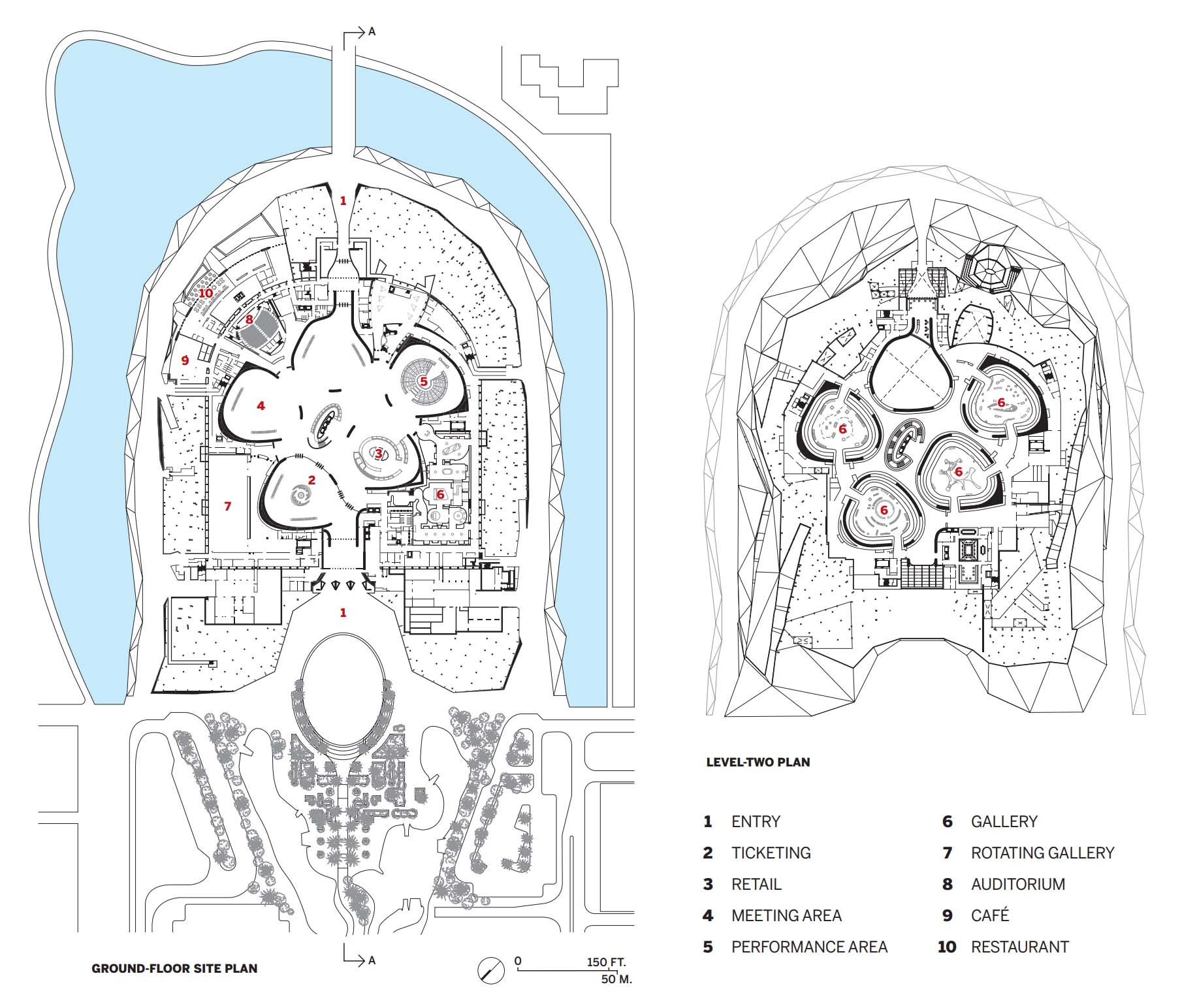
Image courtesy Foster + Partners
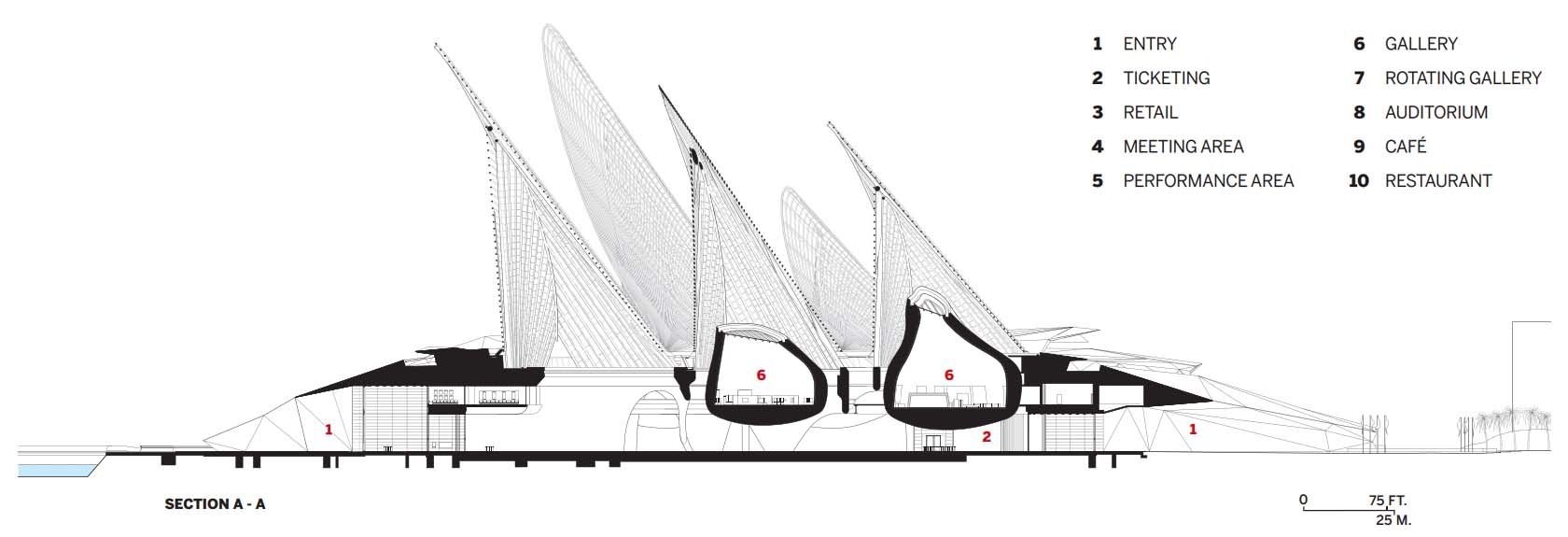
Image courtesy Foster + Partners
Credits
Architect:
Foster + Partners
Architect of Record:
Planar, WSP (joint venture)
Engineers:
BDSP, WSP (MEP); AKT II, WSP (structural); Transsolar (environmental)
Consultants:
Claude Engle (lighting); Lerch Bates (facade); Atelier Dreiseitl, WATG (landscape); RWDI (airflow); Shen Milsom & Wilke (auditorium)
General Contractors:
Arabtec, Six Construct-Trojan (joint venture)
Client:
U.A.E. Department of Culture and Tourism
Size:
610,170 square feet
Cost:
Withheld
Completion:
December 2025
Sources
Structure:
Ready Mix Beton (concrete); DOKA, PERI (formwork); Mais Interiors (honing); Eversendai, REA/LIN (steel)
Cladding:
AES (curtain wall); Fibrex, Abu Dhabi Precast (GFRC)
Exhibition:
Goppion, Click Netherfield, Dominion, Acciona Cultura, Empty SL
Glazing:
AES, ALEC Facades
Doors:
AES, ALEC Facades, Momentum Fireguard, Spazio
Hardware:
Momentum Fireguard
Interior Finishes:
Alec Fit-out, In Out Concepts General Trading; Mayvaert (retail)
Conveyance:
TK Elevator, EW Cox Middle East, Eversendai
Looking for quick answers on architecture and design topics?
Try Ask RECORD, our new smart AI search tool.
Ask RECORD →
Looking for a reprint of this article?
From high-res PDFs to custom plaques, order your copy today!