Record Houses 2025
Near Guadalajara, Estudio Macías Peredo Caps Casa Primaveras with a Jagged Roofline
Zapopan, Mexico

Architects & Firms
The first time Jaime Agnesi and his wife, Uli Meyer, visited the site where they planned to build their home in Zapopan, on the outskirts of Guadalajara, Mexico, they found the 10,225-square-foot lot crowded with old cars and golf carts. Situated in a gated subdivision known as Rancho Contento, this particular piece of land belonged to a woman who had defaulted on her payments and had turned the empty property over to Rancho Contento’s administration. It was, in short, unprepossessing, confined on two sides by neighbors and relatively far from the verdant golf course. What it did have was a sprawling rubber tree, Agnesi recalls, “and I thought, well, it has to be here.”
Before long, Agnesi and Meyer found architects Estudio Macías Peredo and presented the founding partners, Salvador Macías and Magui Peredo, with an ample set of references and ideas. “I wanted a house to enjoy from within; I didn’t care how it looked from outside,” Agnesi recalls. “But, inside, I wanted to see the tree from everywhere.” Meyer, who grew up in northern Germany, desired, above all, a house that celebrated the warm, sun-washed climate of the place where she’d chosen to live.

The architect gave the house a dynamic silhouette comprising many smaller pitched roofs (above and top of page). Photo © César Béjar, click to enlarge.
As they do in all their projects, Macías and Peredo began with a detailed study of the lot, which, in this case, included hiring a specialist to map out a perimeter around the tree’s extensive root system. Invisible on the lot’s surface, the roots cut diagonally across the lot, demarcating a jagged central area where the architects could not build lest they damage the tree. “Whatever steps we took, we knew we had to respect that restriction,” Peredo says. The project the architects proposed hugged the edge of the lot in a rough J shape; plastered walls and small apertures opening on to a central garden gestured toward Guadalajara’s Modernist idiom.
To accommodate the client’s extensive, five-bedroom program, Macías and Peredo placed rooms for the parents and their two young children at the plot’s western extreme, with public spaces to the east and, sunken into the lot—houses at Rancho Contento cannot exceed one story—a service quarters with a private patio and a bar, den, and guest suite.

1
2
3
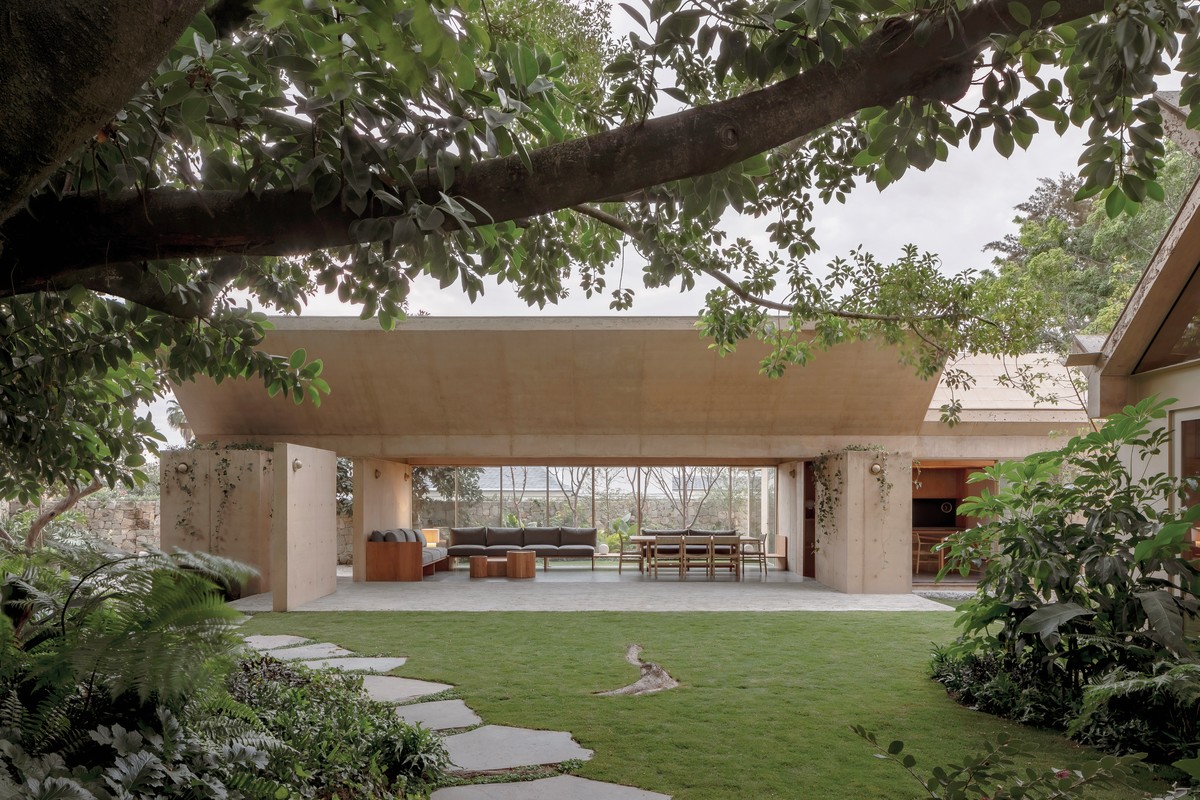
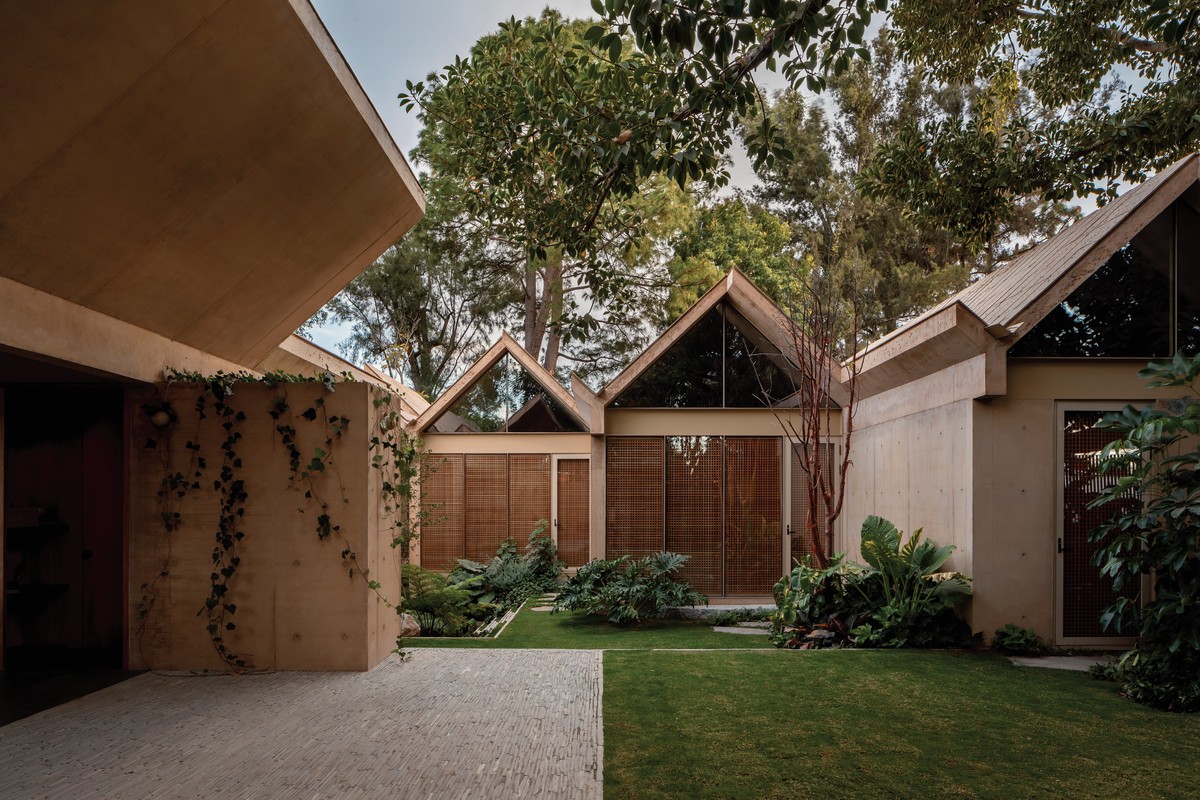
A repeated module often incorporates a triangular clerestory (1) but at times is left open to form cantilevered canopies (2 & 3). Photos © César Béjar
The clients weren’t pleased. “They wanted something riskier, less conventional,” Macías recalls. “And more open,” Peredo adds. “They didn’t want to see the tree—they wanted to see the trees all around.” In their redesign, the architects’ first essential gambit was geometric: a 45-degree shift that pried the house away from the lot’s perimeter. They then rearticulated the footprint as a sequence of modular 11½-foot-wide bays running diagonally across the lot, with gaps over the central fault line defined by the tree.
To bring in the surrounding canopy of oak and pine, Macías and Peredo folded their flat roof into isosceles gables with triangular clerestories to direct views upward. With most of the house’s inward-facing edge turned north, away from a brutal southern exposure, the architects could introduce floor-to-ceiling windows that took in oblique views of the rubber tree. In the modest foyer, for instance, near the lot’s southeastern corner, the main perspective faces straight down one of the house’s long modules while windows to the left overlook the central garden, which cascades “as if it were lava,” Macías says, along a stone staircase to the lower floor. The rubber tree, meanwhile, appears tantalizingly in the distance.
The architects’ structural decisions ultimately dictated the choice of the house’s materials. Excavations for the lower level required concrete foundation walls. To avoid visible hierarchy between the house’s floors, the architects extended the material upward. Concrete beams running the length of each bay allowed the roof, also rendered in concrete for visual coherence, to float free. Pigments added to the mix on-site approximated the pale yellow-pink tone of the solid rock they encountered while excavating.
Looking for quick answers on architecture and design topics?
Try Ask RECORD, our new smart AI search tool.
Ask RECORD →

4

5
The house is formed from tinted concrete (4) and features a lush sunken courtyard (5). Photos © César Béjar
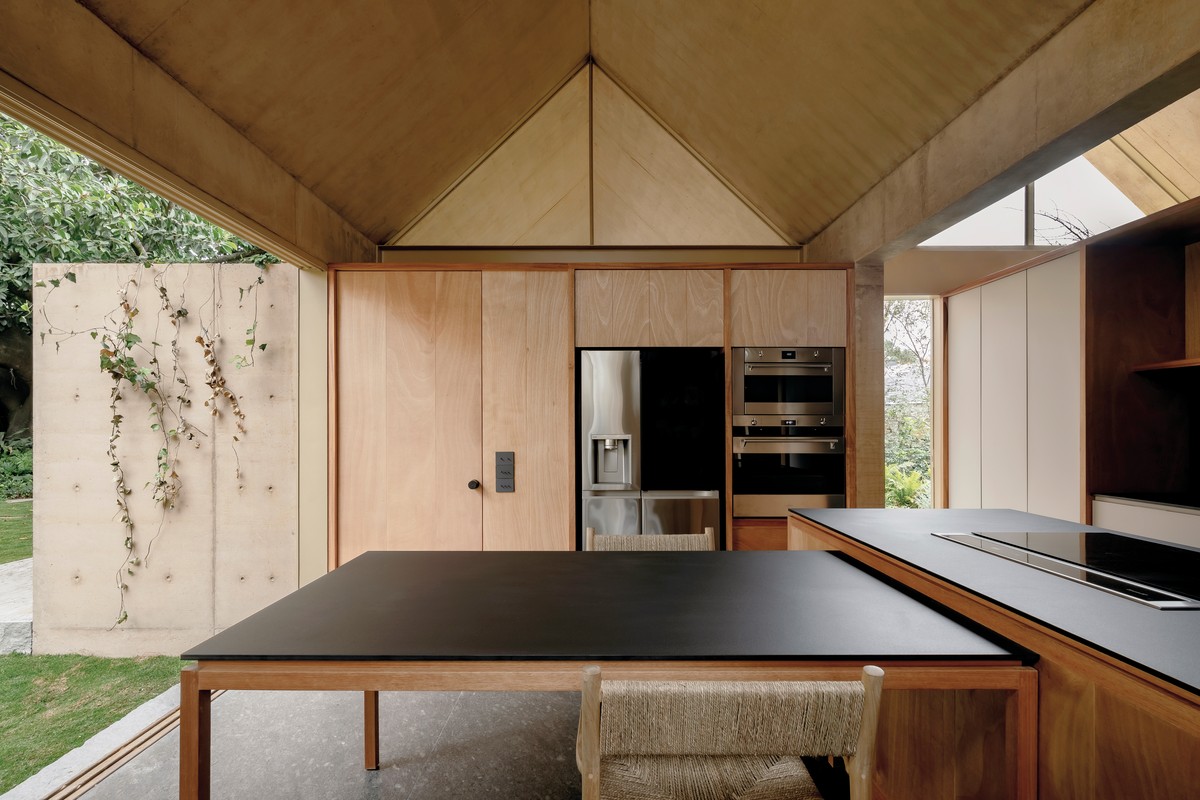
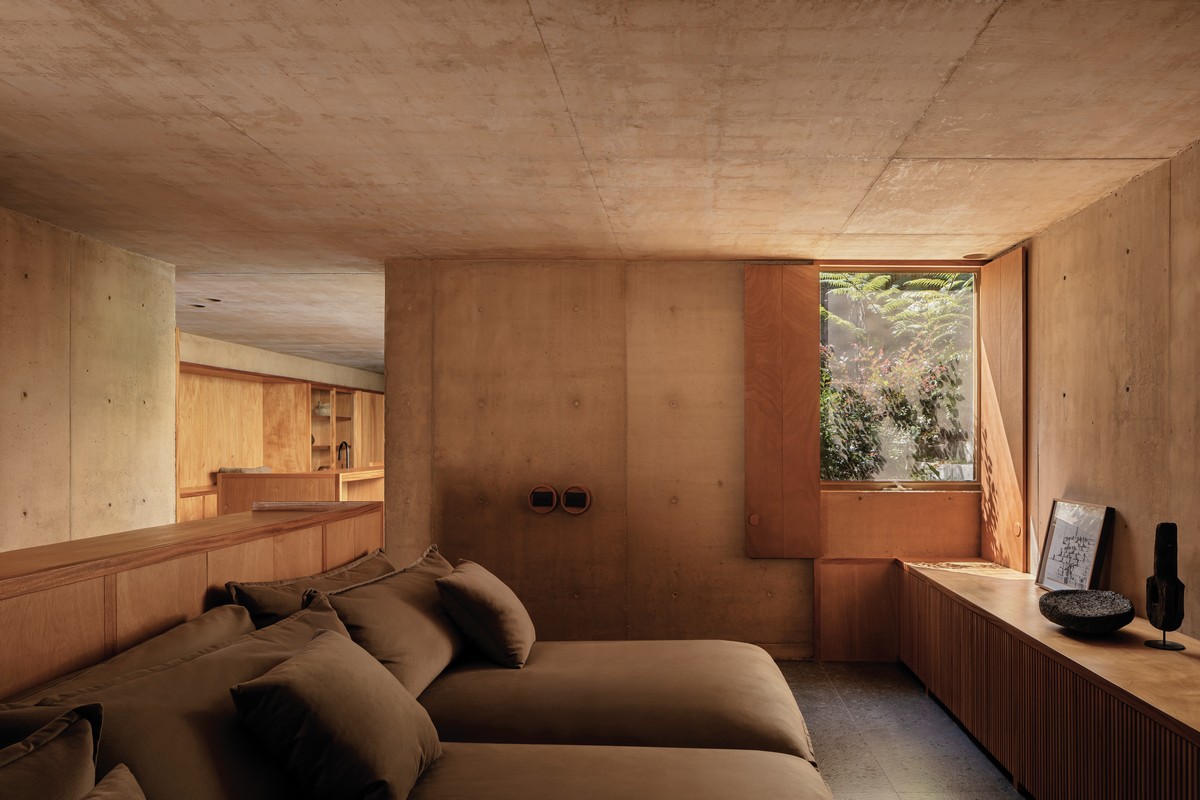
Still, as the project came together, “we became worried it was turning into an art museum,” says Diego Quirarte, the firm’s third partner, “and would be too rigid, too cold.” Despite Agnesi and Meyer’s initial doubts, the architects gradually convinced the clients to introduce wood finishes that not only softened the house’s interiors but allowed for transgressions against its internal order. The kitchen, for instance, did not fit comfortably into the set dimensions of the bays; assembled from ocumaré wood, it pushes past the 11½-foot boundaries of its own module and into the one adjacent, a space otherwise occupied by a staircase descending to the lower level. “There are certain rules not only in the geometry but in the materials,” Quirarte explains. “The wood breaks the rules that govern the concrete.”
6
7

8
Wood millwork softens the concrete interiors, as in the kitchen (6), a lounge (7), and the multimedia room (8). Photos © César Béjar
Just as the concrete structure blurred the boundaries between upper and lower levels, floors of honed black granite seamlessly connect with the slender, locally quarried gray-flagstone pavers outside. “You can leave any space and cross the garden to reach the other side of the house,” Peredo says. “We didn’t want these clear transitions, or for you to feel like you had to take off your shoes when you came inside.” In the living and dining areas, the only protections from summer downpours are the roof and a cantilevered portico; there’s no wall at all to separate the space from the garden and the rubber tree, its long, straight branches reaching out, almost parallel to the ground.
Seen from under the tree’s canopy, a few steps away from the living area, the gabled roofline resembles a cluster of village houses overlooking the rocky bed of a seasonal stream lined with ferns and philodendrons. In their initial conversations with the architects, Agnesi and Meyer had emphasized the signal importance of seeing the tree from inside. But in the end, Agnesi says, it’s the tree itself, looking back over the house and garden, that has the most privileged perspective. “My favorite view,” he says, “is the tree’s view.”
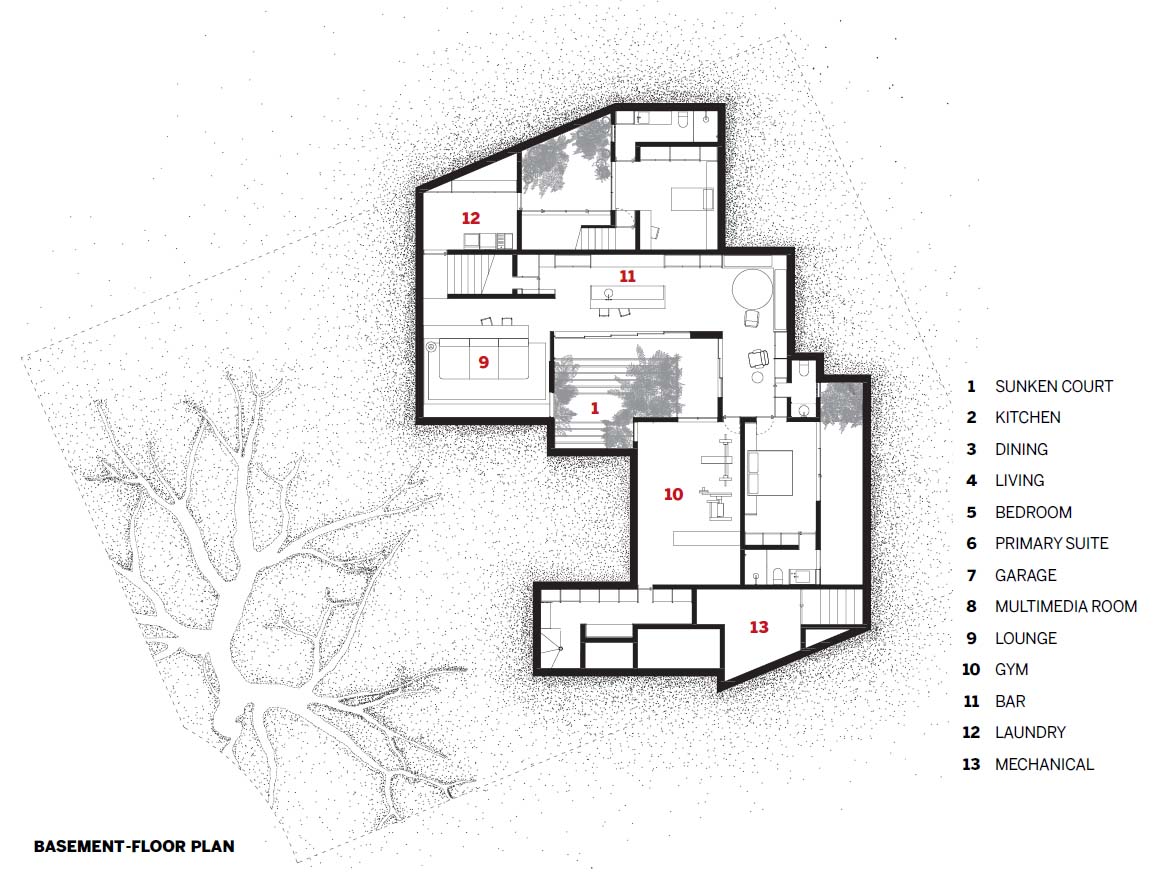
Image courtesy Estudio Macías Peredo, click to enlarge.
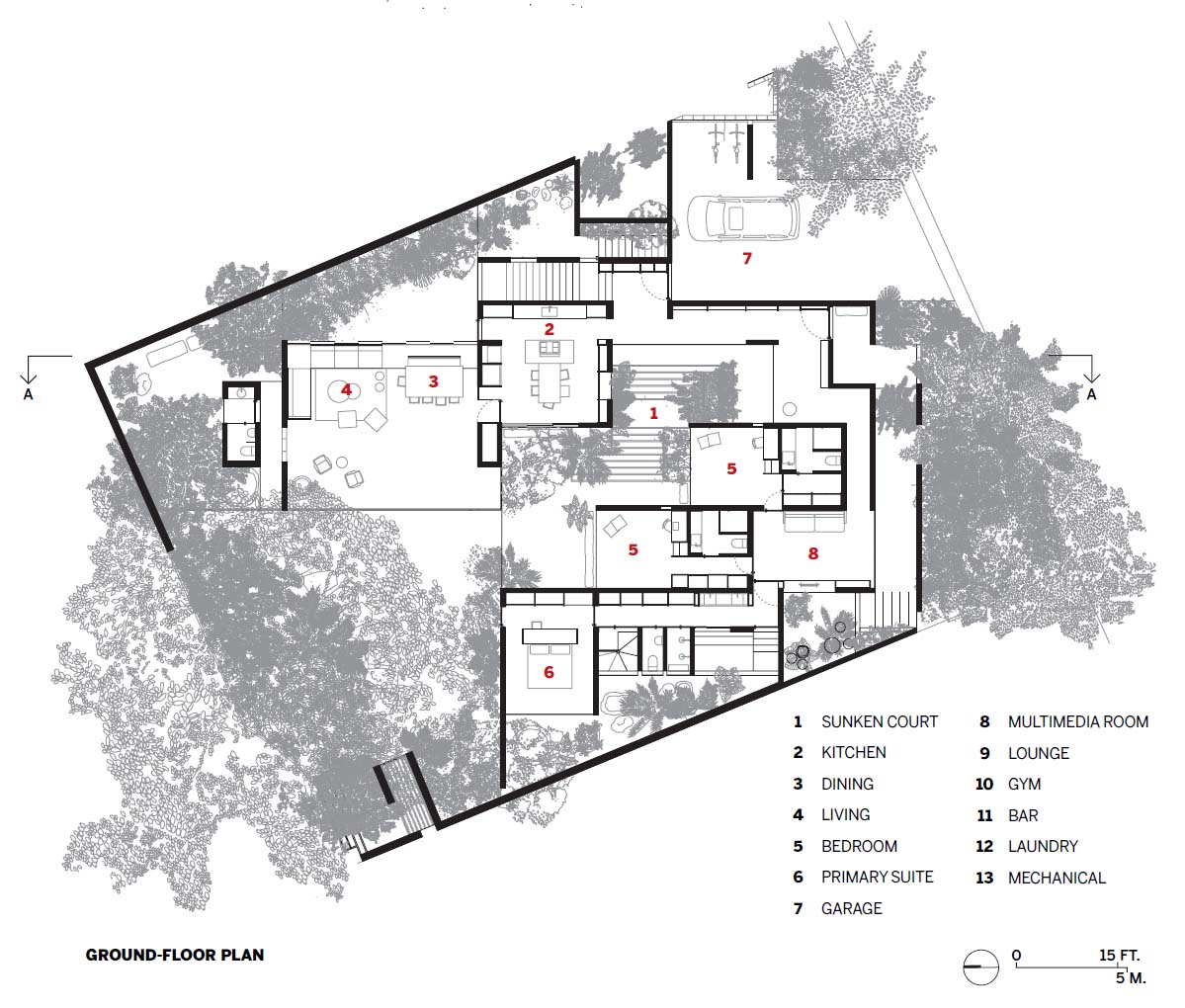
Image courtesy Estudio Macías Peredo, click to enlarge.
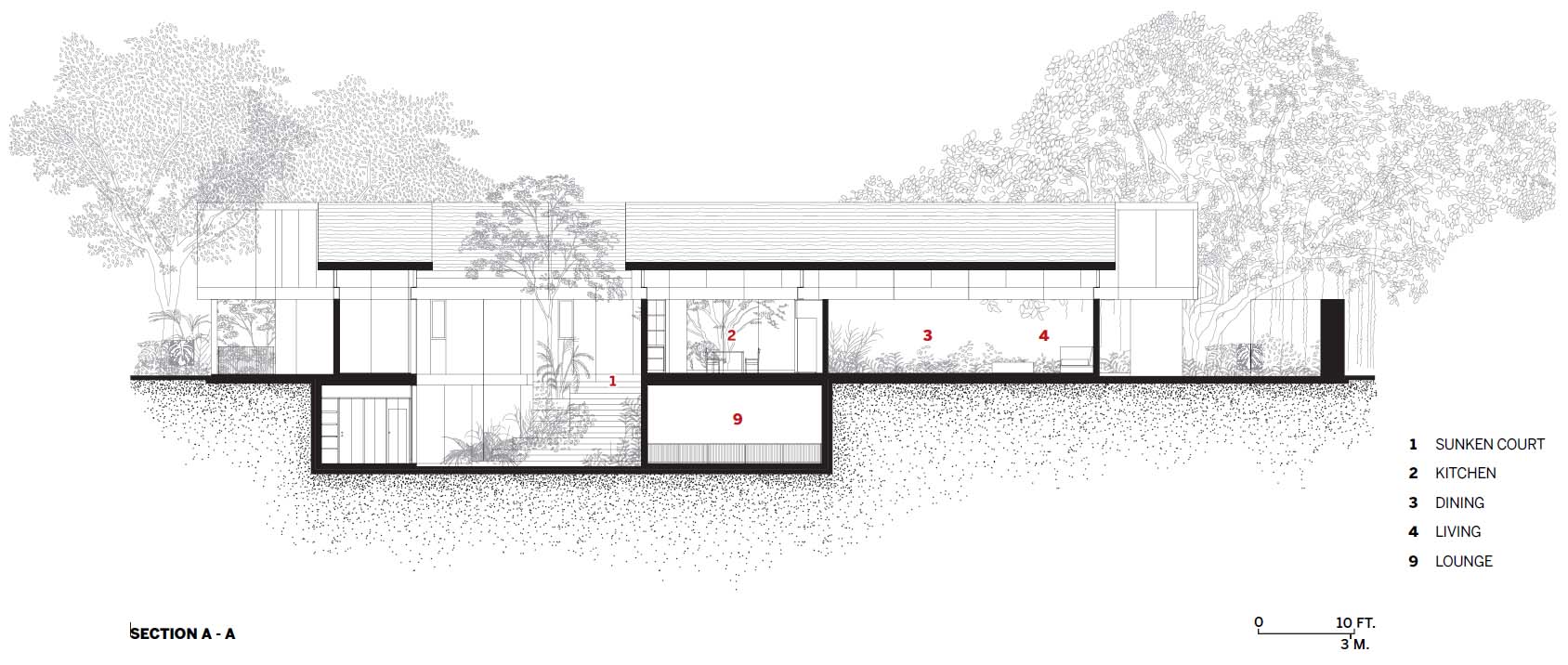
Image courtesy Estudio Macías Peredo, click to enlarge.
Credits
Architect:
Estudio Macías Peredo — Salvador Macías Corona, Magui Peredo Arenas, Diego Quirarte Contreras, design leaders
Engineers:
TADE Tecnología Actualizada en Diseño Estructural (structural); Hydro Design Technologies (plumbing); INRO Instalaciones Romo (electrical)
Consultants:
Juan José García, Viveros de Occidente (landscape)
General Contractor:
Construmova
Client:
Jaime Agnesi and Uli Agnesi
Size:
6,805 square feet
Cost:
$804,800 (construction)
Completion Date:
May 2023
Sources
Structure:
Conscremex (concrete); Aceros Ocotlan (steel)
Cladding:
Oscar Ledezma (metal panels); Fester, Hidrolock, Sellokote (moisture barriers); Tejas República (roof tiles)
Windows/Skylights:
Rocalum
Lighting:
Taller Objeto
Interior Finishes:
Pascual Olivares (cabinetry and millwork)
Looking for a reprint of this article?
From high-res PDFs to custom plaques, order your copy today!