RECORD Interviews
Andrew Ferentinos Rehabilitates Two Eisenman Houses

Of the nine numbered houses that Peter Eisenman designed between 1968 and 1975, only four were ever built. Still, these cerebral structures—and the enigmatic drawings, diagrams, and models that represented them—long ago entered the canon of architectural history. Under the stewardship of new owners, House II in Hardwick, Vermont, and House VI in West Cornwall, Connecticut, are undergoing something of a metamorphosis by architect Andrew Ferentinos, who has years of experience renovating residential projects. Neither house is complete, but Ferentinos spoke to RECORD managing editor Leopoldo Villardi about his approach and the construction process.
Working on any historically significant building—public or private—seems like a difficult commission to land. How did something as canonical as House VI come across your desk?
I first met my clients while on a tour of Modern houses in Connecticut. I worked at SOM in New York before starting my own practice, and they have a house by Whitson Overcash, who was a designer there during the Gordon Bunshaft era. We connected over that. They invited me to see their residence, at which point they shared the news that they had just bought House VI by Peter Eisenman. “Have you heard of it?” they asked.
I had gone to the Cooper Union, where Eisenman taught and lectured, and I learned a lot about his work as a student through my mentor, Anthony Vidler. Eisenman’s knowledge of architecture is deep, and there aren’t many people who can hold discourse with him at such a high level. The owners sensed this appreciation, I think.
But, more practically, I also had a lot of experience doing forensic examinations of houses and renovating them. When I first went out on my own, I took whatever work I could get, including jobs as a so-called house doctor, which is a real term that some states use to describe architects who work on publicly owned houses and housing—everything from minor repairs to exterior and interior improvements.

A photo of House VI, taken in 1976 (above), shows its form before the most recent renovation (top of page). Photo © RAMSA / Robert A.M. Stern Architects, click to enlarge.
House VI was built 50 years ago. I imagine it needed some serious upkeep. How did you approach the project? Do you consider your contributions as renovation, restoration, or something different?
My scope began as a renovation—mostly of the exterior, and also some of the interior. But the longer we worked on the house, the more damage we uncovered. Everything, it seemed, was compromised except for a small leftover portion. And at a certain point it becomes more expensive to save a particular piece of something than to start fresh. And if you start fresh and use higher-quality materials, you end up with a longer-lasting building.
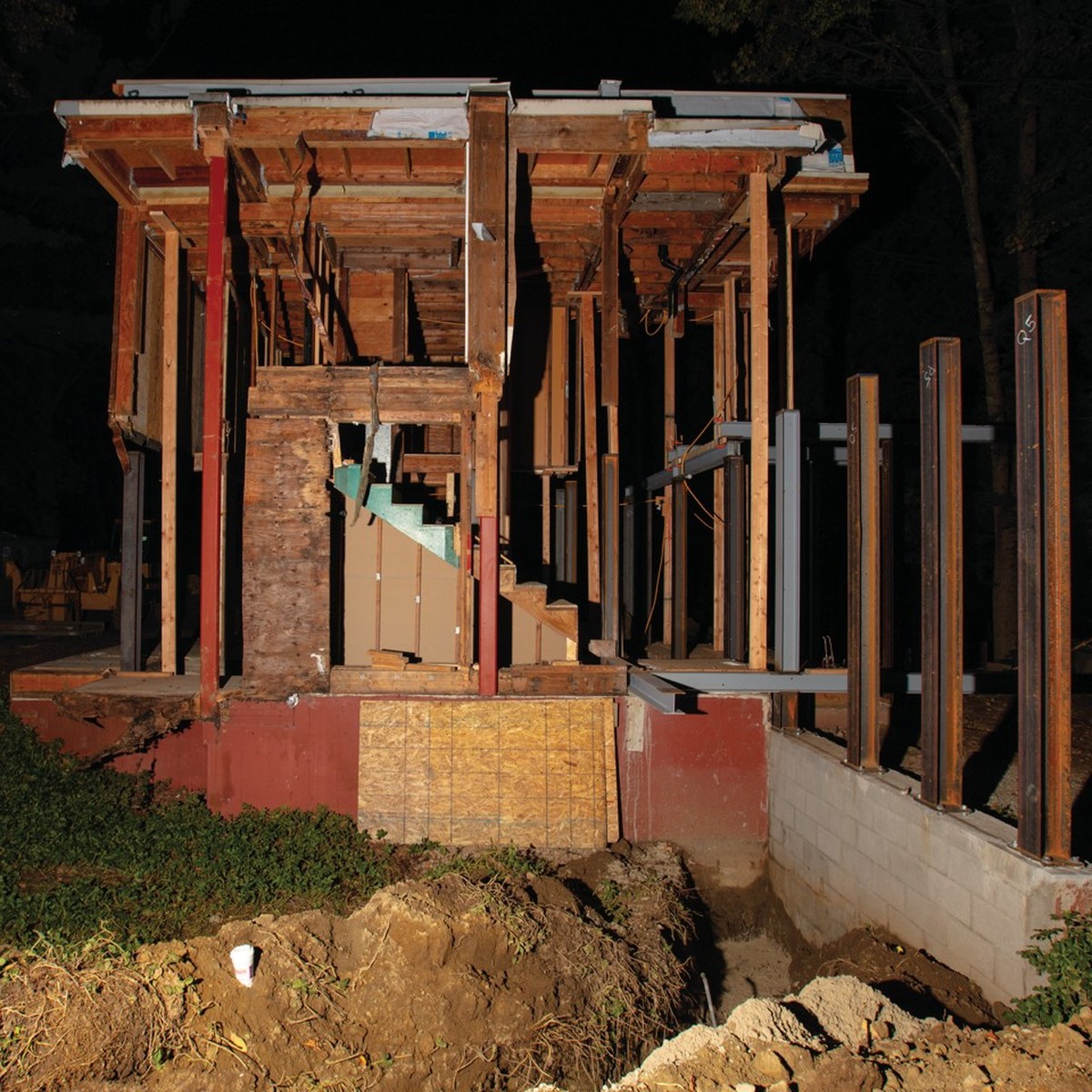
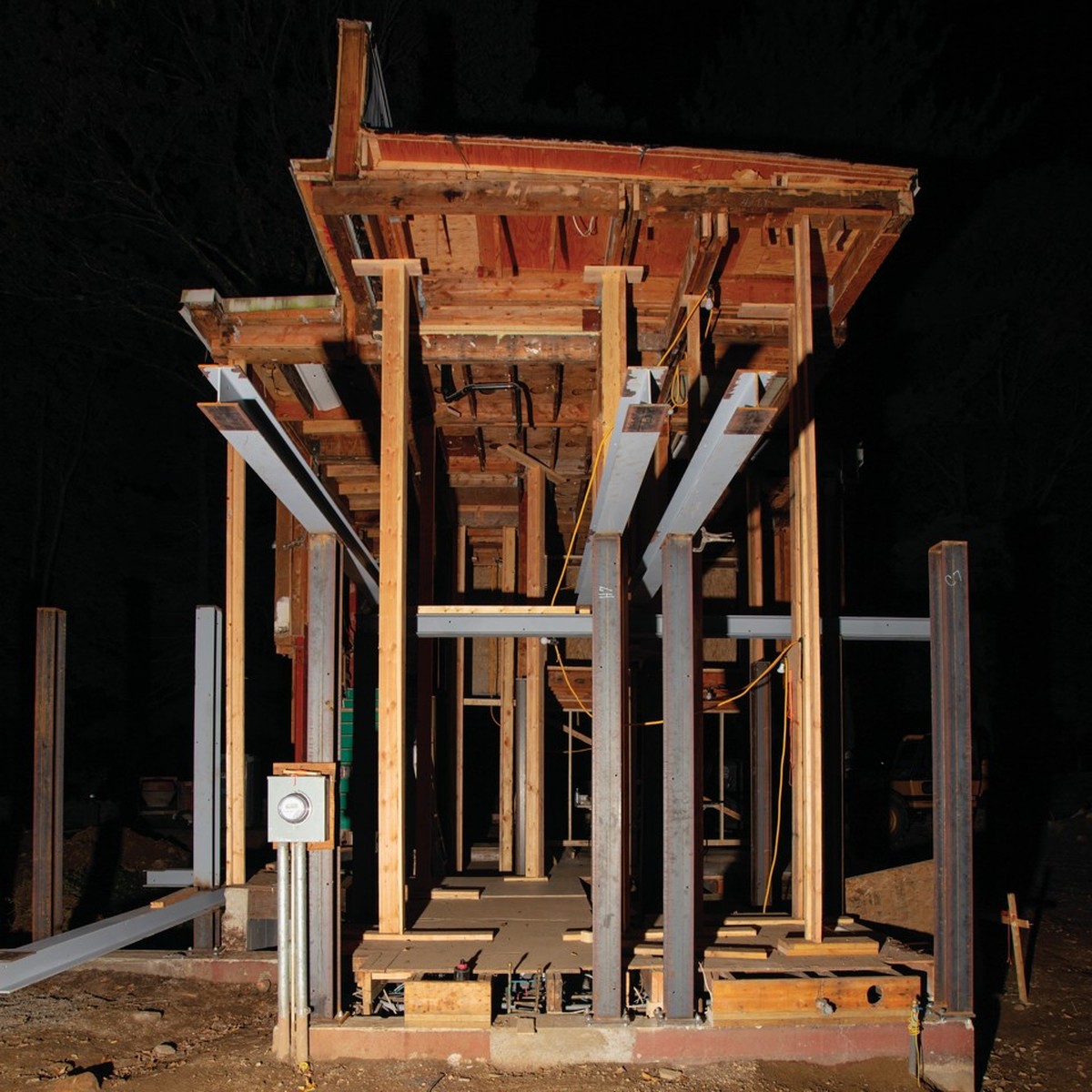
Ultimately, the house was in such bad shape that we stripped it down to the foundation and two steel columns. So I like to think of the current House VI as a reincarnation. It’s the same architecture, but it has a mostly new body. Everything that is core to the design has stayed intact—such as the glazed split between the two beds and the red staircase to nowhere, among other elements.
1
2
The renovated House VI includes new framing comprising steel and lumber (1 & 2). Working with Future Green, Ferentinos has envisioned a landscape plan for the site. Photos © Todd Eberle
Eisenman’s early architecture is highly abstract—dematerialized, even. What was it like to take one of his houses down to the studs, to see how it was constructed?
House VI was framed mostly with conventional lumber and some steel, and the exterior cladding comprised two layers of plywood with a high-tech 3M coating, which was intended to be durable while still allowing the walls to breathe and repel water. But over time, exposed to the elements, it failed. The interiors were just drywall and paint. So when Eisenman calls it “cardboard architecture,” he’s not far off!
The original owners, Suzanne and Dick Frank, should be applauded for their courage and investment in such a radical work. But buildings—especially those constructed of experimental materials or in novel ways—cost money to maintain, and the Franks were limited in how they could maintain it.
Looking for quick answers on architecture and design topics?
Try Ask RECORD, our new smart AI search tool.
Ask RECORD →
Additionally, the building technology available at the time, in the 1970s, was different. Once we opened up the walls, I was surprised to see how little steel there was. Or the sheathing—instead of using large plywood sheets, the builders had created a kind of tapestry using small pieces. Why would they do it that way? Were they strapped for funds or just trying to use as many pieces of scrap as possible?
But the materiality was never critical to the house’s design. Many of our decisions about materials boiled down to performance. The “new” House VI, built with the help of West Mountain Builders, has a very durable primary structure of steel, which has been paired with engineered and conventional lumber. The exterior is coated in a stucco system by Sto, and there’s now a layer of insulation beneath it along with the sheathing. This also meant a thicker envelope in some areas by fractions of an inch, and there are very tight tolerances in the house’s design. I had to work through some of those details. We also updated the mechanical, electrical, and plumbing systems, and the windows have crystal-clear low-iron glass.
Preservation rules can be very restrictive—as preservationists would argue, for good reason. House VI was not landmarked in any way. Was that liberating?
That’s true. But the owners and I agreed to impose some limitations of our own. A guiding principle was to improve the original design intent—to refine it, to enhance it, to make it more vivid, to punch it up. A better way of saying it might be that there were rules to House VI, to its formal generation. I studied those rules, understood them, and followed them in a way that allowed me to transform the architecture for better without compromising it.
This also isn’t the first time that House VI underwent renovation—although, I admit, never before to this extent. Suzanne Frank published a book in 1994 called Peter Eisenman’s House VI: The Client’s Response. The book was a consolidation of the discussions that happened around the quality of the previous renovations, with some invited essays. Importantly, there’s an afterword by Eisenman in which he explains his philosophy of preservation—that buildings ought not be static. He also argues against the restoration of buildings to their original state. He frames his argument around the strength of architecture to resist a kind of “normative culture.” Peter’s words helped me define my own approach.
Do you see things differently between work on public buildings and privately owned houses?
Preservation for its own sake is a scary idea to me. I’m sure there might be some instances when that is an appropriate approach, but houses—along with other types of buildings—want to grow, adapt, and change over time. You could look back at architectural history and easily pick out incredible works that are only so because they were not stuck in an unchanging state.
Two examples that Eisenman identifies in the afterword are St. Peter’s in Rome, and the Frick Collection, which was originally a house. We wouldn’t have the Frick that we have today if it had been preserved in amber in its original state.
A lot comes down to having good judgment, but if your idea of preservation is to keep this building or that building exactly as it is, we’re just limiting our potential architectural future.
You’re also working on Eisenman’s Falk House—House II—in Vermont, right?
A few years after we started renovating House VI, news spread that House II was facing demolition. Devin Colman, who recently stepped down after a long tenure as Vermont’s state architectural historian, got in touch with my clients. He was looking for a very particular type of person, since the house needed a lot of care and attention.
3

4
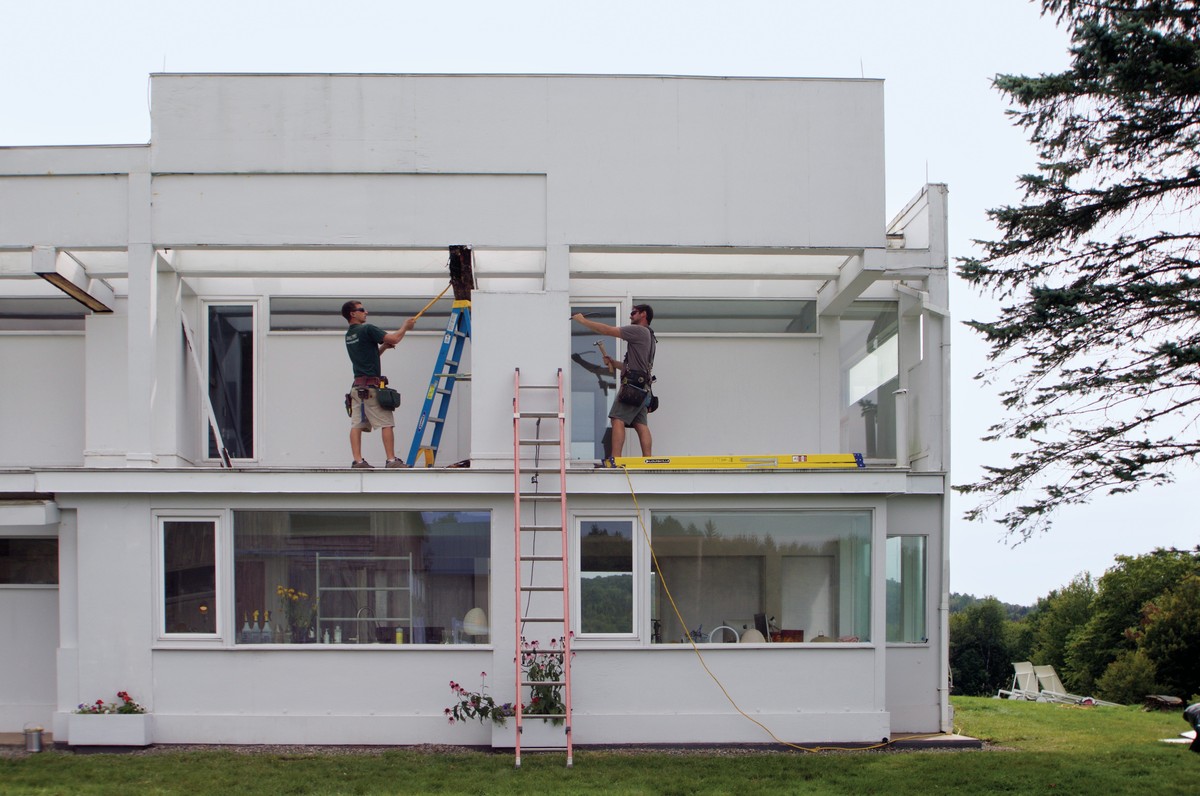
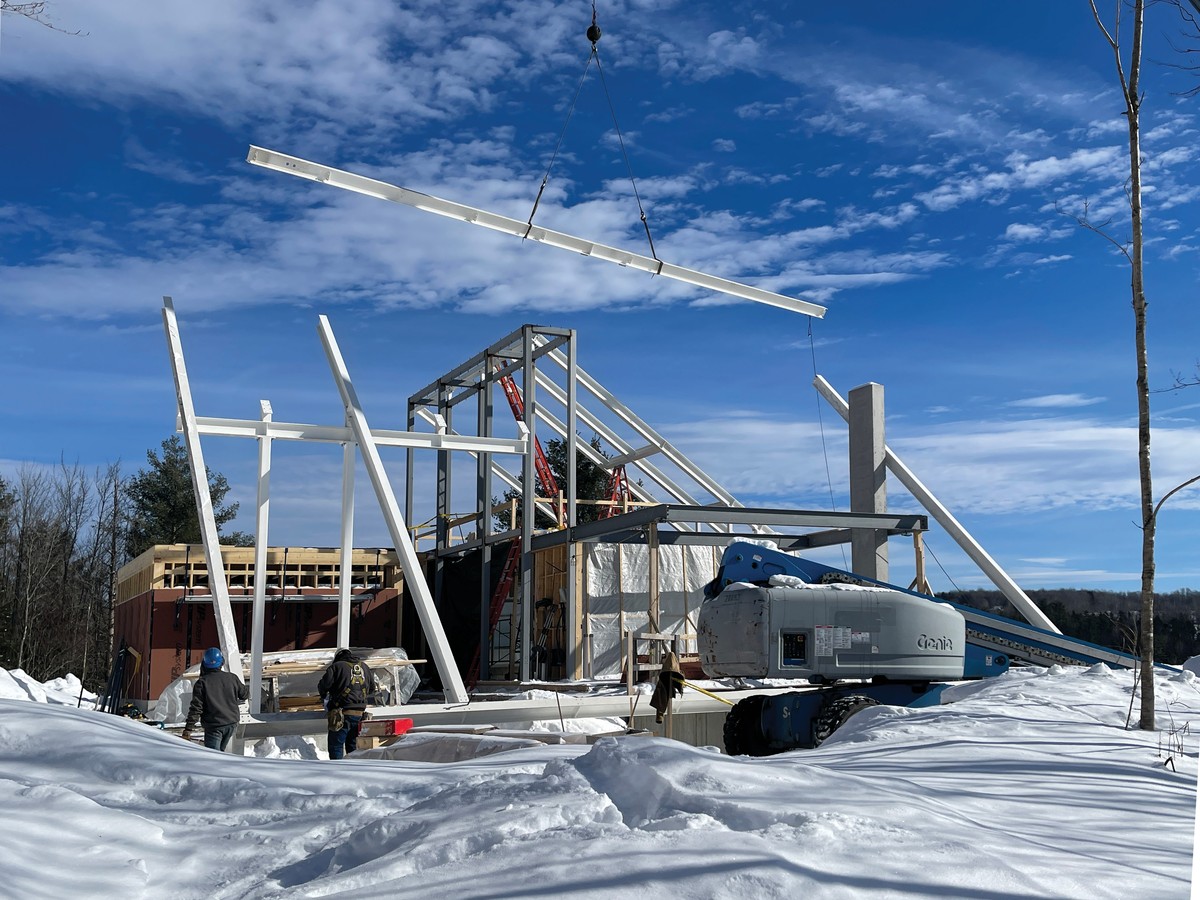
While minor work starts on House II (3 & 4), construction of a ground-up guesthouse is nearing completion (5). Photos © Andrew Ferentinos
5
Something of a savior?
That’s a good way of putting it. I visited House II together with my clients, and they decided to buy it.
The scope of work there will be a little different—more a careful reconfiguration than a renovation. House II has a clear design logic and we have had the benefit of spending a lot of time there. We are following the house’s rules, but changing the playing field, so to speak. In other words, these rules happen in a space, a matrix, a grid with dimensions, and we’re changing this grid. If that sounds abstract, it’s because it is—but I’ll leave it at that for now. I don’t want to jinx anything.
I’ve also designed a guesthouse on the site, which is wrapping up now, to be used by the clients while work on the main house progresses. It’s an entirely ground-up build, and the project raises an interesting question: How do you design such a house—which is completely of my own architectural language—so that it fits within the story of Houses VI and II?
I’ve tried to establish a triangle of relationships among the three.
A contemporary of Eisenman’s—one of the Grays—once told me that “not everyone wants to live in a work of art,” as a rationalization of his own design approach. House VI and House II are quite radical, and clearly your clients are committed to them. What drew them to this architecture?
I don’t want to speak on their behalf, but I would say that they are intellectually curious people. What drives us all is a respect for the discipline and a desire to do right by the architecture.
That is admittedly exciting work to do, but, as your question suggests, it is challenging, perhaps intentionally, to live in an Eisenman house. I believe he once said something along the lines of, “You don’t notice architecture unless it creates some disturbance in your everyday life.” There are a lot of, let’s call them, intentional discomforts in these houses, and we have tried to figure out how to address them without compromising the original intent. Can I provide new comfort and improve the architecture at the same time? Are these two ideas mutually exclusive? What value is there to the discomfort?
There are plenty of these moments in House VI, but we kept all of them because, architecturally, they are important discomforts. I would say that House II has examples of discomfort as well.
Did you ever consult Eisenman? Architects working on other architects’ buildings has been the source of some significant conflicts, past and present. A bit of diplomacy is involved one way or the other.
I talked to him very early on in the process. He said: “Call my office if you ever need anything.” But I never did call, because I never needed anything. And I mean that in all seriousness.
I paid my respects to Eisenman by analyzing every single sketch and drawing, reading every piece of writing that I could find. I studied the houses inside and out. I went to the Canadian Centre for Architecture, which holds his archive. I’ve been researching and working on House VI for nine years. All of Eisenman’s thoughts are so clearly crystallized in the drawings, in the writings, and in the built thing itself that, in the end, I never needed to talk to him.
That was the right way to respectfully consult him in this context. I stand by that decision, and I hope to show him the final result one day. In an alternative circumstance, I might think differently.
What else are you working on?
Yes—a pool house in Mamaroneck, New York, designed by Paul Rudolph, which was originally commissioned by the Edersheims. The same family commissioned Rudolph to design the now well-known apartment on Fifth Avenue.
The pool house is in a flood zone and, after hurricane Ida, almost 3 feet of water entered it. The whole structure was gutted, and the owner asked me, in his words, to bring the pool house up to modern-day standards and to provide “flood-protection measures.”
Given its location, I couldn’t guarantee that water wouldn’t enter the house, but I designed multiple layers of flood protection using the metaphor of Piazza San Marco in Venice, which the owner liked. The house is now designed to dry out if it gets wet, the same way the square frequently floods and dries out. It’s an adaptation to a new climate condition.
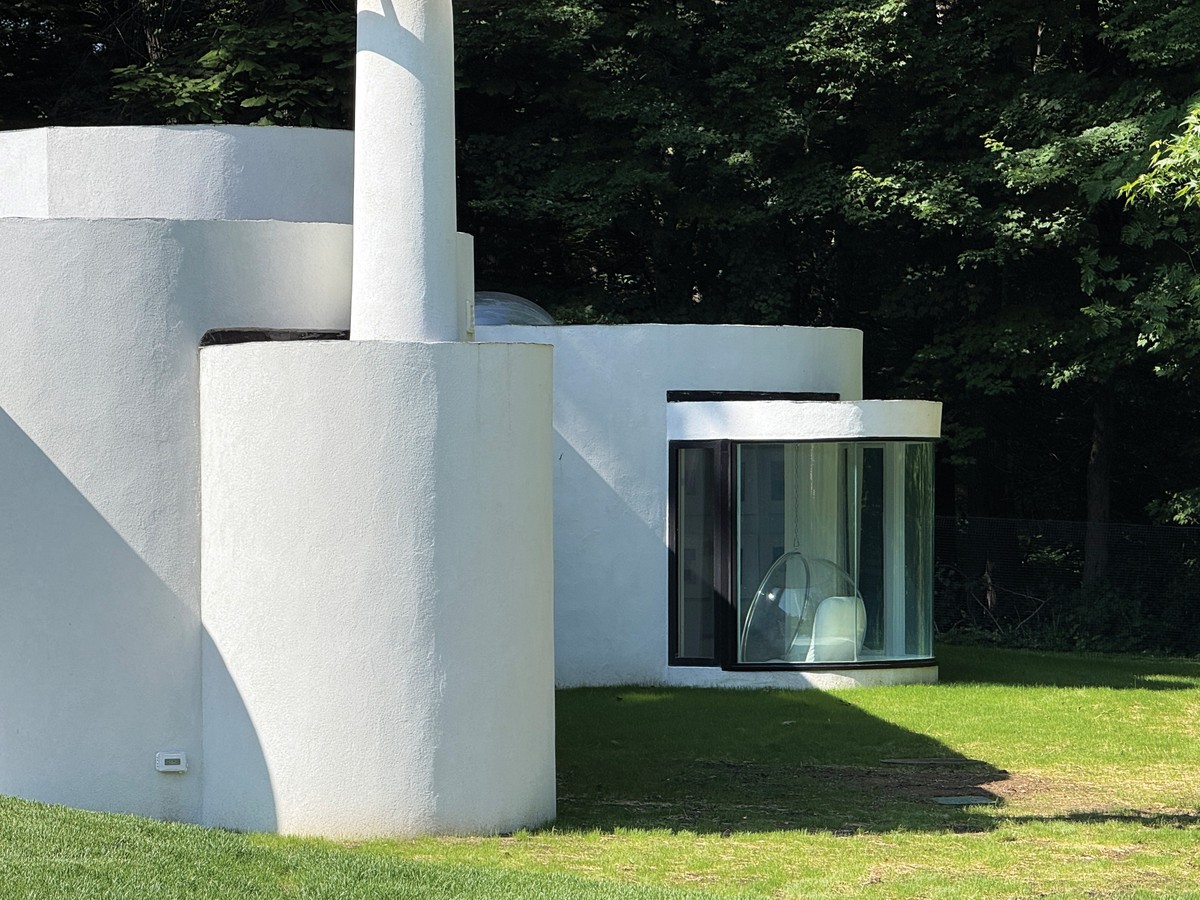
One big change was the removal of a sunken living room—which isn’t a great design element here. It’s basically a pool waiting to be filled. We debated long and hard about keeping it, but ultimately, we leveled out the ground floor, and, as a way to compensate—to give back to the house what I had taken away—I cut the entire roof and raised it. Previously, the space expanded downward, but now it expands upward.
The result is something of a terraced roof, which will soon be planted, and which echoes an unrealized idea Rudolph drew in an early sketch of the pool house.
5

6
The Paul Rudolph–designed pool house in Mamaroneck, New York, takes the shape of clustered cylinders (5 & 6). Photos © Andrew Ferentinos
We look forward to seeing all these projects when they are finished.
Looking for a reprint of this article?
From high-res PDFs to custom plaques, order your copy today!