KlimaKover, a Low-Cost Modular Pavilion Offering Heat Relief, is Showcased at Climate Week NYC 2025
.webp?t=1759395328)
Architects & Firms
The past 10 years have been the 10 hottest since the middle of the 19th century—when such recordkeeping began. Last year was the warmest year on record, surpassing the previous record set only in 2023. Scientists project that 2025 won’t be hotter than 2024. It is likely to come in right behind the past two years, or at least in the top five. But that’s little consolation: The warming trend is clear, making climate-adaptation strategies just as critical as ever.
One such strategy is illustrated by KlimaKover, an open-air pavilion developed by architecture firm Henning Larsen, researchers from the University of Pennsylvania, and R&D company AIL Research. Based on a technology known as membrane-assisted radiant cooling, the pavilion is intended for outdoor spaces such as bus stops, schoolyards, and emergency shelters. It could also provide relief for workers who are often exposed to dangerous heat, like those in construction and agriculture. “It is primarily a heat-stress solution rather than for comfort,” explains Dorit Aviv, assistant professor of architecture at Penn’s Weitzman School of Design and director of its Thermal Architecture Lab. In collaboration with an international team, Aviv has been working on the development of the cooling technology since 2018, with Eric Teitelbaum (now at AIL), when both were graduate students at Princeton.
.jpg "KlimaKover")
The radiant panels enclose chilled water microtubing within an infrared-transparent membrane, which prevents condensation. Photo © Chris Perez, courtesy Henning Larsen
.jpg "KlimaKover")
KlimaKover works by absorbing heat from bodies, rather than by cooling the air. Photo © Chris Perez, courtesy Henning Larsen
With a grant from Denmark’s Ramboll Foundation, the collaborators created the shading and cooling structure, erecting it on New York’s Governors Island in late August. KlimaKover was showcased as part of Climate Week NYC 2025, which brought together environmental leaders focusing on sectors that included buildings, food, health, and finance. It concluded this past Sunday.
.jpg "klimakover")
.jpg "klimakover")
In addition to being the site of a panel discussion during Climate Week, the pavilion has attracted Governors Island visitors. Photos Erick Reifer Marchak, courtesy Henning Larsen
The KlimaKover installation consists of panels enclosing microtubes with chilled water circulating through them. Rather than cooling the surrounding air, the panels draw heat away from the body. The assembly includes an infrared transparent membrane that protects the microtubes from condensation, making the technology suitable even for hot-and-humid climates. “The membrane is the main innovation,” says Aviv. “Radiant cooling itself is not new.”
A small chiller cools the circulating water. It can be powered by rooftop photovoltaics, allowing the modular pavilion, which is based on a four-by-four-foot bay, to be both autonomous and scalable.
.jpg "KlimaKover")
KlimateKover diagram. Image courtesy Henning Larsen, click to enlarge
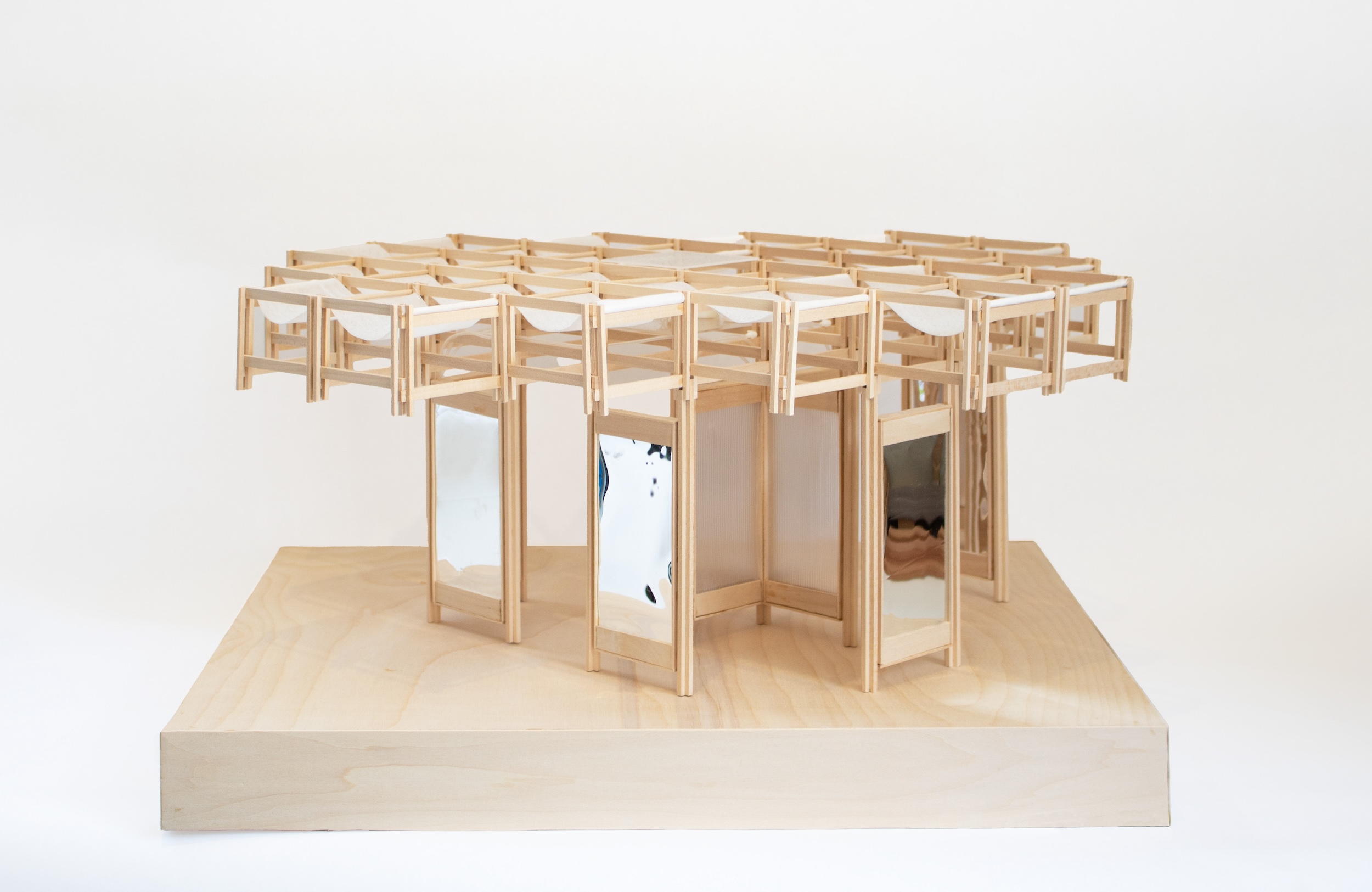
KlimateKover Model. Image courtesy Henning Larsen
With a structure engineered by the New York office of Fast+Epp, the wood frame, braced by threaded rods, was fabricated by Brooklyn-based SITU Studio for ease of disassembly and re-erection. It is made of silky cedar salvaged from trees felled in Oregon forests as part of wildfire mitigation efforts. Though the wood is durable and versatile, it is considered a low-value species by the lumber industry, explains Jeff Cohen, vice president at Cambium, the timber supplier. Henning Larsen says the pavilion could be mass-produced for about $75 per square foot. According to Penn’s Thermal Architecture Lab, it uses 70 percent less energy than traditional air conditioning.
Beyond Climate Week NYC, KlimaKover will remain open to the public on Governors Island through the end of October. Other Climate Week events attended by RECORD included one focusing on embodied carbon policy and innovations in low-carbon concrete, a session summarizing a study into impediments to growing the mass-timber market, a presentation on community engagement with recent sustainable infrastructure projects in New York, and a panel discussing climate threats, adaptation, and existing buildings.
Looking for quick answers on architecture and design topics?
Try Ask RECORD, our new smart AI search tool.
Ask RECORD →
Looking for a reprint of this article?
From high-res PDFs to custom plaques, order your copy today!