House of the Month
A Family Enlists Hariri Pontarini to Realize a Sprawling Lakeside Getaway in Remote Ontario
Muskoka, Ontario

Architects & Firms
Many Americans might be unfamiliar with Muskoka, a remote area in Ontario dotted by hundreds of glistening lakes. But when affluent Torontonians (and celebrities) want to escape the hustle and bustle of city life, or merely hide from paparazzi, this is where they set their sights. “Cottage country,” as some call it, is only a two-hour drive north from downtown—even less by floatplane.
Here, along Lake Joseph, a couple purchased a waterfront tract with the idea of building a summer sanctuary for their extended family of three children and several more grandkids. And when they saw published a cliffside getaway in Kincardine, on the Canadian side of Lake Huron, they knew exactly what architect to ask to design it. “That house had all the things we felt would be interesting to have on a lake,” says the husband. “It didn’t look like anything already in Muskoka, either.”
The couple invited that very architect—Siamak Hariri, one of the founders of Toronto-based Hariri Pontarini Architects—to visit their fern-blanketed wooded site and begin the process of realizing their aspirations. “Just where would you like your living room to be?” Hariri asked them. Together, they wandered about and found an almost ideal spot, which offered views through a thicket of trees toward a small archipelago. The problem, at least for the time being: they were about 20 feet too high, standing on a mound of granite.
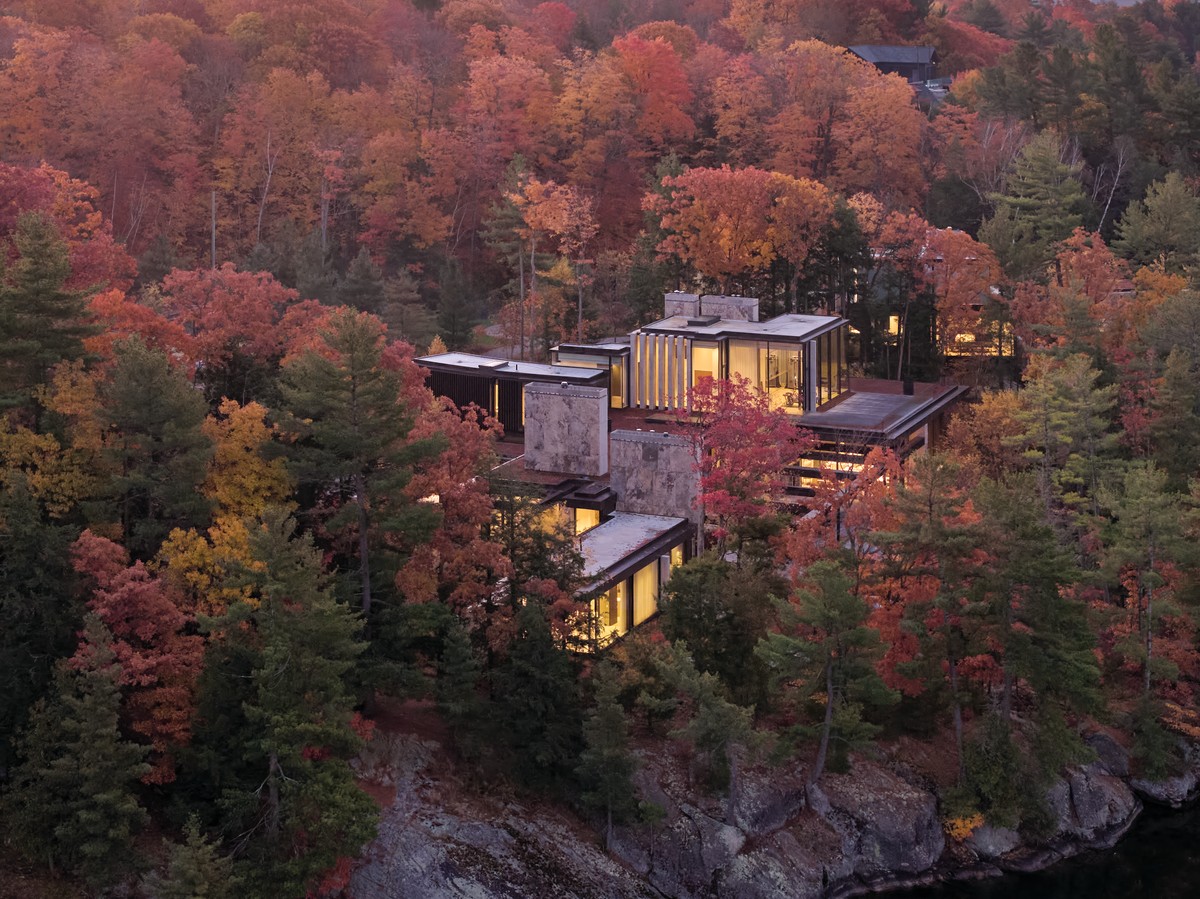
Substantial excavation not only allowed the architects to properly locate the house, but to make something special of the arrival sequence. Guests reach the idyllic retreat—a sprawling 19,000-square-foot five-structure complex, with space for additional staff—after passing through a crescent-shaped canyon carved out of solid rock.
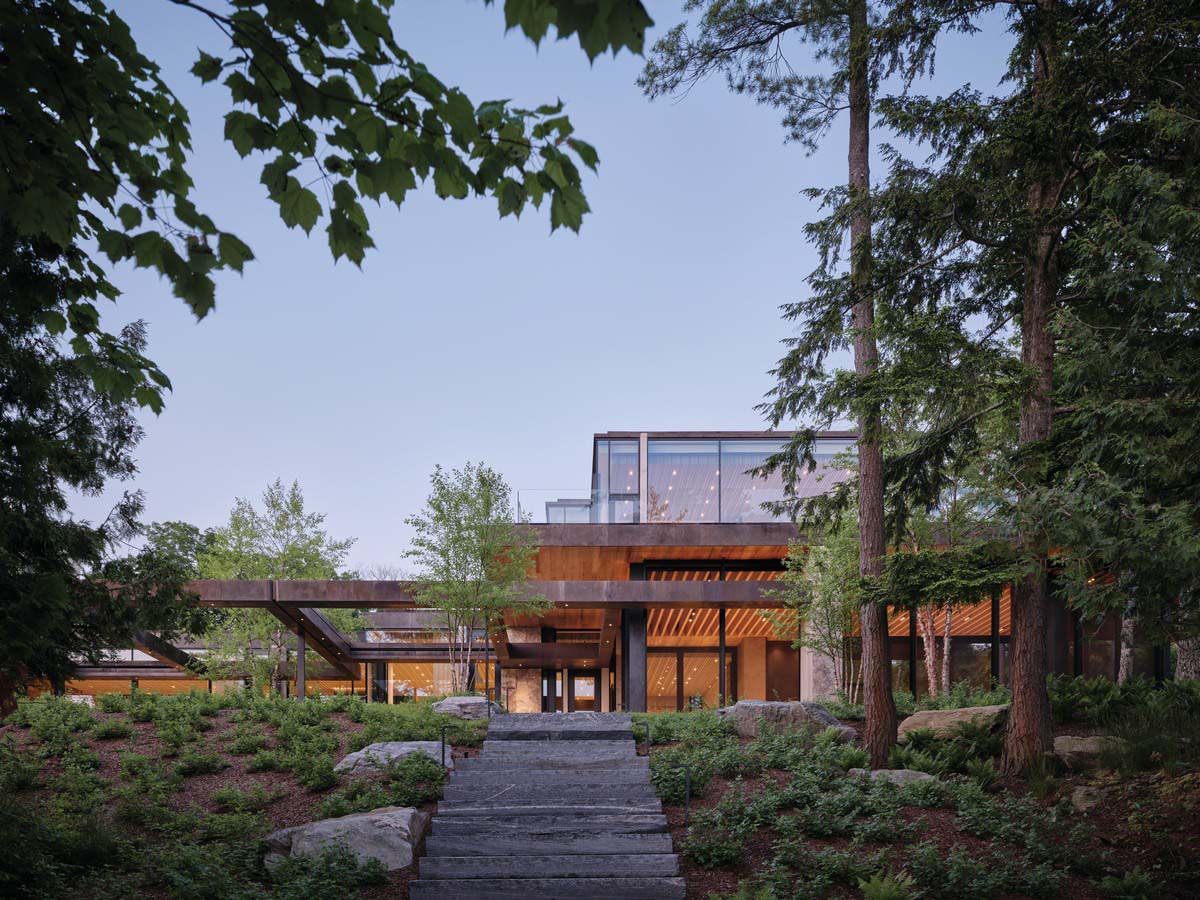
The main house, which is the first building to come into view after one passes through this chasm, initially appears as an amply glazed modernist box, with the requisite minimal silhouette and deep overhangs. But chimney stacks, jacketed in sublimely textured Algonquin limestone, rise high above the roofline like miniature buttes. To the left of the entrance, timber battens wrap around a figural volume peeking out over a wall. These are early hints of the curious duality that characterizes the architecture at Riverdale, the name given to the complex by the owners. On the one hand, a dogged orthogonality undergirds the design logic. Strong axial relationships govern organization; horizontal and vertical planes intersect to shape space. At certain moments, hard-edged volumes hover atop boulders, just barely kissing the ground, doing little to conceal their man-made qualities.
1
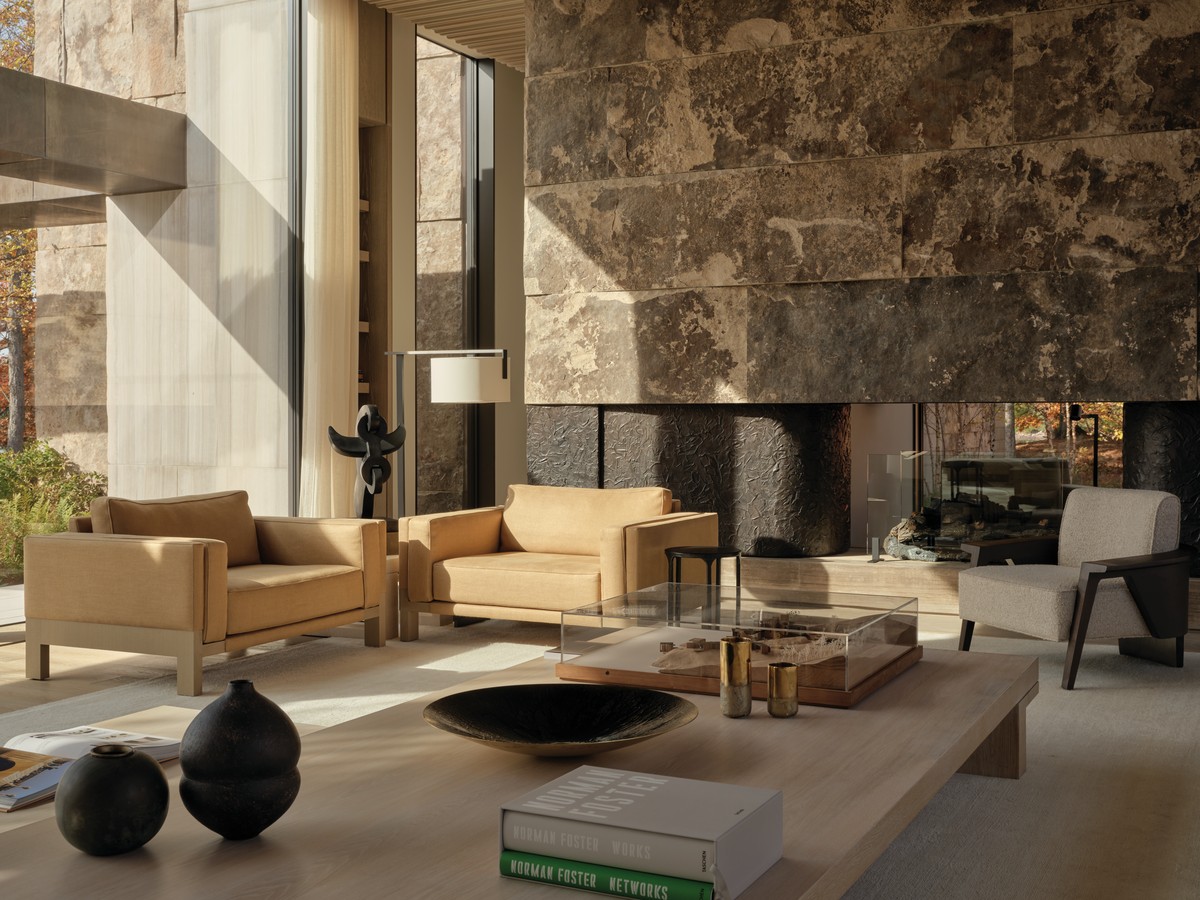
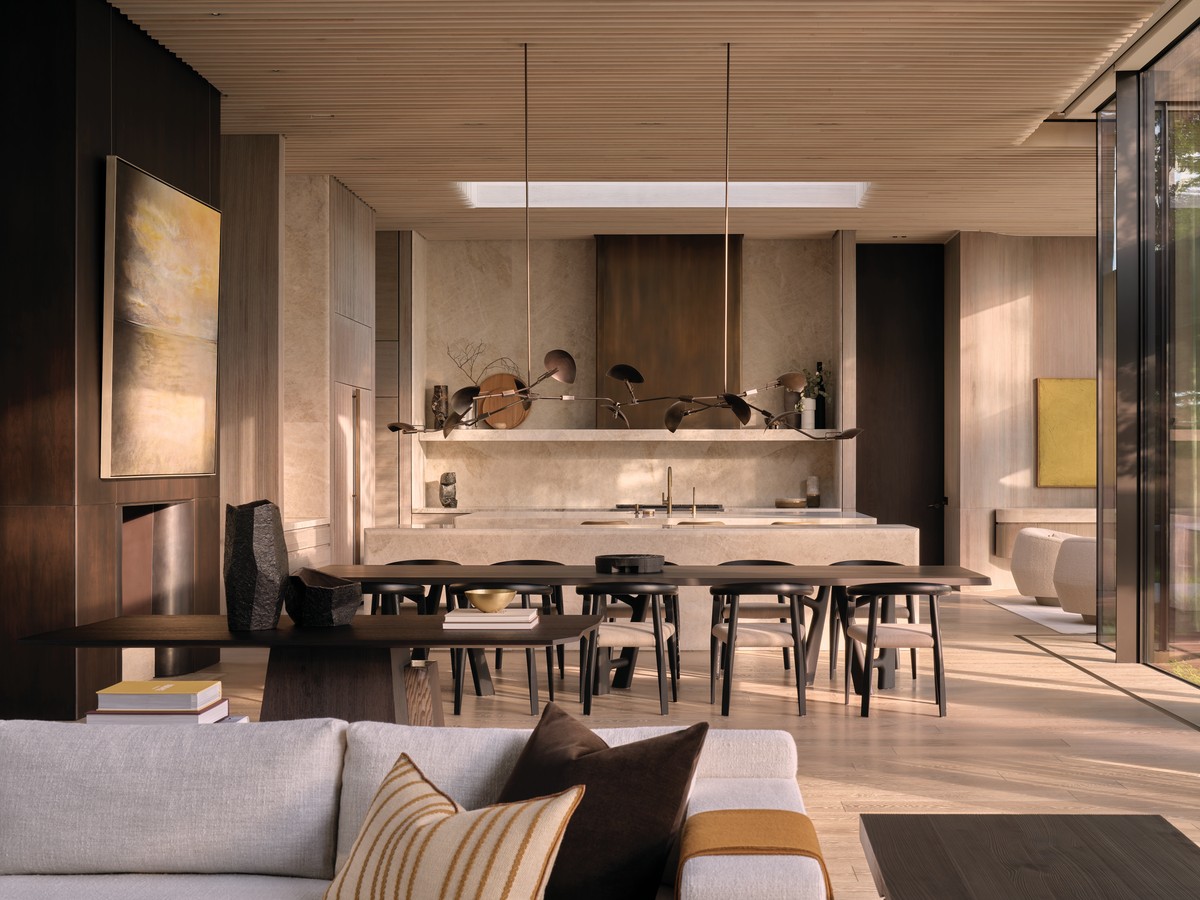
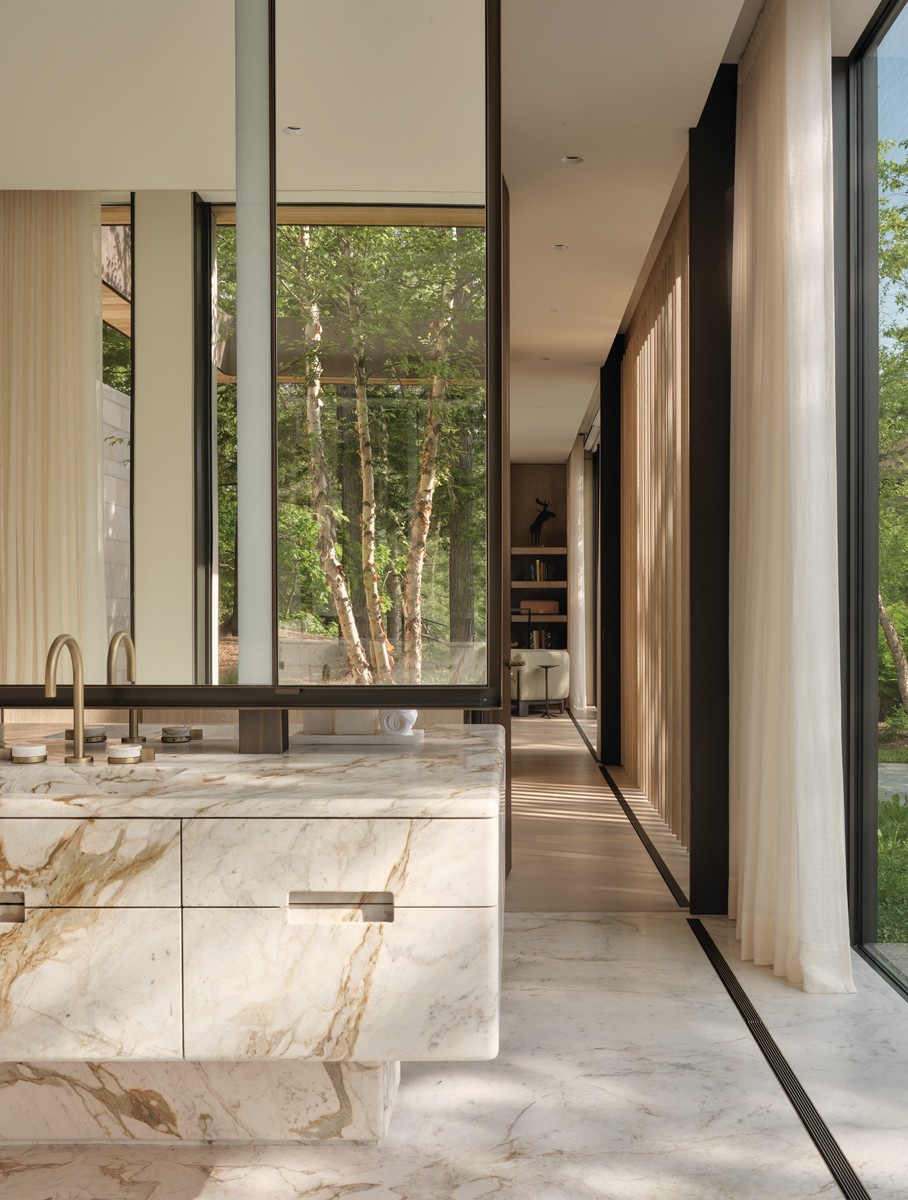
Algonquin limestone (1) appears in the open-plan living and dining area (2), which leads to other spaces, such as the primary suite (3). Photos © Younes Bounhar, click to enlarge.
2
3
But, look long enough, and one begins to see the cultivation of something less tamed. Extraneous walls, no doubt intended to ensure privacy or frame specific views, stretch outward and away from the structures, gently curling as though they were trained, like ground-creeping tendrils, on the sun. Stairwells slither up and around, their underbellies clad in copper panels to resemble that of a serpent’s. Even the choice of limestone, bespeckled as it is, becomes camouflaged against surrounding craggy outcroppings. “This is the top layer, the crust. Quarries used to throw it away,” says Hariri, gesturing toward the stone, with eons of geological activity etched into its surface. “It’s one of those materials that I fell in love with and have been using for decades.” (I was rather smitten as well.)
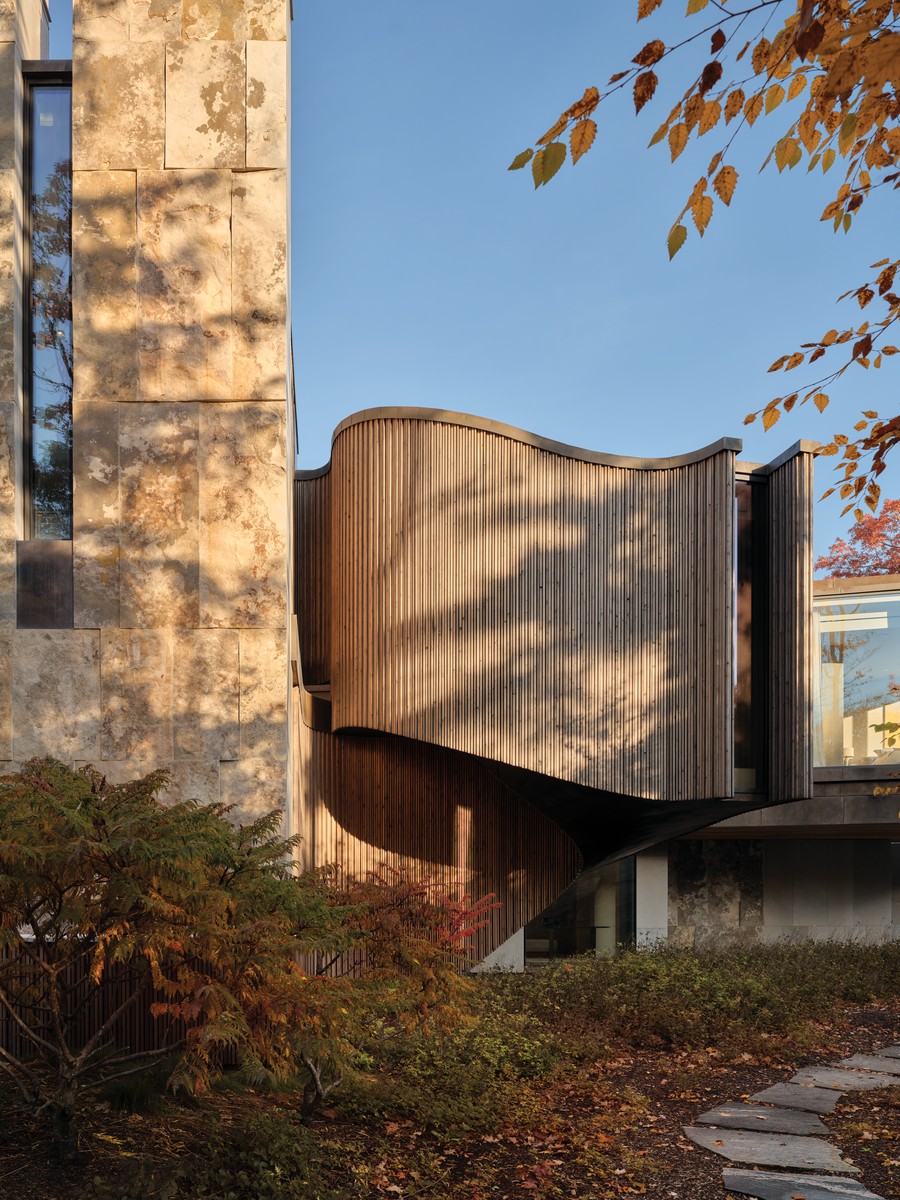
A serpentine volume encloses the stairwell of the main house. Photo © Younes Bounhar
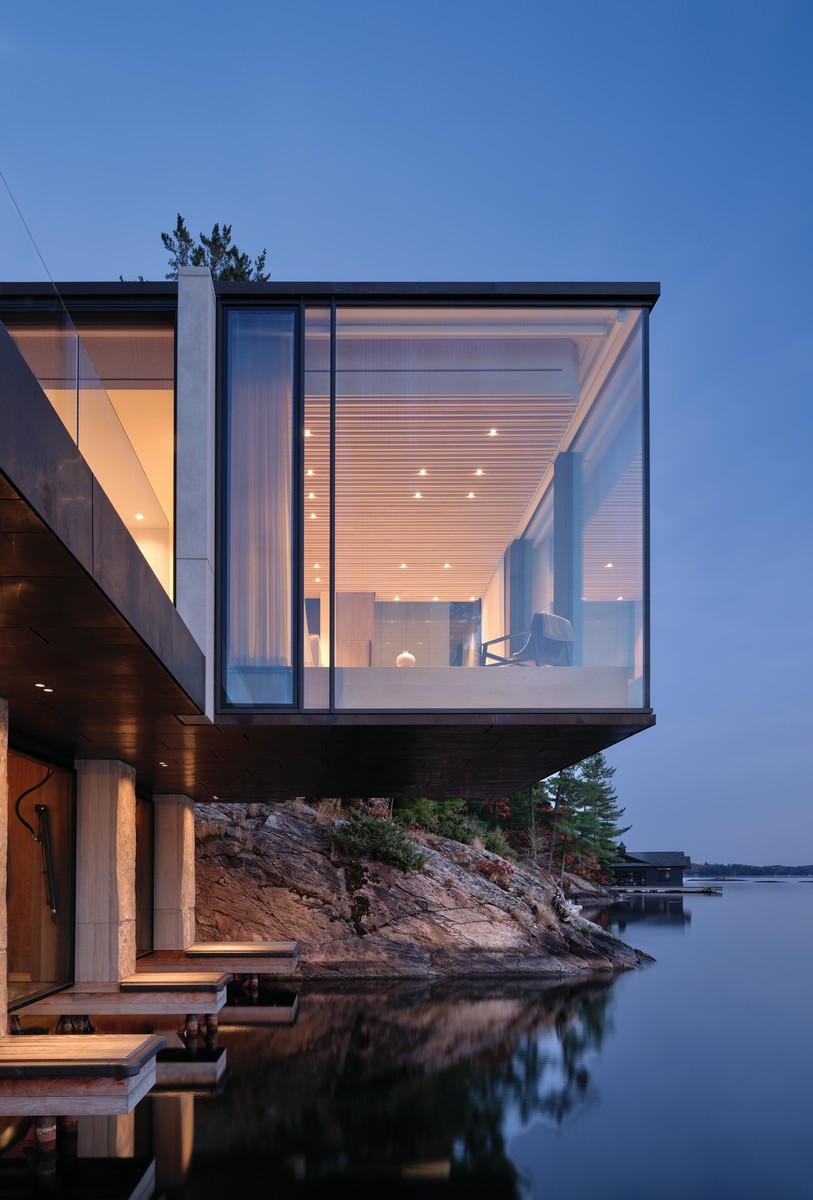
The boathouse, which accommodates a guest suite, dramatically cantilevers over the lake. Photo © Younes Bounhar
In its own way, the tree-shrouded complex seems firmly rooted in the particular place. Hariri speaks almost mystically about the architecture and does not shy from discussing topics such as beauty, order, and tactility. “You can have something contemporary, but you also need softness,” he says. “Alvar Aalto could reduce a handrail to a pipe, but he needed to wrap it in a little leather too.” This ethos—a delicate balancing act reinforced by a shared architectonic language and palette—unifies the various structures of Riverdale. For every stiff material or right angle, there seems to be a counterpoint.
Looking for quick answers on architecture and design topics?
Try Ask RECORD, our new smart AI search tool.
Ask RECORD →
South of the main house, set on a promontory, is the guesthouse, where the owners’ children stay. The residence, kinked in plan, largely runs perpendicular to the shoreline, with two suites on either end. But, in the middle, it rears up above the tree canopy with a double cantilever, giving the perched third suite uninterrupted views. Between these two structures, a path leads down to the lakefront, where two follies—a boathouse and a “cabana”—are used for socializing and to welcome guests who may be arriving by water.
4
A path leads from the lake to the main house (4), which is surrounded by trees (5). Photo © Younes Bounhar
5
The interiors share many sensibilities with the exteriors, largely because Hariri Pontarini was responsible for designing them. “Architecture is also landscape, furniture, interiors, light, proportion—all those things that are intangible and immeasurable,” Hariri says. “Opportunities like this one, to do it all in a single project, don’t come that often.” The firm designed several custom furniture pieces. Oiled bronze surrounds doors, windows, and mantels. Oak, and sometimes granite, appears underfoot. And, at the main house, with its 14-foot-high ceilings and expansive glazing, the outdoors feel remarkably present. Of special importance are the terrace and screened porch, which serve as frequent gathering places for the entire family.
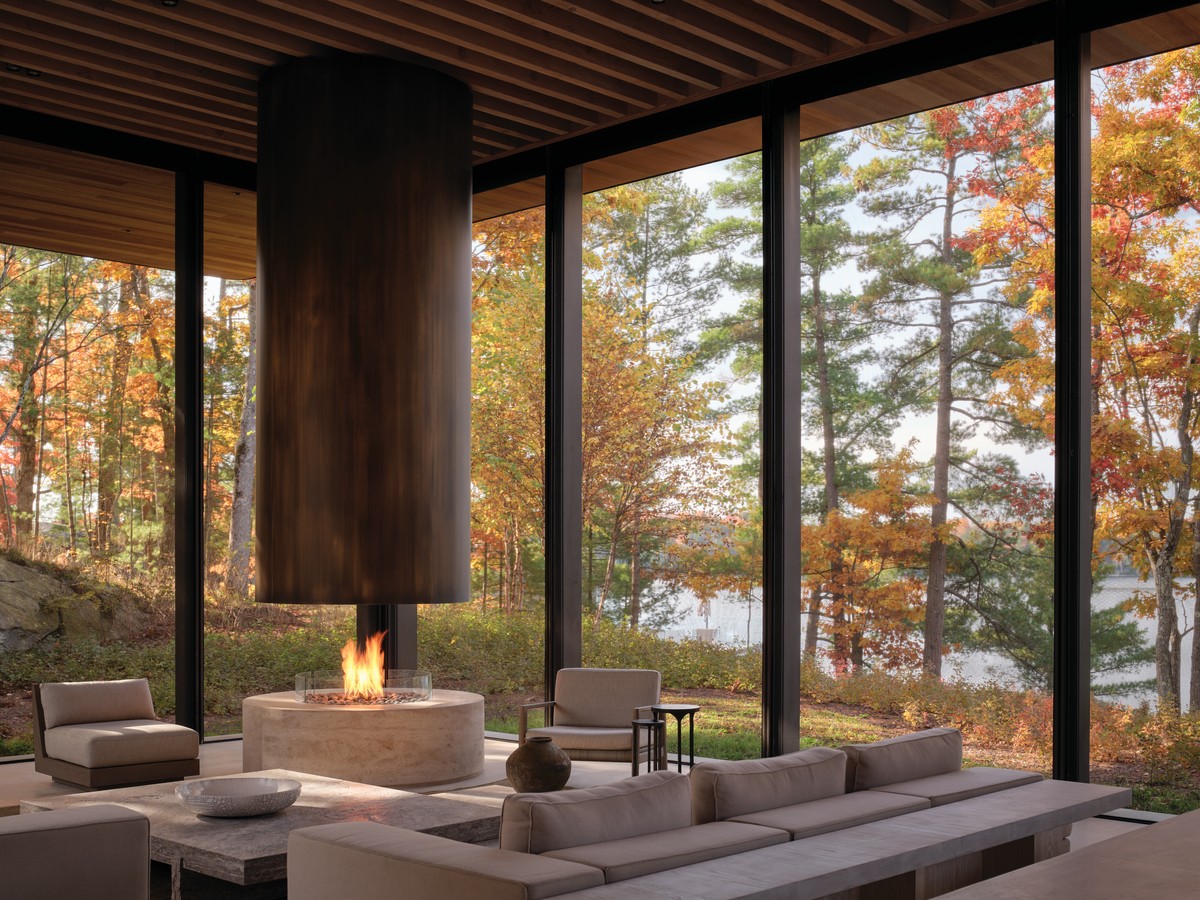
A screened porch is a frequent gathering place. Photo © Younes Bounhar
Of course, all those hard surfaces and materials present acoustical concerns. Overhead, undulating slats hang from acoustical panels; together, those two systems dampen reverberation. The panelized solution—prefabricated in Toronto—is similar to one in other Hariri Pontarini–designed houses, as well as its Tom Patterson Theatre in Stratford, Ontario. Clearly, the firm isn’t interested in reinventing the wheel but instead refines its craft with every project.
“It keeps us, the family, together,” says the wife about Riverdale, standing in the very living room that kicked off the endeavor, and enthusiastic about the many more summers to come. “That’s the best part of it. There’s something for everybody”—including day-trip visitors, like this writer.
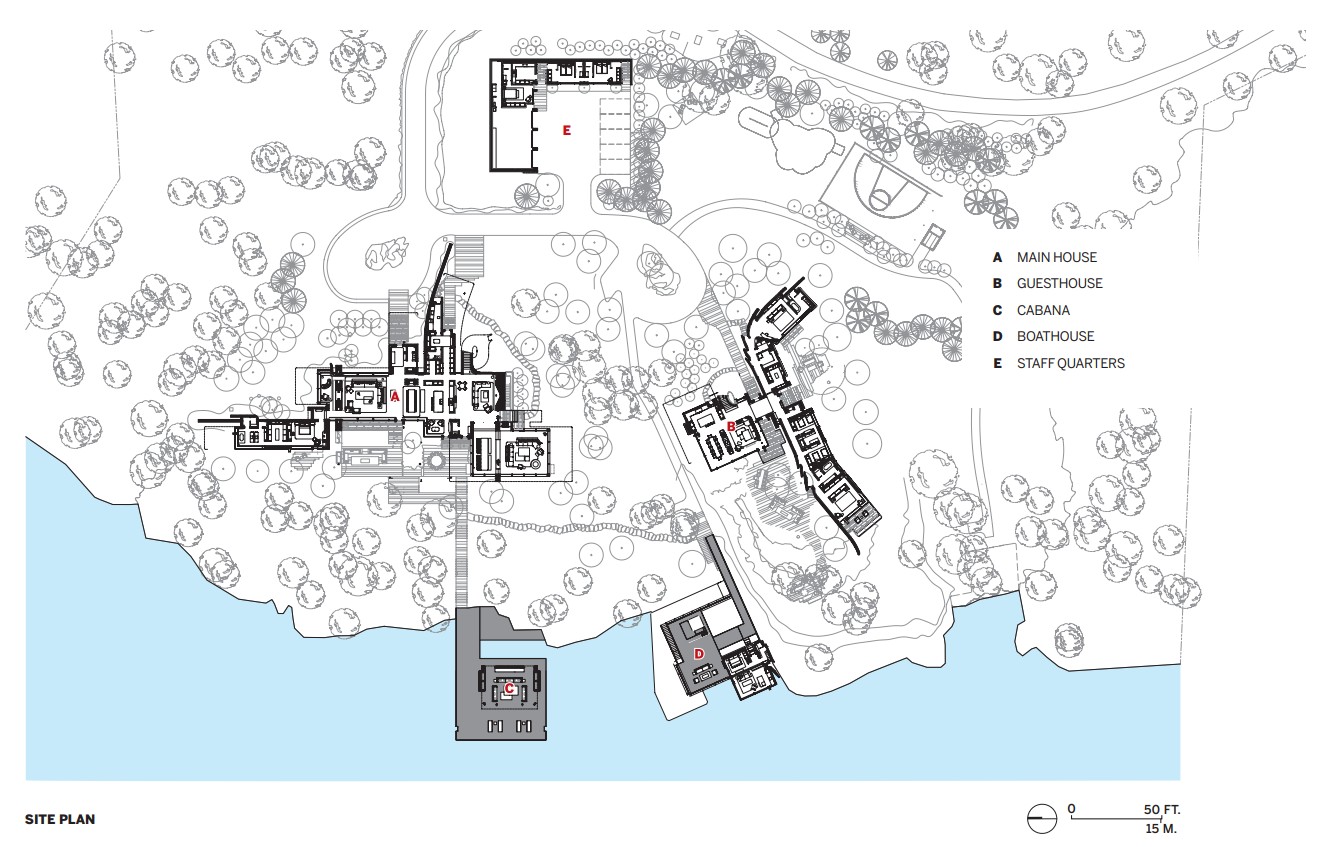
Image courtesy Hariri Pontarini Architects
Credits
Architect:
Hariri Pontarini Architects — Siamak Hariri, design lead and partner in charge; Patrick Cox, Jeff Strauss, Edward Joseph, Kurt Brabson, Andrea Norris, design team
Engineers:
Thornton Tomasetti (structural); RDZ Engineers (mechanical); e-Lumen (electrical); de Koning Group (dock)
Consultants:
Holbrook & Associates, Rockscape (landscape); Planscape (planners); Quantum (geothermal); HLD Muskoka (blasting)
General Contractor:
Del Greco
Client:
Withheld
Size:
19,425 square feet (total)
Cost:
Withheld
Completion Date:
May 2023
Sources
Structure:
Master Steel Fabrication (steel); Camp Form, Core Slab (concrete); Thistlewood (heavy timber); Comfort Build (framing)
Cladding:
Owen Sound Ledgerock, Oliynyk Masonry (stone); ALX Raw, Scot Carpentry (wood); Roof Tile Management (metal)
Windows/Doors:
BigFoot Door, AES, OpenAire
Interior Finishes:
Moncer (flooring); Age of Bronze, Bazay Blacksmithing (fireplace); Fabrica Unique (millwork); Hinge (hardware); Premier (paint); Concord, Brading (shading)
Stairs:
EeStairs
Lighting:
Eurolite, Synergy Systems, UnitFive
Looking for a reprint of this article?
From high-res PDFs to custom plaques, order your copy today!