RECORD Forum
Building, America: What's Missing in Architecture Schools
It is time to restore a word that is almost completely absent from schools of architecture today.
That word, surprisingly, is “building.” If spoken at all in schools, it is in the spirit of apology or obligation. We must make buildings in spite of their inadequacy to the real tasks at hand, which go to the very root of our survival, species- and society-wise. What are these tasks? Above all, to save the planet from imminent heat death or environmental catastrophe. Secondarily, to level inequalities, social and economic.
My concern is with the precise way in which the structure of architectural education has been altered by attempts to measure up to the moment. Squared up against existential crises, the building is an embarrassment. It is too wasteful—its uses of energy and material too flagrant. It is too old, too entangled with histories of violence and oppression. It is too slow (digital assists from computers and robots notwithstanding)—terminally unable to keep pace with evolutions in contemporary culture. Too small, too big, too human, not human enough: the list of the building’s humiliations continues.
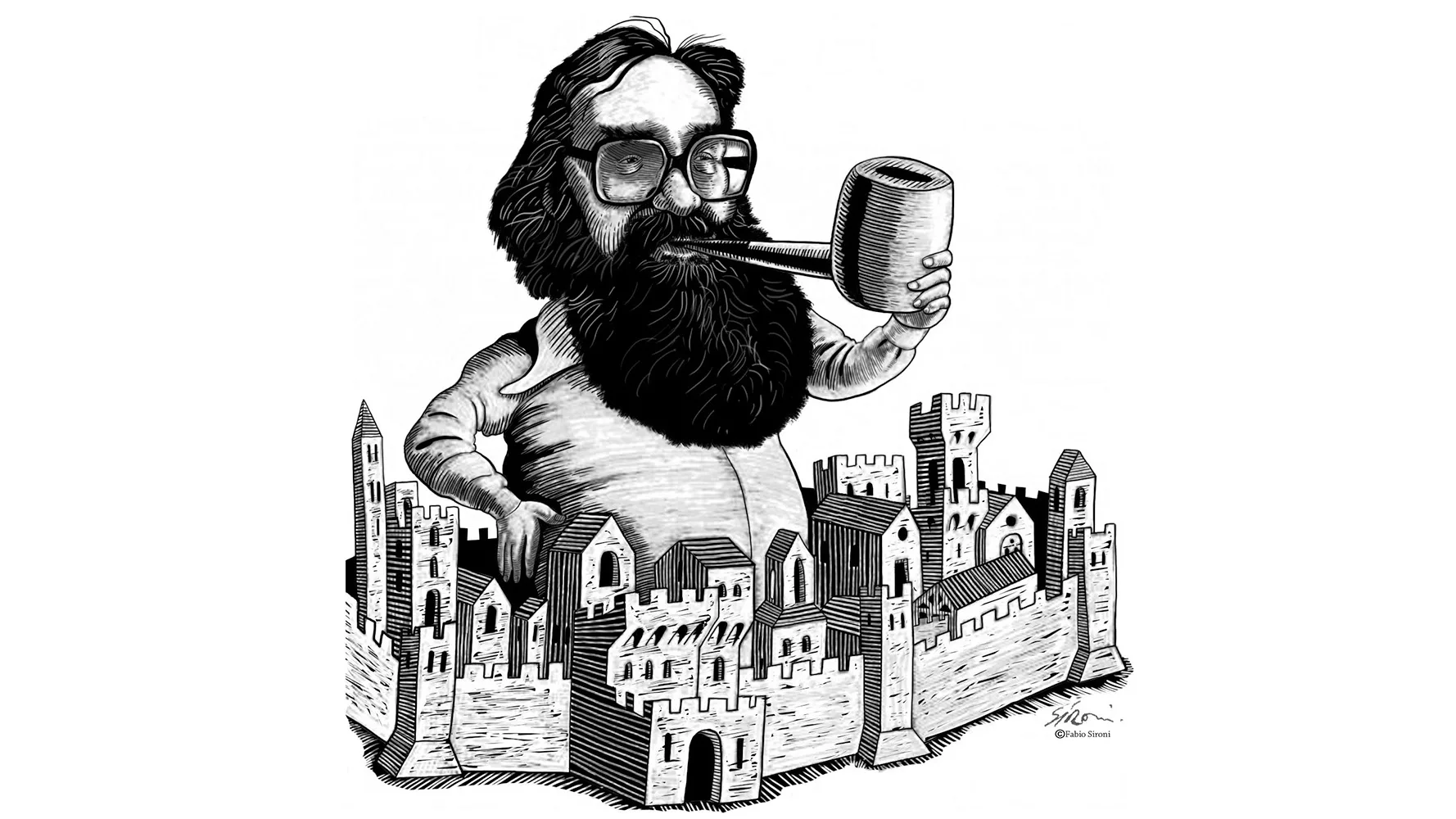
Underlying these judgments is a value system that measures the goodness of buildings by how they are produced, not what they are. To put this in a slightly more expansive, academic way, we could say the material conditions of architecture’s production have become the primary source of the discipline’s value. This is, of course, not an absolute state of affairs, but a choice to hew rather narrowly to a particular model of what architecture is and how it should work. If we could trace the origin of this model to a single figure—an unfair but useful exercise—I would nominate the Italian architect and theorist Manfredo Tafuri. His 1974 essay “L’Architecture dans le Boudoir: The Language of Criticism and the Criticism of Language” closes with a call to radically modify the “negligible phenomenon” of architecture and install in place of the architect a “new technician” whose primary purpose would be tending to the business of construction in the economic cycles of building manufacture. With this, he reclassified architects not according to their value as authors of cultural artifacts but for their role as producers in an economic system.
We have more or less accomplished the transition Tafuri wished for. We no longer teach with the idea of the architectural encounter in mind, where a subject grapples with the artifacts of our making. That thinking, reading, feeling subject at the center of architecture has been displaced by a list of properly materialist measures of architectural production and its consequences: measures of our labor, our interspecies dependence, our production of heat, our expenditure of energy, our histories of violence, the ever-accruing records of our bad actions as a species. The net effect of this displacement of one set of measures for another, though, is a strange and paradoxical return to an old set of habits. Once upon a time, the circles and triangles inscribing the old Vitruvian Man gave geometry an outsize role in the discourses of architecture’s value, as though, in order to be good, architecture needed to be the mirror image of its measures.
The same kind of sameness has returned under the new system of measures. It’s just that the new measures are for the most part optically and organizationally transparent, even if they are of great consequence politically, thermodynamically, ethically, or economically.
Accordingly, students are trained to make buildings disappear. There are many species of this. In certain schools the line of the thermal envelope vacillates so widely, is so shot full of holes and piled over with overlapping facade patterns that the net effect is camouflage, not against the surrounding urban fabric but against the act of recognition altogether. In others there is an overemphasis on the image of conventional construction systems and their attending connection hardware (concrete or light wood frames with expressed bolts, pins, hangers, clips, and ratchet straps), so that the building could be more accurately described as a scaffold—if not literally able to liquidate itself in the act of construction, then at least game to sublimate the finished building in the image of forever becoming a building. In still others, building design is replaced by the documentation of as-found conditions, represented in maps, surveys, and plans in which stuff of the everyday is so omnipresent that drawing can only convey the fullness of accumulating history.
Looking for quick answers on architecture and design topics?
Try Ask RECORD, our new smart AI search tool.
Ask RECORD →
What has been yielded from all this? Have we accomplished a more environmentally responsible or just world? Yes, a little. More consequentially, though, we have created the image of a possible future. We now see what a world would look like if architecture absented itself. Far from being unnecessary, the encounter between subject and (newly transparent) building is essential to allowing us this glimpse. Even as it vanishes, the building remains primary and the limits of Tafuri’s good intentions become clear. The wish for a “new technician” as a “producer” has not and will never emerge, so long as construction and economic activity remain bent toward some future.
The purpose of buildings is not now, nor has it ever been, solely the instrumental modification of material cycles, economic or otherwise. The purpose of building is to produce the imaginary that undertakes those modifications by a more direct means—to literally consolidate us into the very possibility of action. Buildings work this way because they occupy a privileged scale—large enough to index planetary phenomena, small enough to make sense in the space of a direct, one-on-one encounter. In this way, they become a fulcrum around which much larger spheres of activity are caused to pivot in ways that are intelligible to a building-scale audience.
When the building disappears, the real casualty in all this is America. The reasons for this are so fresh and so acute as to almost be unspeakable, but let’s just say that from both the Left and the Right, America has recently become semantically frozen. Look Left and America means the economic edifice built on enslavement, the destruction of its own material riches, and the eradication of Indigenous forebears. Look Right and America means the proud inheritor of Athenian governance and Spartan toughness, with improvements made along the way by Christ, the Mayflower, and Wall Street. Both are grossly conservative dead ends insofar as they arrogate the meaning of America to a fixed set of declarations.
By contrast, a healthy version of America’s semantic functioning is both contested and under construction. Our entire national project is predicated on this promise, and buildings have always played a disproportionately large role in it. We build to imagine possible definitions of ourselves before they actually come to pass, and this imaginary persists long after the fact of construction. In New York alone, think of the radically diverse urbanisms conjured by superficially similar buildings like Harrison’s XYZ buildings on Sixth Avenue, Saarinen’s Black Rock, and Roth, Gropius, and Belluschi’s Pan Am. All were built in the span of a decade within a few blocks of each other, all share a commitment to a blankness of presence achieved by repetitively subdividing the elevation, yet each proposes an entirely different definition of a city block and how it apportions space to an urban public, regardless of whether those urbanisms ever became dominant.
From this vantage point, we can more safely broach subject matter that seems impossibly difficult, like the August 25 Executive Order, “Making Federal Architecture Beautiful Again.” It is interesting to observe the ways in which the document attempts to capture for the political Right the role of buildings that I am advocating. The document clearly understands the power of buildings to install an imaginary and mobilize a population. It has a positive theory of how buildings of different kinds and appearances are related to different imaginings of the future. It has a theory of architecture’s history centered on the built artifact, and it dares to name and describe the aesthetics of those in a linear periodization. I recoil at the classical style it prescribes, and further recoil at the notion that this aesthetic is linked to white Christian nationalism. At the very least, though, we must acknowledge the executive order wins the first round of a game that architecture schools are refusing to play. The order at least recognizes the power of buildings apart from their conditions of material production. If we wish for other outcomes, we must contest this field. In America, where new architecture has long originated in the academy, this task falls to schools.
Two recommendations for doing this. First, hold the line. Do not cede the project of designing buildings to any single ideological position. Do not consent to disappear. Take up architecture’s age-old problem of delineation from other fields—optical, organizational, economic, thermal, or otherwise. Second, keep America plastic. Do not allow the design of buildings to be dominated by any fixed system of meaning or value. Do the opposite: use buildings to make America as transformable, pliant, and up-for-grabs as it should be. This isn’t so hard. When the politics of architecture are articulated in blunt slogans like “Making Federal Architecture Beautiful Again,” they succumb easily to transformations. They’re Mad Libs—the perfect setups for word games of substitutions. The grammar of each declaration is ripe for possible replacements and counter-meanings. Replace the periodization of styles with another. Make classicism punk. Make Brutalism beautiful. All architects have is the ability to design a new image of life, and the field is wide open.
Looking for a reprint of this article?
From high-res PDFs to custom plaques, order your copy today!