Spotlight
Leers Weinzapfel Associates Designs a Mass-Timber Education Center for an Alabama Nature Preserve
Auburn, Alabama
Architects & Firms
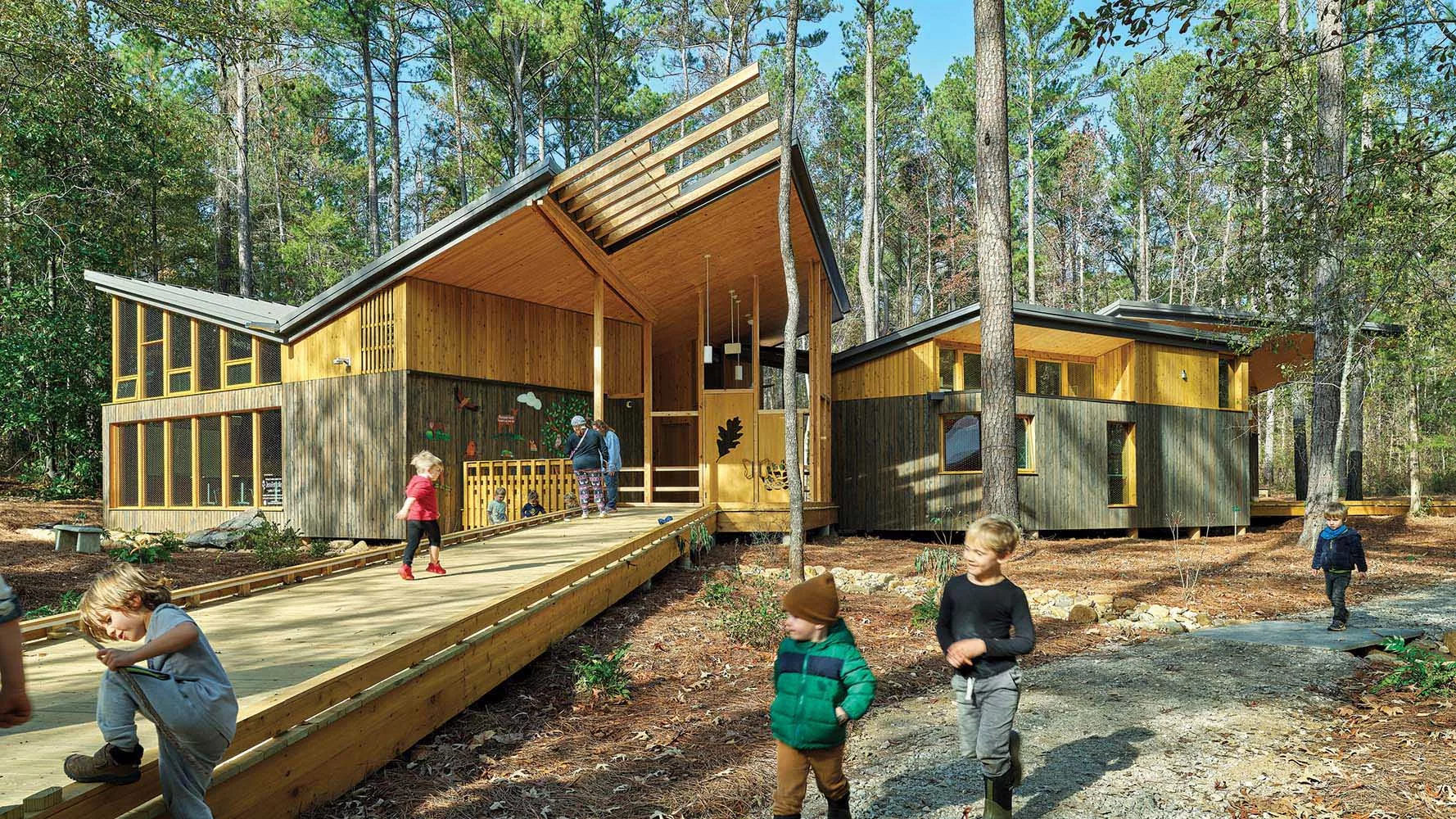
On the road from Atlanta to Auburn, Alabama, the landscape surrounding I-85 transitions from urban sprawl to verdant farms and thick clusters of forest. The woodlands, abundant and comprising over 65 percent of land cover in both states, are predominantly privately owned, without protections against deforestation or enforceable guidelines for their management. The Kreher Preserve and Nature Center (KPNC), a 120-acre forested tract owned by Auburn University’s College of Forestry, Wildlife and Environment has, since its founding some three decades ago, sought to instill a regional spirit of ecological stewardship through outreach programs and public access to its trail system. KPNC’s Environmental Education Building (EEB), completed in December 2024 and designed by Boston-based practice Leers Weinzapfel Associates (LWA), furthers that mission with an expansion of programmable space within a playfully detailed mass-timber structure like a tree house.
Tom Chung, a principal of LWA with vast experience in mass-timber design, was approached for the job back in 2019. He later joined Auburn University’s School of Architecture, Planning and Landscape Architecture’s faculty as a professor of practice in 2022. Chung now also instructs at the school’s interdisciplinary Mass Timber Collaborative, which was founded in 2023 to connect forestry expertise, research and fabrication infrastructure, and architecture.
“The mission of the preserve is to promote harmony between animal and plant life and humans,” notes Chung. “It was important to the client and the design team that the structures nestle in and grow out of the landscape, rather than overwhelm it.”
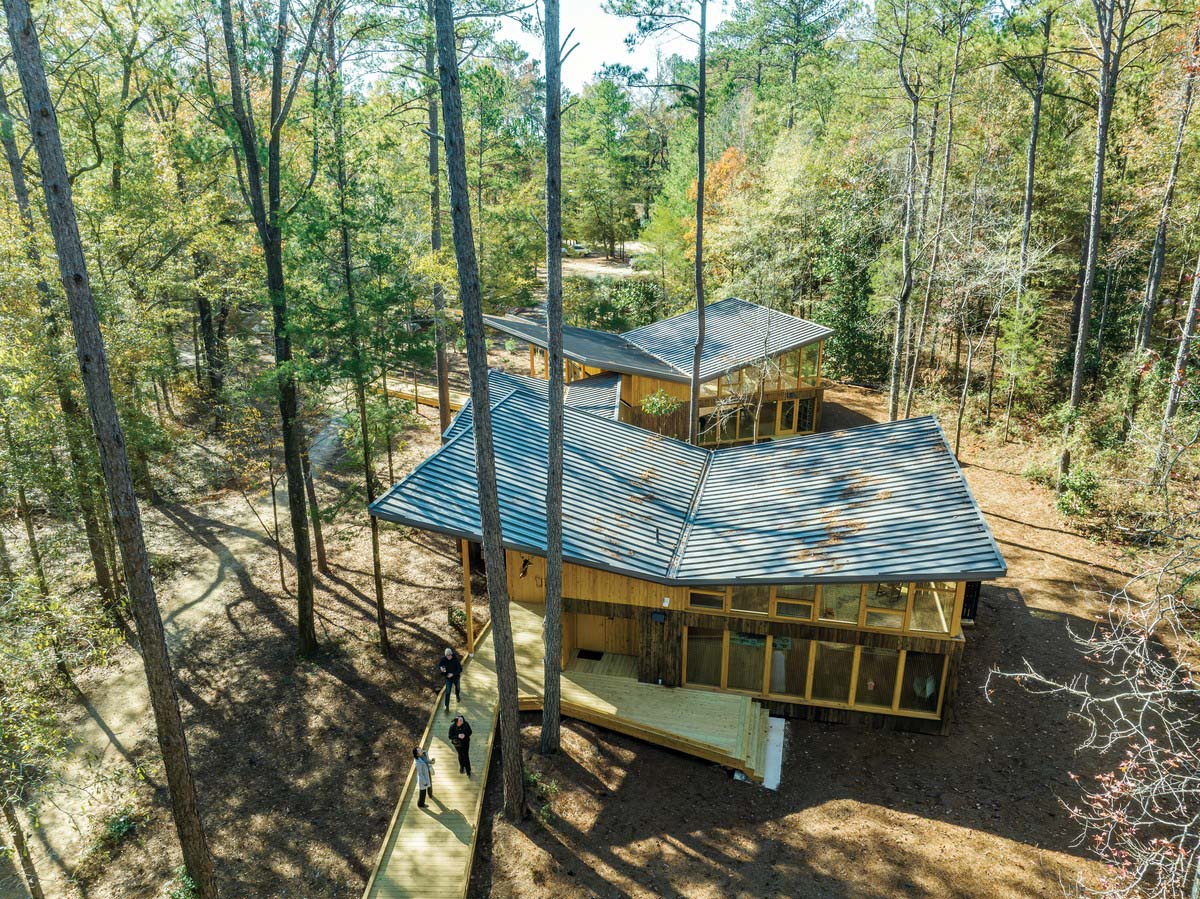
The project is nestled within a forested preserve. Photo © Timothy Hursley, click to enlarge.
The nearly 5,000-square-foot center is located on the western flank of the preserve, next to one of the main trailheads. The structure is split among three volumes that are arranged to form a U-shaped courtyard oriented to the north. The westernmost volume houses a community classroom, which can be used by homeschoolers or for private events and university classes. The staff office is placed within the center pavilion; it also has a reptile collection visible through a large window. KPNC’s preschool program, Woodland Wonders, uses the eastern volume as its classroom. To keep existing root structures intact, the buildings hover some 30 inches off the ground, with concrete pier and wood footings, and are threaded together by an open-air walkway. The walkway is always open to the public, and the complex is considered an extension of the surrounding trail system.
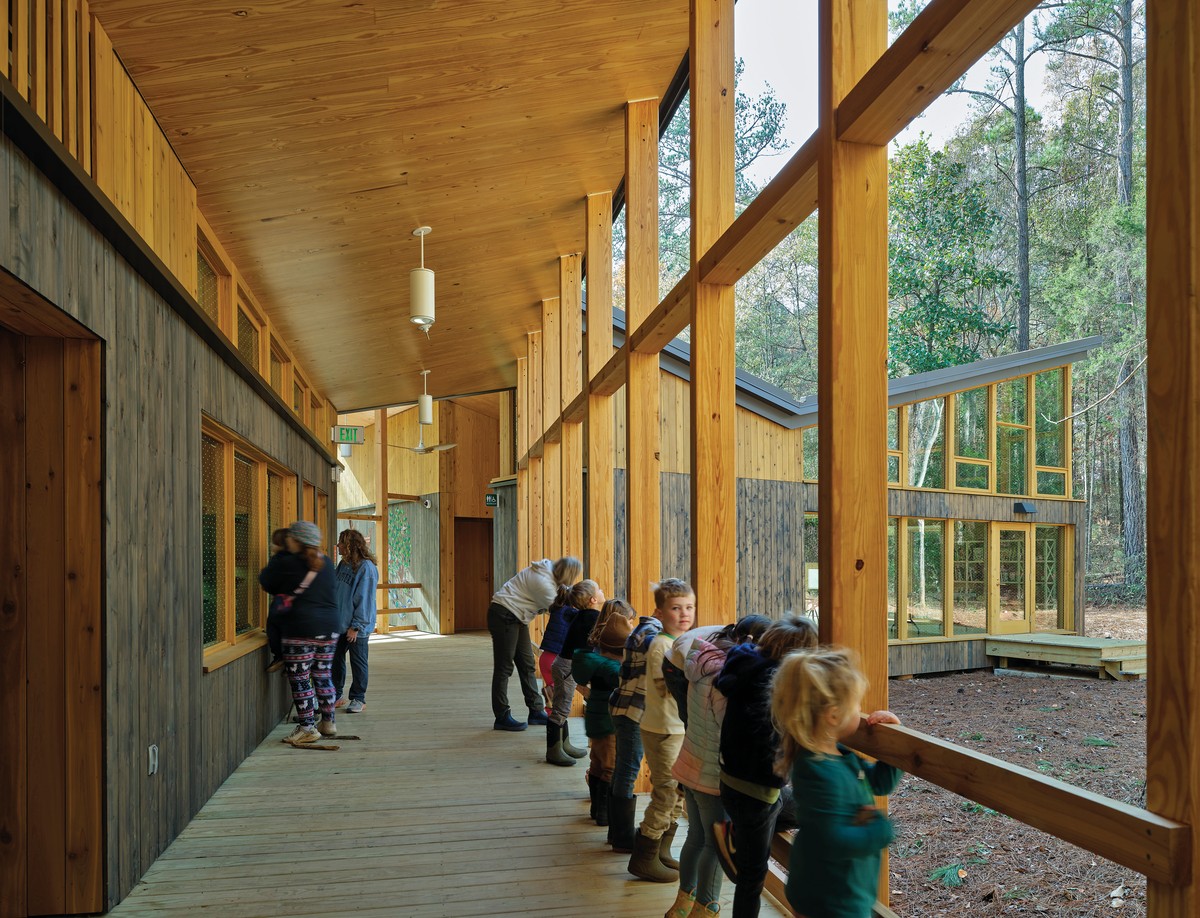
An exposed walkway ties the building’s volumes together. Photo © Timothy Hursley
The project was partially funded by Alabama’s legislature, which sought for the building to showcase the state’s growing engineered-wood industry, sourced from regionally abundant southern yellow pine. At the EEB, cross-laminated timber (CLT) is utilized for shear walls and the two-way spanned slabs of the roof system; glulam columns with point supports help handle the roof’s compressive loads; glulam beams underfoot bear the columns and shear walls, and an array of light-frame wood joists support the floor. Red cedar siding, treated with either a clear coat or dark stain, clads the exterior.
Details and furnishings are kept simple, playful, and, considering the clientele—children and hikers—durable. The complex’s two primary portals, positioned at the eastern and western ends of the walkway, comprise a set of wood doors, one scaled for adults, the other for children, with CNC cutouts of natural motifs, like pinecones and oak leaves. They are pulled open by butterfly-shaped door handles fashioned from powder-coated aluminum and nautical rope.

Wood doors feature nature-inspired cutouts and handles. Photo © Timothy Hursley
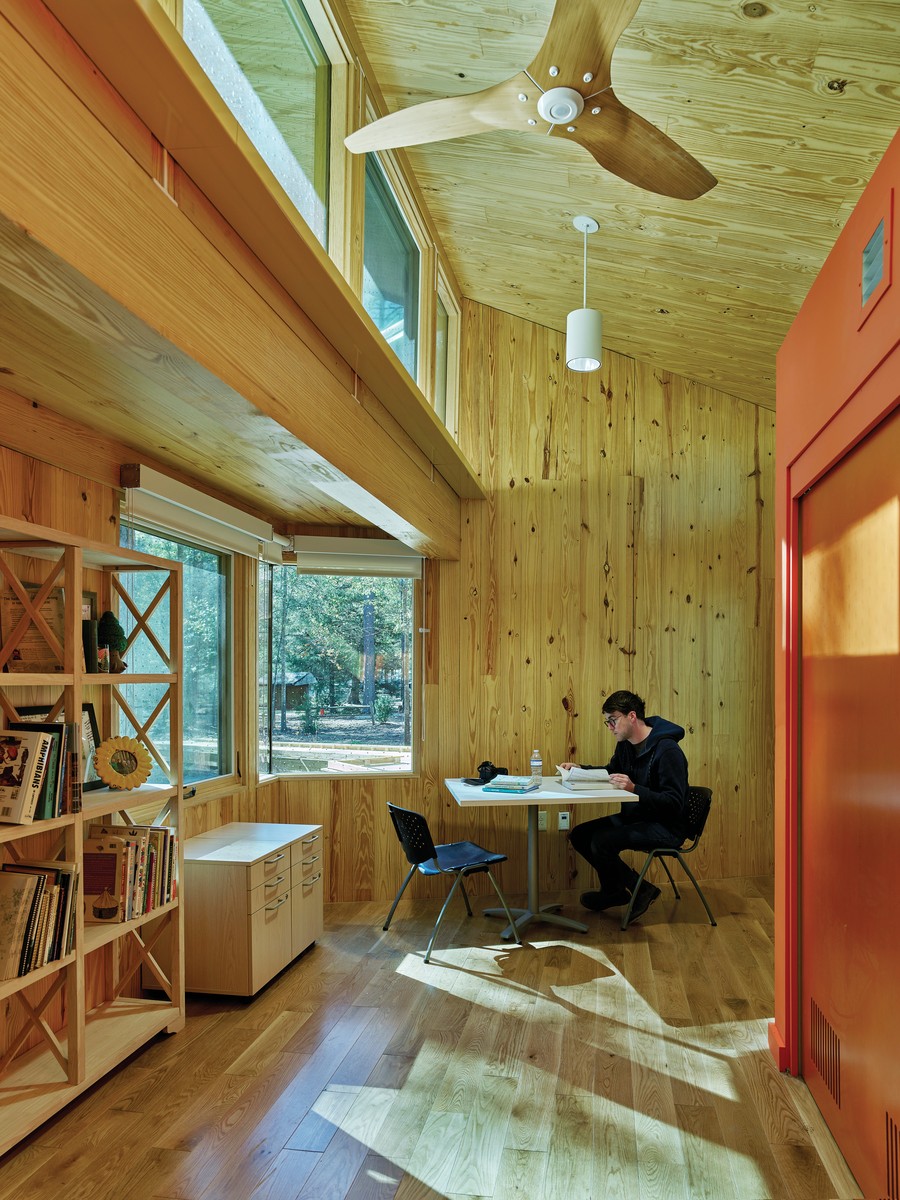
The interior faces of CLT shear walls are left bare. Photo © Timothy Hursley
Wood decking and flooring, and benches hewn of CLT castoffs, are made to be stomped on. CLT shear walls are left visible, and drywall is used sparingly, for select service runs. That treatment is largely located above the interior datum lines (8½ feet), out of reach of errant kicks and collisions. The classroom perimeters are framed by exposed structural glulam columns, spaced 4 feet apart and enclosed by bird-safe glazing, and moments of timber sheathing. Abundant daylight flows into these spaces through clerestory windows, some operable.
Looking for quick answers on architecture and design topics?
Try Ask RECORD, our new smart AI search tool.
Ask RECORD →
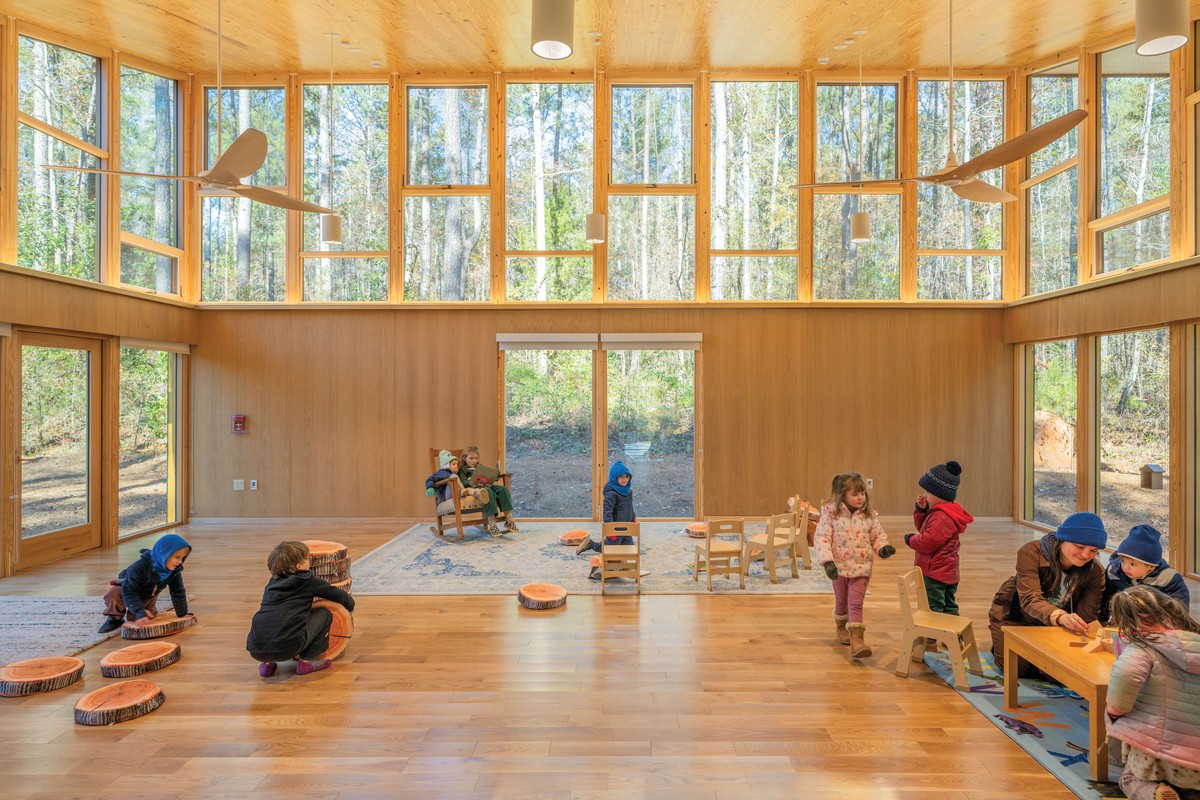
Clerestory windows surround the classrooms. Photo © C.W. Newell
The design team maintained a clean appearance by sandwiching conduits above the CLT slabs, within the roof assembly’s insulation zone. (At only one story tall, it does not require a sprinkler system.)
There were several cost-borne design changes made along the way that serendipitously strengthened the final character of the project. The open-air walkway, balmy and breezy on my visit in August, was to be ensconced in glazing as a conditioned space, and charred wood, initially envisioned for the exterior cladding, was swapped for the less costly stained appearance, that subtly blends with the forest.
Speaking with RECORD at the preschool’s playground some 30 yards away from the building, Woodland Wonders director Sarah Crim noted that the success of the project depended on creating a space that blurred the boundaries between structure and landscape and establishing a realm of comfort and familiarity for students. KPNC also hopes that the school will serve as a pedological model throughout the region and, one day, across the nation.
As I stood at the center of the building in the early evening, children vaulted the walkway railings, clambered over the CLT benches to press their faces against the main office’s reptilian display, and let out sighs of disappointment when their parents dared to bring them home. It’s safe to say that LWA’s pragmatic and charming intervention succeeded in fulfilling these goals.
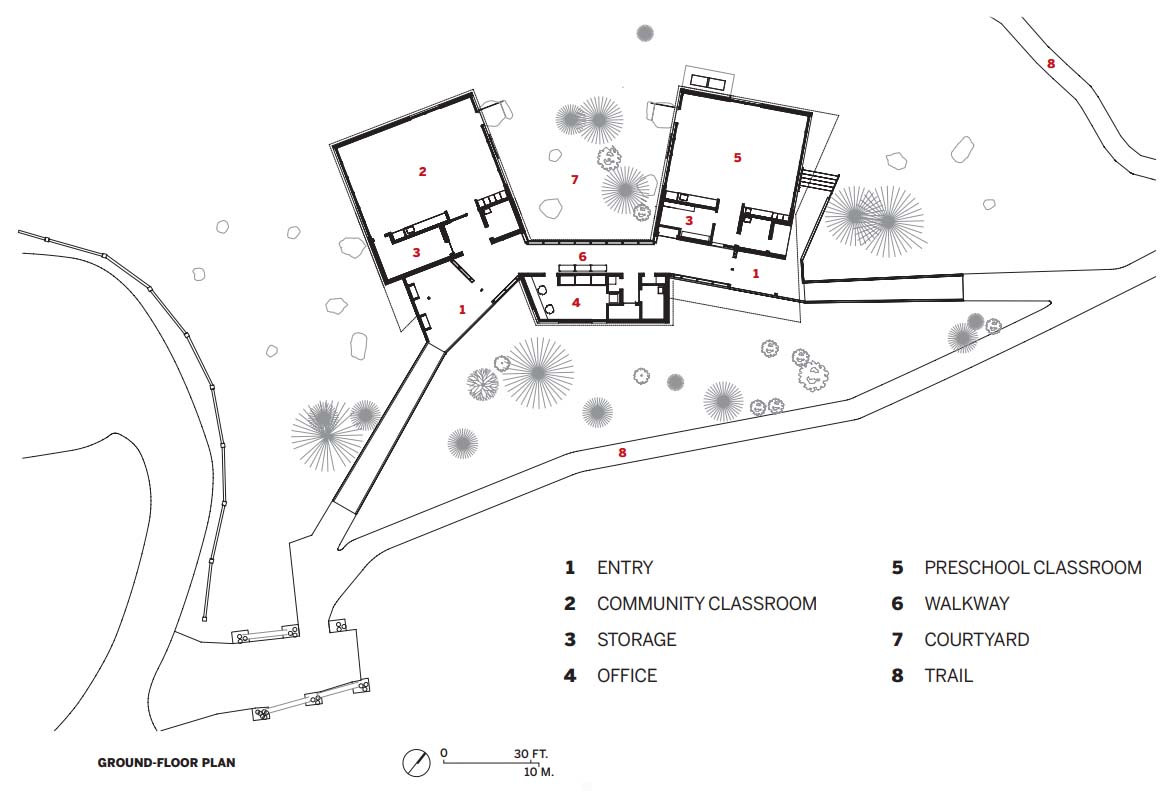
Image courtesy Leers Weinzapfel Associates
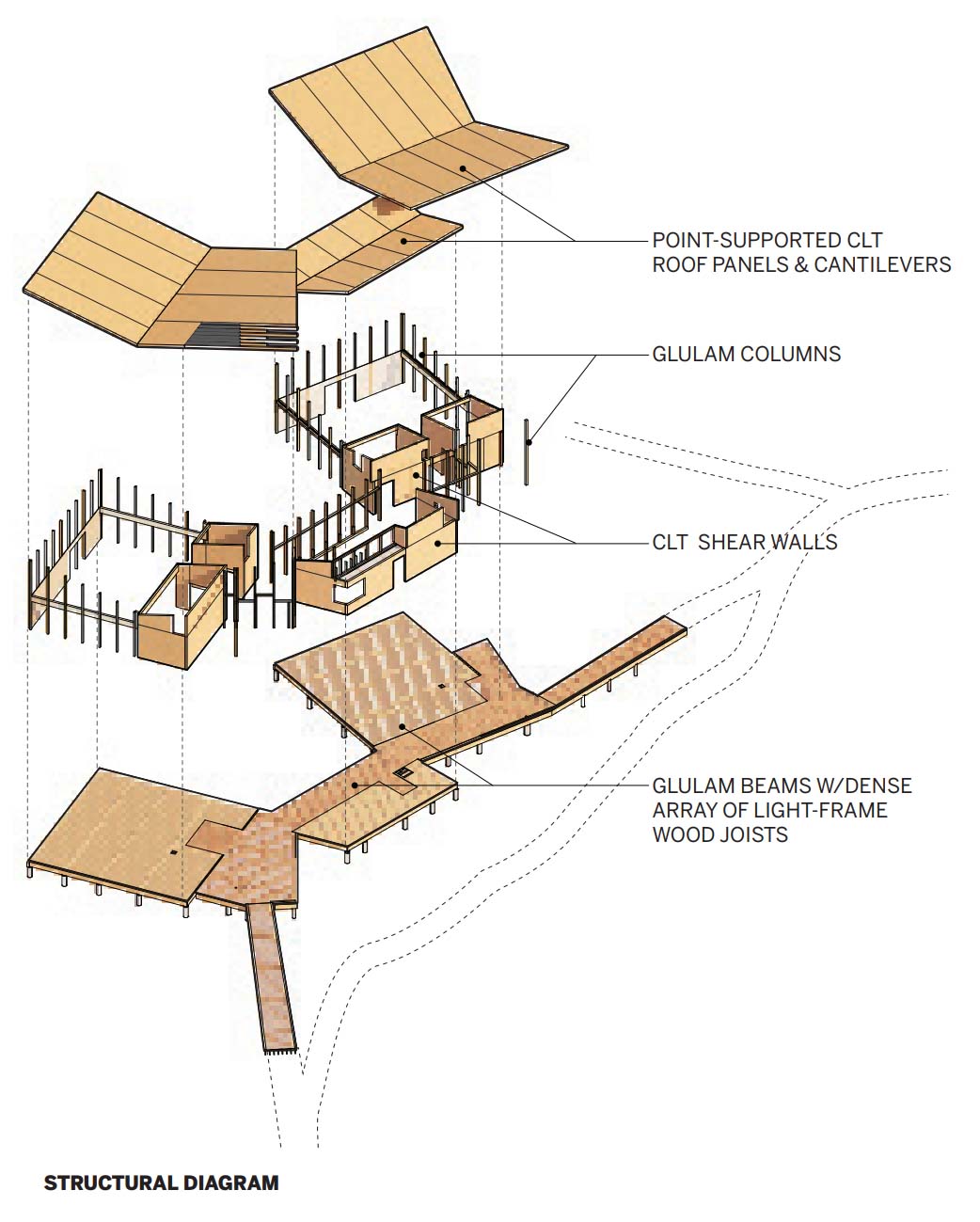
Image courtesy Leers Weinzapfel Associates
Credits
Architect:
Leers Weinzapfel Associates — Tom Chung, principal and design lead; Su Poon, project architect; Juliet Chun, project manager, Maryam Karime, designer; Yoojung Hyun, designer
Engineers:
Simpson Gumpertz & Heger, KPFF (structural); Salas O’Brien (m/e/p, civil)
Consultant:
Stick Architecture (light-frame wood assembly)
General Contractor:
W.W. Compton Contractor
Client:
Auburn University
Size:
4,990 square feet
Cost:
Withheld
Completion Date:
December 2024
Sources
Mass Timber:
SmartLam North America
Windows:
Sierra Pacific
Roofing:
Pac-Clad | Petersen
Looking for a reprint of this article?
From high-res PDFs to custom plaques, order your copy today!