Architectural Record
search
cart
facebook twitter linkedin youtube
  • Sign In
  • Subscribe
  • Sign Out
  • My Account
Architectural Record
  • NEWS
    • Latest News
    • Awards
    • Interviews
    • Obituaries
    • Podcasts
      • Design:Ed Podcast
      • Sponsored Podcasts
  • OPINION
    • Book Reviews / Excerpts
    • Exhibition Reviews
    • Forum
  • EXCLUSIVES
    • Videos
    • Design Vanguard
    • Top 300 Firms
    • Sponsored Content
    • Sponsored eBooks
    • From the Archives
  • CONTINUING ED
    • Editorial Continuing Ed
    • CE Center
    • CE Academies
  • PROJECTS
    • Buildings By Type
    • Reuse & Renovation
    • Museums & Arts Centers
    • Colleges & Universities
    • Multifamily Housing
    • Interiors
    • Lighting
    • Kitchen & Bath
  • HOUSES
    • Record Houses
    • House of the Month
    • Featured Houses
  • PRODUCTS
    • Products by Category
    • Record Products of the Year
    • Latest Products
  • EVENTS
    • Dates & Events
    • Record on the Road
    • Innovation Conference
    • Sustainability in Practice
    • Women In Architecture
    • Webinars
    • Ad Excellence Awards
    • Submit an Event
  • CONNECT
    • Ask RECORD AI
    • Newsletters
    • Contact
    • Advertise
    • Editorial Calendar
    • Store
    • Customer Service
  • SUBMIT
    • Submission Guidelines
    • RECORD Competitions
  • MAGAZINE
    • Subscribe
    • My Account
    • Digital Edition
    • Current Issue
    • Firm Pass
    • Historic Archive
ProjectsSNAPBuildings by TypeWood Projects

The University of Massachusetts Amherst's Design Building by Leers Weinzapfel Associates

Amherst, Massachusetts
By Belinda Lanks
Into the Wood

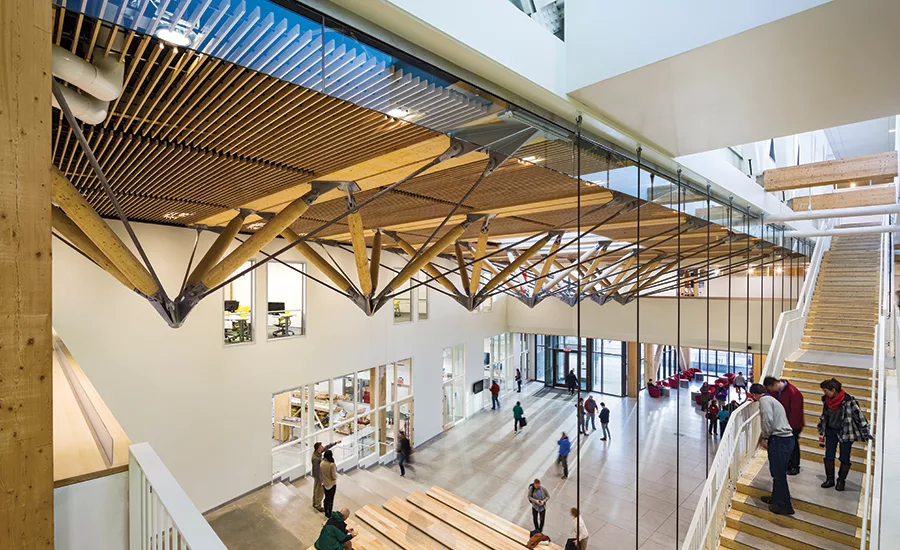
Strong CLT panels at UMass Amherst’s Design Building handle lateral and vertical loads, which made it possible for architects Leers Weinzapfel Associates to create an open, ground-level commons with a long-span, steel-wood truss system.

Photo © Albert Vecerka / Esto 
Into the Wood

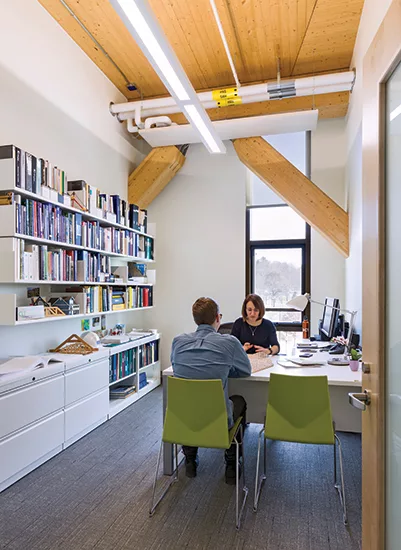
In the faculty offices, radiant-heat panels and natural light help reduce energy costs.

Photo © Albert Vecerka  / Esto
Into the Wood

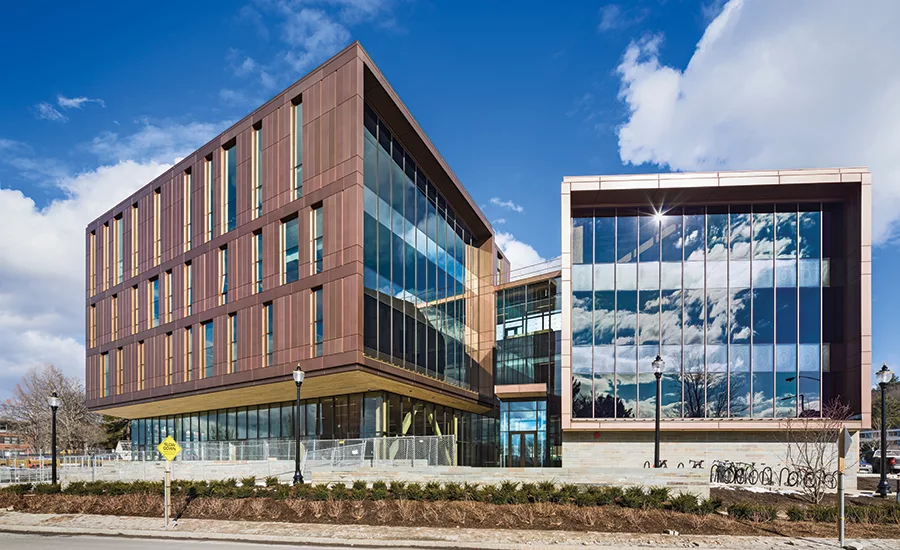
To maximize the New England sunshine, the architects placed glass on the building’s west side as well as along the interior-courtyard walls.

Photo © Albert Vecerka  / Esto
Into the Wood

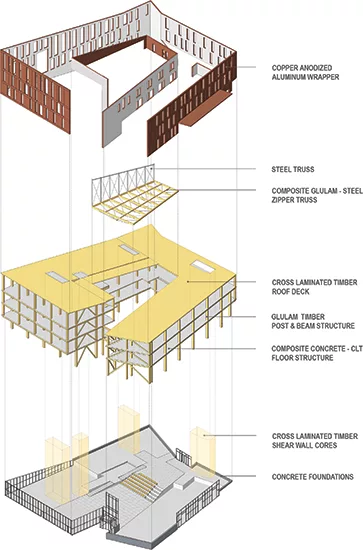
CLT was used for the shear-wall cores, floor structure, and roof deck.

Image courtesy Leers Weinzapfel Associates

Into the Wood
Into the Wood
Into the Wood
Into the Wood
March 1, 2017

The building and construction technology (BCT) program at the University of Massachusetts Amherst has built a reputation on its research of innovative wood-construction technologies. So when the school announced a plan to bring under one roof all its design disciplines—BCT, architecture, and landscape architecture and regional planning—the faculty seized the opportunity to put its academic work into practice. The result is the recently completed 87,500-square-foot Design Building. Created by Boston-based Leers Weinzapfel Associates (LWA), the structure is not only the first academic facility to be made of engineered cross-laminated timber (CLT), an environmentally friendly super- plywood developed as an alternative to stone, masonry, concrete, and steel. It also is the first building in the United States to use a composite flooring system made of cast-in-place concrete and CLT.

“Many people think of wood as just an old material,” says BCT program director Alex Schreyer. “Our group wanted to show how we could work with it in contem­porary terms.” To that end, LWA demonstrated CLT’s ability to handle horizontal and vertical loads by utilizing the material for the building’s exposed glulam frame as well as on the various shaft walls for the stairs, elevator tower, and mechan­­ical systems. In the two-story atrium, where exposed CLT panels span up to 65 feet in an open common area, the architects pushed the material further: They col­lab­orated with engineering firm Equilibrium Consulting on an innovative “zipper” truss system of glulam beams and steel rods that would support the CLT-concrete composite floor above and the weight of the building’s green roof.

“All the members of the seven trusses converge at a single midpoint like a closed zipper,” says LWA principal Tom Chung, “hence the terminology.” Aside from their visual impact, he explains, the trusses are more materially efficient than thick steel or wood options. They also eliminate the need for vertical supports. “We probably cut the number of beams required in a steel structure by half,” he adds.

The finished form departs from the expected, both inside and out. “Most mass-timber buildings in the United States have been basically rectangular boxes,” says Chung. By contrast, the Design Building has a cantilevered entryway and, in response to a sloping site, stands four stories on its downhill side and three on the uphill side.

Although the use of CLT makes a substantial contribution, it is just one of the building’s green features. For example, LWA maximized natural light by adding glass fronts to the structure’s office spaces, which wrap around an outdoor courtyard that doubles as an open-air classroom. The firm also placed skylights in the ceiling of the lower floor to draw light into the building’s interior. The architects minimized solar heat gain through the calculated placement and size of windows as well as by specifying self-shading electrochromic glass, which tints in response to direct light, on the south-and west-facing curtain walls.

The building’s high-performance envelope has two-part insulation: mineral wool along the outside of the sheeting and behind the rainscreen, plus staple insulation in the cavities of the metal-stud drywall backup assembly. In addition, LWA broke up the mechanicals into zones. Four air-handling systems serve their respective areas so that heating and cooling aren’t wasted on empty space. Radiant heat on the ground floor and chilled beams throughout the building increase the energy savings.

Finally, in the upstairs exterior courtyard, integrated landscaping by local studio Stephen Stimson Associates includes a stormwater management system that directs roof runoff to a series of bioswales. Principal Lauren Stimson says her team opted for native mosses, ferns, young spruces, and evergreens instead of the standard sedum which, although drought-resistant, “doesn’t feel like New England.” The structure’s green roof reduces the heat island effect and slows stormwater runoff.

Looking for quick answers on architecture and design topics?
Try Ask RECORD, our new smart AI search tool.
Ask RECORD →

UMass Amherst’s design departments hope their new building will encourage CLT construction to take greater hold in the United States. One hindrance to the material’s adoption, the architects say, is that utilizing it requires a special permitting process. The designers also had to correct the misconception that heavy timber is less fire-resistant than steel.

In the case of the Design Building, it might have taken extra effort to use CLT, but the result satisfies the design faculty’s goal of showcasing a large-scale application of its research. “It demonstrates this sustainable technology is feasible and cost-efficient,” says Schreyer. In fact, the $52 million Design Building—which is aiming for LEED Gold certification—is one of those rare instances of innovation coming in on budget.

KEYWORDS: timber construction

Share This Story

Looking for a reprint of this article?
From high-res PDFs to custom plaques, order your copy today!
Post a comment to this article

Report Abusive Comment

Subscription Center
  • Create an Account
  • Start a Subscription
  • Manage My Account
  • Sign Up for Newsletters
  • Visit Customer Service
  • Update Preferences

More Videos

Sponsored Content

Sponsored Content is a special paid section where industry companies provide high quality, objective, non-commercial content around topics of interest to the Architectural Record audience. All Sponsored Content is supplied by the advertising company and any opinions expressed in this article are those of the author and not necessarily reflect the views of Architectural Record or its parent company, BNP Media. Interested in participating in our Sponsored Content section? Contact your local rep!

close
  • cold storage facility
    Sponsored byCarlisle SynTec Systems

    How Architects Can Design More Continuous Cold Storage Envelopes

  • TAMLYN XtremeTrim Exterior Trim
    Sponsored byTamlyn

    Designing Cleaner Panel Facades: Why Exterior Trim Details Matter

  • Building with Vapor Barriers
    Sponsored byReef Industries, Inc.

    Vapor Barriers Help Control Moisture in Tighter Building Designs

DESIGN:ED Podcast
Listen to Architectural Record’s DESIGN:ED Podcast

Events

June 23, 2026

Enhancing Fire Resistance with Advanced PVC Solutions

Credits: 1 AIA LU/HSW; 1 AIBD P-CE; 0.1 ICC CEU; 1 IIBEC CEH

Evaluate advanced PVC solutions that improve fire resistance, support WUI compliance, and enhance resilience in residential and commercial building design.

June 25, 2026

Designing Glass Railing Systems that Enhance Aesthetics and Meet Code

Credits: 1 AIA LU/HSW; 1 AIBD P-CE; 0.1 ICC CEU

Upon course completion, participants will possess a deeper understanding of glass railings to help ensure that safety, aesthetic, and performance objectives are achieved.

View All Submit An Event

Products

2026 Architect's Square Foot Costbook

2026 Architect's Square Foot Costbook

See More Products

Popular Stories

SanDiegoAirport

Top 300 Architecture Firms of 2026

Lorcan O' Herilhy

California Architect Lorcan O’Herlihy Has Died, Age 66

CCA, Studio Gang

The Winners of the AIA’s 2026 Architecture Award Range from Collegiate Rowing Hubs to Housing for the Homeless

Spoonbill Ranch

Johnsen Schmaling Architects Integrates Spoonbill Ranch into a Pristine Landscape

Dusk House

Design Vanguard 2026: ONO

Enhancing Fire Resistance with Advanced PVC Solutions - Free Webinar - June 23, 2026

Related Articles

  • Harvard University’s District Energy Facility.

    Snapshot: District Energy Facility by Leers Weinzapfel Associates on Harvard's Allston Campus

    See More
  • KPNC Environmental Education Building

    Leers Weinzapfel Associates Designs a Mass-Timber Education Center for an Alabama Nature Preserve

    See More
  • Firm Award: Leers Weinzapfel Associates

    See More

Related Products

See More Products
  • sustainable building.jpg

    Sustainable Building Design: Principles and Practice

  • drawingfrommodel.jpg

    Drawing from the Model: Fundamentals of Digital Drawing, 3D Modeling, and Visual Programming in Architectural Design

  • 1444336282.gif

    The Handbook of Interior Design

See More Products
×

The latest news and information

#1 Source for Architectural Design, News and Products

SUBSCRIBE
  • RESOURCES
    • Advertise
    • Contact Us
    • Submit
    • Store
  • ACCOUNT CENTER
    • Create an Account
    • Start a Subscription
    • Manage My Account
    • Sign Up for Newsletters
    • Visit Customer Service
    • Update Preferences
  • PRIVACY
    • PRIVACY POLICY
    • TERMS & CONDITIONS
    • DO NOT SELL MY PERSONAL INFORMATION
    • PRIVACY REQUEST
    • ACCESSIBILITY
  • SERVICES
    • Marketing Services
    • Reprints
    • Market Research
    • List Rental
    • Survey/Respondent Access
  • STAY CONNECTED
    • Linkedin
    • Facebook
    • Instagram
    • YouTube
    • X (Twitter)

Copyright ©2026. All Rights Reserved BNP Media, Inc. and BNP Media II, LLC.

Design, CMS, Hosting & Web Development :: ePublishing