Spiritual Projects 2025
In Qatar, Diller Scofidio + Renfro Realizes a Sanctuary Where Women Can Worship and Learn
Doha, Qatar
Architects & Firms
The Quran tells the story of Khawla bint Tha’labah, a wrongly divorced woman who advocates for herself to the prophet Muhammad, looking to correct the injustice. She became known as Al-Mujadilah, which roughly translates to “she who engages in dialogue.” In Islamic tradition, many mosques still segregate on the basis of sex—or do not permit women at all—making hers an apt moniker for the Al-Mujadilah Center & Mosque for Women, which offers religious and educational programming to Muslim women of all ages and backgrounds.
The pathbreaking project, designed by New York–based Diller Scofidio + Renfro (DS+R), opened last year, having broken ground in 2022. “I never thought that I would design a spiritual building of any sort. Being secular, religion was never part of my life,” says Elizabeth Diller. “But there was this broader objective about educating women, about bringing them into the contemporary sphere, and I was all in for that.” Her firm was selected to design the center after winning an invited competition organized by the Qatar Foundation, led by Sheikha Moza bint Nasser, the mother of the country’s emir. “She is a fierce advocate of women’s education and rights,” adds Diller.
To best serve its mission, the 53,225-square-foot center is located on a triangular plot at a corner of Doha’s Education City, a nearly 3,000-acre campus dotted by research facilities led by top-tier universities and designed by the upper echelons of the profession near and far, from Arata Isozaki and Rem Koolhaas to Ricardo Legorreta, among others.
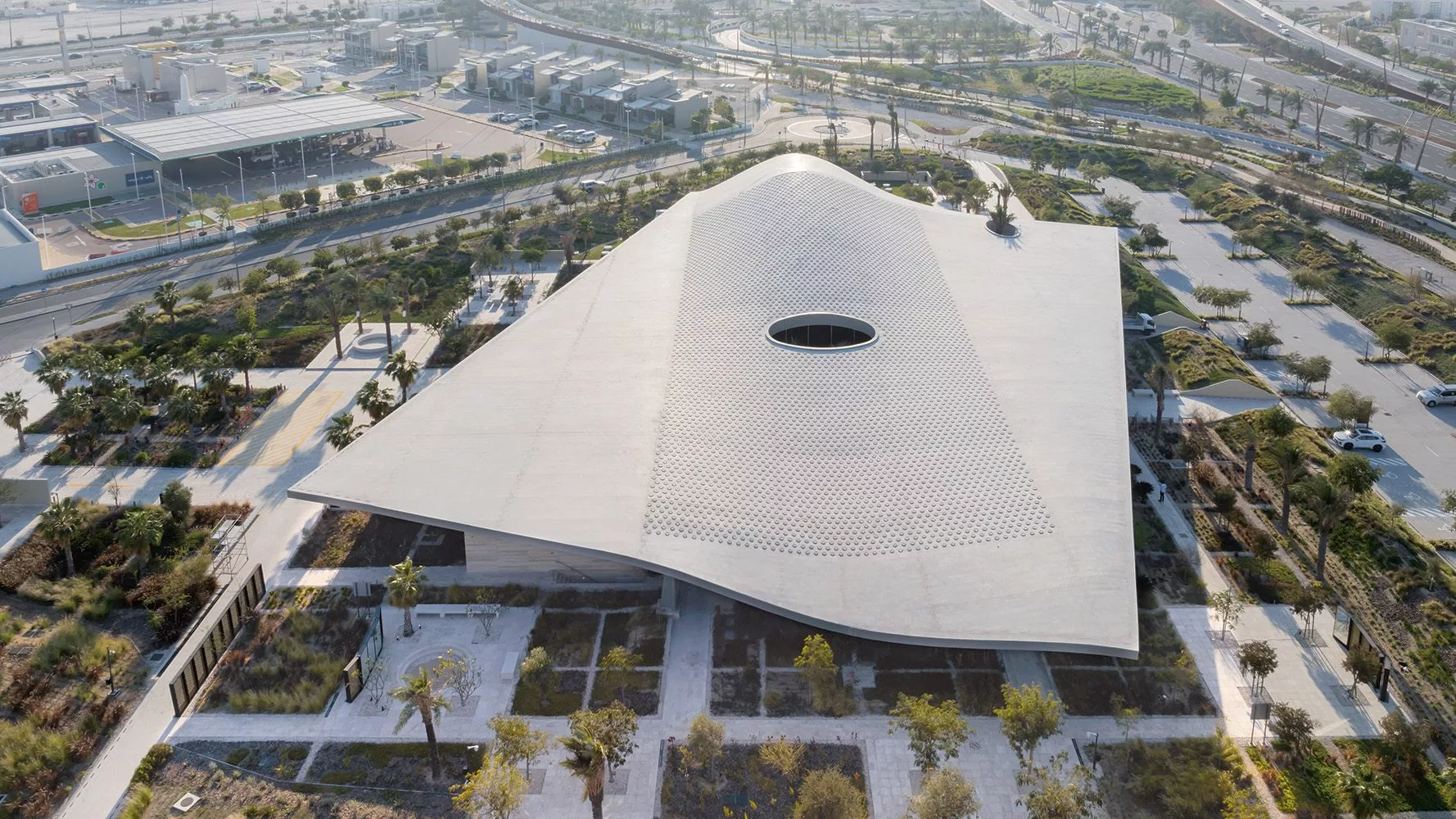
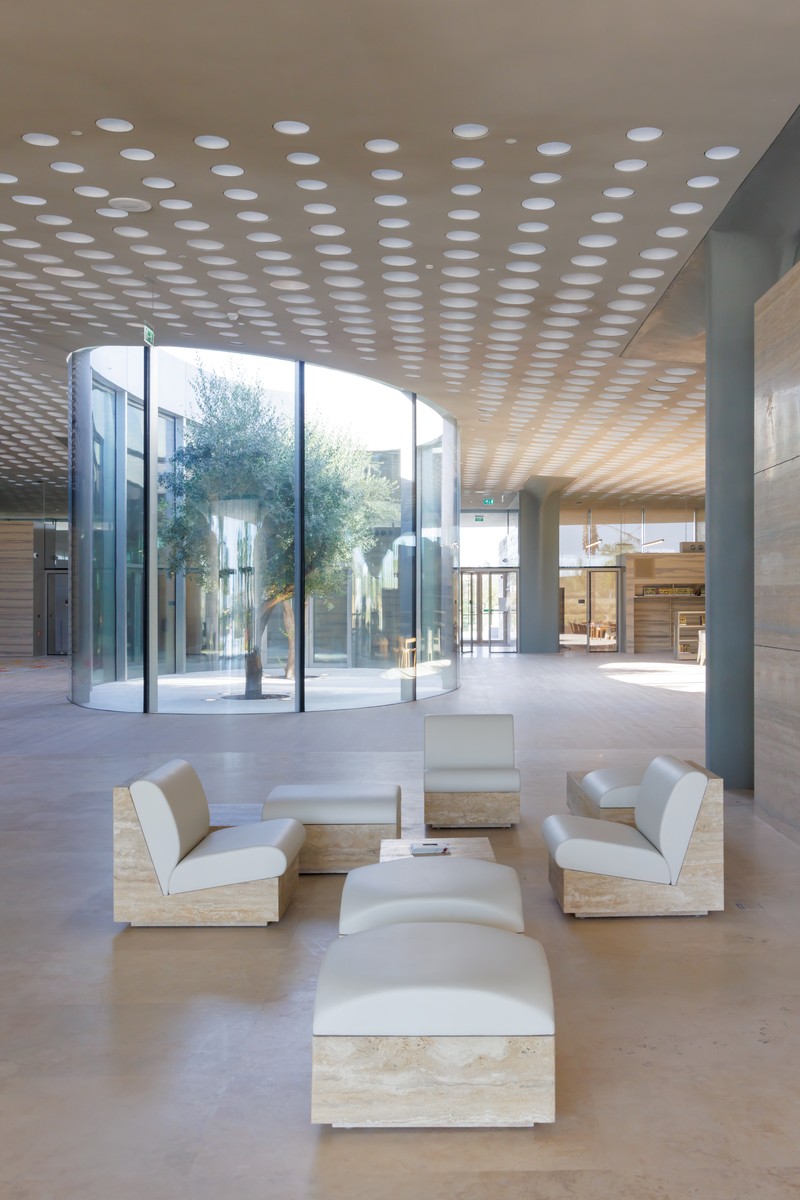
The form of Al-Mujadilah is simple, following a clear set of rules and geometric distortions that have outsize effect. The longitudinal axis is oriented toward Mecca; exterior walls in this orientation are largely glazed. A series of thick transverse walls, clad in vein-cut travertine—as if they had been pulled directly out of the Earth’s crust, strata and all—create a cross grain. Capping the structure is a low-slung rectangular (in plan) roof, which has been shifted 17 degrees to align with the cardinal directions and extends well beyond the building’s footprint. In section, this expansive surface is doubly curved, tilting and arching upward above the westward prayer hall while simultaneously dipping over a communal area with classrooms to the east. Where the curves meet, an ellipse is cut out to form a courtyard with two olive trees—a universal symbol of peace, but particularly important in Islam.
1
An elliptical enclosure separates educational functions (1) and protects two olive trees (2). Photos © Iwan Baan, click to enlarge.
2
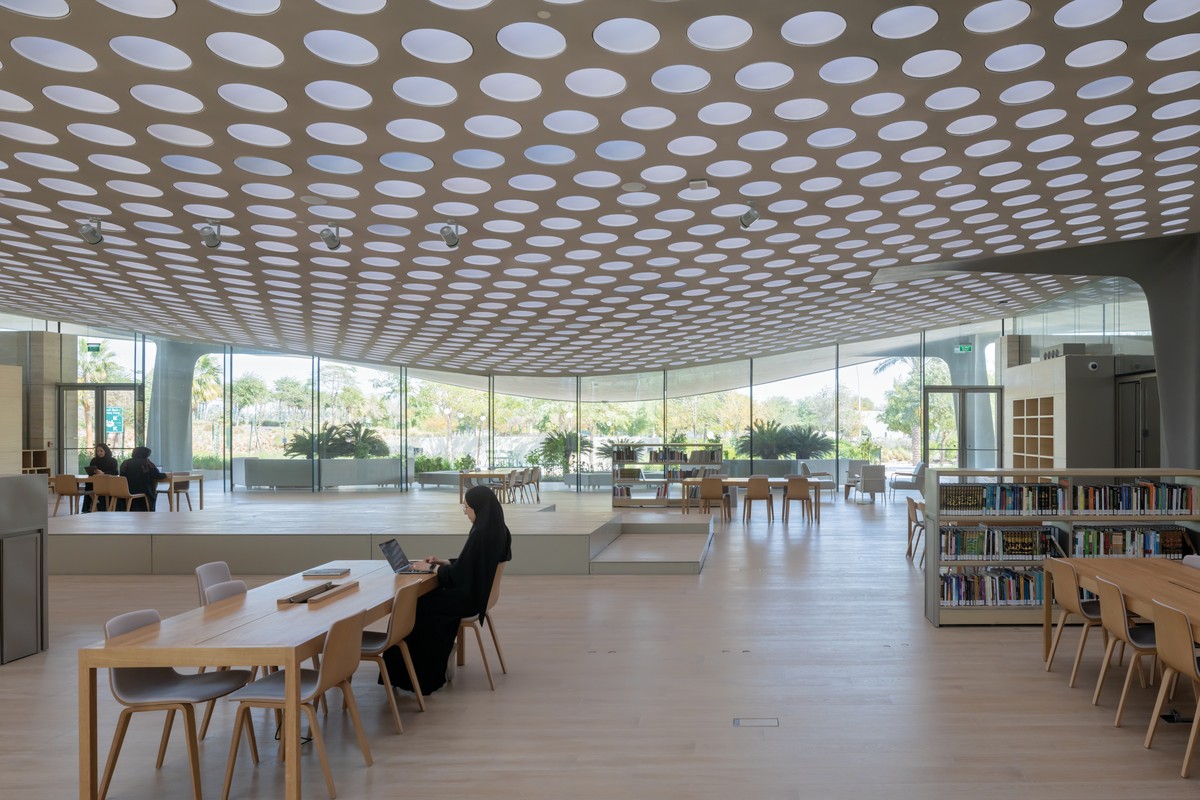
The roof plane—about 3½-feet thick—is framed with bent steel members, while a network of straight secondary and tertiary beams as well as purlins inch closer to the intended curvature. Above them, insulated panels and a screed of concrete constitute a bed for the outermost layer: a field of dimensionally cut limestone slabs from Oman. An array of 5,488 skylights finishes the assembly. “One idea that carried over from our research of historic precedents was the sublime,” Diller says. “And we accomplished it not through decoration or visible patterns but through light.” These round apertures—wider on the ceiling than they are on the rooftop, to minimize heat gain—mediate the intense near-equatorial sun while flooding the main hall in a diffuse, almost heavenly glow.

A field of skylights stipples the doubly curved roof of the Al-Mujadilah Center & Mosque for Women (above and top of page). Photo © Iwan Baan
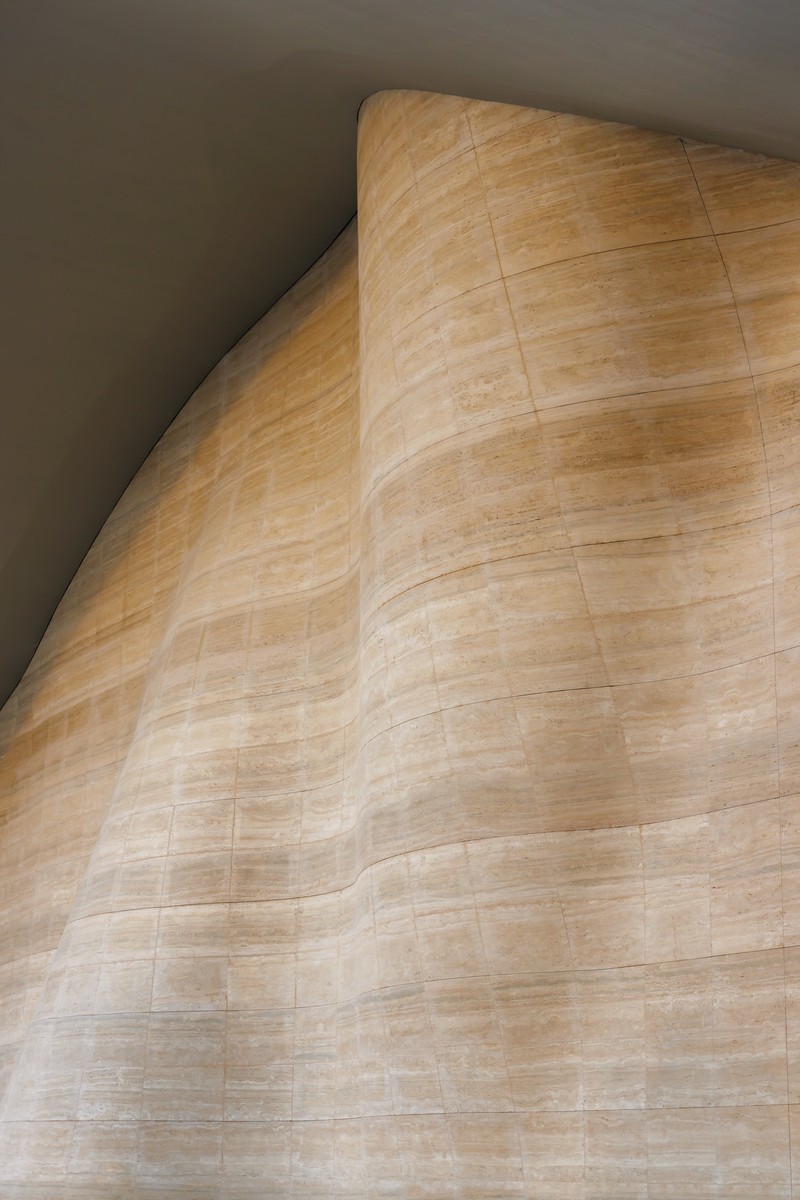
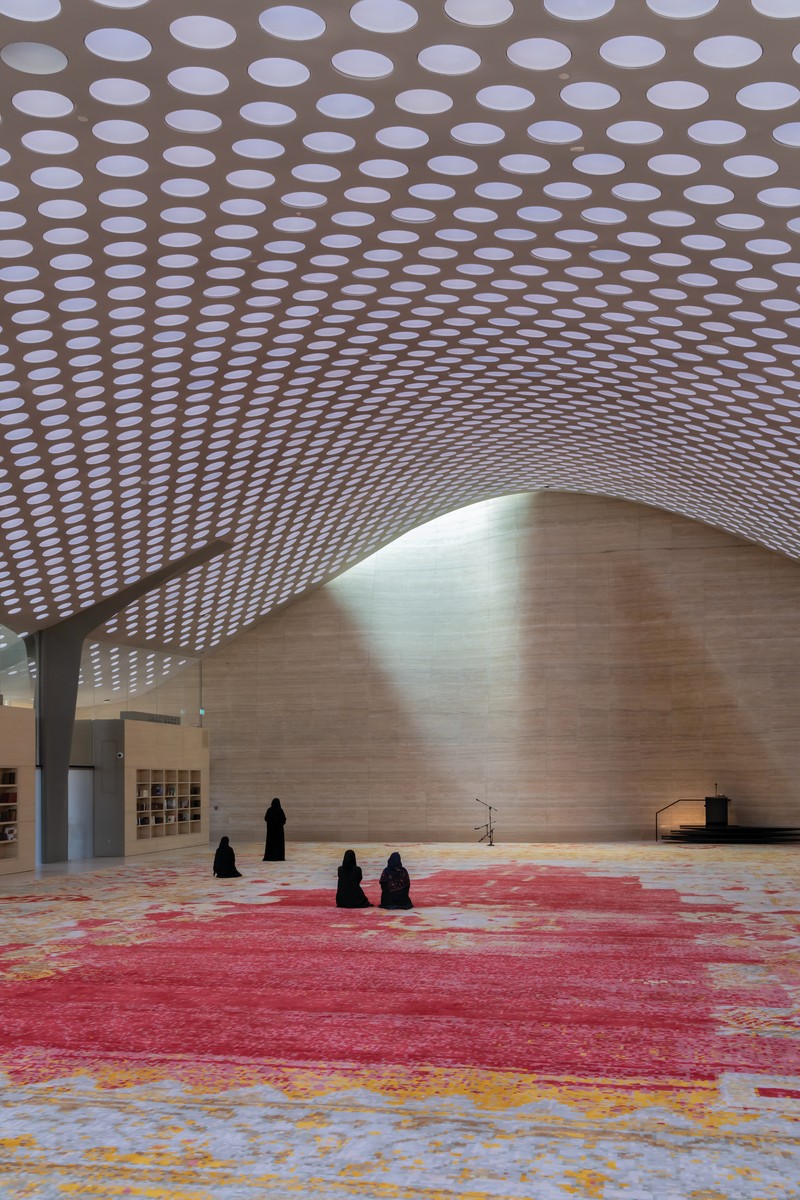
The move is one of many by DS+R to abstractly reinterpret mosque architecture. Another example is the qibla wall, which in many traditional settings is marked by a mihrab (an alcove indicating the direction of prayer) and a nearby minbar (a pulpit from which an imam delivers sermons). “To us, these elements were always identifiable but seldom architecturally integrated,” says Evan Tribus, associate principal at DS+R. “We wondered if we could achieve both in a single gesture.” At Al-Mujadilah, the architects warped the qibla wall to form two side-by-side conical niches. One has its rounded base on the floor; the other’s is at the intersection with the ceiling. Simple as the move is, the resultant effect is nothing short of divine—the mihrab appears to be sculpted out of light, while the minbar is rendered in shadow.
3
4
Deformations in the qibla wall (3) create cones of light and shadow (4). Photos © Iwan Baan
The hand-tufted wool carpet in the prayer hall is another example. Beginning with the length of a traditional prayer rug—typically dimensioned to allow prostration—the architects developed a planimetric module of 1,250 millimeters (about 49 inches) that, as Tribus explains, dictated Al-Mujadilah’s structural grid and the placement of walls. But they also photographed this rug and digitally manipulated the image, scaling it to the size of the prayer hall (115 feet by 66 feet), “cutting” it into horizontal ribbons that were then staggered, and pixelating it. To ensure that the outcome of this digital exercise retained some degree of legibility with the original object, the team printed a quarter of the carpet as a mock-up, at 1:1 scale. Following their planimetric module, prayer rows were delineated using a shorter pile.
Looking for quick answers on architecture and design topics?
Try Ask RECORD, our new smart AI search tool.
Ask RECORD →
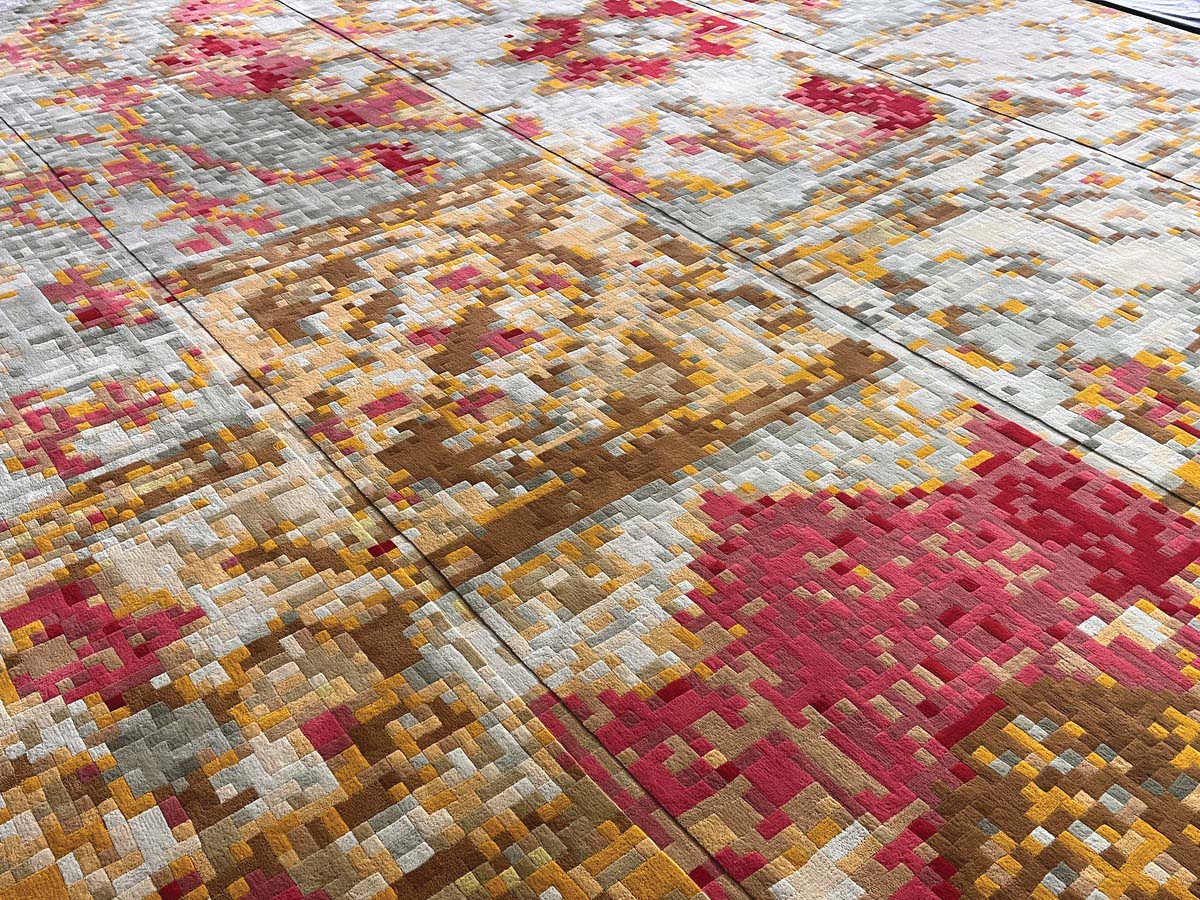
The height of the carpet’s pile delineates prayer rows. Photo courtesy Diller Scofidio + Renfro
The main hall is large enough to accommodate about 750 worshippers, but during Ramadan a “sister” carpet can be rolled out to increase capacity to about 1,300. Auxiliary spaces, including offices, several classrooms, a café, a library (with holdings that span Islamic and women’s history as well as books by female Muslim authors), and a room for performing ablution (called wudu) flank the main hall, often with views out to lush gardens of sedges and palms.
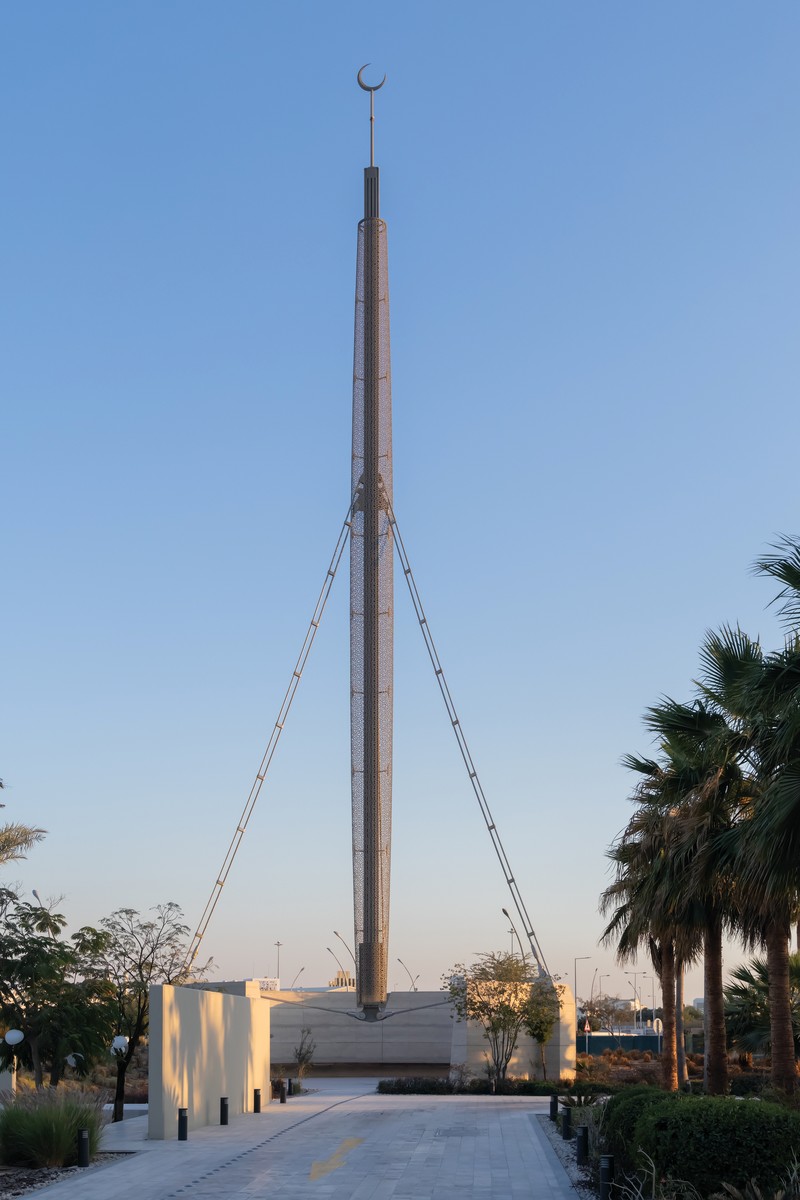
The mesh-wrapped minaret utilizes tensegrity. Photo © Iwan Baan
Beyond this field of greenery, tucked into a dune and suspended in the air by cable stays, is the center’s minaret—a distinctly high-tech interpretation of its traditional counterpart. Typically, a muezzin delivers the five daily calls to prayer from the top of the tower. Here, DS+R designed a cluster of speakers and lights that ascends the 128-foot-tall spire and broadcasts the prayer, before descending. This minaret, which is wrapped in a metallic mashrabiya-like scrim, casts a dazzling tessellated pattern as the electronic device moves up and down, especially during Fajr and Isha (the first and last prayers of the day).
Watch as the mesh-wrapped minaret’s speaker system rises to broadcast the call to prayer. Video courtesy DS+R
“This is a place for women to gather and talk, where they can be spiritual together,” Diller says. It’s a safe haven—one that carefully treads between tradition and contemporaneity, between a particular place and global culture. Although Al-Mujadilah’s opening was kept low profile—perhaps for fear of religious backlash—the number of its followers has steadily grown. And, next month, a three-day conference will bring together international scholars and worshippers at the center to discuss the history of Muslim women and the challenges they still face.

Images courtesy Diller Scofidio + Renfro
Credits
Architect:
Diller Scofidio + Renfro — Elizabeth Diller, Ricardo Scofidio, Charles Renfro, Benjamin Gilmartin, partners; Evan Tribus, project director; Yushiro Okamoto, Michael Hundsnurscher, project architects; Miles Nelligan, Anthony Saby, Kevin Rice, Lilian Fitch, Andreas Kostopoulos, Magdalena Naydekova, Danielle Schwartz, Rawan Elnatour, Mike Robitz, project team
Architect of Record:
Halcrow
Engineers:
Werner Sobek (structural, m/e/p, civil, facade); Halcrow (structural)
Consultants:
Mohamad Ziad Jamaleddine (Islamic architecture); Atelier Miething (landscape); Charcoal Blue (AV, acoustics); Buro Happold (daylighting); IN-FO.CO (signage)
General Contractor:
RC Al Mana
Client:
The Private Office of Her Highness Sheikha Moza bint Nasser
Size:
53,225 square feet
Cost:
Withheld
Completion Date:
January 2024
Sources
Roofing:
Sika (waterproofing); Kingspan (insulated panels)
Glazing:
Saint Gobain
Carpet:
Tsar Carpets, Ruckstuhl
Doors:
Boon Edam, Gemino
Looking for a reprint of this article?
From high-res PDFs to custom plaques, order your copy today!