Building Technology
A Belgian Tower Bares All With an Unconventional Exoskeleton
Brussels
“How can structure create a language?” asks Adrien Verschuere, founder of Brussels-based architecture firm Baukunst. He is referring to Frame, the flagship building of a new media park that the Société d’Aménagement Urbain (a publicly owned development company) is constructing in the Belgian capital. Invited by the Brussels bouwmeester (city architects for government projects) to take part in the 2017 design competition, Baukunst teamed up with French practice Bruther (a 2017 Design Vanguard, headed by Stéphanie Bru and Alexandre Thériot), beating proposals by the likes of Office Kersten Geers David Van Severen, Xaveer De Geyter, and 51N4E. Two main principles guided their approach: responding to the visually prominent site, and achieving maximum flexibility to accommodate an evolving list of occupants.

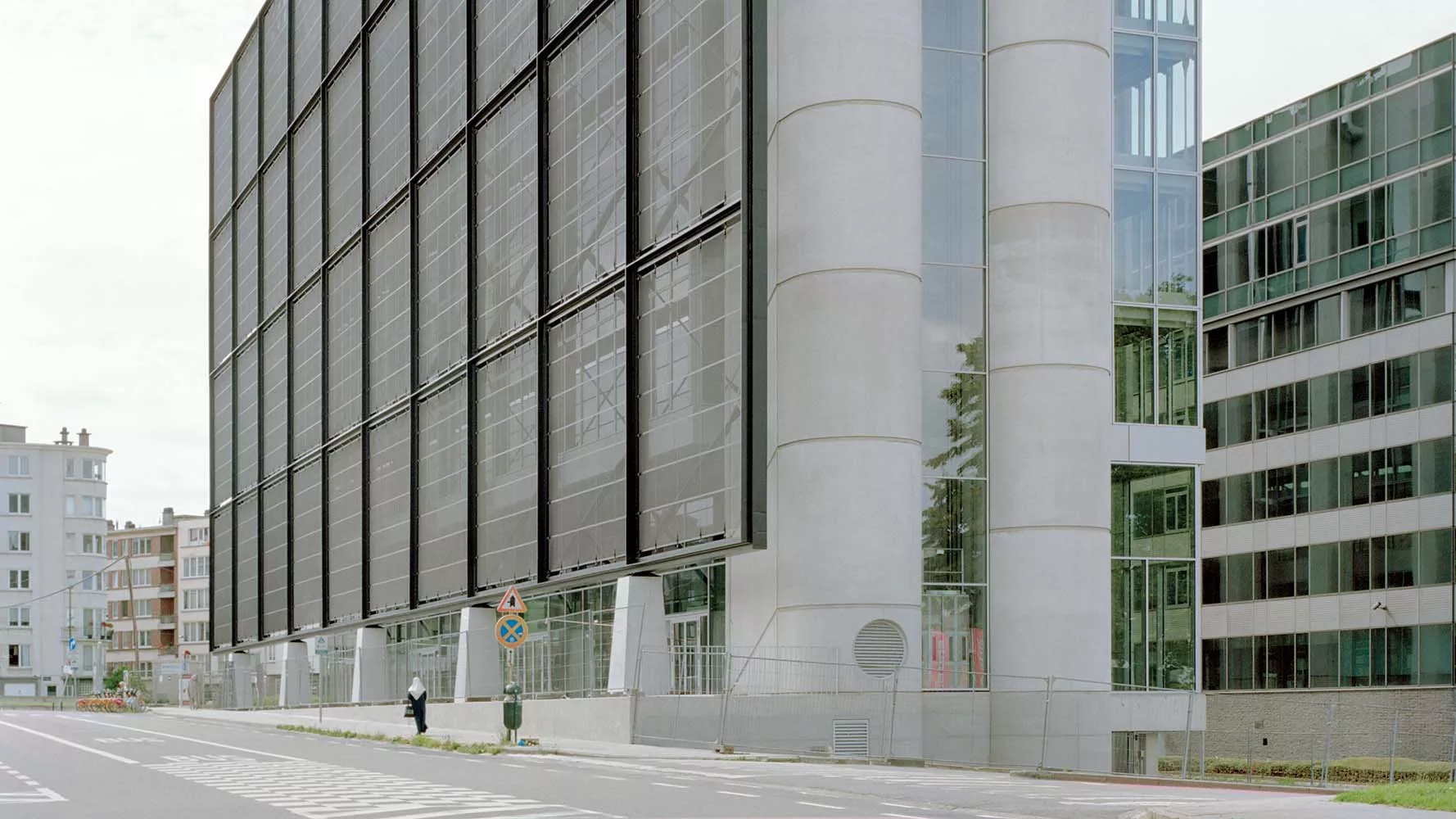
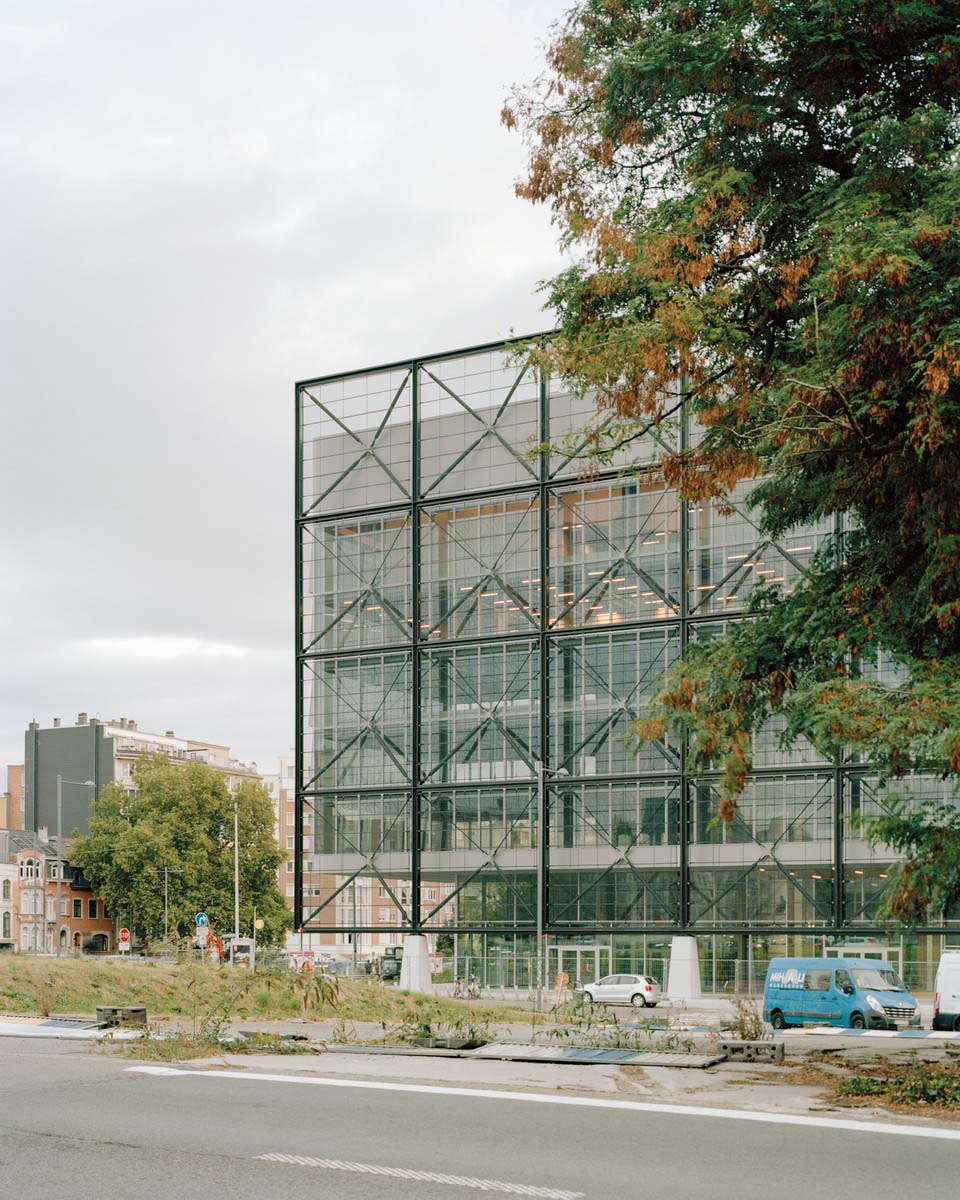
The building’s south-facing elevation is fronted by a steel frame and a fabric-mesh screen. Photo © Maxime Delvaux, courtesy Baukunst, click to enlarge.
Located in eastern Brussels, the media park is in fact a redevelopment, involving demolition and reconstruction of some buildings and preservation of others. Frame, the first new structure to be completed, occupies a former parking lot and greets visitors as they exit the local metro. Rising 100 feet, like the 1990s glass office buildings next door, it stands perpendicular to the boulevard Auguste Reyers, a major traffic artery, and faces a grassy plaza. The building is entered from its narrow western boulevard elevation, while the southern facade, overlooking the plaza, constitutes its main public face. In contrast, the northern and eastern elevations are very much backstage, a difference reflected in the project’s structural engineering.
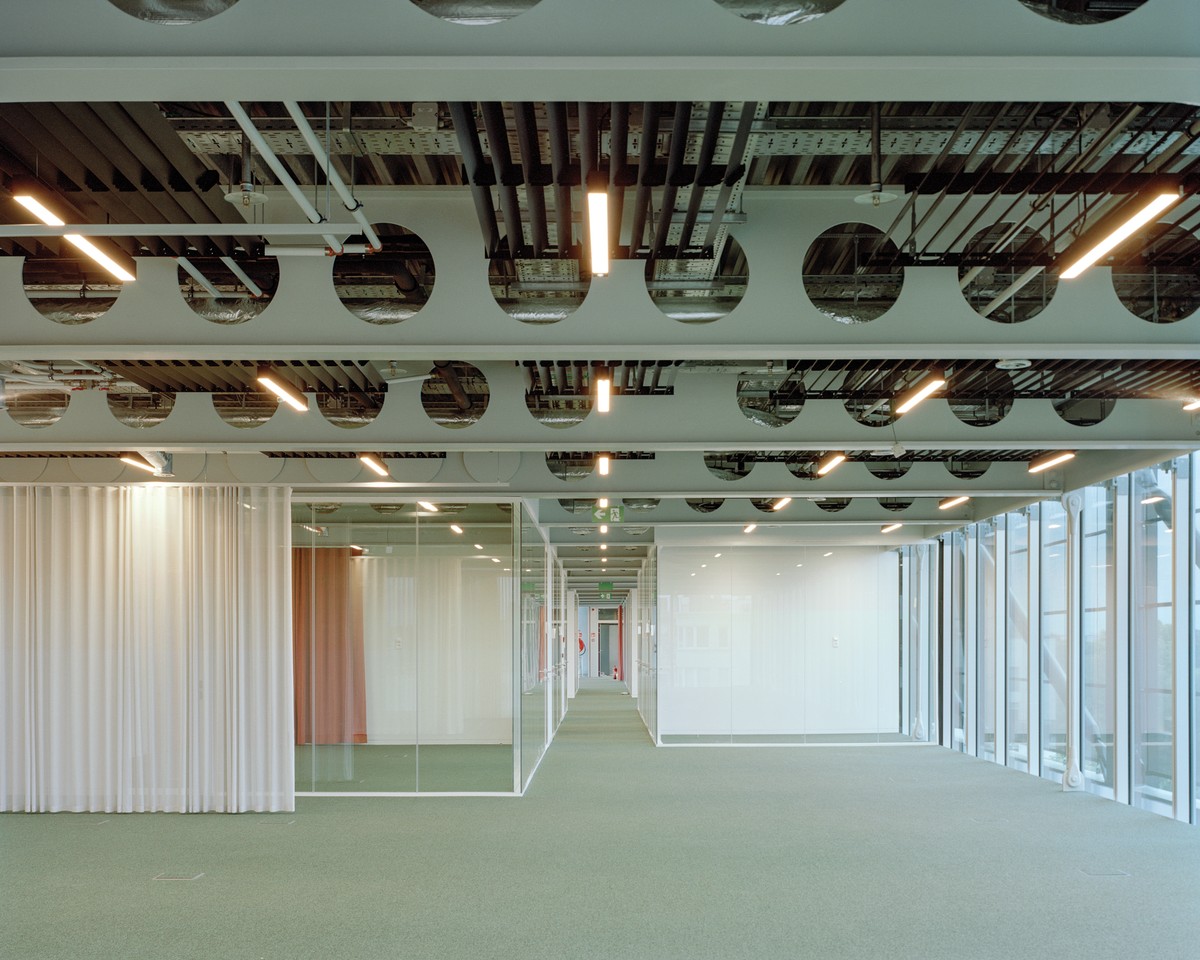
The interiors are column free. Photo © Séverin Malaud, courtesy Bruther
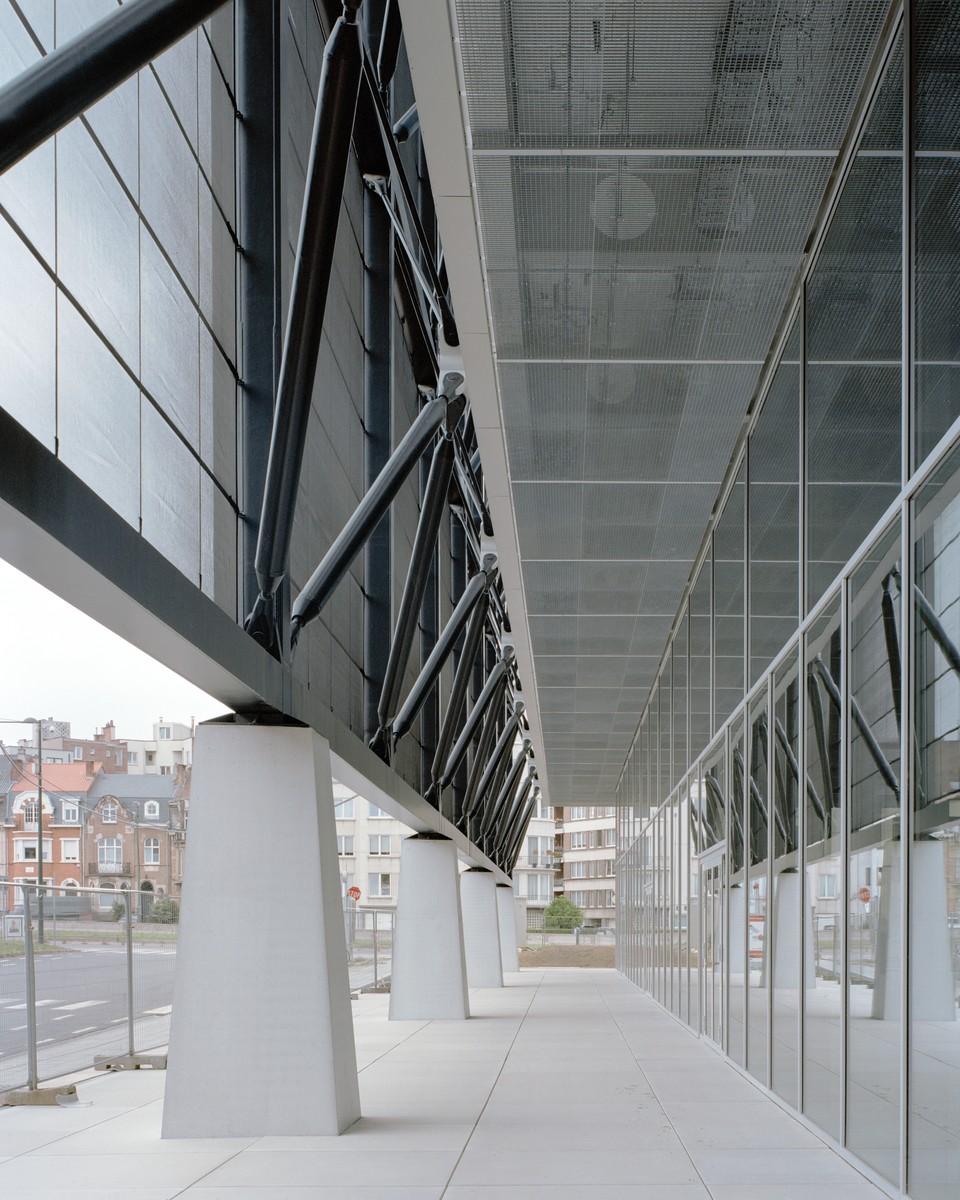
“Frame is more like a piece of infrastructure than a classic building with four walls and windows,” says Bru of the 91,500-square-foot edifice. To achieve entirely column-free floors, the architects turned to the principle of the exoskeleton but gave it very different expression at the front, in comparison to the rear. While full-height concrete piers, set 25 feet apart, give a cadence to the northern elevation, the southern facade features a giant steel frame that stands on stumpy concrete columns and comprises 25-by-25-foot squares. Spider ties connect the frame to every other floor, with each of those in between being suspended from the one above.
1
2
Short concrete piers support the structural steel frame and form an arcade. Photos © Séverin Malaud, courtesy Bruther (1), Maxime Delvaux, courtesy Baukunst (2)
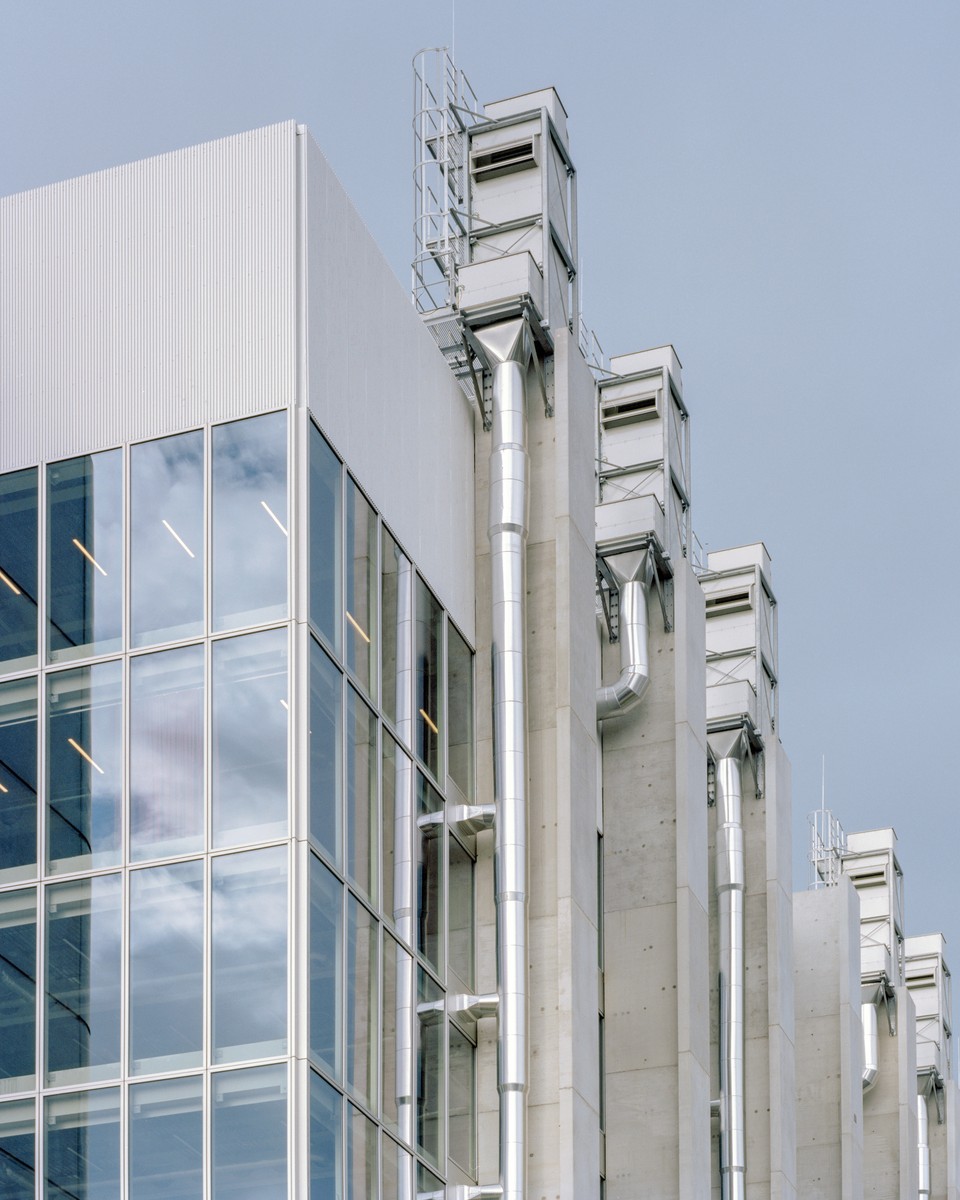
Mechanical systems are exposed. Photo © Maxime Delvaux, courtesy Baukunst
Mechanical systems are also externalized, snaking up the northern facade and onto the roof, while external concrete cores, placed to the east and northwest, contain stairs, elevators, and restrooms, and help to stiffen the structure against the wind.
“We imagined the southern facade as a giant billboard, visible from your car as you drive down the boulevard,” says Bru. It is also a screen, in both the metaphorical and literal sense, since strapped to it are sheets of agricultural windbreak, a tough, inexpensive fabric mesh the architects repurposed as sunlight filters. Floor-to-ceiling glazing units make up the building envelope, in line with the client’s request for maximum daylight penetration; on the western elevation, a reflective coating mitigates the hot afternoon sun, while on the ground floor the envelope pulls back to create an entrance porch to the west and a covered colonnade to the south. In this architecture of assemblage and tectonics, articulations and forces are all made visible, as demonstrated inside at the top level, which was engineered as an “inhabited beam,” or outside in the different diameters of the spider-tie rods, those in compression being noticeably thicker than those in tension.
Frame’s interior is divided into seven levels: a basement parking garage, a tall ground floor, four standard floors, and a double-height top level, which has been fitted out as TV and radio studios for the local news station, BX1. A bistro will soon occupy the ground floor, audiovisual archives and coworking spaces are programmed for part of the building, while the remainder has yet to find tenants. The building’s dimensions, Verschuere explains, were based on a module of 5 feet, which is half of the minimum width required for a workspace. Measuring 50 feet by 220 feet, each floor is rented entirely empty, with cellular beams and ceiling tech left deliberately exposed. “We provided a toolbox for tenants, explaining how to fit the spaces out,” says Verschuere.
Frame’s construction involved a high degree of prefabrication, in both concrete and metal. Assembling all the different components was a complex operation, during which the floors were supported on scaffolding poles; only once everything was in place could they be removed and the building set in tension. “It was a little nerve-racking, like launching a ship,” says Verschuere. Indeed, given the challenges posed by Frame’s complex engineering, not to mention the project’s ballooning costs as Covid and the war in Ukraine took their toll—slated at €16 million ($18.7 million), it finally came in at around €20 million ($23.3 million)—he wonders whether it would still be possible to build such a structure today.
As for the language Frame speaks, it is clearly High Tech, the idiom pioneered by architects such as Renzo Piano, Su Rogers, and Richard Rogers at the Centre Pompidou (1971–77) or Foster + Partners at the Hong Kong and Shanghai Bank (1979–86). Though evidently adept at exploiting its aesthetic possibilities, Baukunst and Bruther are far more interested in its functional potential than in its machine-age glamour: they would be more than happy to see Frame’s systems stripped away and its glazing changed in order to allow natural ventilation, something that Belgium’s construction code currently prohibits.
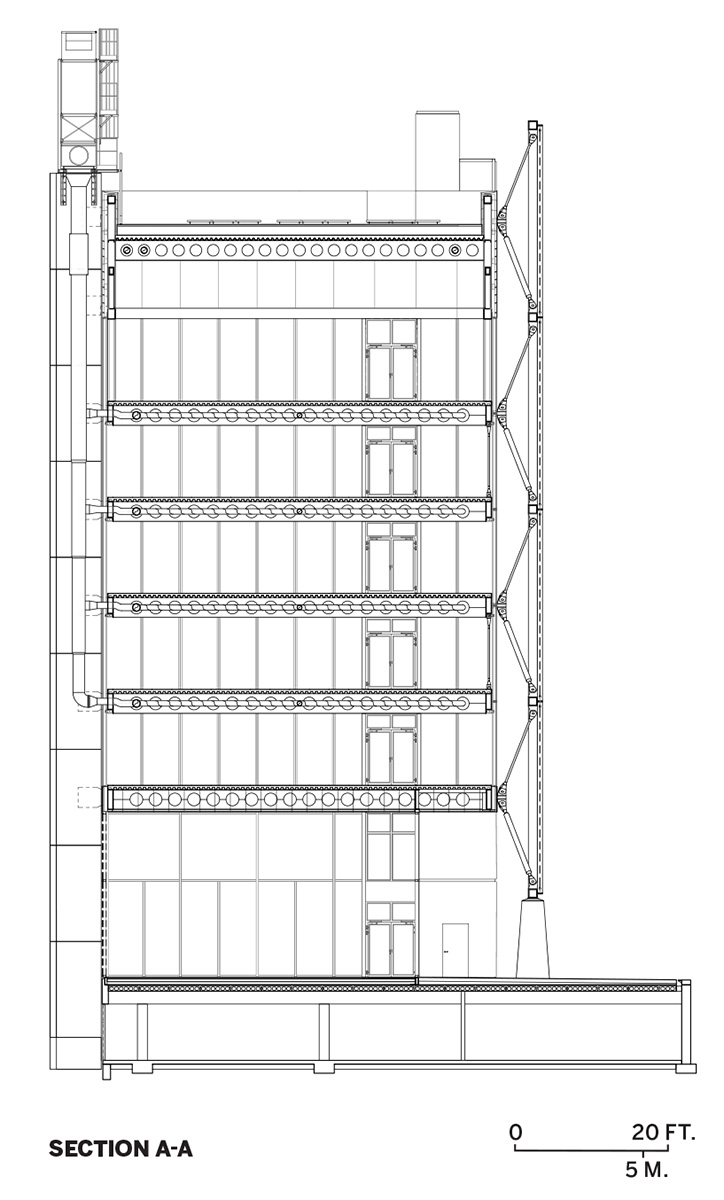
Image courtesy Baukunst
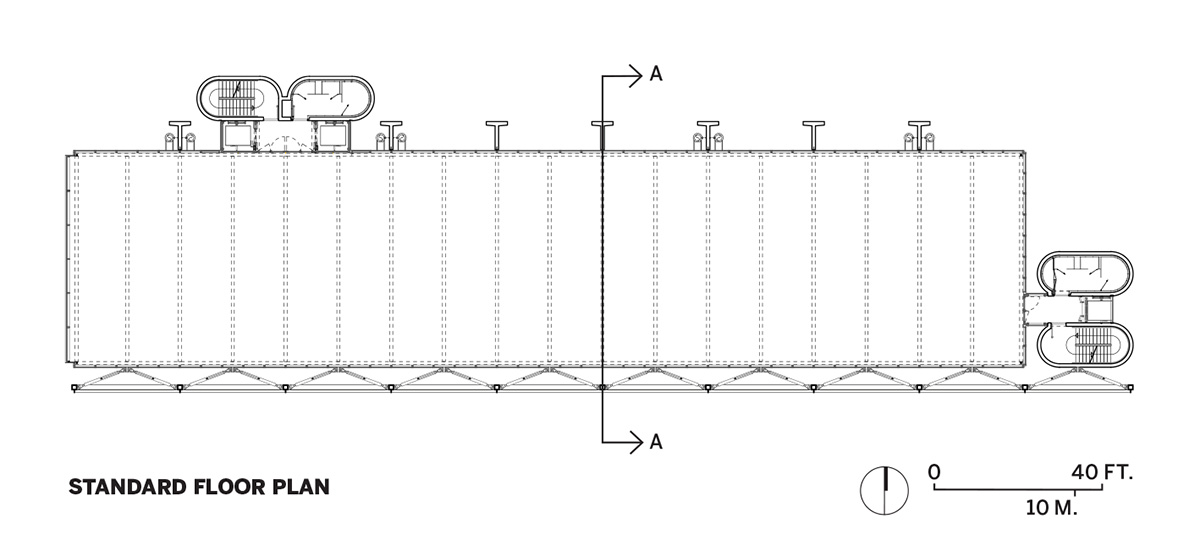
Image courtesy Baukunst
Looking for quick answers on architecture and design topics?
Try Ask RECORD, our new smart AI search tool.
Ask RECORD →
Looking for a reprint of this article?
From high-res PDFs to custom plaques, order your copy today!