The Bard Graduate Center Mounts the First U.S. Exhibition of Viollet-le-Duc’s Expansive Drawing Practice
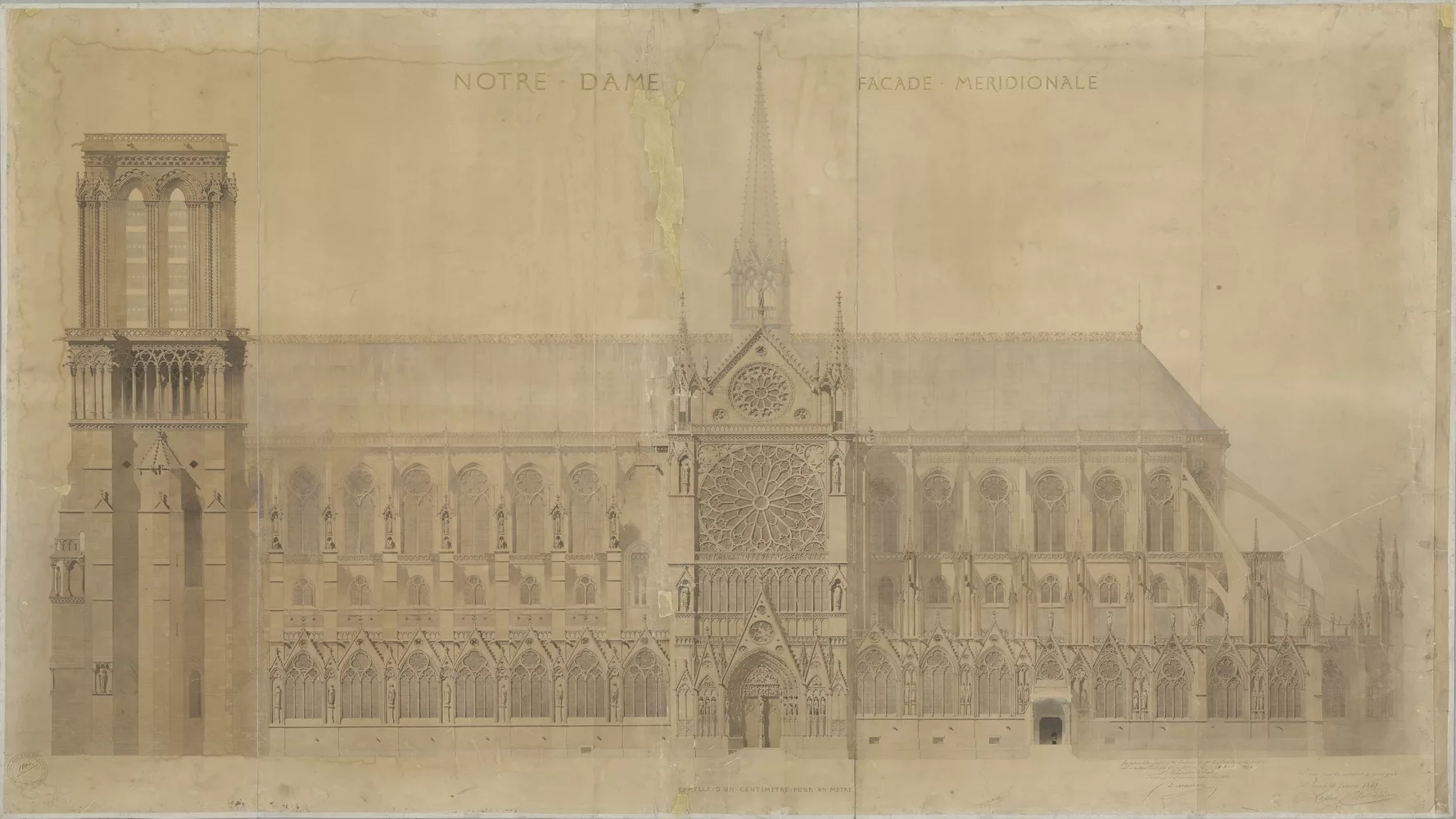
Eugène-Emmanuel Viollet-le-Duc, Jean-Baptiste-Antoine Lassus, south elevation of Notre-Dame de Paris, competition drawing, January 28, 1843. Watercolor on paper. Médiathèque du patrimoine et de la photographie, Charenton-le-Pont, F/1996/83/-1840 |
The harrowing images of Notre-Dame Cathedral engulfed in flames, livestreamed around the world in April 2019, are still emblazoned on the public consciousness. As grieving Parisians watched from the banks of the River Seine, the church’s 315-foot-tall spire, capped in a golden Gallic rooster symbolizing both French identity and Christ’s resurrection, crumbled. Few would have noted that what collapsed in that moment was not an icon that had endured from the 12th century, but a mid-19th-century addition by architect Eugène-Emmanuel Viollet-le-Duc (1814–1879).
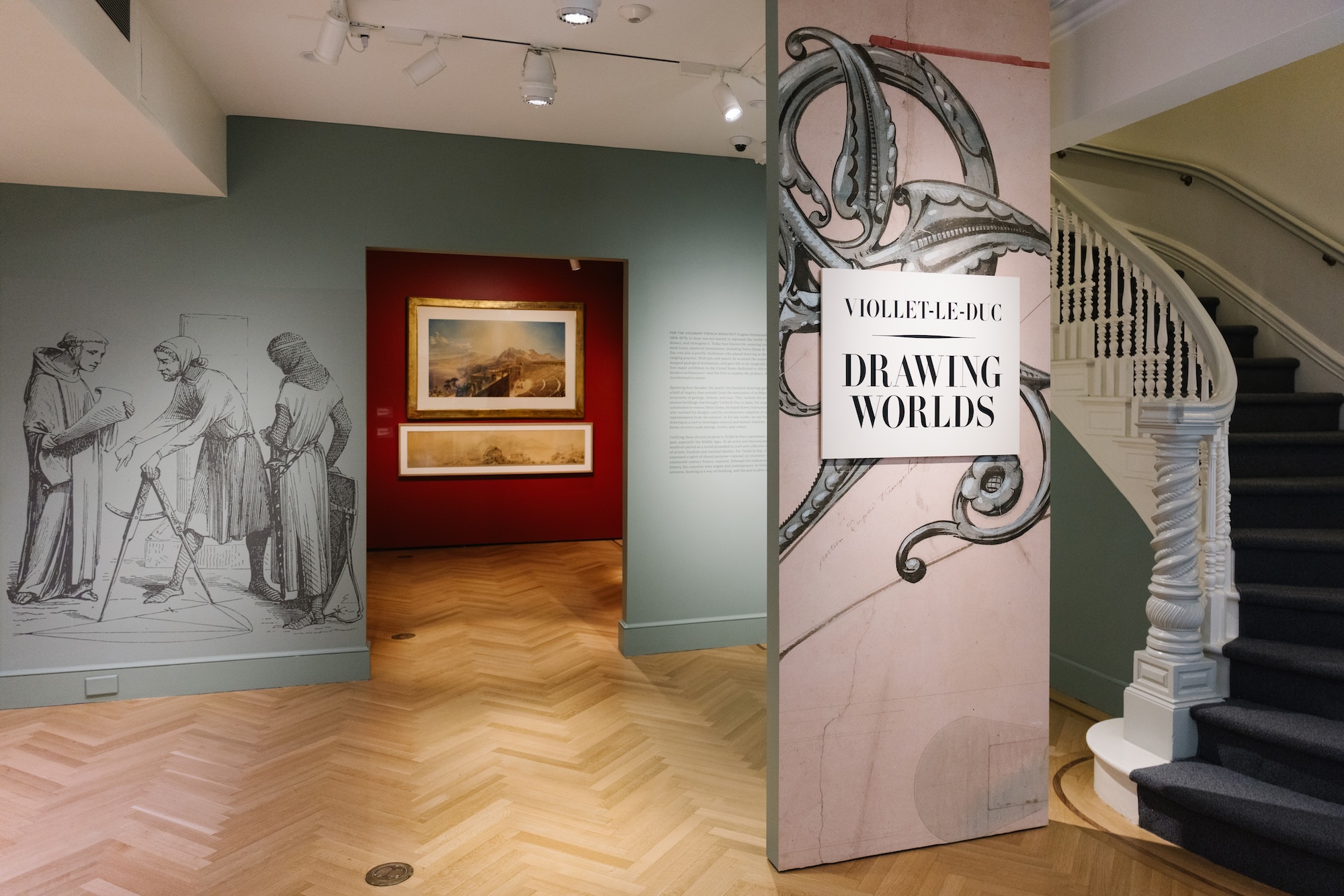
Installation view Viollet-le-Duc Drawing Worlds, Bard Graduate Center, New York. Photo © Da Ping Luo
The cathedral’s remarkable restoration and reopening in December 2024 sparked interest in Viollet-le-Duc, particularly his meticulous drawings, which were used as references by the preservationists working on rebuilding the structure. In this context, planning began for Viollet-le-Duc Drawing Worlds, the first major exhibition in the United States dedicated to the French architect, on view at the Bard Graduate Center in New York City through May 24, 2026. The show was cocurated by Barry Bergdoll, a Columbia University professor who was formerly the Philip Johnson Chief Curator of Architecture & Design at the Museum of Modern Art, and Martin Bressani, an architect and historian teaching at McGill University who, in 2014, published a comprehensive biography of Viollet-le-Duc titled Architecture and the Historical Imagination.
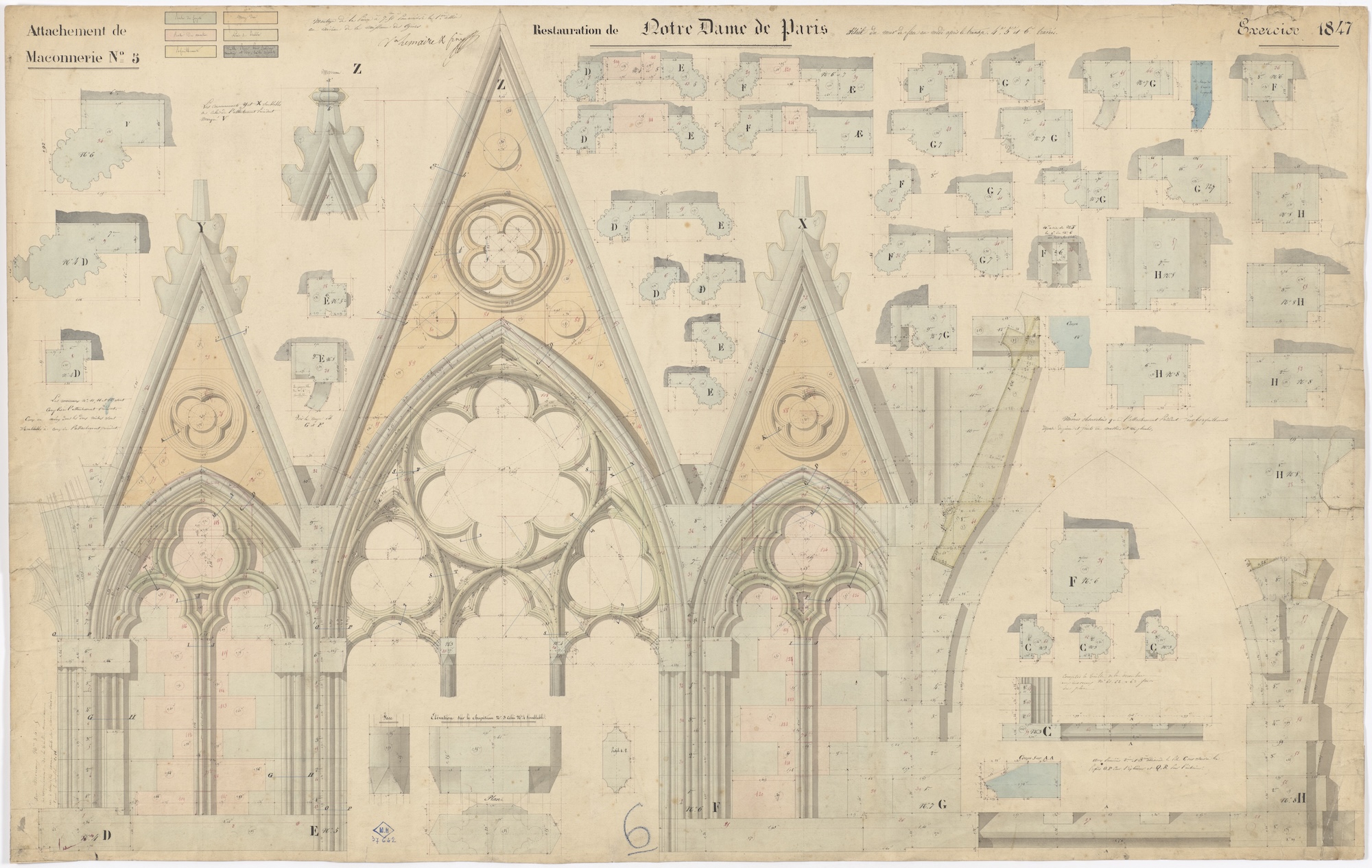
Jean-Baptiste-Antoine Lassus, Eugène-Emmanuel Viollet-le-Duc, and Émile Boeswillwald, Janvier; Lemaire et frères (contractors), southern choir aisle of Notre-Dame de Paris, shop drawing of the gables of the fourth, fifth, and sixth bays after the transept, 1847. India ink and wash on paper. Médiathèque du patrimoine et de la photographie, Charenton-le-Pont, F/1996/83/389-37642.
The show focuses on Viollet-le-Duc’s extensive drawing practice. Spanning four floors, Drawing Worlds brings together more than 150 works, including sketches, working drawings, graphite and charcoal renderings, ink washes, paintings, and even a few models and furniture pieces. Most of the material was lent by France’s Médiathèque du patrimoine et de la photographie, a national media library housing much of the architect’s archives. After an introductory gallery on the first floor that establishes Viollet-le-Duc’s interests and prowess as a draftsman through a selection of his earliest travel drawings and commissions, gallerygoers ascend to the second level, where they are met with the grand dame herself.
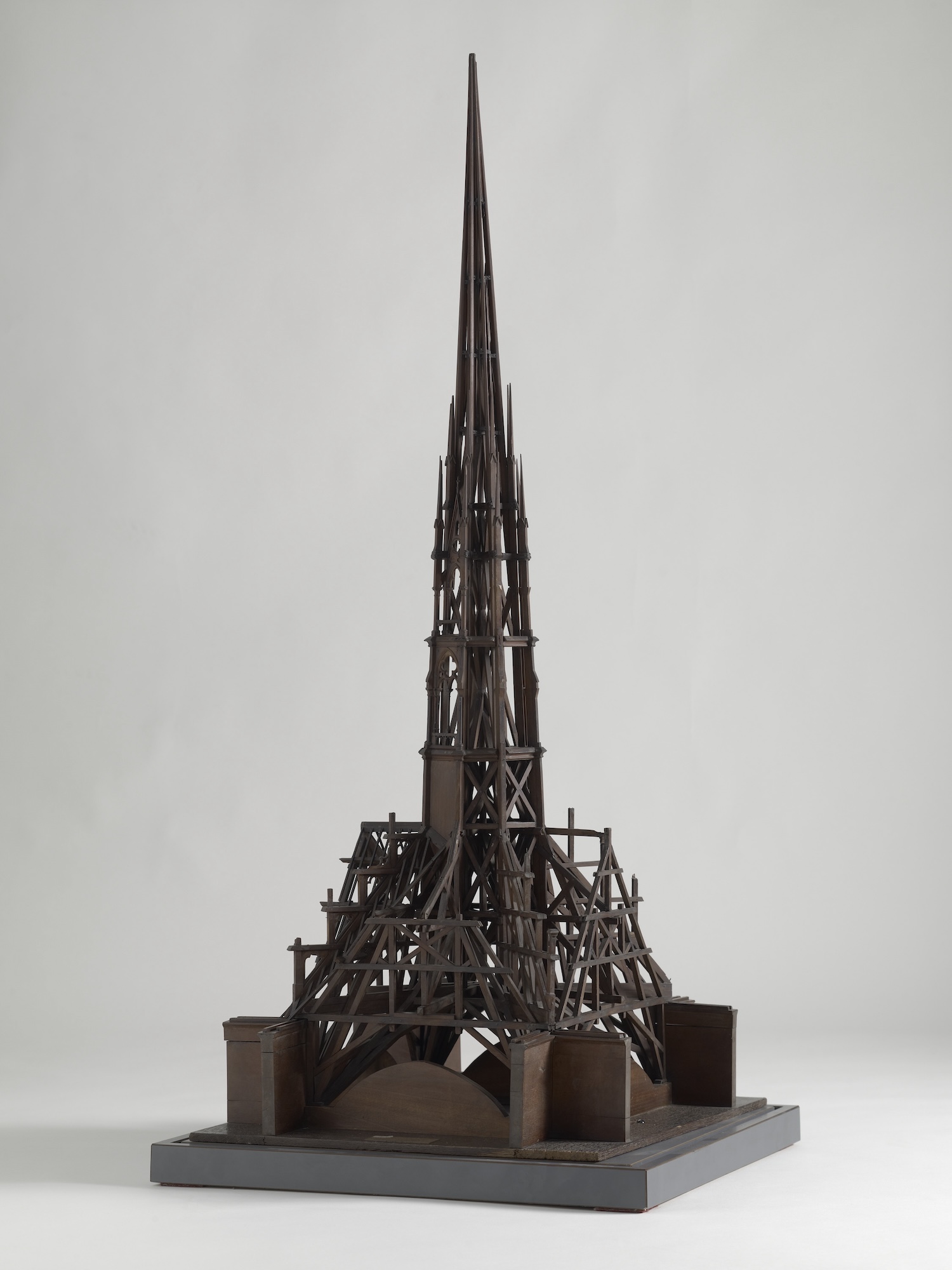
The entire second floor is dedicated to the drawings that Viollet-le-Duc, with Jean-Baptiste Lassus (1807–1857), produced in the two decades spent restoring Notre-Dame to its medieval splendor. From the large-format plans, elevations, and sections of the 1843 competition entry, the color-coded attachements that recorded daily progress on-site, to doodled designs of the 56 gargoyles that were added during the restoration, the documentation is exhaustive. While the curators are interested in the “practice of drawing as a way of seeing and knowing,” as Bergdoll emphasizes, it’s the 1858 wood model of Viollet-le-Duc’s spire that steals the show—perhaps its exposed skeleton is reminiscent of the images from the 2019 fire, a video of which is also on display on a small screen in the gallery.
1

2
Auguste Bellu (French, 1796–1862), carpenter, model of the spire of Notre-Dame de Paris, ca. 1858. Wood and paint. Médiathèque du patrimoine et de la photographie, Charenton-le-Pont, Z/1996/81/197-1 (1); Eugène-Emmanuel Viollet-le-Duc (French, 1814–79); Jean-Baptiste-Antoine Lassus (French, 1807–57), west elevation of Notre-Dame de Paris, competition drawing, January 28, 1843. Watercolor. Médiathèque du patrimoine et de la photographie, Charenton-le-Pont, F/1996/83/189-4358 (2).
The 19th-century restoration of Notre-Dame demonstrates Viollet-le-Duc’s dual nature. On the one hand, he was a Romantic, reimagining and bringing to life a halcyon past through his drawings. But on the other, he was a protomodernist, adopting a scientific approach of careful study, categorization, and detailing to understand these worlds lost to time. “Viollet-le-Duc approached Gothic construction like a biologist,” write the curators. The wall text for an ink-washed sketch of a reconstructed Colosseum from 1836 gives an example in his own words, quoting a letter Viollet-le-Duc wrote to his father: “I sit down, and after much effort to decipher its construction, my imagination takes hold of me. I see the Colosseum with its immense tiers packed with Romans. I see purple velum stretched above the crowd, their murmur like the sea from afar.”
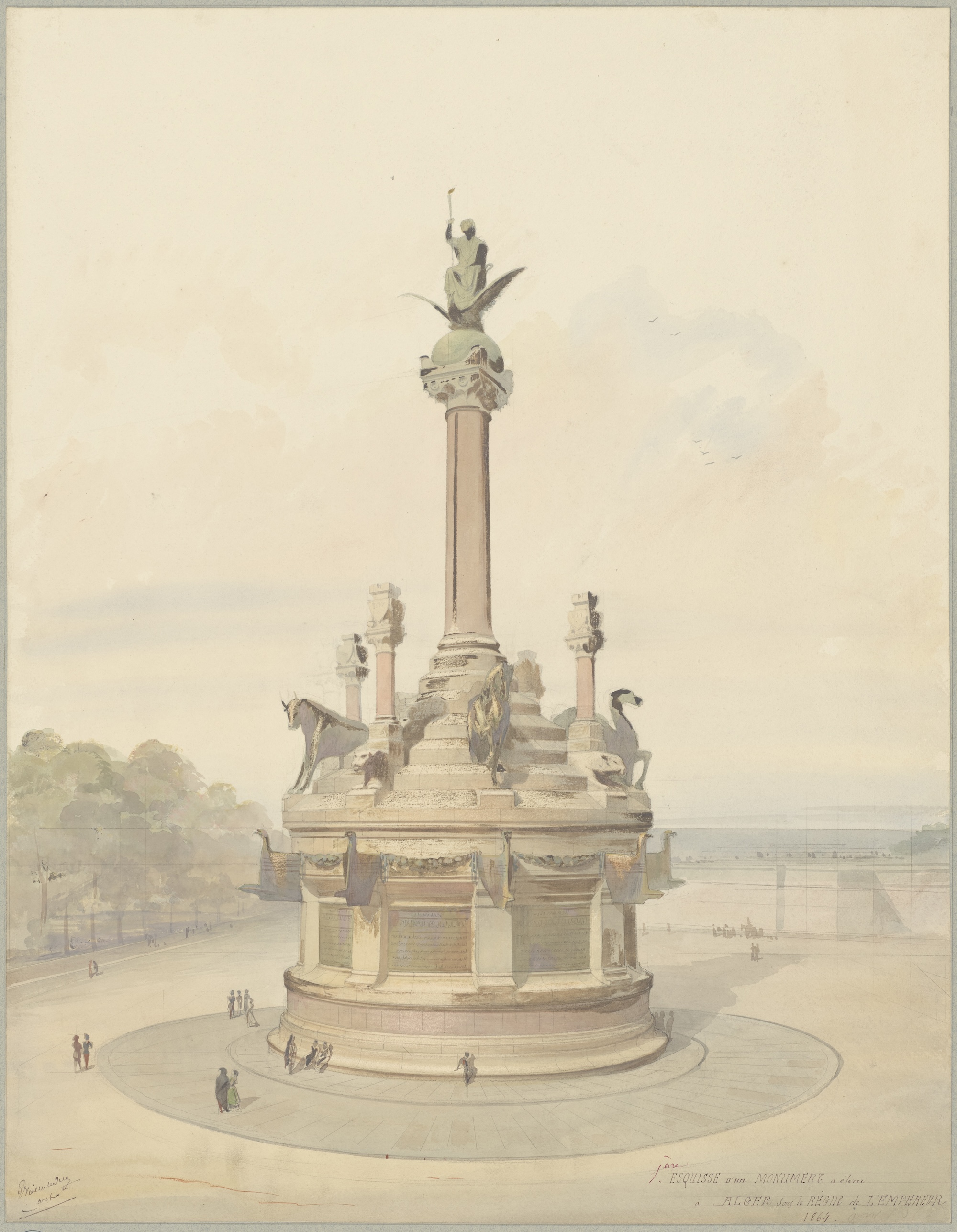
Eugène-Emmanuel Viollet-le-Duc, first sketch for a monument to be erected in Algiers under the reign of Emperor Napoleon III, 1864. Ink, watercolor and wash on paper. Médiathèque du patrimoine et de la photographie, Charenton-le-Pont, F/1996/83/332-1442.
Recurring in wall texts as a constant reminder that the architectural is never far from the political, Napoleon III haunts the show as the constant presence behind Viollet-le-Duc’s work. The architect is said to have “had his ear,” but the exact dimensions of that relationship are not enumerated. While the machinations in France during Viollet-le-Duc’s life are beyond the scope of this show (and of this review), Napoleon III can be understood as a populist strongman who suppressed the chaos that had defined more than two decades by the time he declared himself emperor in 1852—think uprisings and barricades like the 1832 June Rebellion immortalized in Victor Hugo’s Les Misérables.
It was another of Hugo’s books that laid the political groundwork for Viollet-le-Duc’s restoration of Notre-Dame: published in 1831, The Hunchback of Notre-Dame cast the decrepit Gothic cathedral as a tarnished emblem of the once-great nation. Viollet-le-Duc’s restoration work—both of Notre-Dame and Carcassonne, that medieval fortified city in the south of France, which is documented on the third floor—should be understood not merely as Romanticism, but as a project entwined with French identity and the politics of his day. He viewed the Gothic not as a medieval relic but as a symbol of rational progress, a technological innovation birthed in France that could point toward modernity.
Looking for quick answers on architecture and design topics?
Try Ask RECORD, our new smart AI search tool.
Ask RECORD →

Eugène-Emmanuel Viollet-le-Duc, fortified city of Carcassonne, elevation of the west front, restored and existing state, January 1853. Ink and watercolor on paper. Médiathèque du patrimoine et de la photographie, Charenton-le-Pont, F/1996/83/6-128.
Fortunately, this is subtext in the exhibition. Perhaps bucking the trend, or rather the trap that befalls many architecture shows, Bergdoll isn’t didactic in his approach to curation, instead inviting exploration and open-ended interpretation (a praiseworthy aspect also of his 2023 exhibition in Mexico City on Sordo Madaleno Arquitectos). The work of Viollet-le-Duc is presented as comprehensively and with as much context as can be expected in a retrospective spanning a 40-year career. This is especially welcome on the third floor, where Viollet-le-Duc’s interest in taxonomy beyond architecture is highlighted. Like other early modernists, it led him to racial pseudoscience: drawings of his “Aryan Chalet” and other grisly documents are simply presented as facts, neither anachronistically moralized nor whitewashed.
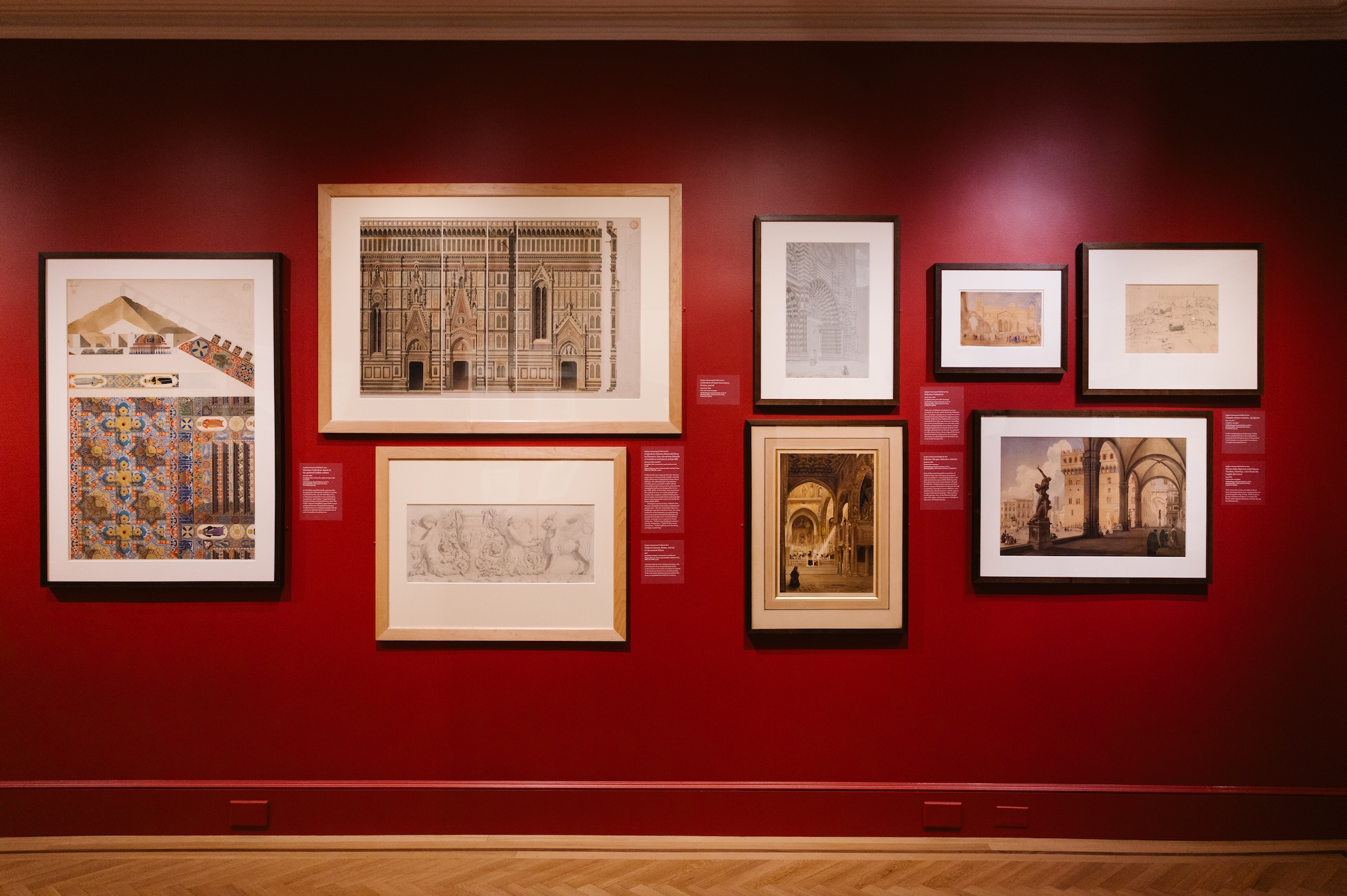
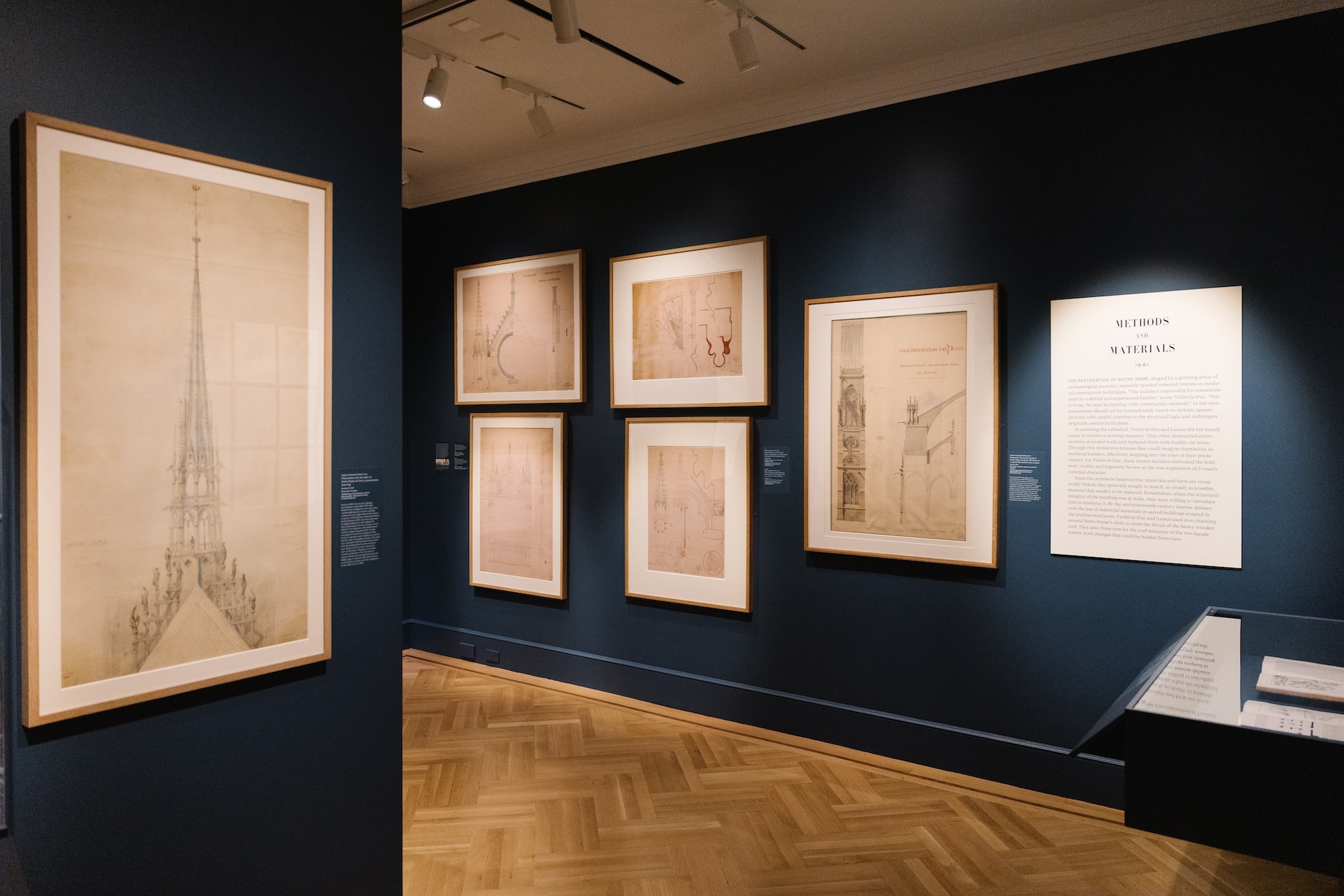
Installation views Viollet-le-Duc Drawing Worlds, Bard Graduate Center, New York. Photos © Da Ping Luo
The fourth-floor gallery brings questions of restoration, heritage, and national identity into the present, with a VR tour, Lego set, video game, and Disney cartoon each engaging the legacy and cultural importance of Notre-Dame. As Bergdoll notes, “ideas about historical memory in architecture, and the role of society in shaping buildings, are as relevant today as they were in Viollet-le-Duc’s time.” In a corner of the top-floor gallery is a large copper mold. Metalsmith Joe Wood and sculptor Chuck Stigliano used the drawings Viollet-le-Duc produced nearly 200 years ago to recast and remount the Gallic rooster that was lost in the fire, reimagining it as a phoenix rising from the ashes.
Looking for a reprint of this article?
From high-res PDFs to custom plaques, order your copy today!