‘Material Worlds’ Celebrates Bruce Goff’s Miscellany
A twinkling disco ball suspended above an eye-searing fluorescent pedestal greets visitors to an exhibition at the Art Institute of Chicago (AIC). It is an apt entry point for a playful yet reverent investigation of the work of Bruce Goff (1904–82), the underexplored Oklahoma architect best known for his idiosyncratic houses that explode with color, surprise with texture, and refuse simple categorization. Bruce Goff: Material Worlds, on view until March 29, curated by Alison Fisher and Craig Lee, is the first show at the AIC in 30 years to exhibit the architect’s inimitable practice and sprawling archive.

Bruce Goff in his office at the University of Oklahoma, about 1954. Photo by Philip B. Welch; Art Institute of Chicago, Ryerson and Burnham Art and Architecture Archives, Bruce A. Goff Archive
For the curators, the time was ripe to introduce Goff to a new audience. Detecting an “antiminimalist” sentiment in the zeitgeist, they position Goff as an alternative to the well-trodden histories of modernism. Once derided as the “Michelangelo of kitsch” by historian Charles Jencks, Goff’s high-low taste serves as a respite from constraining century-old values.
Beside the disco ball hang other objects from the Goff collection: a Japanese temari toy ball, a garland of shag carpet samples, and a mirrored-plastic T-square. This is “a different kind of retrospective,” Lee explains, one that aims at exploring Goff’s mind. “One of the things we can do uniquely at the AIC with its comprehensive Goff collection is showcase the totality of the person and his creative world.”
.jpg "Material Worlds Bruce Goff")
.jpg "Material Worlds Bruce Goff")
The exhibition, designed by New Affiliates, puts furniture, artworks, and drawings in dialogue. Photos © Joseph Tallarico
Goff was largely self-taught. Showing a proclivity for drawing, at 12 years old he apprenticed at the architecture firm Rush, Endacott and Rush in Tulsa, Oklahoma, and made firm partner by 26. He corresponded closely with Frank Lloyd Wright and Louis Sullivan at that time. Goff’s first works are in Tulsa. These designs, like the Boston Avenue United Methodist Church (1929), presented in the exhibition through an expressive charcoal rendering, or the Glass Block and Vitrolite House (1936), introduce Goff as an architect simultaneously with-it—that is, steeped in an emerging American avant-garde—but also “profoundly uncomfortable with labels, ‘organic architecture’ chief among them,” says Fisher. In the exhibition, interior renderings of the 1939 Marks House in Chicago—Wrightian at first glance—are paired with spectacular Japanese woodblock prints from Goff’s extensive art collection. Surprising juxtapositions cleverly order the show. Presented in curvilinear, colorful casework by exhibition designers New Affiliates, Goff’s architecture is put into conversation with his eccentric art collection. Thai sculpture, Hopi paintings, Austrian ceramics, and Japanese textiles share space with butterfly specimens and magazines.
Goff was also influential in his transformative role as the head of the School of Architecture at the University of Oklahoma. The groundbreaking pedagogy he created there, dubbed the American School, challenged students to develop their own personal expression and resourcefulness rather than replicate the products of modernist dogma. The curators situate Goff’s work in context with his prairie identity. Described by architect Paul Nicolaides as a “cross between a tepee and an oil derrick,” the Hopewell Baptist Church (1948) draws on local labor and vernacular forms and recalls both the infrastructure of extraction and Indigenous dwellings. The oversized, immersive watercolor perspective of the church demonstrates what the curators call an “alternative kind of site-specificity.”
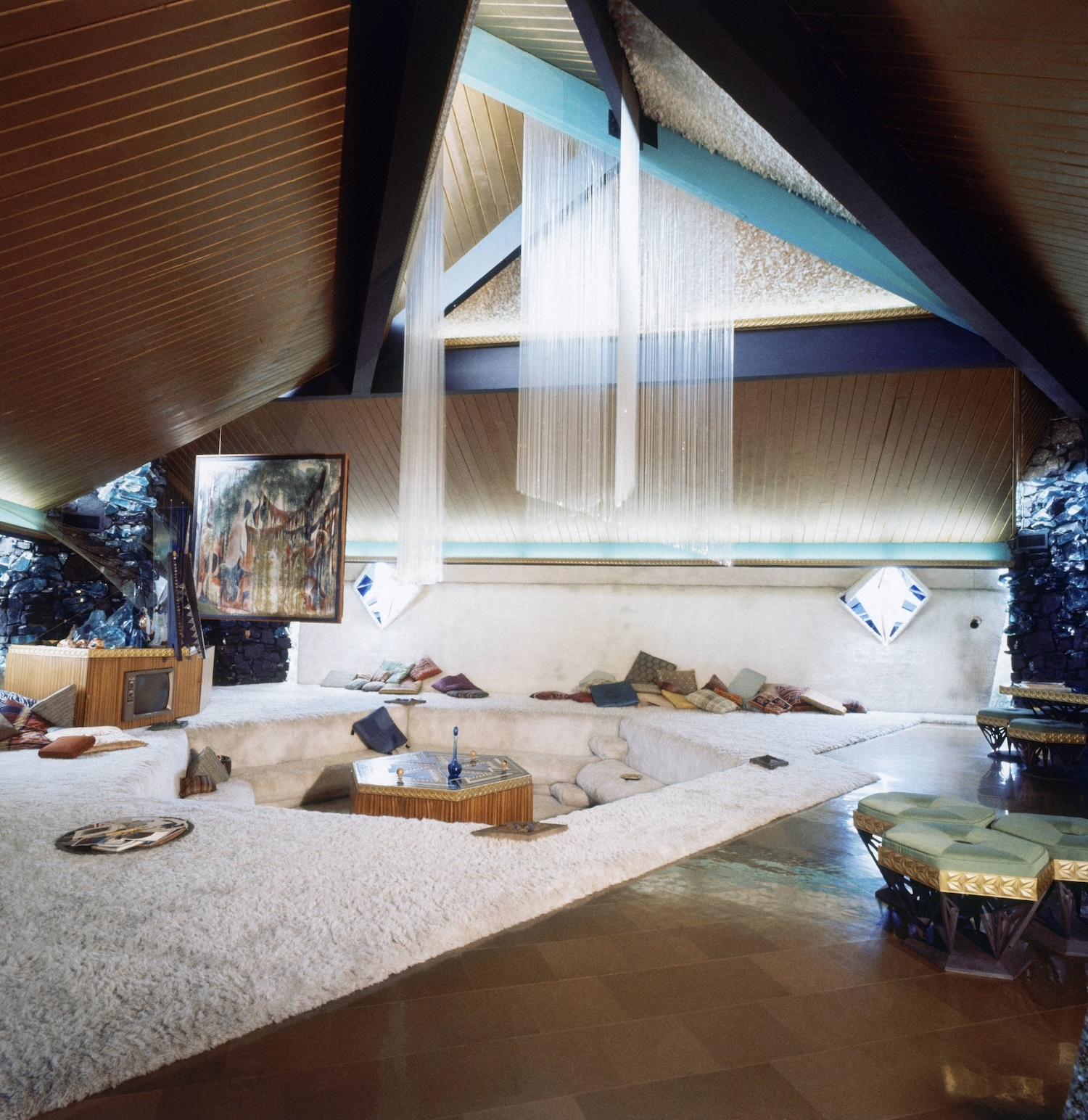
Goff’s interests expand into pop culture. His formal language closely tracks a midcentury sci-fi aesthetic that is at once pulpy and profound. Issues from his collection of the sci-fi magazine Omni are set against a perspective drawing of the 1952 Garvey House, a jellyfish-swarm of clear plastic domes and aluminum orbs. Quips Fisher: “Mies is looking back at Palladio. Goff is looking at Star Trek.” While he’s not trying to create social change through technology (“He’s not a Buckminster Fuller,” she says), Goff pushes against confining social mores by reordering the prototypical American home from within. The indoor garden of the Irma Bartman House (1956), and the white shag conversation pit at the Etsuko and Joe Price House (1972) hint at his domestic politics.
1
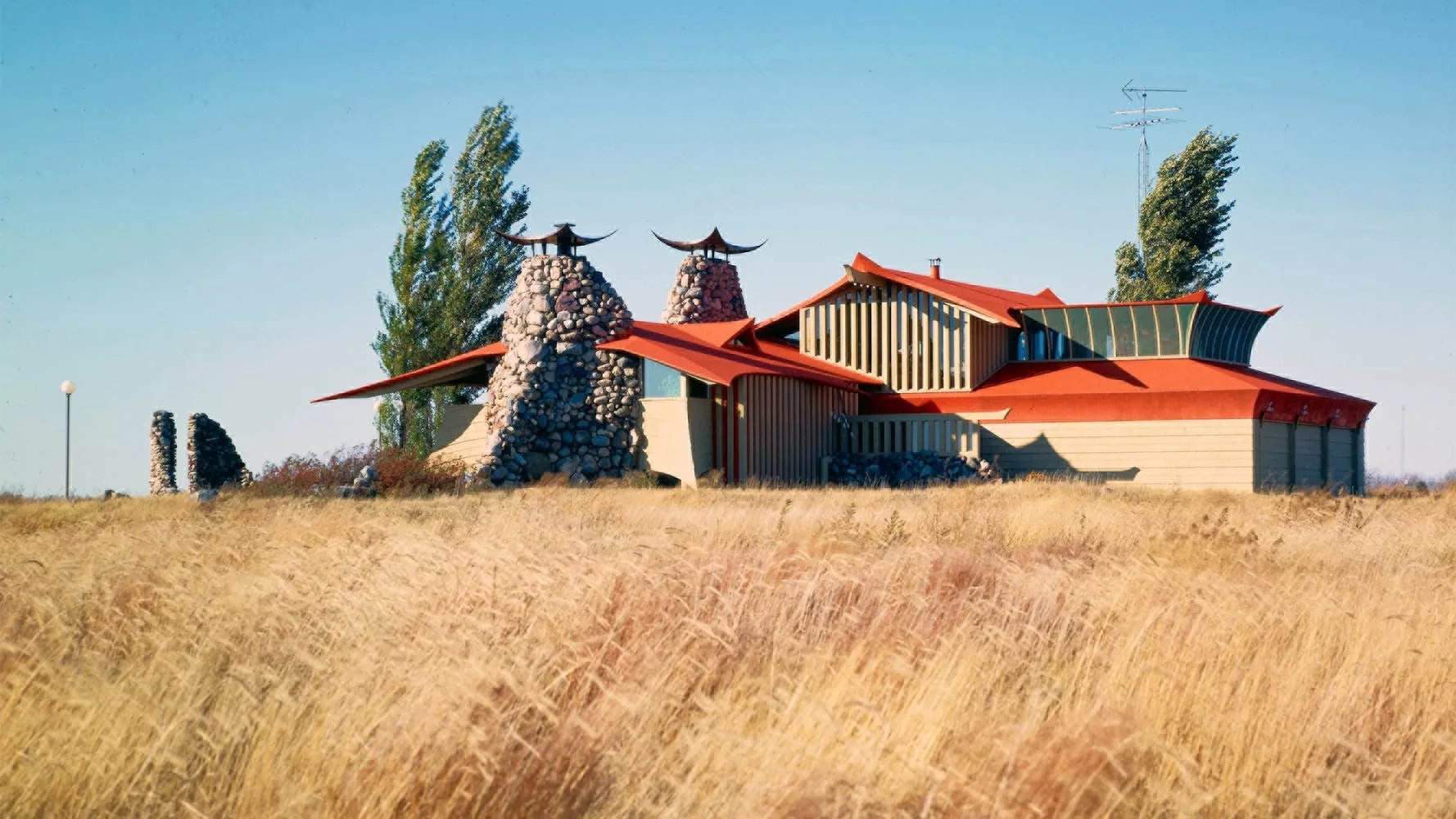
Projects like the Eugene and Nancy Bavinger House (1) and Etsuko and Joe Price House (2) demonstrate Goff’s formal expressiveness. Image courtesy Art Institute of Chicago. gift of Shin’enKan, Inc; (1); photo by Horst P. Horst for Vogue (2)
2
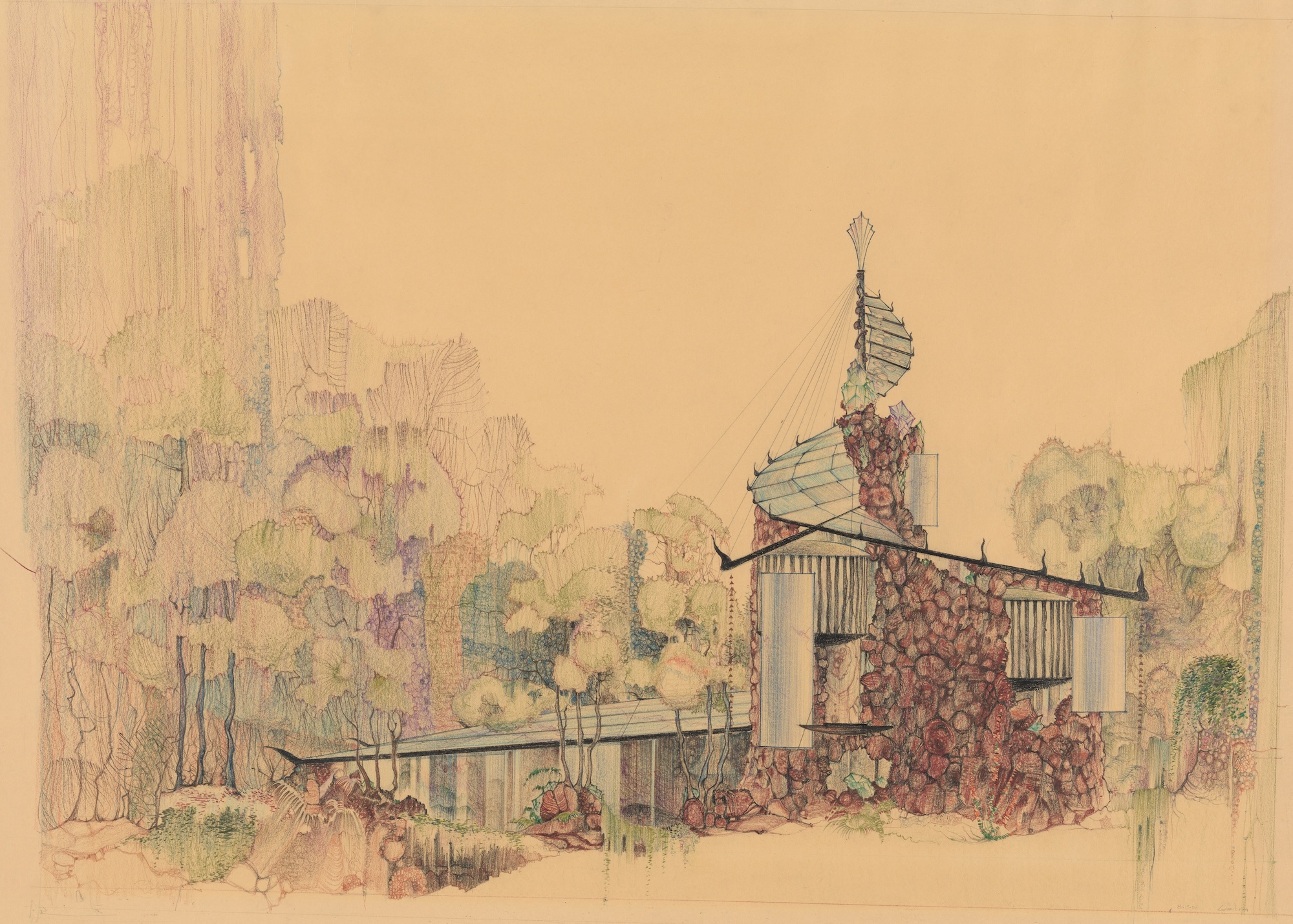
When immersed in this riotous material world—the dozens of abstract paintings on lenticular plastic alone are enough to dazzle and confound—it’s impossible not to become a Goff disciple. One is left in a pink haze: As designers, is it enough just to express yourself? In the Architecture and Design gallery upstairs, New Affiliates instead “reimagines” Goff’s most emblematic houses for us, literally unravelling the nautilus spiral of his Bavinger House (1950) and, by situating its rough stone and cullet wall within a landscape of felled trees, oil rigs, and Quonset huts, placing it literally against the backdrop of resource extraction and military mobilization. This context tempers the exuberance of Goff’s work.
One critical set of items links Goff’s varied material practices—a player piano and the percussive, not-quite atonal music it automatically performs, and an unfurled player roll hand-incised with intricate geometric patterns. For Lee, these compositions are where “architecture, painting, and music collide.” The crafting of form and experience is at the heart of these material landscapes. They suggest a creativity neither hung up on disciplinary boundaries nor absorbed by navel-gazing. At a moment when the purview of the architect has ballooned to planetary systems and aesthetic pursuits have been fettered to didactic signaling or relegated to the set-dressing of crisis response, Material Worlds grounds us within sincere, joyful acts of making.
Looking for quick answers on architecture and design topics?
Try Ask RECORD, our new smart AI search tool.
Ask RECORD →
Looking for a reprint of this article?
From high-res PDFs to custom plaques, order your copy today!
.webp?height=200&t=1766000778&width=200 "Glen and Luetta Harder House, Mountain Lake, Minnesota, 1980. Bruce Goff. Photograph by Julius Shulman. © J. Paul Getty Trust. Getty Research Institute, Los Angeles (2004.R.10).jpeg")