From the RECORD Archives: 'House of the Tranquil Mind'

“House of the Tranquil Mind”
By Paul M. Sachner
Architectural Record, September 1988
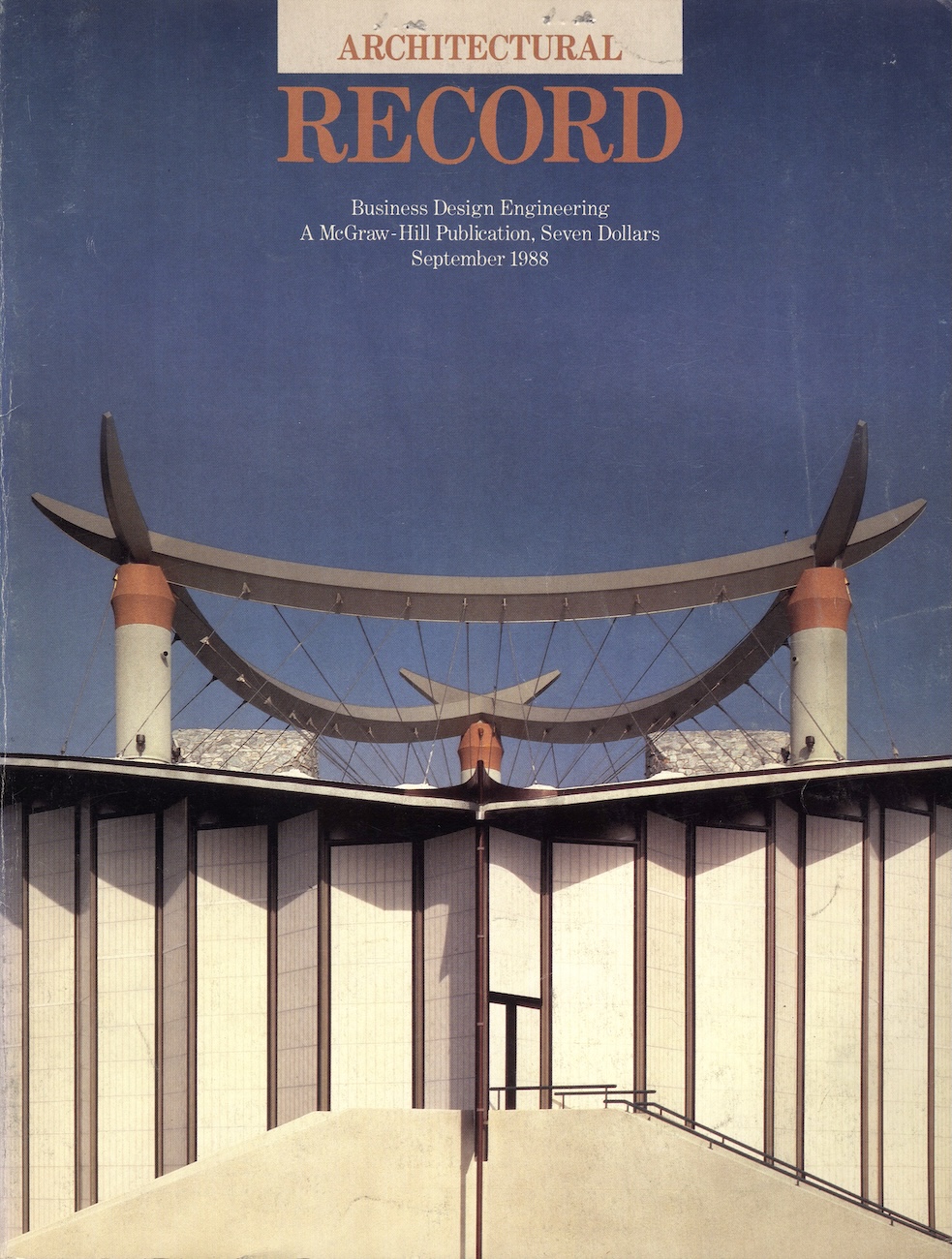
Between 1978 and 1982 Bruce Goff sketched preliminary plans for a unique gallery of Japanese art, but he died before completing the design. A six-year collaboration among a generous patron, a talented disciple, and an expanding Los Angeles museum has turned Goff’s schematic drawings into built reality. The result is an instant landmark along Wilshire Boulevard and an homage to one of America’s greatest architectural expressionists.
© Architectural Record, September 1988
“Simplicity is considered by some a virtue,” wrote Bruce Goff in 1957, “but it may only disguise the absence of anything important; complexity is sometimes considered confusing, when in reality this is only a matter of first appearance.” Throughout a long career that began in 1916 when the 12-year-old Goff entered an apprenticeship with the Tulsa firm of Rush, Endacott & Rush and ended with the architect’s death in 1982, he consistently masked some surprisingly straightforward notions about program and interior space with elaborate geometries and complicated structural mannerisms. Given the highly personal character of his buildings, most of which are single-family homes inaccessible to the public, scattered across the Great Plains and Southwest, Goff has addled historians attempting to determine his position among his architectural contemporaries. As David De Long observes in a monograph recently published by the Architectural History Foundation, Goff’s artistic temperament, like Frank Lloyd Wright’s, was based on “an expression of individual choice unfettered by concerns of taste of style.” The Kansas-born architect, geographically and philosophically isolated from the intellectualizing of Bauhaus-trained peers, believed that “each time we do a building, it should be the first and the last . . . Artists who attempt to create a ‘manner’ or ‘style’ by endless variations on a theme . . . usually have only one song to sing.” If a few critics still dismiss Goff as an aberrant footnote to the history of 20th-century architecture, most have come to view his oeuvre in a more favorable light, using terms such as “characteristically American” or “romantically idiosyncratic” to describe Goff’s 450 commissions and 147 realized designs.
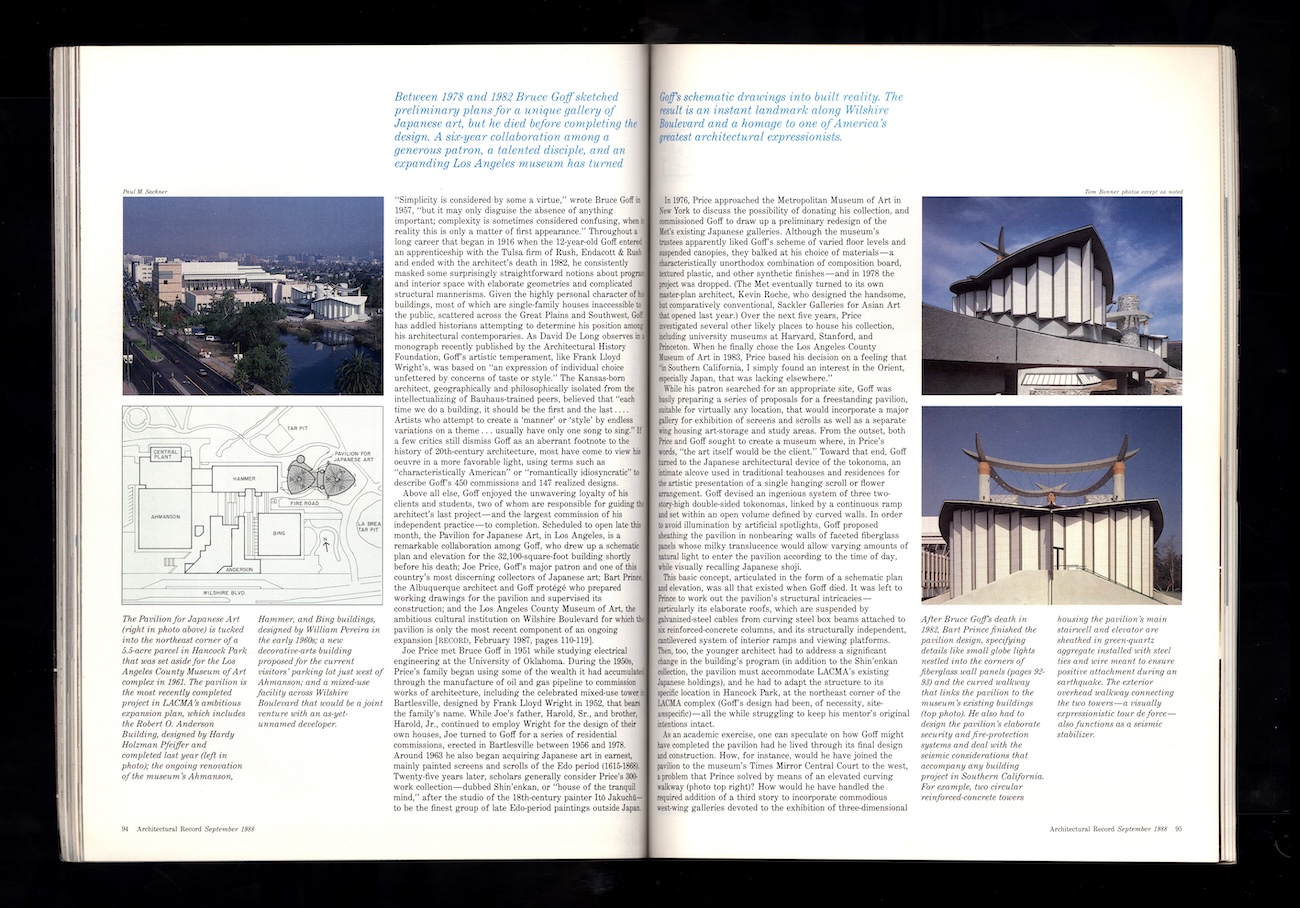
Above all else, Goff enjoyed the unwavering loyalty of his clients and students, two of whom are responsible for guiding the architect’s last project—and the largest commission of his independent practice—to completion. Scheduled to open late this month, the Pavilion for Japanese Art, in Los Angeles, is a remarkable collaboration among Goff, who drew up a schematic plan and elevation for the 32,100-square-foot building shortly before his death; Joe Price, Goff’s major patron and one of this country’s most discerning collectors of Japanese art; Bart Prince, the Albuquerque architect and Goff protégé who prepared working drawings for the pavilion and supervised its construction; and the Los Angeles County Museum of Art, the ambitious cultural institution on Wilshire Boulevard for which the pavilion is only the most recent component of an ongoing expansion (RECORD, February 1987).
© Architectural Record, September 1988
Joe Price met Bruce Goff in 1951 while studying electrical engineering at the University of Oklahoma. During the 1950s, Price’s family began using some of the wealth it had accumulated through the manufacture of oil and gas pipeline to commission works of architecture, including the celebrated mixed-use tower in Bartlesville, designed by Frank Lloyd Wright in 1952, that bears the family’s name. While Joe’s father, Harold, Sr., and brother, Harold, Jr., continued to employ Wright for the design of their own houses, Joe turned to Goff for a series of residential commissions, erected in Bartlesville between 1956 and 1978. Around 1963 he also began acquiring Japanese art in earnest, mainly painted screens and scrolls of the Edo period (1615–1868). Twenty-five years later, scholars generally consider Price’s 300-work collection—dubbed Shin’enkan, or “house of the tranquil mind,” after the studio of the 18th-century painter Itō Jakuchū—to be the finest group of late Edo-period paintings outside Japan.
In 1976, Price approached the Metropolitan Museum of Art in New York to discuss the possibility of donating his collection, and commissioned Goff to draw up a preliminary redesign of the Met’s existing Japanese galleries. Although the museum’s trustees apparently liked Goff’s scheme of varied floor levels and suspended canopies, they balked at his choice of materials—a characteristically unorthodox combination of composition board, textured plastic, and other synthetic finishes—and in 1978 the project was dropped. (The Met eventually turned to its own master-plan architect, Kevin Roche, who designed the handsome, but comparatively conventional, Sackler Galleries for Asian Art that opened last year.) Over the next five years, Price investigated several other likely places to house his collection, including university museums at Harvard, Stanford, and Princeton. When he finally chose the Los Angeles County Museum of Art in 1983, Price based his decision on a feeling that “in Southern California, I simply found an interest in the Orient, especially Japan, that was lacking elsewhere.”
© Architectural Record, September 1988
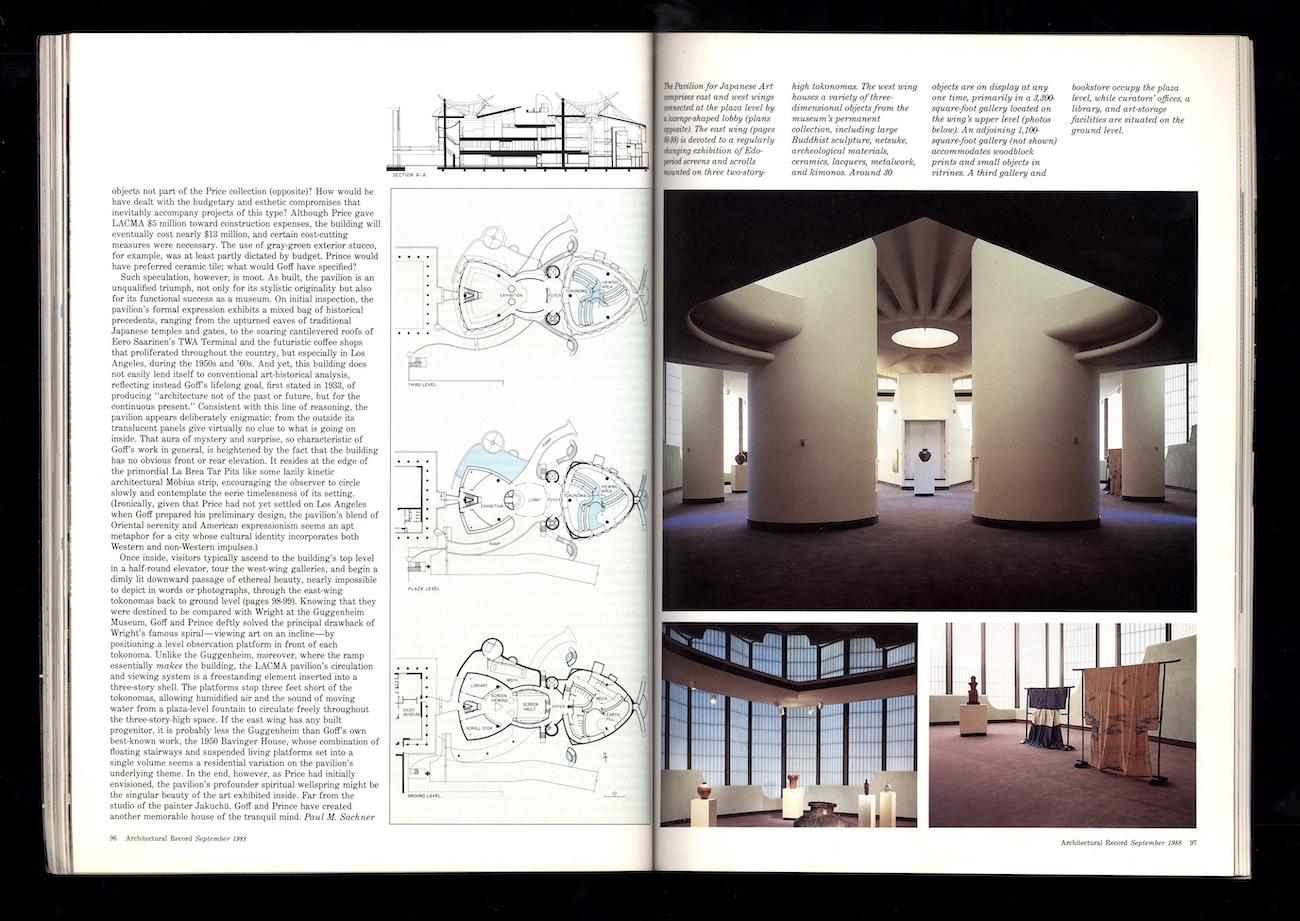
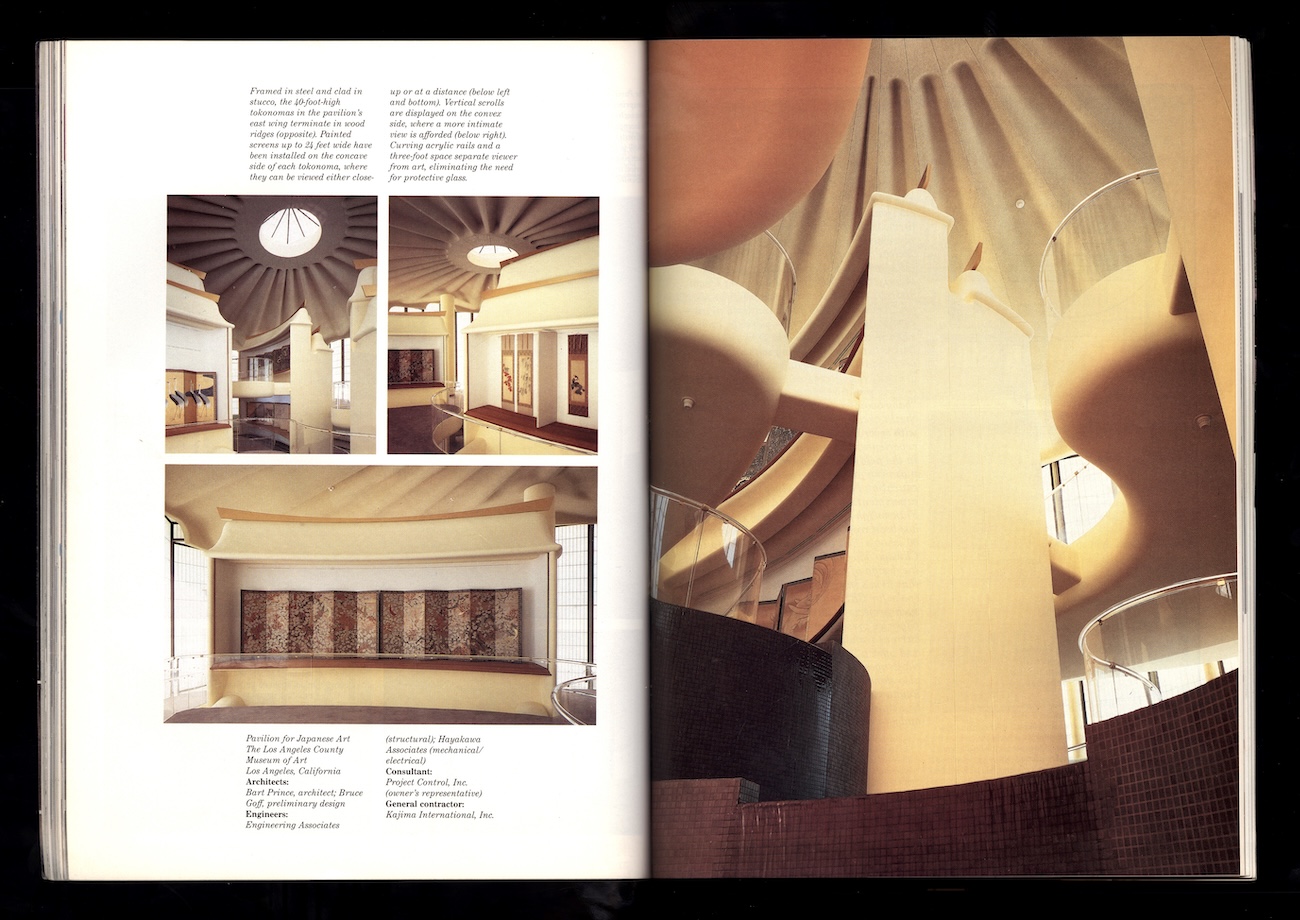
While his patron searched for an appropriate site, Goff was busily preparing a series of proposals for a freestanding pavilion, suitable for virtually any location, that would incorporate a major gallery for an exhibition of screens and scrolls as well as a separate wing housing art-storage and study areas. From the outset, both Price and Goff sought to create a museum where, in Price’s words, “the art itself would be the client.” Toward that end, Goff turned to the Japanese architectural device of the tokonoma, an intimate alcove used in traditional teahouses and residences for the artistic presentation of a single hanging scroll or flower arrangement. Goff devised an ingenious system of three two-story-high double-sided tokonomas, linked by a continuous ramp set within an open volume defined by curved walls. In order to avoid illumination by artificial spotlights, Goff proposed sheathing the pavilion in nonbearing walls of faceted fiberglass panels whose milky translucence would allow varying amounts of natural light to enter the pavilion according to the time of day, while visually recalling Japanese shoji.
Looking for quick answers on architecture and design topics?
Try Ask RECORD, our new smart AI search tool.
Ask RECORD →
The basic concept, articulated in the form of a schematic plan and elevation, was all that existed when Goff died. It was left to Prince to work out the pavilion’s structural intricacies—particularly its elaborate roofs, which are suspended by galvanized-steel cables from curving steel box beams attached to six reinforced-concrete columns, and its structurally independent cantilevered system of interior ramps and viewing platforms. Then, too, the younger architect had to address a significant change in the building’s program (in addition to the Shin’enkan collection, the pavilion must accommodate LACMA’s existing Japanese holdings), and he had to adapt the structure to its specific location in Hancock Park, at the northeast corner of the LACMA complex (Goff’s design had been, of necessity, site-unspecific)—all the while struggling to keep his mentor’s original intentions intact.
© Architectural Record, September 1988
As an academic exercise, one can speculate on how Goff might have completed the pavilion had he lived through its final design and construction. How, for instance, would he have joined the pavilion to the museum’s Times Mirror Central Court to the west, a problem that Prince solved by means of an elevated curving walkway? How would he have handled the required addition of a third story to incorporate commodious west-wing galleries devoted to the exhibition of three-dimensional objects not part of the Price collection? How would he have dealt with the budgetary and aesthetic compromises that inevitably accompany projects of this type? Although Price gave LACMA $5 million toward construction expenses, the building will eventually cost nearly $13 million, and certain cost-cutting measures were necessary. The use of gray-green exterior stucco, for example, was at least partly dictated by budget. Prince would have preferred ceramic tile; what would Goff have specified?
Such speculation, however, is moot. As built, the pavilion is an unqualified triumph, not only for its stylistic originality but also for its functional success as a museum. On initial inspection, the pavilion’s formal expression exhibits a mixed bag of historical precedents, ranging from the upturned eaves of traditional Japanese temples and gates to the soaring cantilevered roofs of Eero Saarinen’s TWA Terminal and the futuristic coffee shops that proliferated throughout the country, but especially in Los Angeles, during the 1950s and ’60s. And yet, this building does not easily lend itself to conventional art-historical analysis, reflecting instead Goff’s lifelong goal, first stated in 1933, of producing “architecture not of the past or future, but for the continuous present.” Consistent with this line of reasoning, the pavilion appears deliberately enigmatic: from the outside its translucent panels give virtually no clue to what is going on inside. That aura of mystery and surprise, so characteristic of Goff’s work in general, is heightened by the fact that the building has no obvious front or rear elevation. It resides at the edge of the primordial La Brea Tar Pits like some lazily kinetic architectural Möbius strip, encouraging the observer to circle slowly and contemplate the eerie timelessness of its setting. (Ironically, given that Price had not yet settled on Los Angeles when Goff prepared his preliminary design, the pavilion’s blend of Oriental serenity and American expressionism seems an apt metaphor for a city whose cultural identity incorporates both Western and non-Western impulses.)
Once inside, visitors typically ascend to the building’s top level in a half-round elevator, tour the west-wing galleries, and begin a dimly lit downward passage of ethereal beauty, nearly impossible to depict in words or photographs, through the east-wing tokonomas back to ground level. Knowing that they were destined to be compared with Wright at the Guggenheim Museum, Goff and Prince deftly solved the principal drawback of Wright’s famous spiral—viewing art on an incline—by positioning a level observation platform in front of each tokonoma. Unlike the Guggenheim, moreover, where the ramp essentially makesthe building, the LACMA’s pavilion’s circulation and viewing system is a freestanding element inserted into a three-story shell. The platforms stop three feet short of the tokonomas, allowing humidified air and the sound of moving water from a plaza-level fountain to circulate freely throughout the three-story-high space. If the east wing has any built progenitor, it is probably less the Guggenheim than Goff’s own best-known work, the 1950 Bavinger House, whose combination of floating stairways and suspended living platforms set into a single volume seems a residential variation of the pavilion’s underlying theme. In the end, however, as Price had initially envisioned, the pavilion’s profounder spiritual wellspring might be the singular beauty of the art exhibited inside. Far from the studio of the painter Jakuchū, Goff and Prince have created another memorable house of the tranquil mind.
Looking for a reprint of this article?
From high-res PDFs to custom plaques, order your copy today!