Close Up
Inside New York City’s Landmarked Steinway Hall and its Adjacent Glass Tower, Bonhams Finds a New Home
New York City
Architects & Firms
Surmounting a city’s egregious overdevelopment takes more than conscientious clients, imaginative architects and designers, and shrewd planners. One more element helps, as shown by the new home for Bonhams auction house at 111 West 57th Street in New York—a scrupulous landmarking commission that keeps historic architectural gems intact.
In February, Bonhams, the auction house founded in 1793 in London, moved its U.S. headquarters into the landmarked Steinway Hall. The 16-story neoclassical building, designed in 1925 by Warren & Wetmore, the architects of Grand Central Terminal, had long been headquarters to the renowned piano manufacturer Steinway & Sons. Nevertheless, the company itself was enticed to move to a new location when JDS Development Group offered to purchase its building and the property around it to build a supertall residential tower. By using air rights zoning, the developers created a skinny 84-story, 1,428-foot-high, 58-foot-wide shaft that hovers over and connects to the existing Steinway Hall. And now 111 West 57th Street is part of what is called Billionaires Row, a slew of needle-like, ultra-high-rise apartment towers stretching along 57th Street.

1

2
The distinct fenestration of Steinway Hall (1) stands out in the North Auction Hall (2). Photos © Tom Sibley (1); Colin Miller (2), click to enlarge.
In spite of its architectural anorexia, 111 West 57th Street, designed by SHoP Architects, is one of the more distinctive works of this cohort, owing to its south-facing stepped-back glazed profile. The architects located most of the structure, completed in 2022, close to 58th Street, where its terra-cotta-clad shear walls are visible on the east and west, just behind the old-world Steinway Hall.
Warren & Wetmore’s Steinway-building exteriors received landmark status in 2001, preserving the handsome Indiana limestone facade with its four-story colonnaded top and pyramidal roof. The stately neo-Renaissance interiors, containing an ornate double-height rotunda with a shallow-domed ceiling and balcony, plus a gently barrel-vaulted corridor on its west side, were landmarked in 2013.
Although the upper floors of Steinway Hall have been converted to 14 luxury condominiums to supplement 45 apartments in the new tower, its lower portion was available for commercial rental. Bonhams saw the opportunity to expand its quarters by 30 percent over its former showroom on Madison Avenue, to 42,000 square feet.
“In addition to having a Midtown street-level showroom, here was a chance to blend the past with the future and make the most of Steinway Hall’s sense of heritage,” says Lilly Chan, managing director of Bonhams US. The auction house, of course, faces competition: last year, Sotheby’s commissioned Herzog & de Meuron to restore and subtly renovate another landmark, the former Whitney Museum on upper Madison Avenue designed by Marcel Breuer (1966). Another rival, Christies, has long been an integral part of Rockefeller Center and was recently renovated and expanded discreetly by Selldorf Architects. The result? Arguably Bonhams’ location is more central than Sotheby’s, and it has more presence on the pavement than Christies.
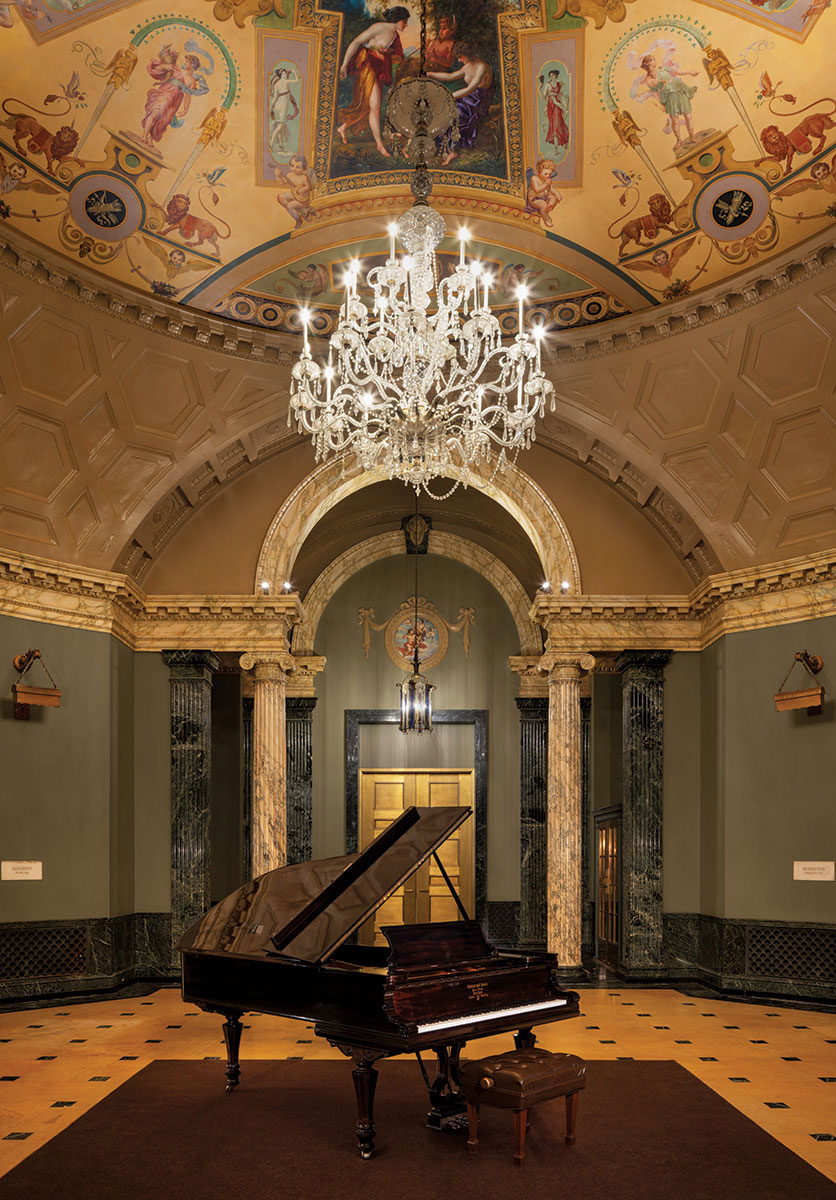
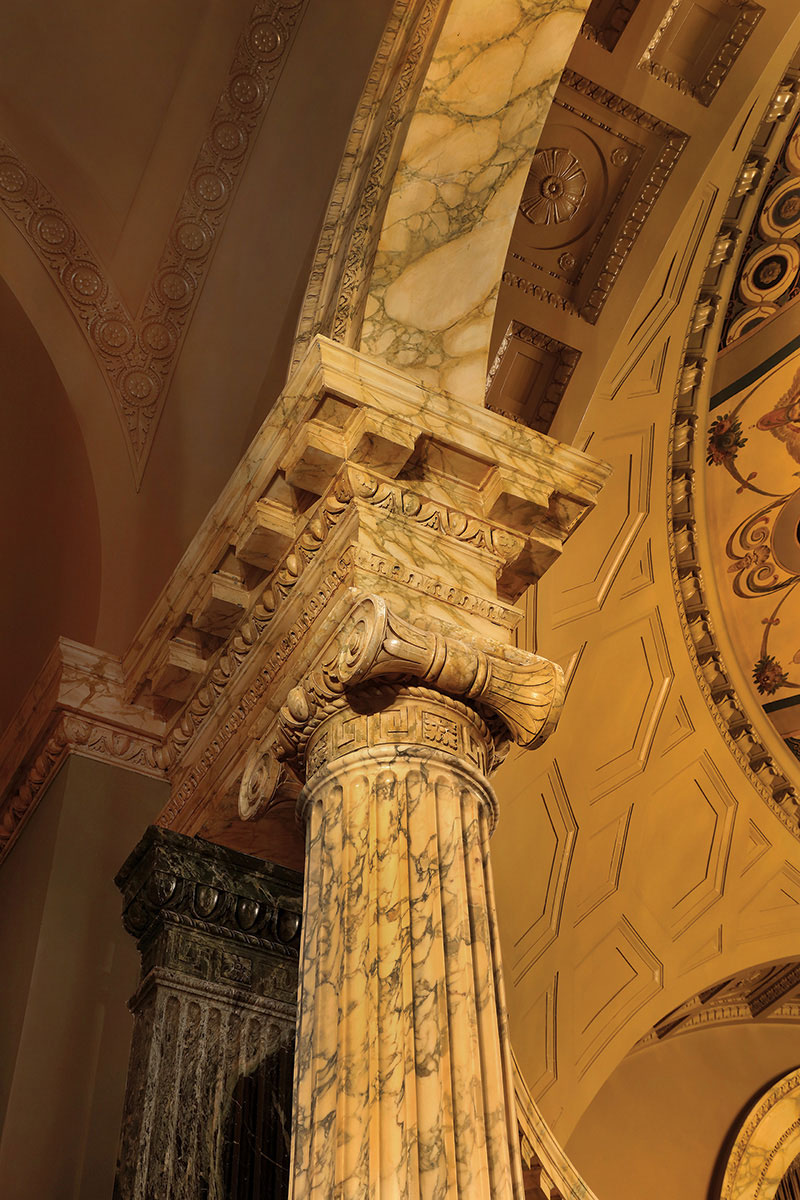
Bonhams chose Gensler to be the design architect for the interior of Steinway Hall, with the understanding it would meld Warren & Wetmore’s architecture with a SHoP-designed 80-foot-high glass-and-steel atrium on the east. Gensler didn’t have to do too much to the rotunda, which had already been restored by the developers of the tower. To enhance the rotunda’s white marble arches and fluted Ionic columns, flanked by pilasters of green marble, the architects placed subdued lighting on top of the cornice molding, while an interior design firm, Design X Nada—which had worked with Bonhams on a salesroom in London—added sedately quirky modern furnishings.
Looking for quick answers on architecture and design topics?
Try Ask RECORD, our new smart AI search tool.
Ask RECORD →
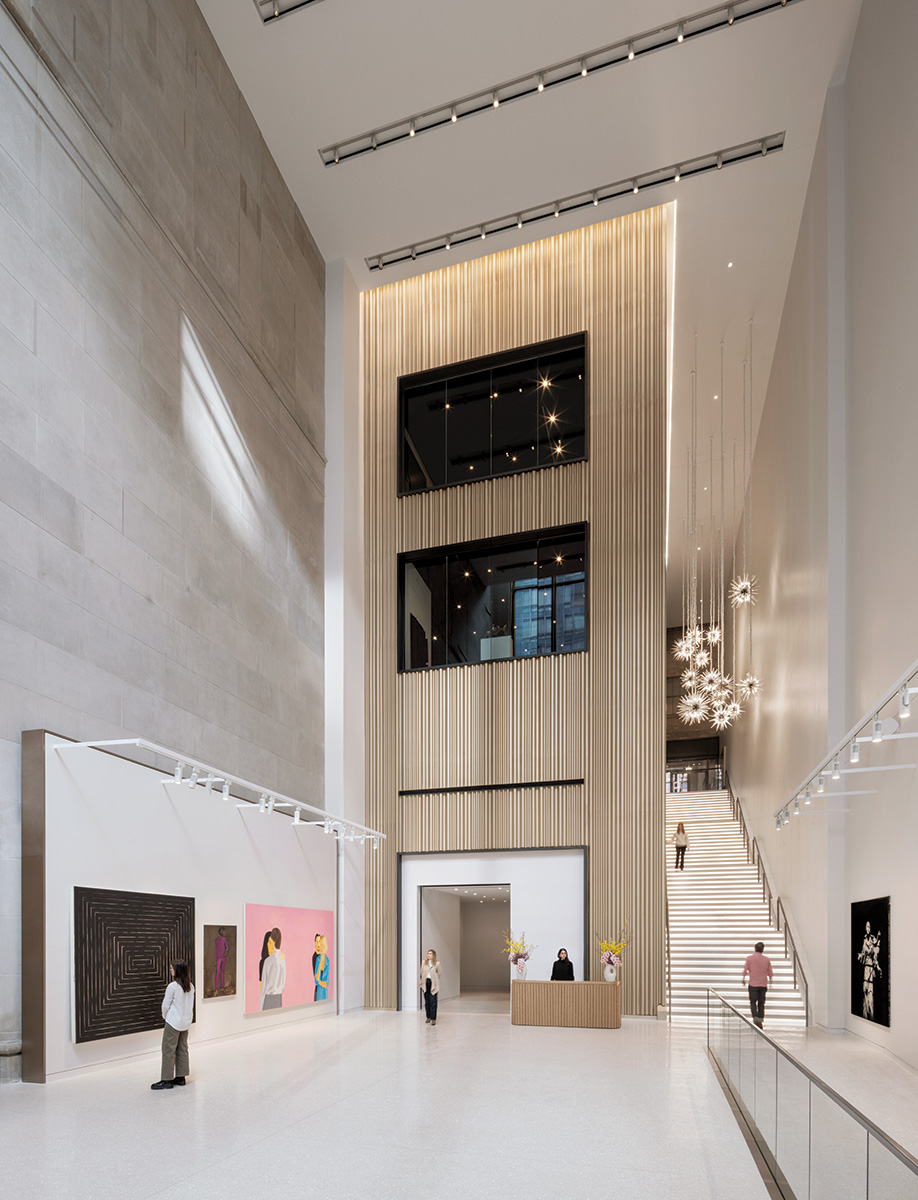
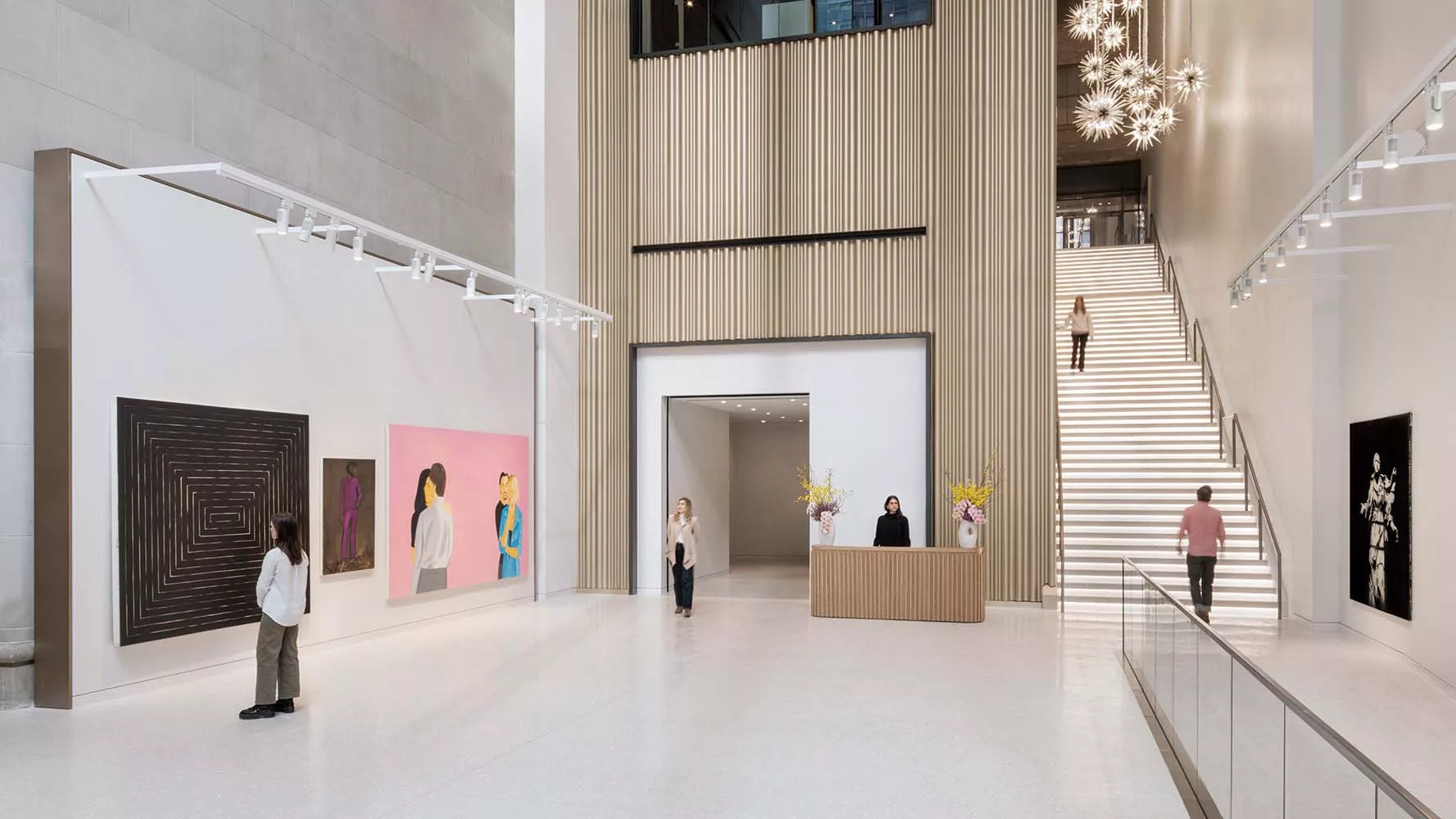
The 80-foot-high atrium is part of SHoP’s glass tower. Photo © Colin Miller
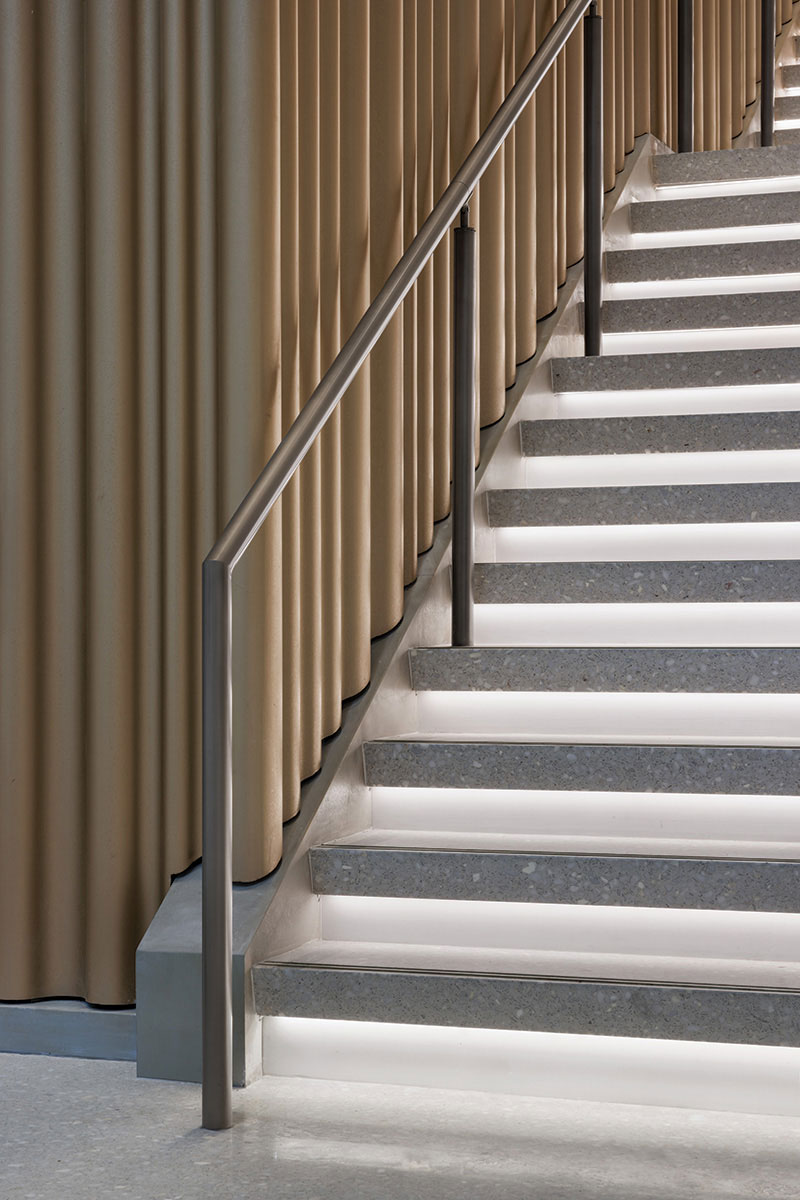
A wavy wall of glass fiber reinforced gypsum meets the monumental stair. Photo © Colin Miller
Visitors to Bonhams enter through the atrium, where they encounter art mounted on Gensler-designed partitions that seem to float in front of the limestone wall separating the rotunda from the atrium. At the back of this soaring, daylight-filled space, the architects wrapped a structural shear core in rippled glass fiber reinforced gypsum cladding, coating it with a silvery-taupe luminescent paint. “We tried to echo the contours of the draperies that were in the old Steinway showrooms,” says Gensler design director Jason Carney. Flanking the core on the east is a stairway of sleek white terrazzo, the same material as the atrium floor. Its treads are softly lit underneath to create an ethereal glow and counterbalance the sparkling illumination from the Murano chandeliers above.
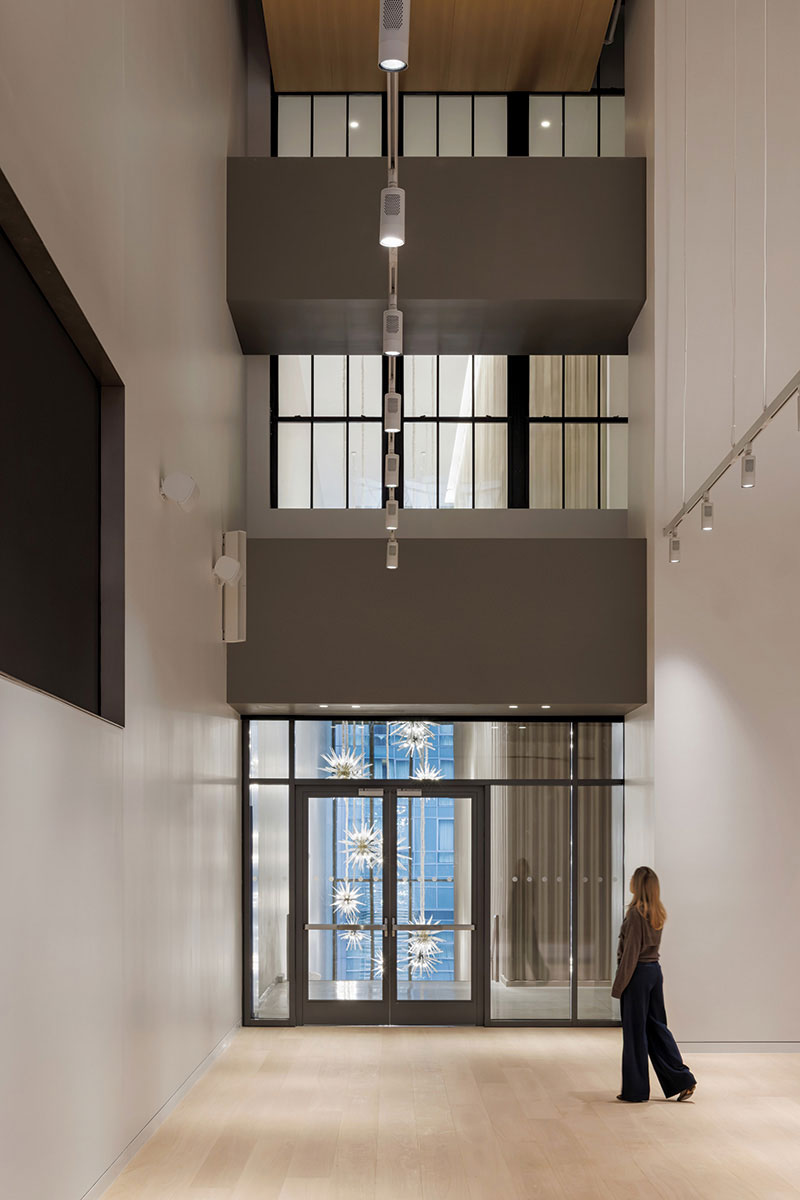
The grand stair culminates on the third floor. Photo © Colin Miller
The stair ends at the third floor’s North Auction Room, bypassing the second level of Steinway Hall, which was absorbed into some double-height spaces for the residential portion of 111 West 57th Street. If truth be told, the stairway appears to be there more for a grand visual effect than for pure function, since most of the clientele will probably prefer to take the nearby elevators. But it does enliven the space.
The North Auction Room, which seats 90, is located on the 58th Street side of the Steinway building’s L-shaped plan. Gensler emphasized the 30-foot-high daylit space by forming a backdrop of stark white drywall and muted white oak floor planks, which allow items for auction to stand out. In fact, most of the interiors adhere to this quiet ambience of neutral colors and minimal detailing. The auctioned object rules.
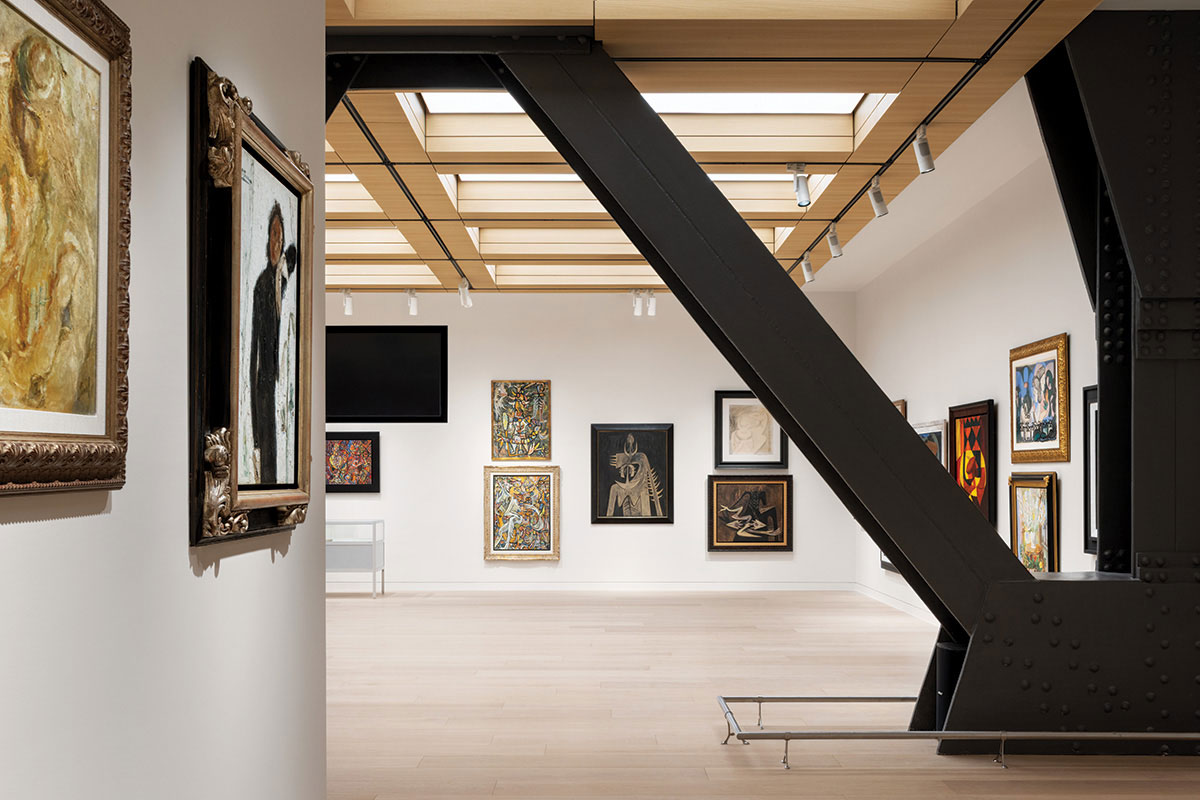
Another auction room along the 57th Street side has no daylight, only a softly illuminated, deeply coffered ceiling. Yet the architects infused drama into the smaller, 55-seat space by exposing the large steel trusses that span the rear of the auction room to transfer the loads over the rotunda below. The idea, says Carney, was to “show off the technological advances that had existed within this classically styled building.” On the fourth floor, an open plan allows daylight to permeate workspaces, while a boardroom within the structural core overlooks the lobby. The spaces for more practical operations—photography shops, cataloguing areas, and studios—are located in the basement.
3
Elements of the landmarked building include an exposed truss (3) and ornate murals (4) and fluted Ionic columns (5). Photos © Colin Miller (3 & 4), Peter Murdock (5)
4
5
In this complex, visitors may wonder where the residential entrance for the apartment tower is located; it is through a landmarked vestibule and corridor just west of Steinway Hall’s display window. It soon becomes clear this is not part of Bonhams due to the efforts of interior designer Studio Sofield. Sofield vamped up the corridor as it continues to the residents’ lobby and porte cochere on 58th Street, with outré murals and flamboyant embellishments. The lavish setting definitely departs from Warren & Wetmore’s more hushed aesthetic, not to mention Gensler’s low-key contemporary approach. Nevertheless, the presence of the historic Steinway Hall as a central objet d’art on the street, and buffered by the atrium, should bring bidders and buyers, art habitués, and other consumers of culture to this new address.
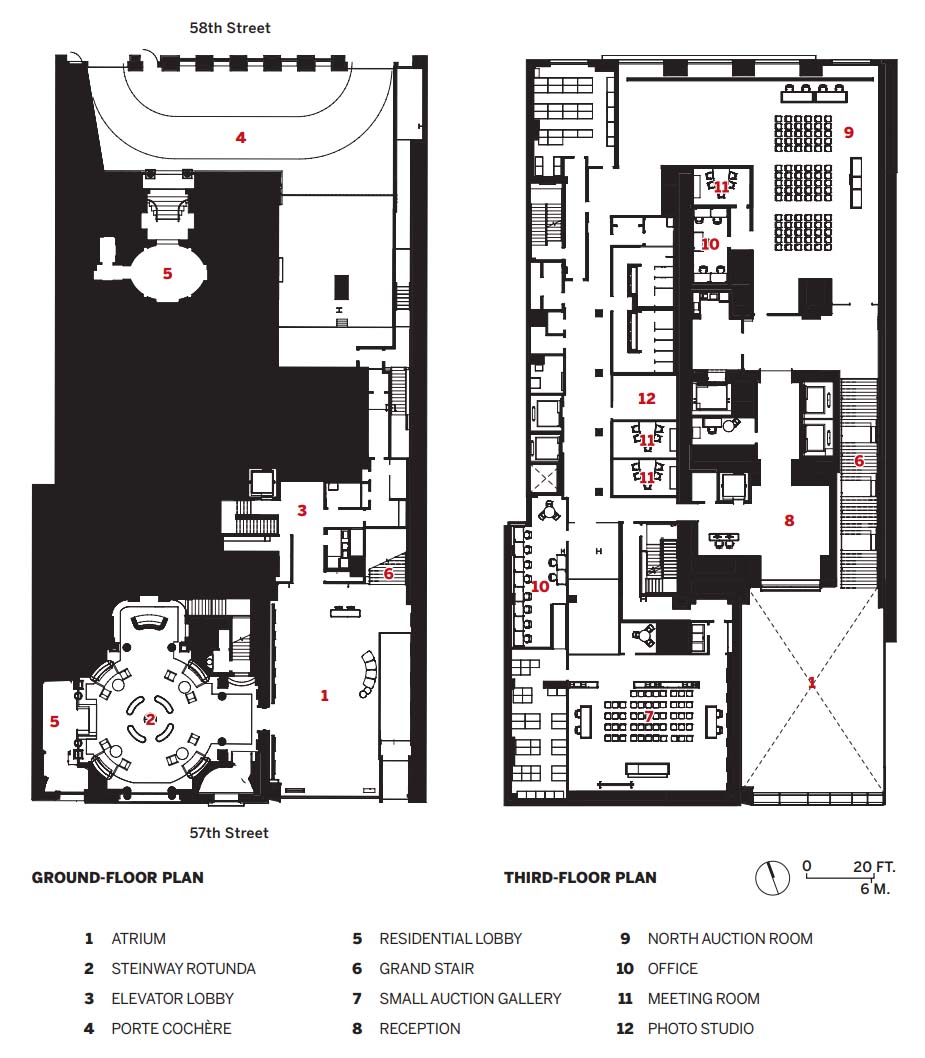
Image courtesy Gensler
Credits
Architect:
Gensler — Joseph Lauro, managing director; Jason Carney, design director; Andy Powell, studio director; Chris Nelson, project architect
Engineers:
CMTA (MEP); WSP (structural)
Consultants:
Tillotson Design Associates (lighting); MIR Design Group (AV/IT); DGA (security)
General Contractor:
JT Magen
Client:
Bonhams
Size:
42,000 square feet
Cost:
Withheld
Completion:
February 2026
Sources
Acoustical Ceilings:
Pure + FreeForm
Special Surfacing:
Formglas
Demountable Partitions:
Teknion
Wood Flooring:
Grato
Paints and Stains:
Scuffmaster, Benjamin Moore
Fire-Control Doors/Security Grilles:
TGP
Special Doors:
Total Door Systems
Looking for a reprint of this article?
From high-res PDFs to custom plaques, order your copy today!