Record Interiors 2026
In Brooklyn, O’Neill Rose Architects Revives a Small Brick Building that Has Lived Many Lives
Brooklyn, New York

Architects & Firms
Before it was an annex space for a sausage maker, and before it was a Greek Orthodox church, which was after it was a dance hall, the little brick building just off Fourth Avenue in Brooklyn’s Sunset Park served, originally, as the local chapter of the Boys and Girls Club. A cryptic inscription over the door, “S&B Ass’n”—for “sisters and brothers”? “sausages and brats”?—may hint at one or the other of its former uses; so too might its interior plan, a wide-open main floor suitable for waltzes and foxtrots, with a bingo-ready basement below. Other than that, little remains of any of the building’s assorted past lives, going back to its construction in 1930.
1
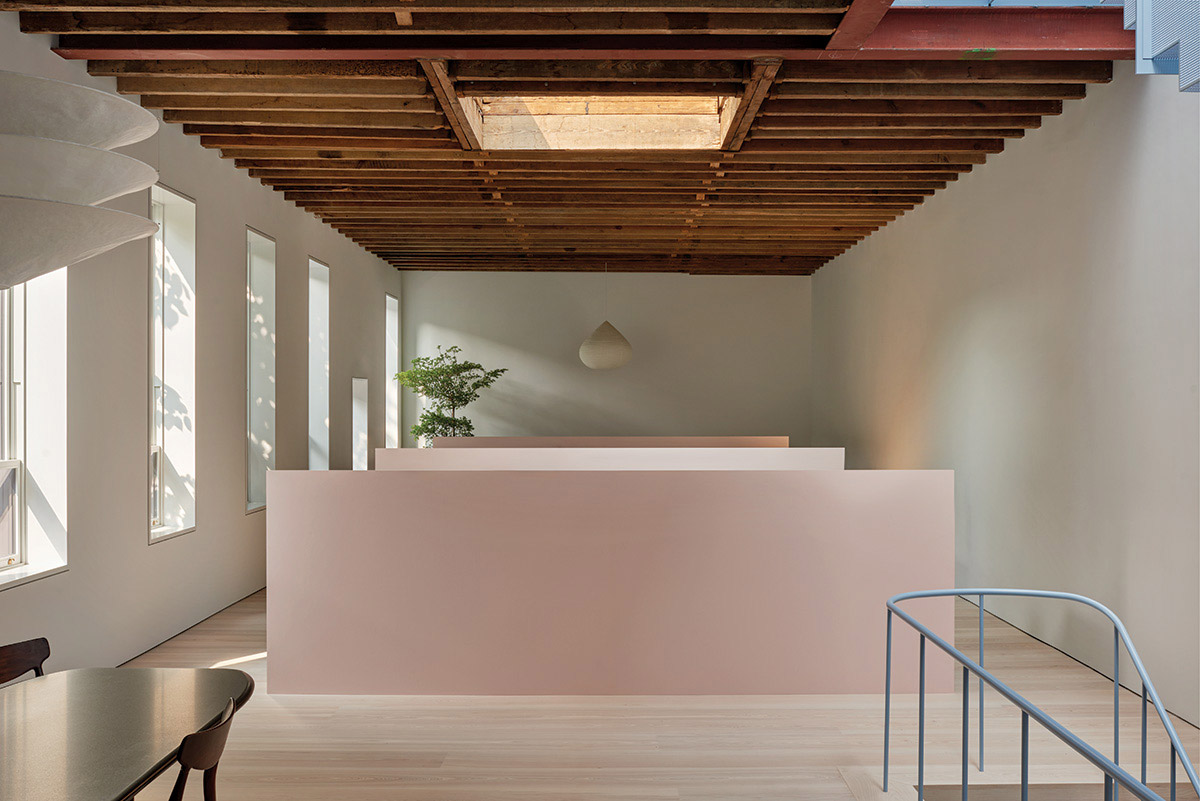
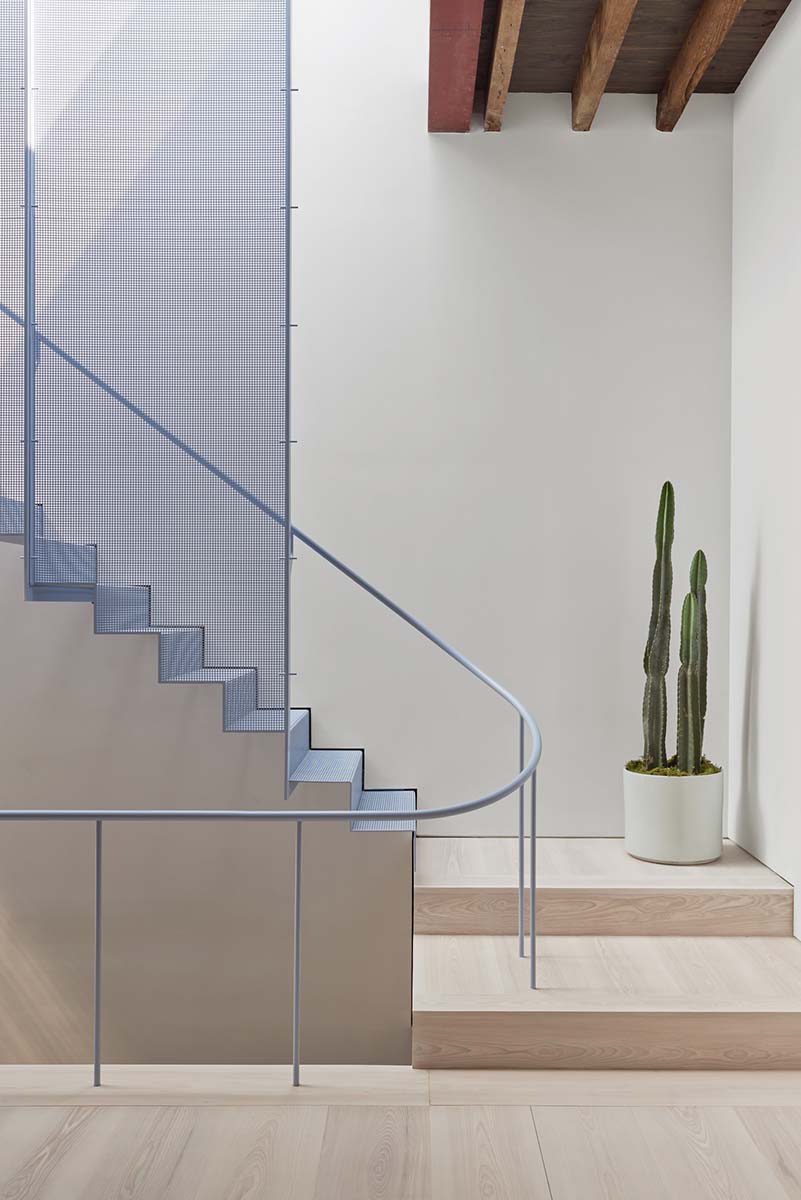
A new stair, made of blue perforated polypropylene (top of page & 2), connects the workspace (1) to the roof terrace. Photo © Brooke Holms, click to enlarge.
2
Yet something of its communal spirit remains in its latest transformation, carried out by the firm of O’Neill Rose Architects. Led by the husband-and-wife team of Devin O’Neill and Faith Rose, the practice has turned the 3,800-square-foot space into a light-filled and relaxed working environment tailor-made to the needs of some very discriminating clients: the designers themselves, who now use it as headquarters for both their shared studio and for the Design Studies Collaborative (DSC), a nonprofit planning consultancy for community groups shepherded by Rose. The shared office also includes a lounge, event space, resource library, and model shop. “We wanted a space that would feel more like a public than a private one,” she says. “We always keep the wooden outer doors open.”
3
4
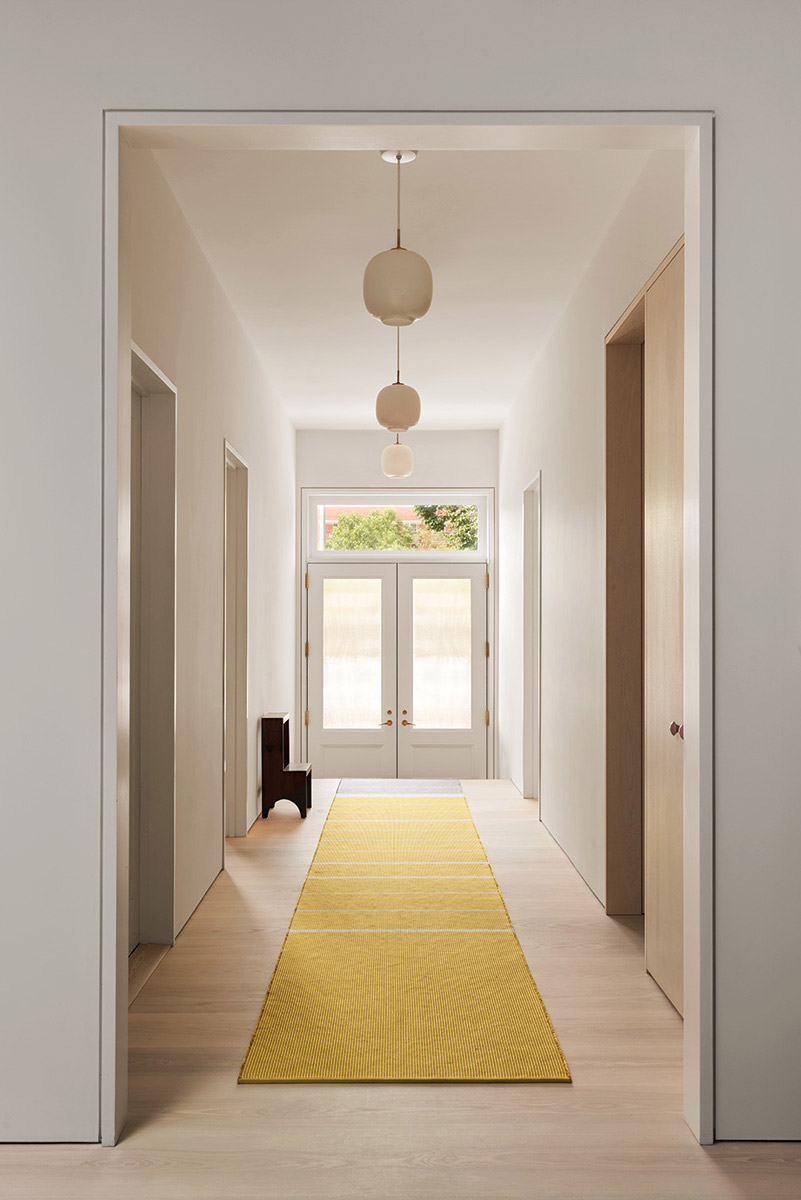
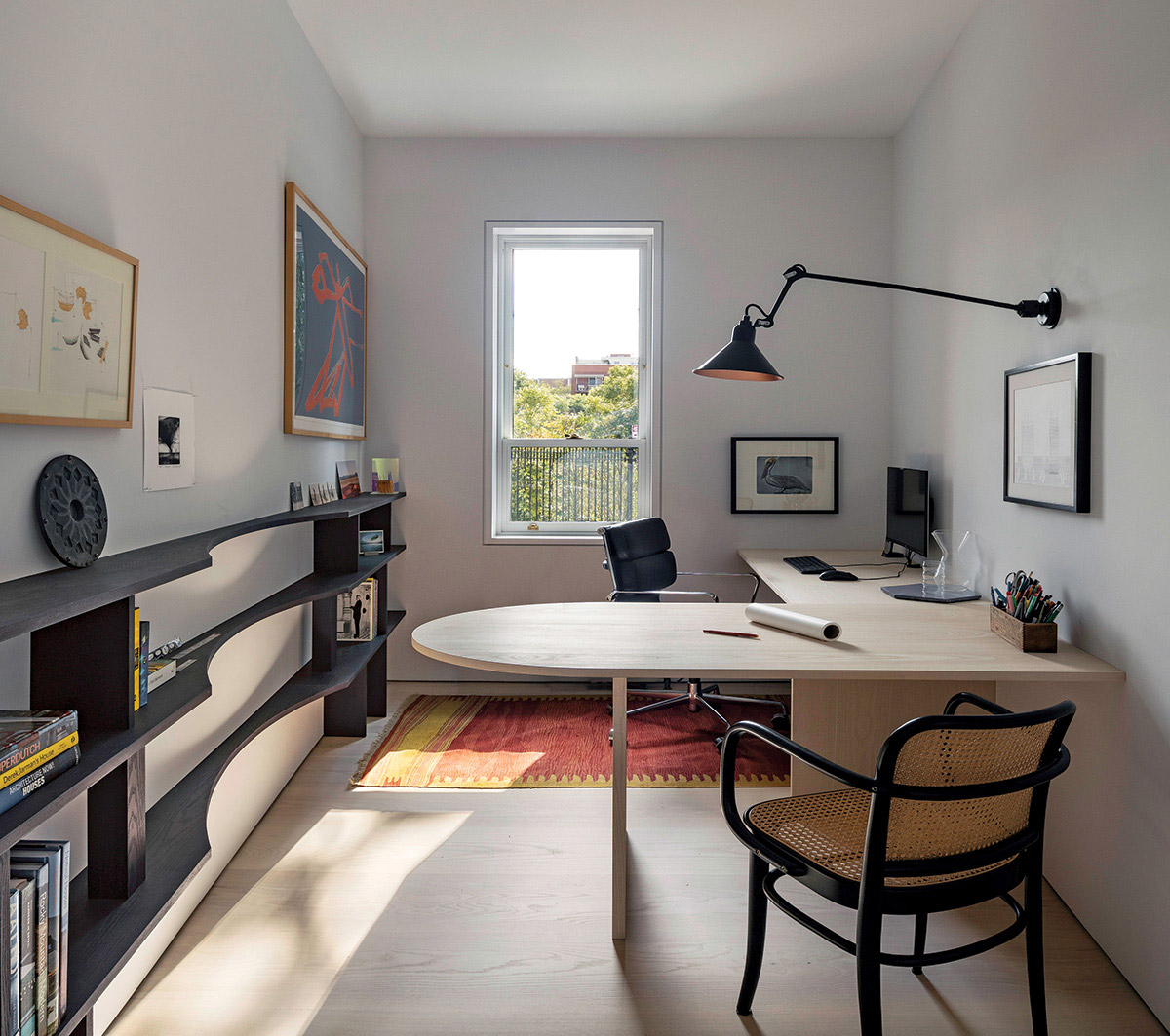
Custom millwork and furniture create flexible workspaces (3 & 4). Photo © Brooke Holms (3), Michael Moran/OTTO (4)
The journey to the building began when the duo launched their namesake office in 2008. While O’Neill led the practice out of their previous studio space in DUMBO, Rose worked in city government, first as the Director of Design Excellence at the Department of Design and Construction and then (by mayoral appointment) as executive director of New York’s Public Design Commission. Since her departure from public service in 2016, the firm has been racking up new commissions—for example, rowhouse renovations in Manhattan and Brooklyn and a private club on the Lower East Side. At the same time, Rose’s DSC initiative has gained traction, with a series of community-service projects as close as the Brooklyn waterfront and as far away as New Hampshire. The pair’s expanding professional remit called for newer and better digs; three years ago, O’Neill found just the spot. “I was driving around and passed this burnt-out-looking building,” he says. “I thought, ‘That’s going to be cheap.’”
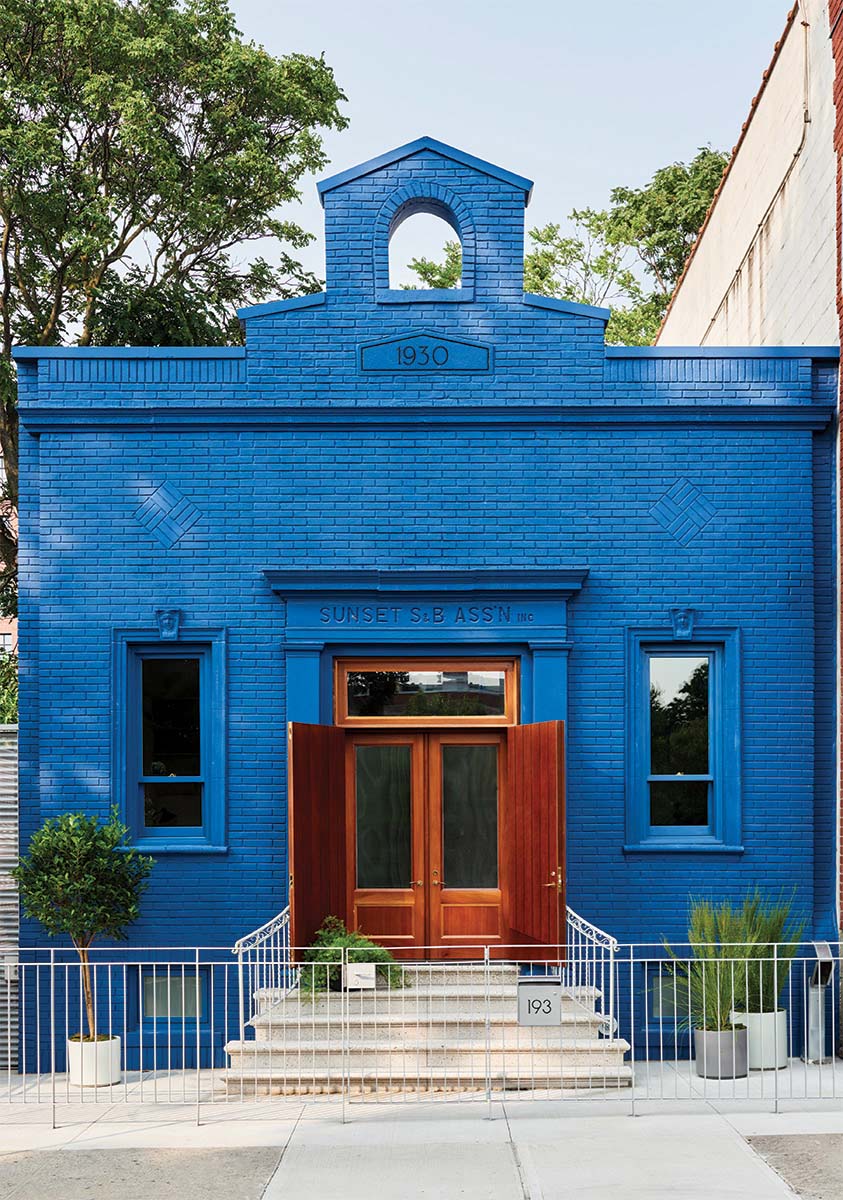
Much of the brick facade was replaced. Photo © Brooke Holms
While buying the property seemed within reach, its restoration would be a heavy lift. “The sausage maker had knocked a large hole through the brick party wall,” says O’Neill. Left partly open to the elements, with no working mechanical systems of any kind, the building was a raw shell, with serious structural erosion to the primary facade that would ultimately require much of the brick to be replaced. The plumbing location could be kept as it was, but all-new pipes were required; the roof was still in place, but it needed an additional layer of insulation. Spatially, however, the building was perfectly suited to the program the couple had in mind: the former dining hall downstairs was an ideal place for a model shop, while the rooms flanking the old vestibule could be repurposed as private offices. There was even the potential for a sought-after open-air terrace—though getting outside would require some ingenuity.
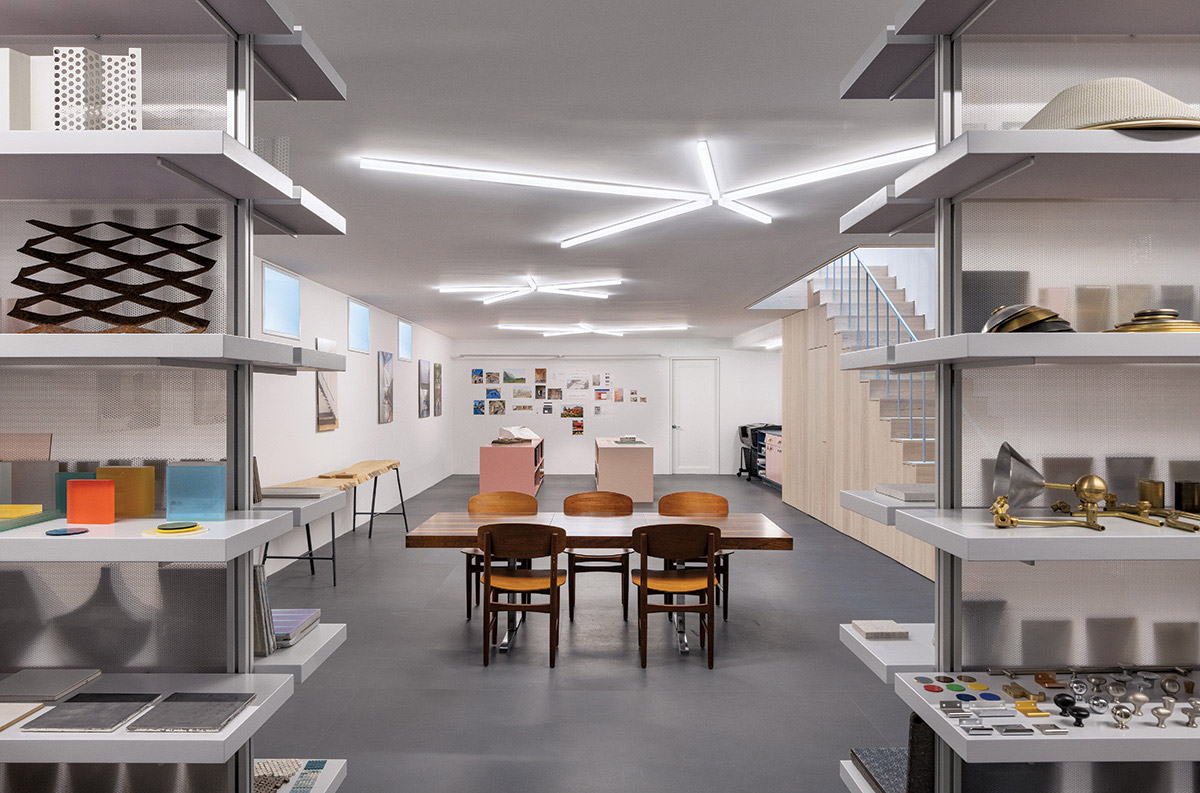
The basement accommodates a model shop, pinup space, and materials library. Photo © Michael Moran/OTTO
Leaving much of the building’s existing fabric untouched, the designers executed two signature interventions that immediately seize a visitor’s attention. The floors are the first. A friend in Denmark put the designers on to a contractor in the city who happened to have a large quantity of ash boards and no particular use for them; Rose and O’Neill swooped in and had the contractor install them as is, with only a light coating of linseed oil for a bit of added luster. Second, and most eye-catching of all, is the mechanism by which the architects mean to realize their summer-barbecue dreams: passing through a fresh cut in the wood-joist ceiling (the void braced by new steel structural beams), a giant staircase of perforated polypropylene now rises to the roof above. Secured to the wall by slender rods, and to itself through welded pegs, the blue-toned modular system was custom fabricated by fellow Brooklynites Argosy Designs. In an adaptive-reuse project where so little was left to reuse, the staircase makes a dramatic centerpiece.
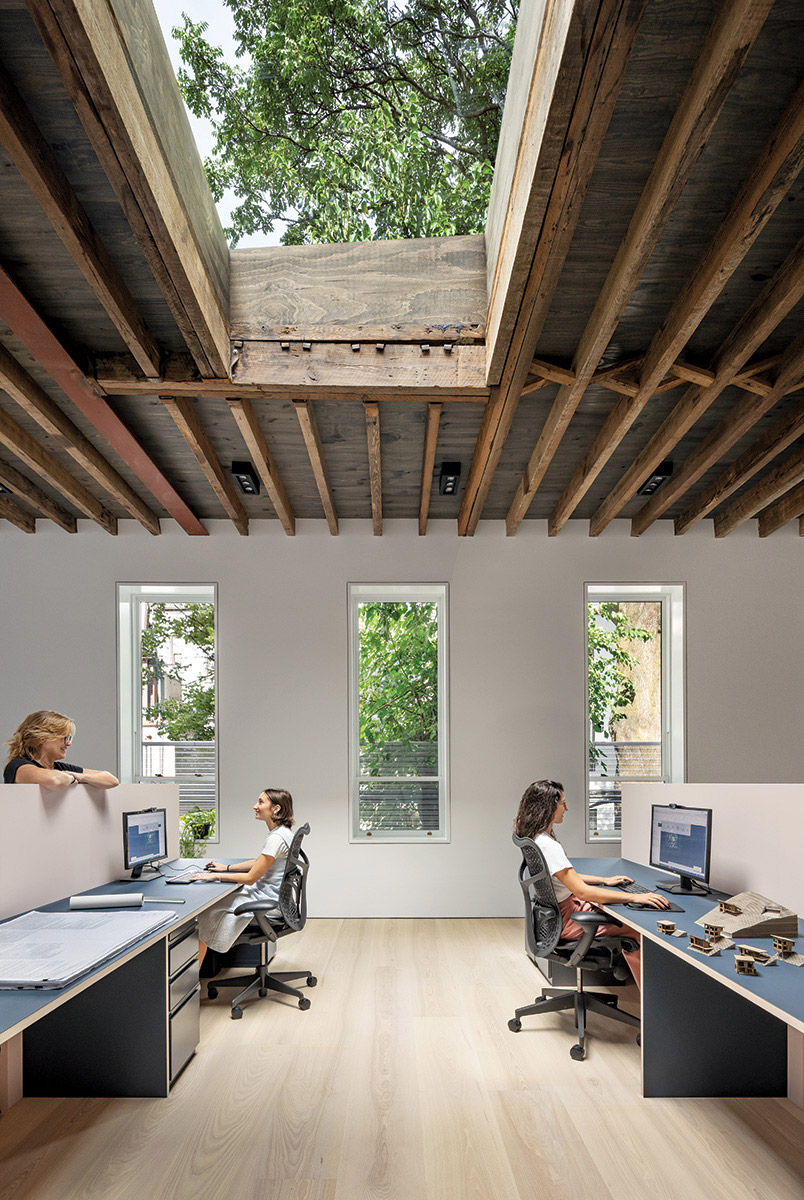
A new skylight allows light into the studio. Photo © Michael Moran/OTTO
“I think what we always come back to is this sense of being humble,” says Rose. “We just say, ‘Okay, this is the budget, how can we make it cool?’” Underscored by subtle touches like ceramic fixtures (also sourced via their Danish connection), the hipness of the new office pairs interestingly with the civic ambitions of the Design Studies Collaborative, which Rose describes as committed to “finding urban strategies that help communities stay in place in spite of gentrification.” That ethos appears to have worked for the designers’ own space, with neighbors popping by ever since work began on the project. “People would come by and hang out with us,” says O’Neill. “We wanted everyone to know the building is back.”
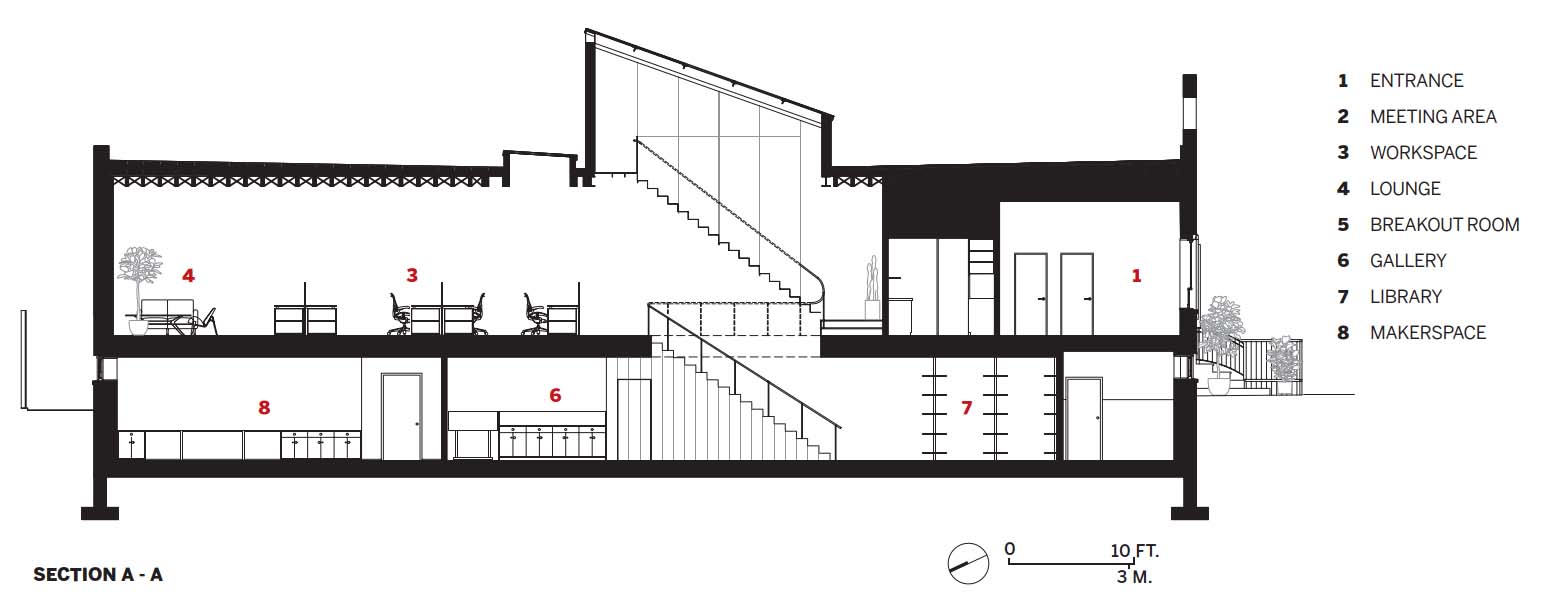
Image courtesy O’Neill Rose Architects
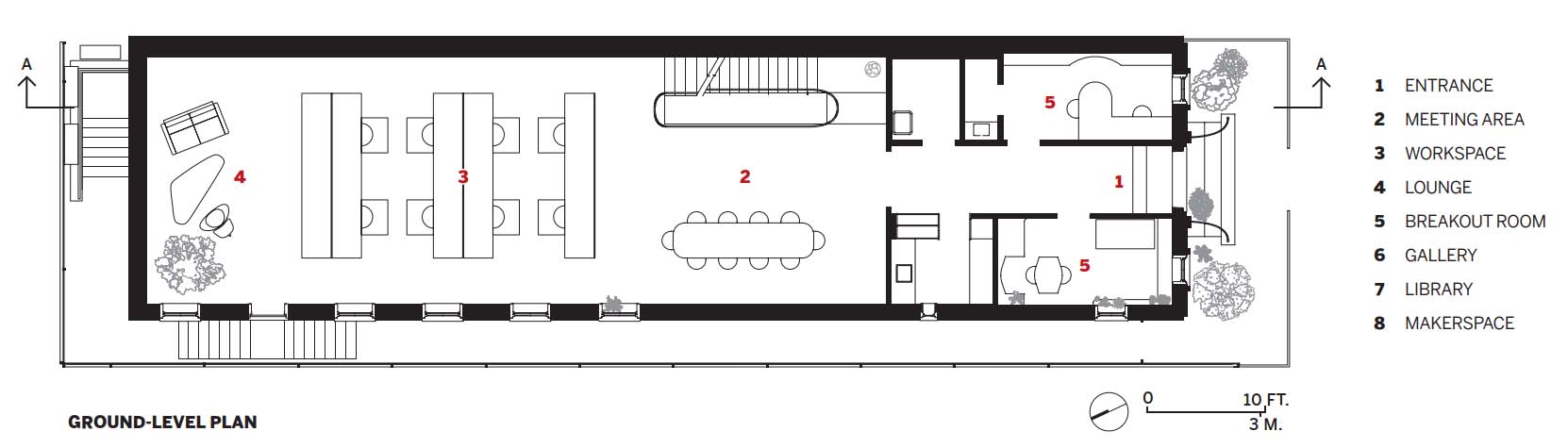
Image courtesy O’Neill Rose Architects
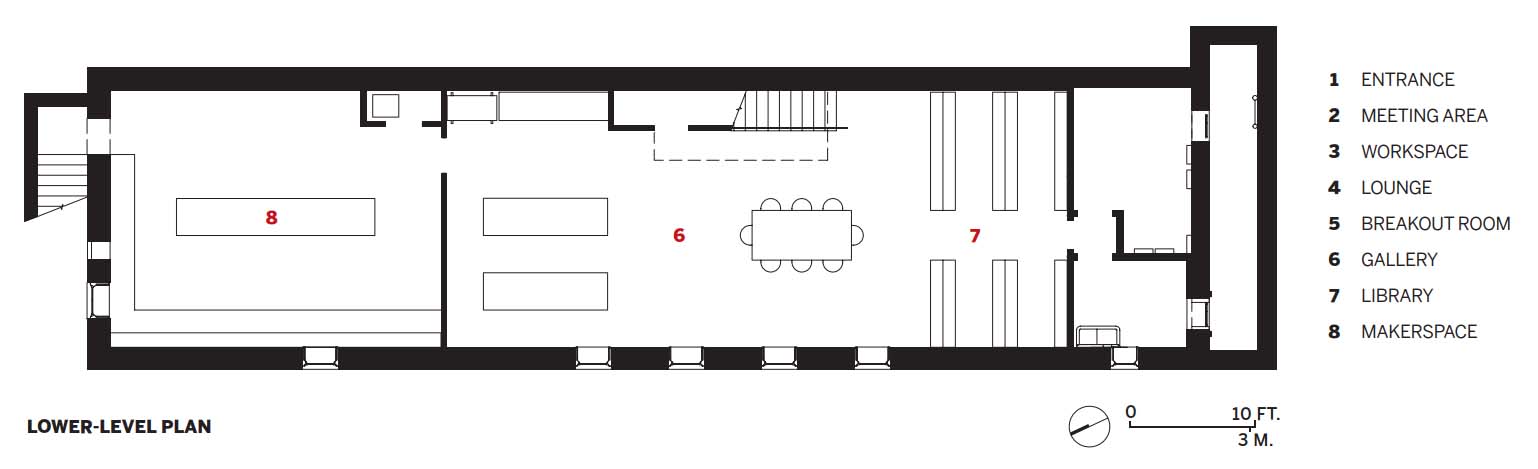
Image courtesy O’Neill Rose Architects
Credits
Architect:
O’Neill Rose Architects — Devin O’Neill, principal; Hans Villamayor, senior project manager; Andrew Martin, designer
Engineer:
TYLin (structural)
Contractors:
Ocular (millwork and flooring); Argosy (metalwork); Made A Mano (tile)
Client:
Design Studies Collaborative
Size: 3,800 square feet
Cost:
Withheld
Completion:
June 2024
Sources
Exterior Finish:
Benjamin Moore
Windows:
Lepage
Skylights:
Glazing Vision
Doors:
Creekside Millwork
Hardware:
D Line
Flooring:
Woodnotes, Forbo Furniture Linoleum, Dinesen
Lighting:
Claesson Koivisto Rune, Ingo Maurer, Goodlite, RBW
Plumbing:
Creekside Millwork, Watermark, Duravit
Looking for quick answers on architecture and design topics?
Try Ask RECORD, our new smart AI search tool.
Ask RECORD →
Looking for a reprint of this article?
From high-res PDFs to custom plaques, order your copy today!