Tall Buildings 2026
KPF’s Mixed-Use Supertall at 520 Fifth Avenue in Manhattan Spirals Toward the Sky
New York City

Architects & Firms
Old-fashioned cold calls seem a rarity nowadays, but that’s exactly how Jamie von Klemperer, president of Kohn Pedersen Fox (KPF), landed the commission for the firm’s latest supertall in New York City.
“I found out through some gossip who had bought the site,” von Klemperer recalls. “So I reached out to say, ‘I understand that you’re thinking about a mixed-use tower. Give us a call.’” He admits it was an unusual tactic, but von Klemperer knew the parcel in question all too well. The vacant lot at 520 Fifth Avenue, just around the corner from KPF’s Manhattan office, had been the focus of a feasibility study for a hotel, later abandoned, with a previous client. To von Klemperer’s delight, the new owner—developer Mickey Rabina—returned his call with something different in mind.
Architects and developers are often guilty of overusing the term mixed-use. Planting a penthouse atop an office building or positioning retail on the ground floor of an apartment complex hardly warrants the description, but the program of 520 Fifth Avenue indeed justifies it. KPF, responsible for the project’s core and shell, managed to tightly pack a slender, arch-laden tower with a four-story social club, residential amenities, and retail alongside 25 levels of leasable office space and 37 floors of apartments—all on a site that, at 10,625 square feet, isn’t much larger than three side-by-side tennis courts.
Von Klemperer likens the 1,000-foot-tall 520 Fifth Avenue, which broke ground in 2022, to a Swiss watch—precise, efficiently planned, and requiring a high degree of technical coordination. A previous transfer of air rights to the site from the neighboring Century Association, the now-defunct Princeton Club, and General Society of Mechanics and Tradesmen also gave designers about 200,000 more square footage to shape. (The structure is now the tallest on Fifth Avenue after the Empire State Building.)
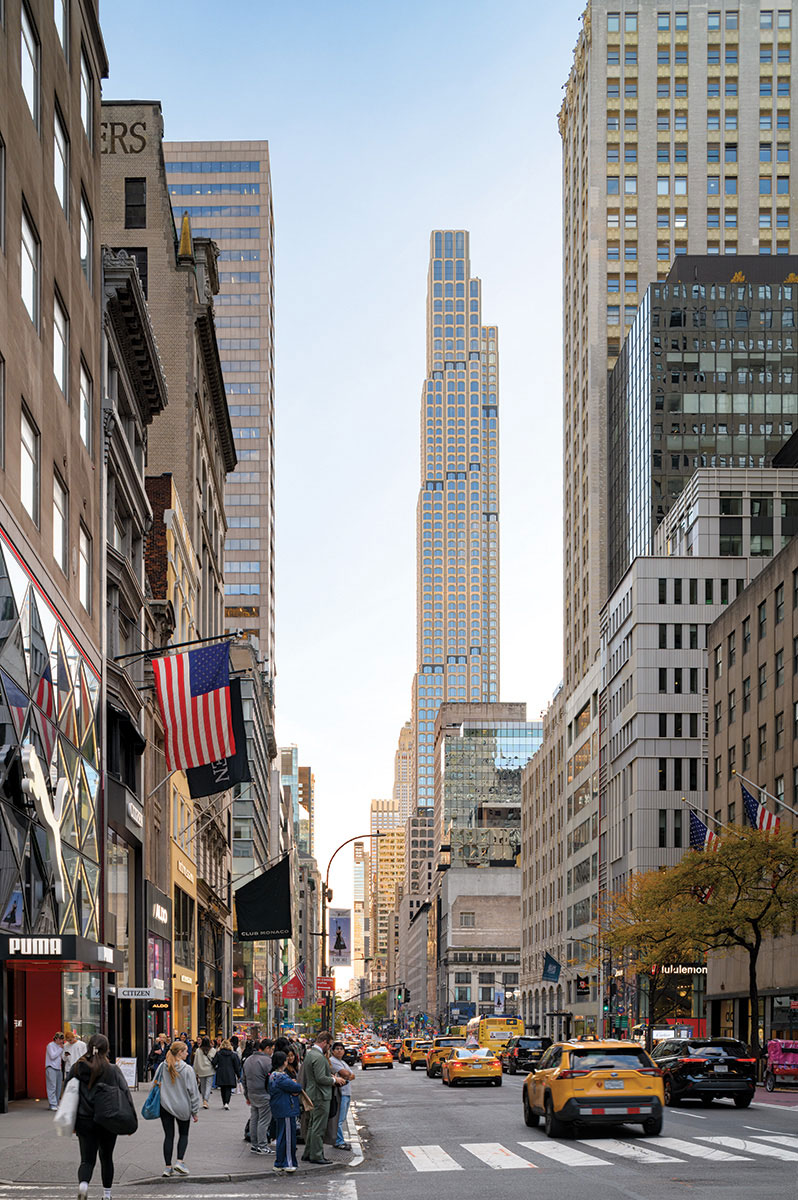
The tower’s setbacks corkscrew upward. Photo © Raimund Koch, click to enlarge.
“The massing is very much part of the performance of the zoning,” von Klemperer says, citing the 1916 municipal code that went on to define the classic silhouettes of many Manhattan towers, “and the stepping also suits this mixed-use type, where the lower office floors want to be a bigger dimension than the upper residential apartments can tolerate.” These setbacks double as terraces and balconies that offer fresh air—design elements, von Klemperer says, whose importance was “amplified by the pandemic.” They also appealed to brokers who have long insisted on such outdoor spaces. However, unlike the many high-rises of yesteryear, 520 Fifth Avenue’s setbacks form something of a spiral as the tower thins out at its crown.
On the ground, large arches define the street-facing elevations, and a 32-foot-tall entry portico filters residents, tenants, and club guests into three separate lobbies. The western and central lobbies lead to apartments and offices, respectively, by way of a core that has been pragmatically pushed to the northern edge of the site. The residential units—100 in total, 98 of which have already sold—are laid out in a mix of bedroom configurations, but the highest occupiable space, on floor 88, has been set aside for shared amenities. Among them is a solarium, measuring 16 feet by 25 feet and glazed on three sides, offering spectacular simultaneous views of uptown, the Hudson River, and downtown. Above this sky-high lounge are various mechanical areas, including one that houses a tuned mass damper, which reduces the building’s sway and, in turn, minimizes structural bulk (critical for space-saving planning on such a small footprint).
The offices on the lower floors are trimmed in oak and other upscale finishes to plans by Charles & Co., the interior design firm founded by Soho House alumna Vicky Charles. The aesthetic is carried into the three entryways and the social club, named Moss, accessed via the easternmost lobby. Guests can enjoy a spa, gym, restaurant, and a bar, which is situated within a double-height area behind one of the facade’s grand arches, as well as programming, such as talks and exhibitions. (Residents and office occupants have complimentary membership, turning the club into a kind of social incubator.)
Looking for quick answers on architecture and design topics?
Try Ask RECORD, our new smart AI search tool.
Ask RECORD →
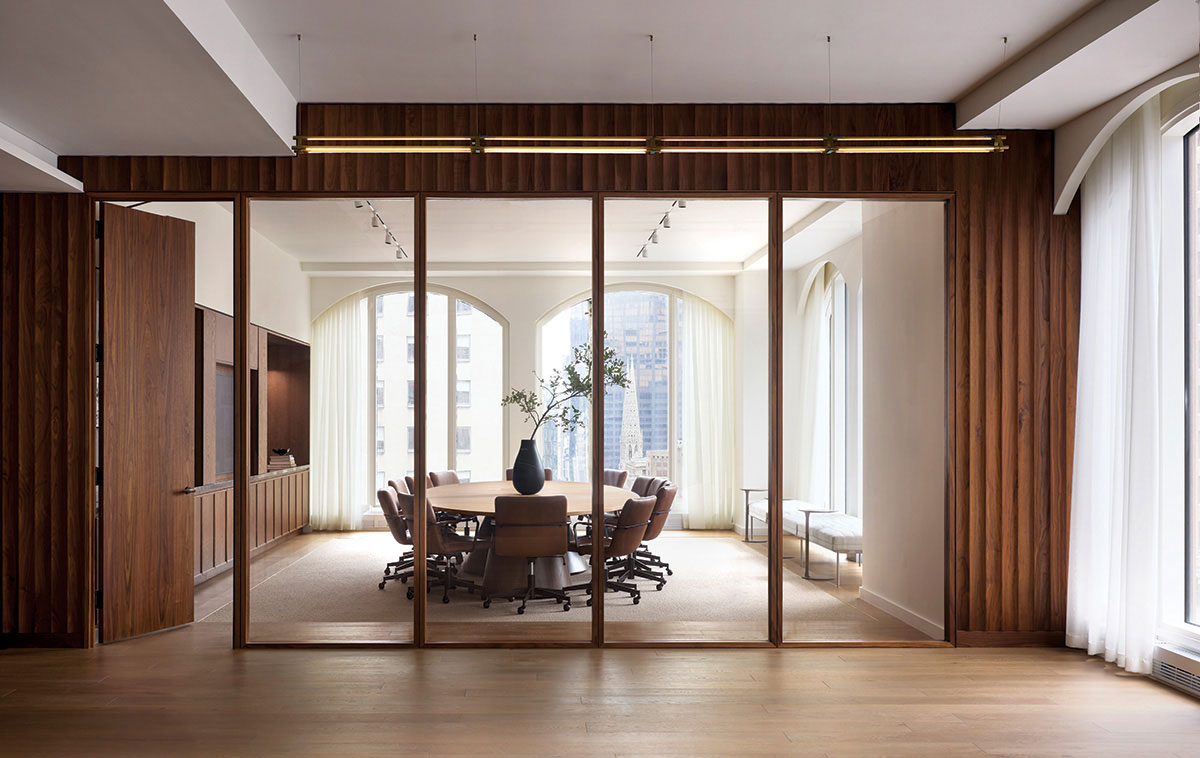
Office floors are trimmed in wood. Photo © Gieves Anderson
Wrapping the entire supertall is a modular system of arches—an appropriate geometry, says von Klemperer, given the residential program and the surrounding context. “It is an inherently humane form,” he says, “but we knew we didn’t want to be literal about the correspondence to history.” Rather than feign load-bearing masonry, the facade instead intentionally signals its artifice through the gaps left between panels, suggesting curtain wall construction. The arches are stepped too, creating a surprising amount of depth and expression for panels that are only 12 inches thick.
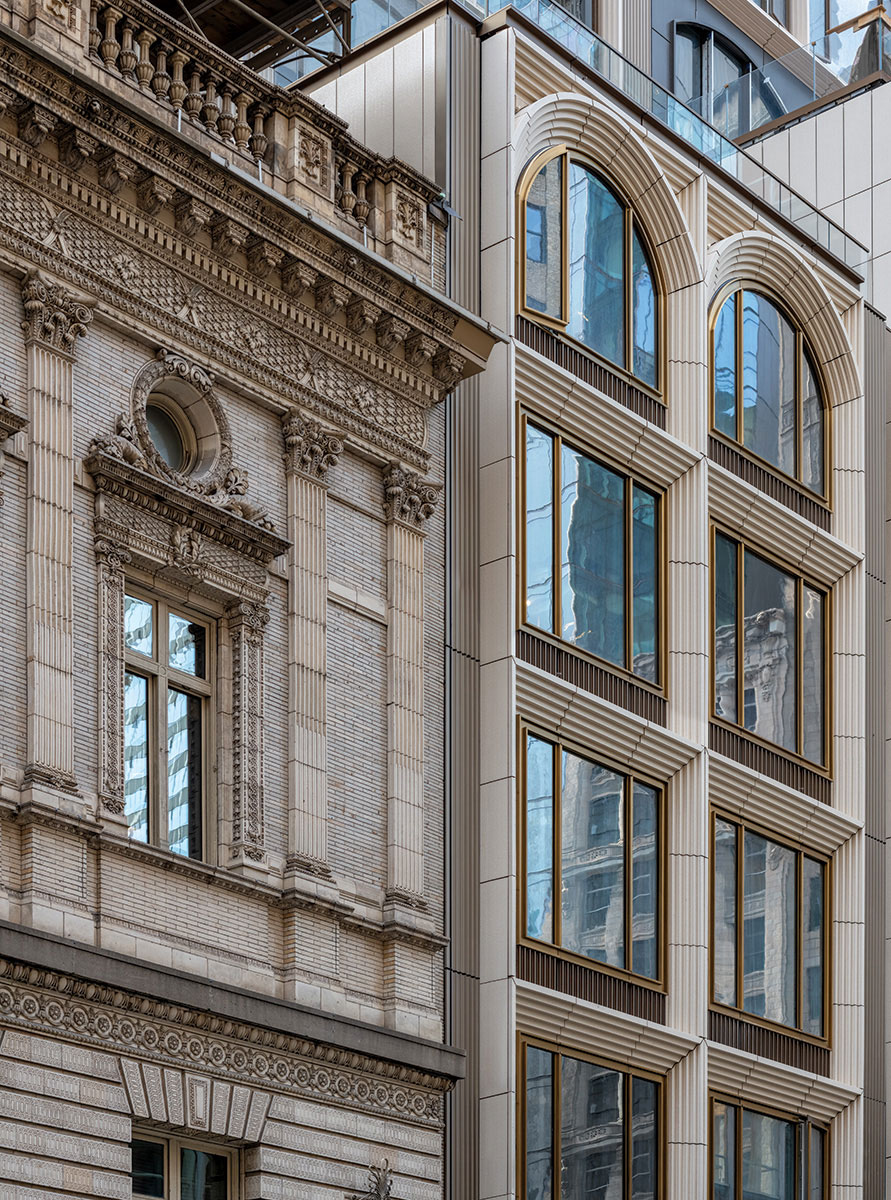
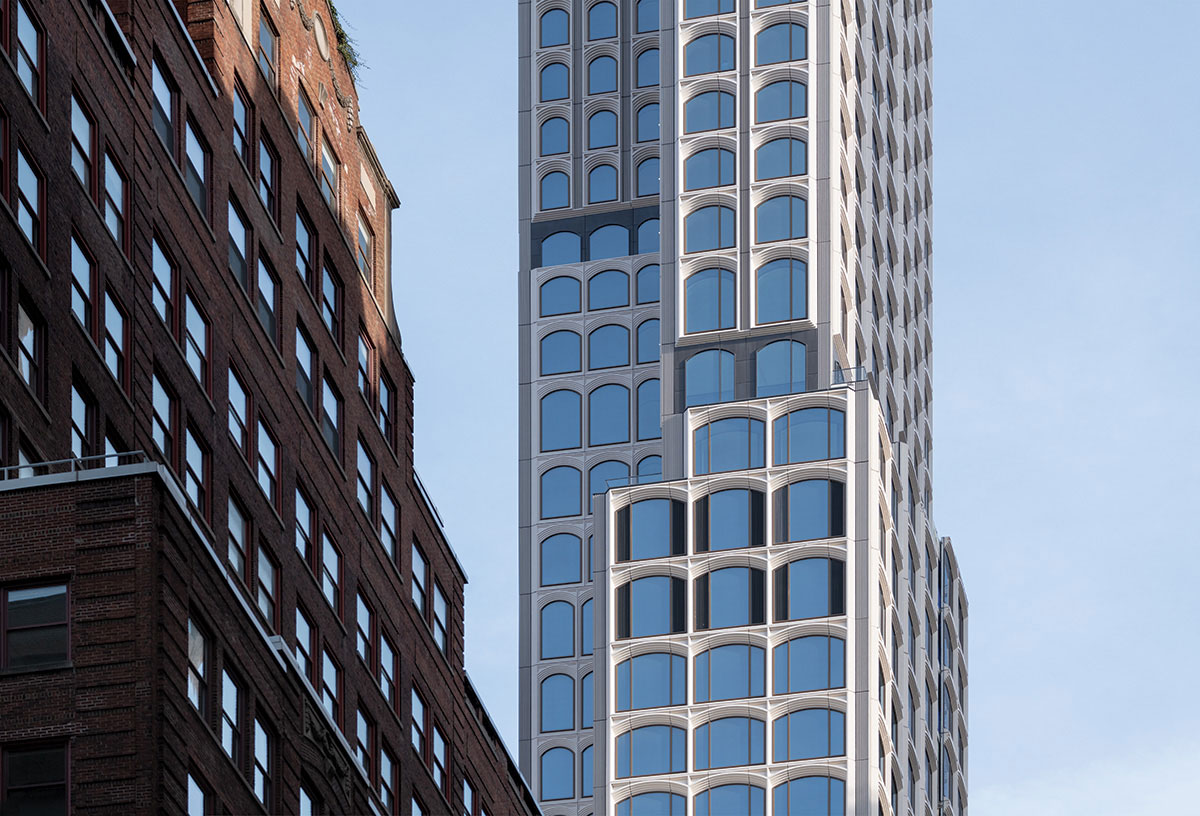
Up to the first setback, the facade mixes groupings of large arched and square windows, trimmed in beige terra-cotta, set between piers of fluted metal. Above this base, the panels switch to a more cost-effective, less-heavy, and easier-to-install aluminum with a color-matched ripple glaze; from the sidewalk, the two cladding systems are almost indistinguishable. On those upper floors, the arches’ spring points change, and they become shallower. Some of these micro-adjustments, including occasional changes of floor-to-floor height, detract slightly from the otherwise strict consistency of the facade’s design—except at the crown, where the panels’ graduated increase in height produces a kind of acceleration toward the sky.
1
2
Facade panels consist of terra-cotta at the lower levels, echoing the Century Association (1), while aluminum is used higher up (2). Photos © Raimund Koch
In many ways, 520 Fifth Avenue is an unexpected addition to a city skyline that KPF, celebrating 50 years in July, has helped to shape with dozens of buildings. But the project is also indicative of what to expect from the firm in the near future: less glazing and more terra-cotta, brick, and stone. “More broadly, the professional pendulum has swung away from all-glass towers, and that’s something that we have been part of in a way,” says von Klemperer. “We realized that cities benefit more from this kind of surface—when buildings aren’t just mirrors, but give something back.”

Image courtesy of KPF
Credits
Architect:
KPF — James von Klemperer, design principal; Dominic Dunn, Andrew Cleary, managing principals; Nicole McGlinn, managing/technical director; Javier Galindo, design director
Interior Designer:
Charles & Co.
Engineers:
WSP (structural/MEP); Langan (civil, environmental); Longman Lindsay (acoustical); Entek (facade maintenance)
Consultants:
DeSimone Consulting Engineering (facade, building envelope); VDA (vertical transportation); Aquatectonics (pool/spa); CCI (life safety); United Spinal (accessibility); One Lux, OVI (lighting); WJE (stone)
General Contractor: Suffolk
Client:
Rabina Properties
Size:
380,000 square feet
Cost:
Withheld
Completion:
June 2026
Sources
Cladding/Curtain Wall:
Shildan (terra-cotta); Alubuild/Alabbar (metal panels)
Interior Finishes:
Armstrong, CertainTeed, Pyrok (acoustical ceilings); Aran World (cabinetry); PGS (millwork); Farrow & Ball, Benjamin Moore (paints and stains); Portola (plaster)
Lighting:
Circa, Acolyte, USAI, iGuzzini
Doors:
Long Island Fire Doors
Looking for a reprint of this article?
From high-res PDFs to custom plaques, order your copy today!